Reclaiming TPS: Understanding the True Origins of Improvement

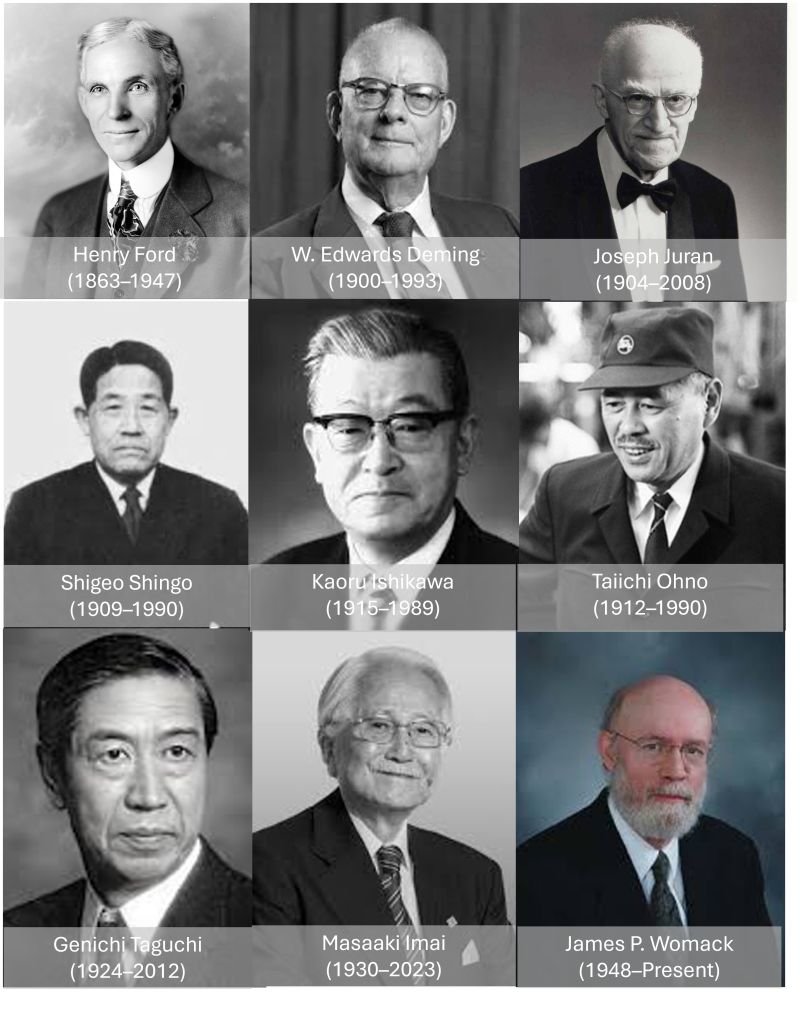
Collage of key improvement figures including Ford, Deming, Juran, Shingo, Ishikawa, Ohno, Taguchi, Imai, and Womack, illustrating the origins of modern industrial systems.
TPS is not Lean or Six Sigma. It is the original system built on quality, leadership, and respect for people. This article restores historical accuracy by identifying the true pioneers, architects, and practitioners behind modern improvement.

Reclaiming Toyota Production System: My Lean TPS Basic Thinking

Lists that group TPS, Lean, Six Sigma, and Kaizen together often confuse history and misrepresent purpose. While all contributed to improvement, they differ in philosophy, structure, and intent. The Toyota Production System stands apart as a complete management system built on problem-solving and respect for people, not a collection of tools.

To preserve accuracy, it is essential to distinguish pioneers, architects, and practitioners. This classification clarifies who created new systems, who structured them, and who promoted or applied them.

Misclassification of Figures

Many improvement leaders are incorrectly labeled as “gurus.” The term blurs their true roles and contributions.

Pioneers introduced original concepts that changed industrial practice.
Architects structured methods and principles into systems.
Practitioners applied and spread these systems through teaching, documentation, or consulting.

Recognizing these roles provides a more accurate understanding of the evolution of improvement.

Correct Historical Context

Lean did not exist before 1988.
The term “Lean” was introduced in The Machine That Changed the World to describe elements of the Toyota Production System observed externally. Lean borrows TPS tools but often omits its cultural and quality foundations. TPS existed decades earlier as a complete system built on Just-in-Time, Jidoka, and people development.

TPS must be recognized as the origin.
Toyota’s system transformed manufacturing by creating flow, eliminating waste, and embedding quality at the source. Lean simplifies this depth, often reducing it to efficiency tools rather than a leadership system.

Six Sigma is separate.
Developed and commercialized by GE, Six Sigma relies on statistical control and the unproven 1.5 sigma shift assumption. Its focus on defects differs from TPS, which targets waste, variation, and imbalance through process design and prevention.

Kaizen is not generic.
Kaizen is a registered trademark of the Kaizen Institute. It represents a structured approach to continuous improvement and should not be generalized or detached from its original meaning.

Reevaluating the Key Figures

Each figure in the commonly shared list deserves correct attribution:

NameContribution TypeKey Contributions
Henry FordPioneer, ArchitectFlow production, standardization, and early assembly line development.
W. Edwards DemingArchitectStatistical Process Control, PDCA, and management principles for quality.
Joseph JuranArchitect, PractitionerJuran Trilogy, Pareto analysis, and quality leadership.
Kaoru IshikawaArchitect, PractitionerTotal Quality Management, Fishbone Diagram, and Quality Circles.
Taiichi OhnoPioneer, Architect, PractitionerToyota Production System, Just-in-Time, Kanban, and waste elimination.
Shigeo ShingoPioneer, PractitionerPoka-Yoke, SMED, and process efficiency.
Genichi TaguchiArchitect, PractitionerRobust design, Loss Function, and quality engineering.
Masaaki ImaiPractitionerPromoted and globalized Kaizen philosophy.
James P. WomackPractitionerDocumented and explained TPS through “Lean” research but did not create it.

The Overlooked Foundation: Quality

Quality is the core of TPS. The system’s strength lies in prevention, not inspection. By integrating quality into every step, TPS eliminates cost and risk before they reach the customer. Deming, Juran, Ishikawa, and Taguchi contributed essential foundations for this mindset.

Any classification that neglects quality as the center of improvement misrepresents what Toyota built. Improvement without built-in quality cannot be sustained.

The True Gurus

If one individual deserves recognition as a true TPS guru, it is Taiichi Ohno. He did not write theory from observation; he developed the system through direct experience at the shop floor. His thinking connected leadership, quality, and daily improvement into one living structure.

Equally important, Sakichi Toyoda and Kiichiro Toyoda must be included in any true account of TPS origins. They were pioneers and architects whose invention, discipline, and purpose created the foundation for Toyota’s continuous pursuit of excellence.

Preserving the Integrity of TPS

Mislabeling these figures erases the distinction between systems. TPS should not be grouped with Lean or Six Sigma. It stands as a system of leadership that develops people to prevent failure and achieve perfection through process design.

To reclaim TPS, we must preserve its history, terminology, and intent. The goal is not to combine systems but to understand and apply them with integrity.

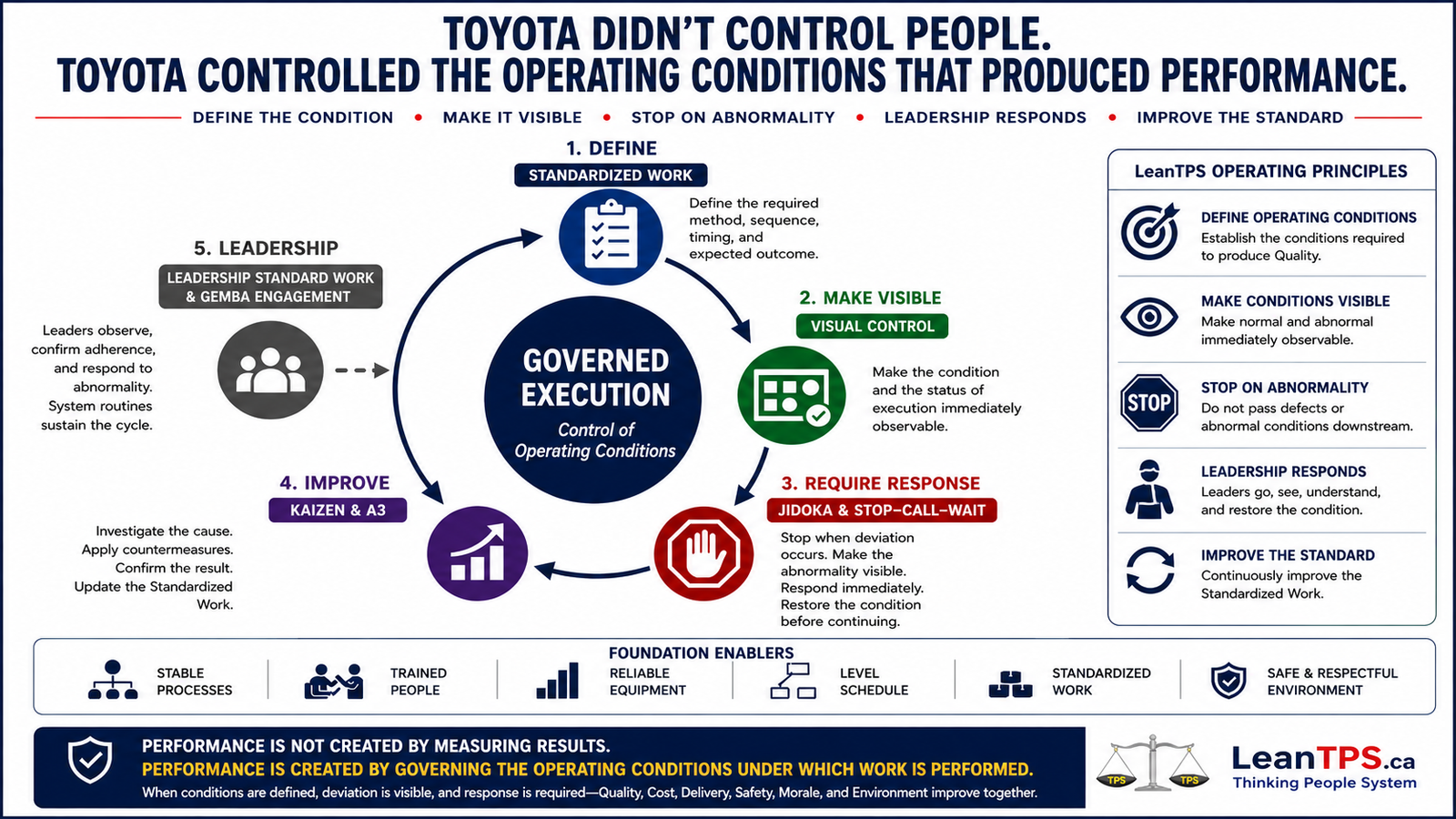
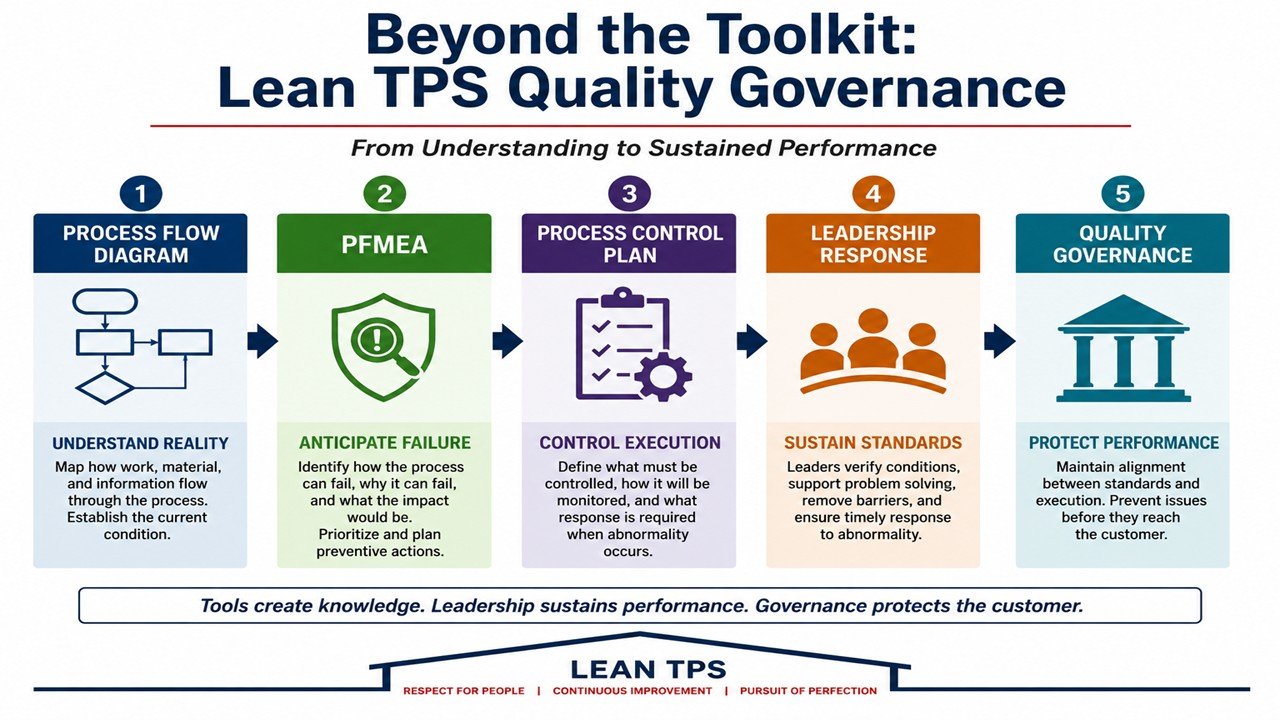
A Lean TPS system requires that execution is governed by three questions that define control. The required condition for execution must be explicitly defined through method, sequence, timing, and outcome. The point at which the condition is violated must be immediately recognizable during execution. The response required when the condition is not met must be enforced without delay. When these three elements operate together, execution is controlled and Quality is maintained as a condition of the system. Control precedes improvement because improvement depends on a stable and defined state of execution. When conditions are not defined, exposed, and enforced, improvement activity operates on an unstable system and results do not hold. Work continues under abnormal conditions, variation accumulates, and outcomes remain inconsistent. When control is established, improvement operates within defined boundaries and reinforces the condition that governs execution. Quality exists only when the required condition is maintained during each cycle of work. Quality is not achieved through measurement or inspection after execution. Quality is protected through enforcement of conditions during execution. When the condition is not met, work does not continue, and response restores the defined state before execution resumes. This enforcement prevents deviation from propagating and maintains stability at the source. A Lean TPS system requires that continuation under abnormal conditions is not permitted. When work continues despite violation of method, sequence, timing, or outcome, control does not exist and the system becomes dependent on judgment. Deviation is absorbed into normal work, and Quality is degraded. When continuation is prevented, the system enforces the boundary between normal and abnormal states and maintains control of execution. The system extends beyond individual elements and requires integration across condition definition, exposure, response, and learning. When these elements are aligned, execution is governed, leadership responds as required, and learning is embedded through repeated cycles of confirmation and correction. This integration establishes a system that maintains control and protects Quality as a condition of execution. Further development of this system requires expansion into condition design, response structure, and leadership integration at scale. The next stage addresses how conditions are constructed, how response is embedded across functions, and how governance is sustained across the organization.
Lean TPS governance image showing how conditions, deviation detection, and enforced response control execution.
Industrial Engineering and Toyota Production System comparison showing governance, stop authority, and no continuation under abnormal conditions in Mixed-Model Human–Humanoid environments
Industrial Engineering develops system capability through analysis and optimization. The Toyota Production System governs execution in Mixed-Model Human–Humanoid environments by enforcing stop authority and preventing continuation under abnormal conditions.
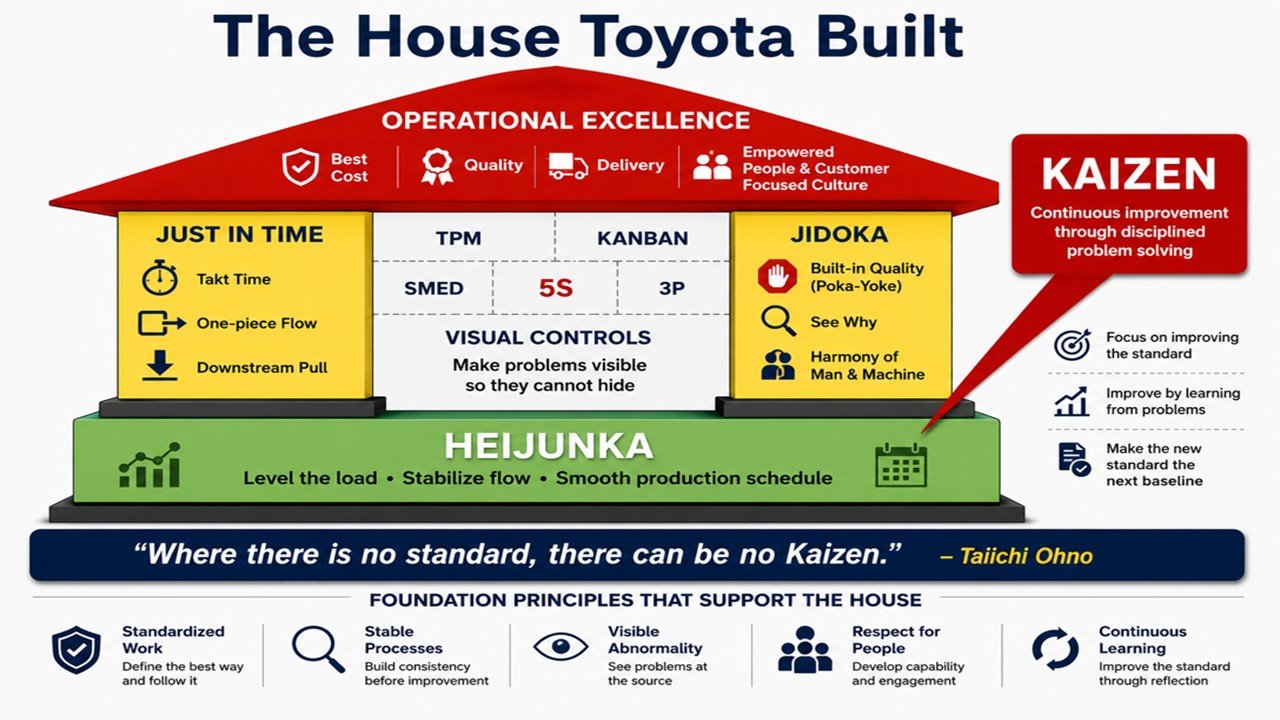
Governance as the missing link in continuous improvement systems showing standard operating procedures, visual control, Andon stop, Jidoka, and required leadership response to protect Quality
Continuous improvement systems fail when governance is absent. Standard operating procedures, visual control, Andon, and Jidoka must function together to stop execution, require leadership response, and protect Quality at the source
Toyota Production System Quality progression showing governing conditions, abnormality detection, and enforced response across operations
Quality in the Toyota Production System governs execution. Work continues only when conditions are met, abnormality is visible, and response is required.
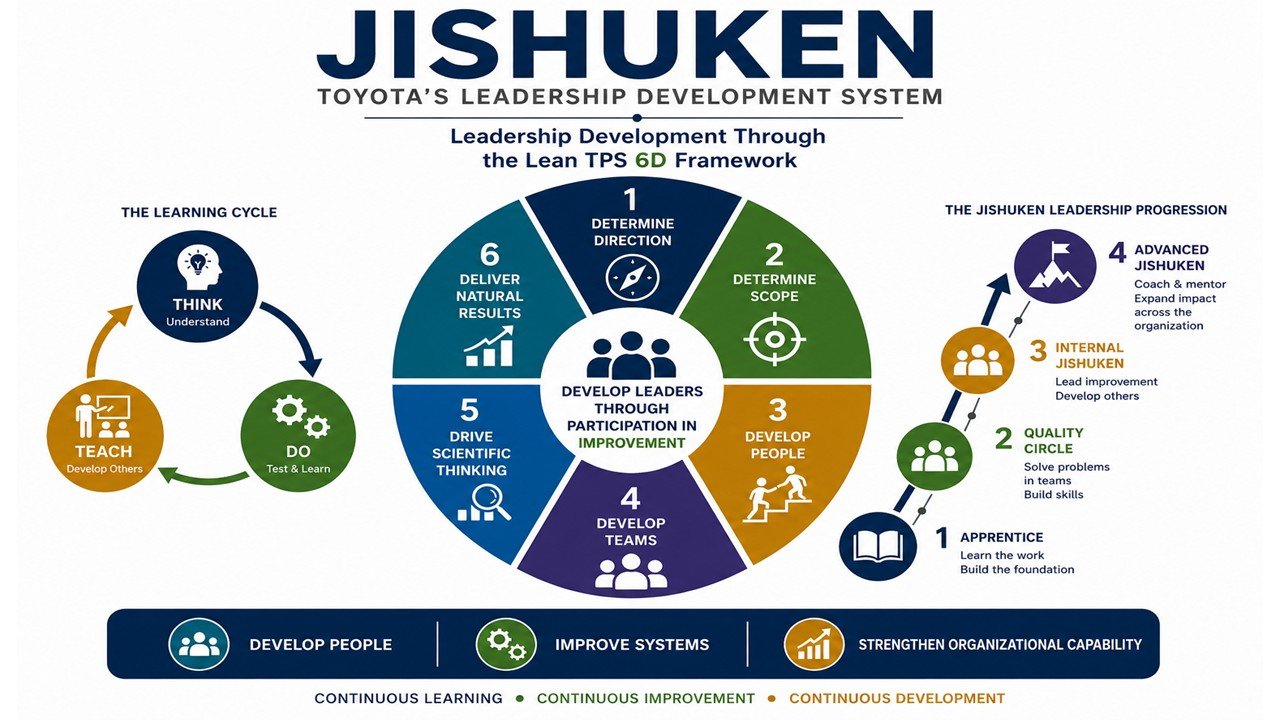
Diagram illustrating Jishuken as deliberate buffer reduction within Lean TPS governance, showing how reduced manpower, inventory, and cycle time expose management behavior and test Quality protection under disciplined control.
Improvement without governance amplifies variation. Jishuken deliberately reduces buffer to expose whether leadership discipline can protect Quality under tighter operating conditions. Stability under compression confirms governance maturity.
Lean TPS Swiss Cheese Model showing four aligned cheese slices representing Organizational Systems, Leadership Governance, Task Conditions, and Point of Execution, with layered penetration paths demonstrating Quality containment.
A visual representation of the Lean TPS Swiss Cheese Model™, demonstrating how layered governance architecture progressively protects Quality from Organizational Systems through to Point of Execution.