How Early Toyota Production System Advisory Influence Evolved into Enterprise Governance Architecture
Executive Summary
Danaher Business System governance-first enterprise architecture demonstrates how sequencing discipline determines enterprise durability. The diffusion of Lean (post-1988) introduced Toyota Production System terminology to global industry. Tools, events, certification structures, and improvement routines spread rapidly across sectors. In many implementations, however, sequencing reversed. Visible mechanisms preceded governance architecture. Activity expanded while structural control weakened. Improvement became episodic rather than systemic.
Prior to this diffusion, exposure to Toyota Production System practice in the West occurred through direct advisory engagement led by former Toyota practitioners, most notably through Shingijutsu, founded in 1987. These engagements transmitted not only tools, but sequencing discipline embedded in Toyota practice. Governance preceded activity. Leadership obligation preceded empowerment language. Financial consequence followed operational stability.
In the early 1990s, Danaher absorbed this advisory influence and began constructing what became the Danaher Business System. Rather than replicate factory mechanics, Danaher abstracted the underlying governance logic and translated it into an enterprise operating architecture. By the mid-1990s, DBS was formalized as a non-optional system integrating strategy deployment, leadership participation, operational discipline, and capital translation.
The Danaher Business System illustrates governance-first sequencing at enterprise scale. Direction is defined before deployment. Leadership obligation is embedded before tool proliferation. Financial architecture enforces consequence before event reporting. Continuous improvement operates within defined boundaries rather than replacing them.
This whitepaper examines DBS as a structural case study in governance-first system design derived from Toyota Production System lineage. It analyzes how sequencing discipline preserved architectural integrity while Lean (post-1988) implementations frequently inverted that order. It then identifies blueprint implications for organizations seeking to build a new TPS-derived operating system anchored in governance rather than activity.
Governance precedes tools. Architecture precedes routine. Enterprise durability depends on sequencing discipline.
1. The Structural Drift of Lean (post-1988)
The global diffusion of Lean (post-1988) expanded awareness of Toyota Production System concepts across manufacturing, healthcare, government, and service sectors. Terminology such as Kaizen, Value Stream Mapping, Standard Work, and Hoshin Planning became widely adopted. Training programs, certification pathways, and consulting frameworks accelerated implementation. Improvement activity increased across industries.
However, diffusion altered sequencing. In many implementations, visible tools preceded governance architecture. Organizations launched Kaizen events, implemented visual boards, trained A3 facilitators, and mapped value streams before defining operating boundaries, escalation logic, financial translation, and leadership obligation. Improvement became an activity layer rather than an architectural layer.
When tools are deployed without defined governance, three structural effects follow.
First, optimization becomes local. Functions improve within their own boundaries without integration across the enterprise. Policy-level instability remains unaddressed. Mura and Muri generated by strategic misalignment or capital allocation decisions persist beneath tool activity.
Second, financial interpretation conflicts with operational stability. Traditional accounting measures often reward inventory accumulation, utilization maximization, and short-term variance absorption. Without governance sequencing, Lean tools operate within financial logic that may undermine flow stability and Quality protection.
Third, leadership participation becomes discretionary. Improvement is delegated to specialists or improvement offices. Frontline routines increase while executive integration remains weak. Without embedded leadership obligation, adoption becomes uneven and reversible.
The result is not absence of improvement, but absence of architectural coherence. Activity expands. Standards may be documented. Visual systems may be implemented. Yet escalation logic, capital discipline, and enterprise alignment remain undefined or loosely coupled.
Lean (post-1988) did not intend this inversion. Toyota Production System was constructed as governed operating architecture. Standardized Work defined normal condition before improvement expanded. Jidoka revoked permission under abnormality before flow intensified. Strategy deployment aligned activity before local initiatives multiplied. Sequencing was structural, not optional. When reversed, improvement became episodic rather than systemic. Tools operated without defined authority. Performance improved locally, durability remained fragile.
The governance gap created by this inversion raises a structural question. Can continuous improvement scale across diversified enterprises without first defining governance architecture? The Danaher Business System provides a case study in sequencing discipline that addresses this question.
2. Early Toyota Production System Advisory Influence and Translation
Prior to the widespread diffusion of Lean (post-1988), exposure to Toyota Production System practice in the West occurred primarily through direct advisory engagement led by former Toyota practitioners. Shingijutsu, founded in 1987 by former Toyota leaders, played a significant role in transmitting TPS practice outside Japan.
These engagements did not present TPS as a collection of tools. They emphasized sequencing discipline embedded in Toyota operations. Work began with defining normal condition. Standards were clarified before improvement cycles expanded. Abnormality was exposed before optimization intensified. Leadership participation was direct and non-optional. Structural change preceded event activity.
The distinction lies in transmission focus. Early TPS advisory influence centered on operating logic rather than terminology. Escalation pathways, containment discipline, and cross-functional integration were treated as foundational elements. Tools were applied within defined boundaries rather than deployed as independent initiatives.
In the early 1990s, Danaher encountered this advisory influence during its transformation efforts. Rather than replicate Toyota factory structures, Danaher abstracted governance principles and translated them into an enterprise context. Direct replication was neither feasible nor appropriate across diversified businesses. What proved transferable was sequencing discipline.
Governance preceded tools. Strategy alignment preceded event expansion. Leadership obligation preceded delegation. Financial consequence followed operational stability.
By the mid-1990s, these principles were formalized within the Danaher Business System. The architecture extended governance logic beyond production into enterprise strategy, capital allocation, talent development, and portfolio integration.
This moment marks a structural divergence. While Lean (post-1988) diffusion expanded tool visibility across industries, Danaher concentrated on sequencing architecture first and deployment second. The durability of the system reflects that order.
3. Governance Architecture of the Danaher Business System
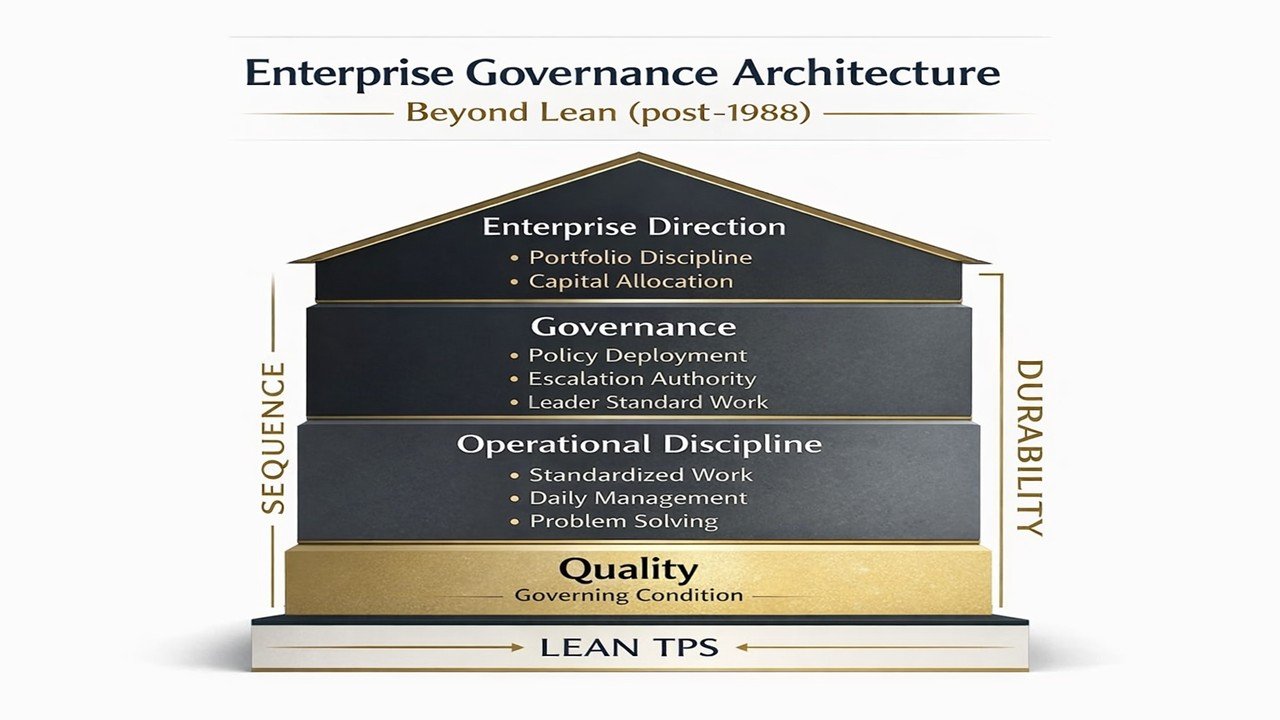
The Danaher Business System did not emerge as a collection of Lean (post-1988) tools applied to isolated functions. It evolved as an enterprise governance architecture in which operating discipline, strategic direction, capital allocation, and leadership obligation were structurally integrated. Its significance lies not in the presence of familiar TPS terminology, but in the sequencing logic through which those elements were institutionalized.
The architecture begins with defined direction. Enterprise intent precedes operational activity. Long-term value creation, disciplined portfolio management, and measurable performance expectations govern decision making. Improvement is not discretionary and not symbolic. It is structurally tied to enterprise outcomes. This sequencing prevents the common failure pattern in Lean (post-1988) deployments, where improvement activity expands without defined strategic anchoring or Quality accountability.
Strategy deployment within DBS operates as a governance bridge rather than a planning exercise. Policy deployment mechanisms align business unit objectives to enterprise direction through explicit accountability and review cadence. Objectives are not aspirational statements. They are translated into measurable operating conditions with defined ownership. This linkage ensures that improvement activity is subordinated to defined enterprise priorities rather than locally interpreted ambition.
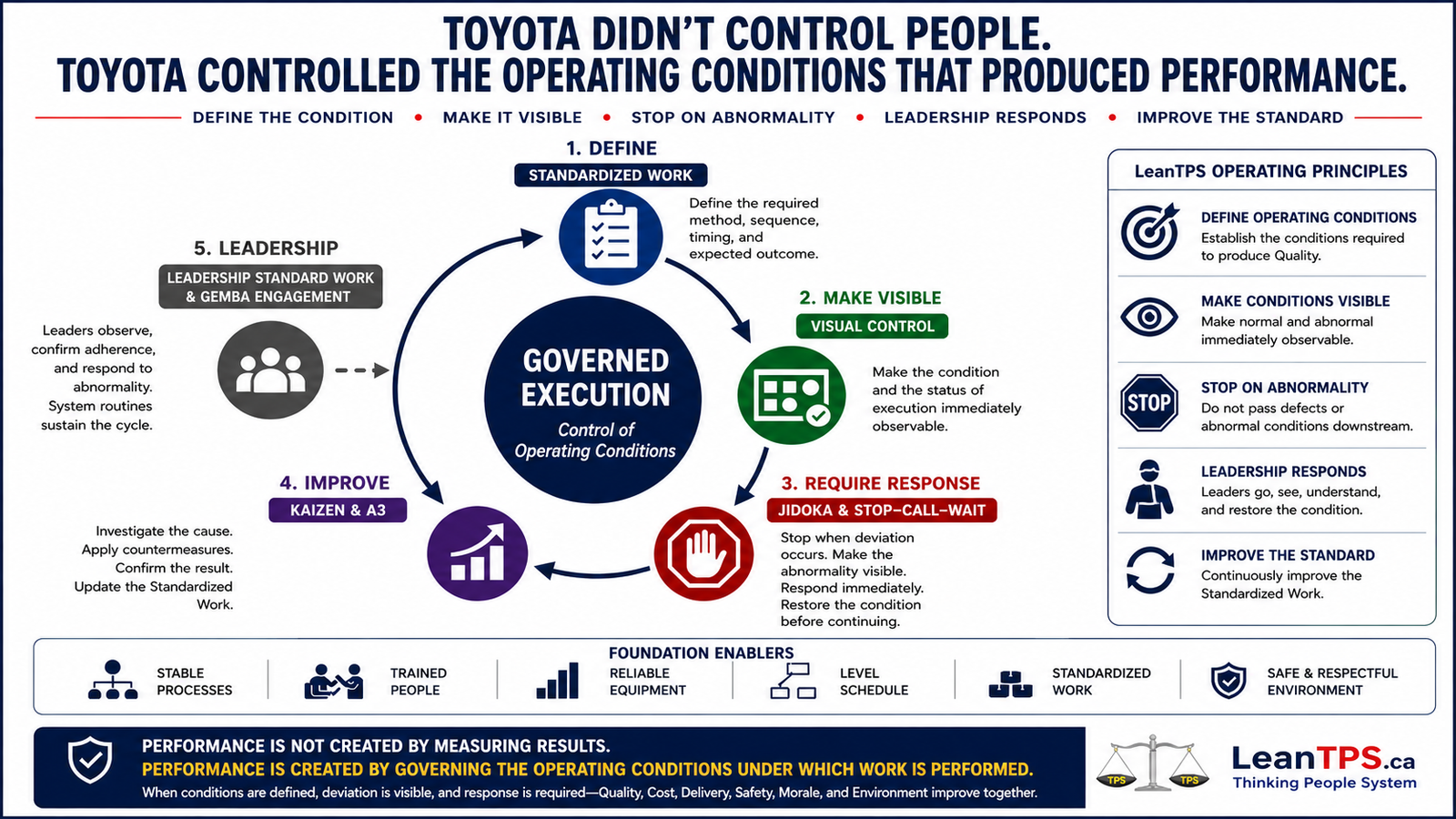
Operational discipline functions inside this governance boundary. Standardized Work defines normal condition across manufacturing, commercial, and transactional environments. Structured problem solving enforces root cause discipline before corrective action. Visual and daily management routines institutionalize cadence and immediate response. Improvement engagement is not motivational activity; it is structured modification of defined process conditions under governed Quality boundaries.
Quality within this architecture is not a downstream metric reviewed after performance variance occurs. Quality operates as a governing condition embedded within operating expectations, escalation pathways, and review structures. Deviation from defined condition demands response. Performance visibility is paired with consequence. Improvement that does not reinforce Quality stability is incomplete.
A distinguishing feature of DBS is the integration of operational governance with capital discipline. Improvement is required to translate into balance sheet strength, cash generation, and disciplined investment decisions. Operational gains must demonstrate measurable financial impact. This layer enforces seriousness. It prevents Lean (post-1988) activity from becoming philosophical or cultural rhetoric detached from enterprise durability. Quality improvement and financial performance are structurally linked rather than rhetorically associated.
Leadership obligation permeates each layer. Governance is not delegated to improvement teams. Senior leadership maintains responsibility for direction, review cadence, escalation integrity, and capital allocation. Daily management, structured problem solving, and policy deployment are embedded within leadership routine rather than positioned as specialist functions. This preserves coherence across scale and time.
The result is an enterprise architecture in which TPS-derived mechanisms operate within defined governance boundaries. Improvement remains subordinated to direction. Quality remains enforced rather than reported. Financial translation enforces consequence. Leadership cadence sustains continuity.
This architecture illustrates governance-first sequencing. Direction precedes deployment. Deployment precedes routine. Routine reinforces Quality. Quality reinforces enterprise durability.
The lesson is structural. Sustainable systems do not begin with tools. They begin with governance that protects Quality, aligns leadership, and institutionalizes learning before routine expands.
4. Why Governance Sequencing Determines Durability
The distinction between early Lean (post-1988) adoption and the maturation of the Danaher Business System is architectural. Many Western deployments began with visible mechanisms before defining authority, escalation discipline, leadership cadence, and enforced Quality protection. Activity expanded while governance remained partial.
DBS reversed that sequence. Governance was established first. Strategic deployment defined direction. Leadership obligation was embedded in structured review. Capital allocation reinforced consequence. Operational mechanisms were integrated within that architecture rather than used to construct it.
Without governance sequencing, improvement expands horizontally. Local optimization increases. Engagement rises. Metrics fluctuate. Enterprise coherence weakens. Strategic alignment becomes discretionary. Leadership cadence varies by function. Quality accountability becomes informational rather than enforced. Visibility replaces control.
When defined authority precedes routine, system behavior changes. Improvement reinforces enterprise intent rather than substituting for it. Mandatory escalation pathways trigger response rather than explanation. Standardized Work defines normal condition across functions, making variation measurable and Quality exposure visible. Jidoka revokes permission to proceed under defect conditions, shifting governance from observation to enforcement. Explicit financial translation converts operational gains into enterprise durability. Quality becomes structural rather than aspirational.
Durability within DBS does not derive from tool sophistication. It derives from governance-first sequencing. Improvement operates inside defined boundaries. Leadership accountability is sustained through embedded cadence. Stop logic protects continuation. Learning is institutionalized through revision of standards. Financial consequence enforces seriousness.
Systems that begin with tools attempt to construct governance later. Systems that establish governance first embed disciplined routine within defined authority. The latter sustains.
The lesson is architectural. Quality-driven enterprises require defined authority, enforced interruption, embedded review cadence, and institutionalized learning before improvement activity expands. Governance defines integrity. Routine strengthens it.
5. Constructing Governance Before Routine: A Blueprint for Enterprise Leaders
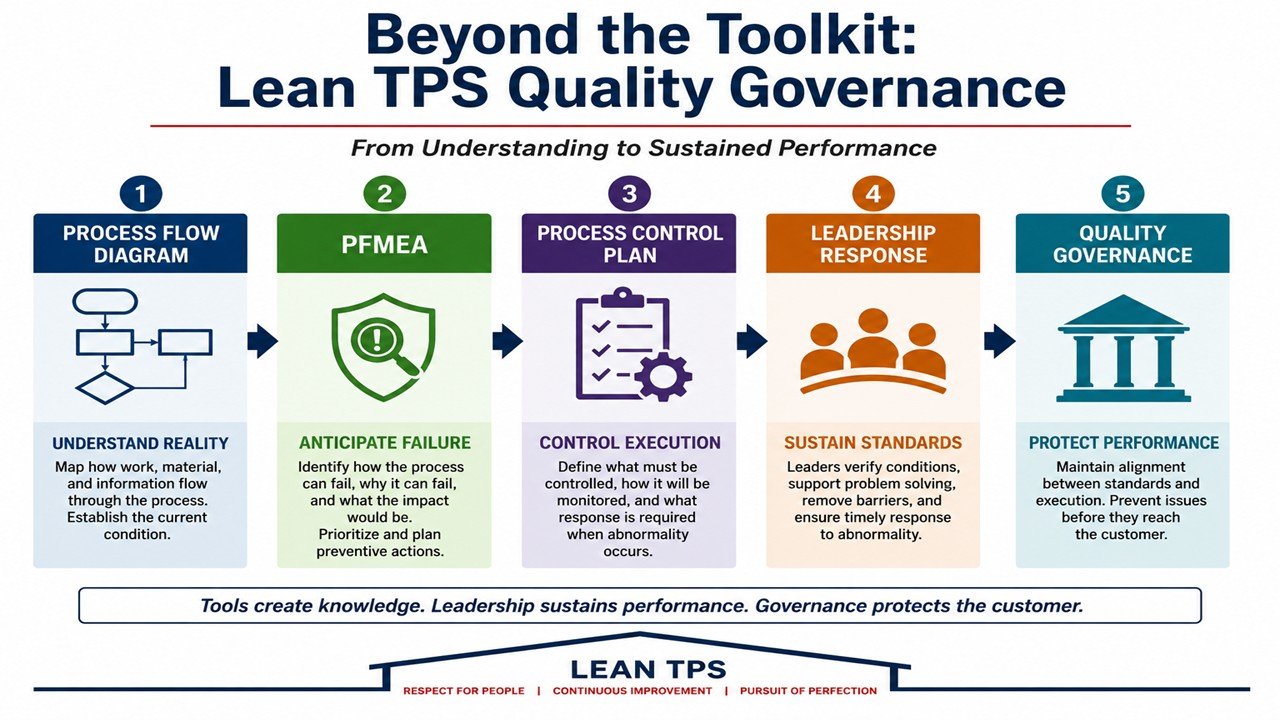
The lesson from the evolution of the Danaher Business System is not that tools should be avoided. It is that tools must be subordinated to governance architecture. Leaders seeking durable systems must sequence development correctly. Governance defines authority before routine expands. Quality governs continuation before activity accelerates.
The first requirement is to define normal condition at the enterprise level. Normal is not a performance target. It is a documented operating expectation specifying how work is performed, how decisions are escalated, and how Quality is protected. Standardized Work must extend beyond production into managerial, transactional, and strategic processes. Without defined normal, improvement lacks anchor and variation lacks boundary.
The second requirement is to enforce binary response to abnormality. Deviation from defined condition must revoke permission to proceed until evaluated and contained. Escalation pathways must be clear, time-bound, and mandatory. Quality cannot function as a downstream metric reviewed after performance decline. It must operate as a governing condition that determines continuation. Without enforced interruption logic, visibility systems remain observational rather than protective.
The third requirement is to institutionalize leadership cadence. Review frequency, accountability structures, and documented follow-up routines must be embedded within Leader Standard Work. Governance cannot depend on personality or enthusiasm. It must be sustained through defined rhythm. Daily management, policy deployment review, and structured problem solving must operate as integrated expressions of leadership obligation.
The fourth requirement is to align improvement with strategic intent. Improvement cycles must originate from defined enterprise objectives or structural risk signals. Activity initiated without alignment fragments coherence. When direction is explicit and reviewed, improvement reinforces enterprise stability and protects Quality at scale.
The fifth requirement is to translate operational stability into financial durability. Quality improvement must convert into measurable enterprise outcomes, including productivity, cash flow strength, capital efficiency, and disciplined reinvestment. Improvement that does not strengthen economic resilience remains incomplete. Financial consequence enforces seriousness and prevents symbolic engagement.
Learning must then be institutionalized. When improvement yields validated gains, Standardized Work must be revised, training updated, escalation thresholds clarified, and review cadence adjusted. Without structural revision, learning remains individual rather than systemic. Durability depends on documented reinforcement.
This blueprint reflects governance-first sequencing. Authority defines boundaries. Boundaries protect Quality. Routine strengthens defined conditions. Improvement operates within architectural limits rather than redefining them informally.
Systems built in this sequence resist drift. Quality remains protected. Leadership accountability remains enforced. Improvement strengthens stability rather than destabilizing it.
Sustained enterprise performance requires architecture before routine. Governance defines integrity. Discipline advances capability. Quality remains the governing condition.
6. Reclaiming Toyota Production System as Governance Architecture
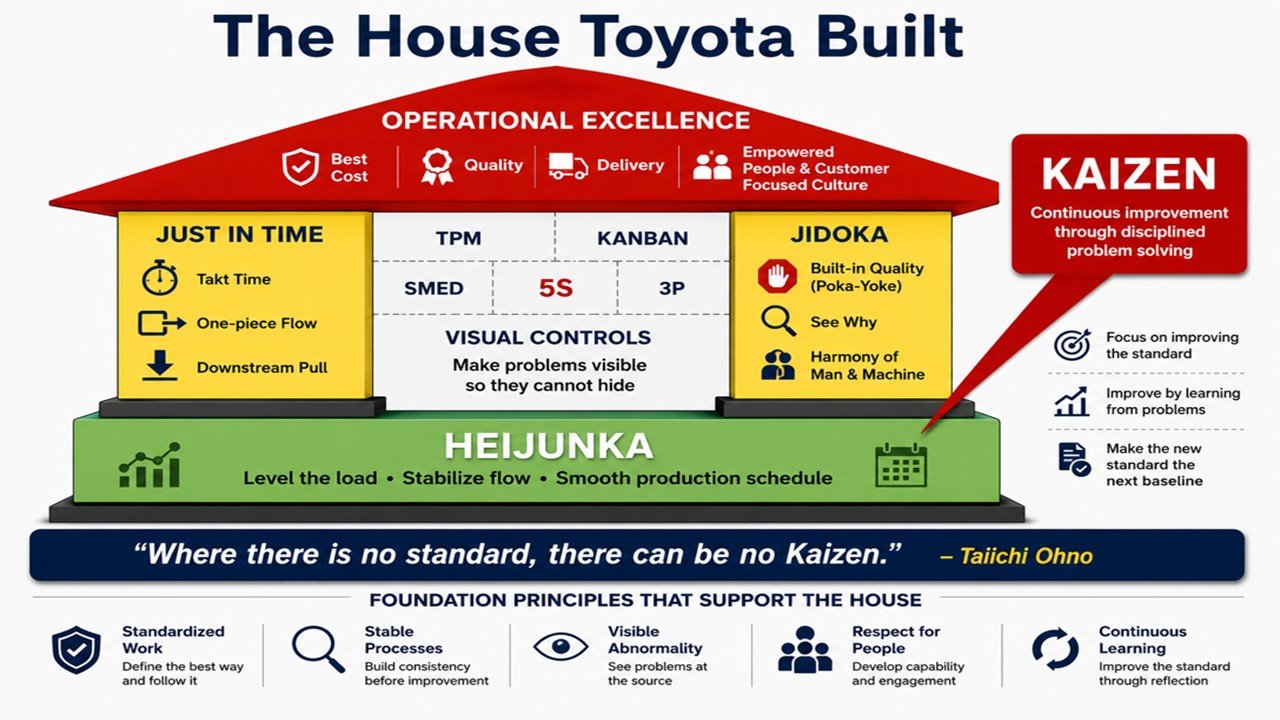
The historical arc from early TPS advisory influence to the maturation of the Danaher Business System illustrates a structural truth. Toyota Production System was never intended to be exported as a collection of tools. It was practiced as a governed operating architecture in which Quality determined continuation, Jidoka enforced stop authority, leadership carried structural obligation, and improvement modified defined conditions rather than opinions.
When former Toyota practitioners established advisory organizations in the West, they transmitted essential mechanisms of TPS. Standardized Work, visual control, structured problem solving, material and information flow analysis, and disciplined improvement cycles became visible and transferable. These mechanisms provided organizations with a powerful foundation for operational improvement.
However, transmission of mechanisms does not automatically transmit governance architecture. In many Lean (post-1988) translations, tool adoption expanded more rapidly than structural embedding. Improvement activity increased, yet Jidoka enforcement, escalation discipline, leadership cadence, and institutionalized Quality protection were unevenly developed. The result was capability without architectural coherence.
The Danaher Business System represents a different trajectory. Initial exposure to TPS mechanisms evolved into enterprise-level governance design. Direction was formalized. Policy deployment aligned execution to strategy. Leadership cadence became institutionalized. Operational discipline was embedded across functions. Capital allocation was integrated with improvement performance. Most importantly, Quality performance was tied to consequence through structured review and defined accountability.
This evolution demonstrates that the power of Toyota Production System does not reside in terminology. It resides in sequencing and enforcement. Governance defines operating boundaries. Standardized Work specifies normal condition. Jidoka establishes binary abnormality and removes permission to proceed under defect conditions. Leadership enforces cadence. Improvement revises defined condition. Financial translation reinforces seriousness. Quality governs continuation.
Reclaiming Toyota Production System therefore requires clarity. TPS is not Lean branding. It is not event activity. It is not motivational framing. It is governance architecture designed to prevent failure by protecting Quality through defined standards, enforced interruption, disciplined escalation, and institutionalized learning.
Systems that adopt tools without stop authority generate episodic gains. Systems that embed governance before routine generate durability. The distinction determines whether improvement depends on individual enthusiasm or institutional design.
The structural lesson is enduring. Architecture precedes activity. Governance precedes routine. Jidoka protects Quality. Leadership obligation sustains discipline.
When these elements are sequenced correctly, improvement strengthens integrity rather than fragmenting it. That is the enduring contribution of Toyota Production System. That is the foundation upon which durable enterprise systems are built.
7. Strategic Implications: Architecture Before Expansion
The structural lesson emerging from the evolution of the Danaher Business System is not methodological. It is architectural. Sustainable enterprise performance depends on governance sequencing, not on the accumulation of improvement routines.
Organizations seeking to build durable systems must begin by defining authority location. Who has the right to stop? What defines normal condition? What constitutes abnormality? How is escalation structured? Where is Quality protected? Without explicit answers to these questions, improvement activity risks expanding faster than control.
Governance must precede expansion.
Standardized Work must define normal condition across operational and managerial domains. Jidoka must remove discretion when Quality conditions are violated. Escalation pathways must be mandatory and time-bound. Leader Standard Work must institutionalize review cadence. Financial architecture must translate operational stability into enterprise durability.
Improvement routines such as structured problem solving, flow analysis, and disciplined experimentation then operate within these boundaries. They do not create governance. They reinforce it. When validated learning results in revised standards, governance strengthens. When governance weakens, routine activity accelerates drift.
The DBS example demonstrates that early exposure to Toyota Production System mechanisms can mature into enterprise architecture when sequencing is correct. Tools were not abandoned. They were subordinated to governance. Direction aligned deployment. Deployment structured routine. Routine reinforced Quality. Quality reinforced enterprise durability.
This sequencing is not optional for leaders pursuing long-term resilience. Lean (post-1988) translations often expanded routine before defining architecture. Durable systems reverse that order.
The implication for contemporary enterprise design is direct. Digital systems, analytics platforms, and advanced planning algorithms increase precision. Precision does not equal control. Without stop authority, escalation discipline, and institutionalized review cadence, visibility becomes observation without intervention. Quality becomes reported rather than governed.
Architecture must therefore anchor expansion. Governance must define boundaries. Jidoka must protect continuation. Leadership must sustain cadence. Standards must institutionalize learning. Quality must remain the governing condition.
When architecture precedes routine, growth reinforces integrity. When routine precedes architecture, growth amplifies fragility.
Toyota Production System endures because it was constructed as governance architecture before routine proliferation. Systems that internalize this sequencing preserve Quality, protect stability, and sustain enterprise resilience across time.
8. Final Position
The evolution of the Danaher Business System demonstrates that exposure to Toyota Production System mechanisms is insufficient without governance architecture. Tools initiate improvement. Only defined authority, enforced stop logic, structured escalation, institutionalized learning, and financial consequence sustain Quality.
Toyota Production System was constructed as governance architecture designed to prevent failure. Standardized Work defines normal condition. Jidoka revokes permission under defect conditions. Leadership sustains cadence. Learning is institutionalized through revision of standards. Quality governs continuation.
Enterprise systems that internalize this sequencing convert improvement from activity into architecture. Systems that reverse the order substitute visibility for control and engagement for governance.
Architecture before routine. Governance before expansion. Stop authority before acceleration. Quality before output.
Durability depends on sequence.
Continuity With the Earlier Articles in This Series
This article continues a structural examination developed across LeanTPS.ca: how governance was progressively separated from system behavior as Toyota Production System was translated into portable improvement routines.
Each prior article analyzed this separation at a distinct enterprise layer.
Kata (post-2009) extended the examination into behavioral discipline. Structured experimentation strengthens adaptive thinking. The architectural question remains whether routine can substitute for defined operating boundaries. Lean TPS answers directly. Governance defines the boundary. Experimentation operates within it. Quality remains the governing condition.
https://leantps.ca/house-toyota-built-embedded-kata-lean-tps-governance/
Six Sigma (post-1990s) and Lean Six Sigma (post-2010s): How Quality Governance Was Replaced examined how certification structures, project hierarchies, and belt systems displaced direct leadership ownership of Quality, producing technical capability without durable operating control.
https://leantps.ca/six-sigma-lean-six-sigma-quality-governance/
Kaizen (post-1980s): How Governance Was Removed from the Toyota Production System traced how Kaizen became portable by detaching from Jishuken, escalation discipline, and leadership obligation, allowing improvement activity to persist while governance eroded.
https://leantps.ca/kaizen-post-1980s-how-governance-was-removed-from-the-toyota-production-system/
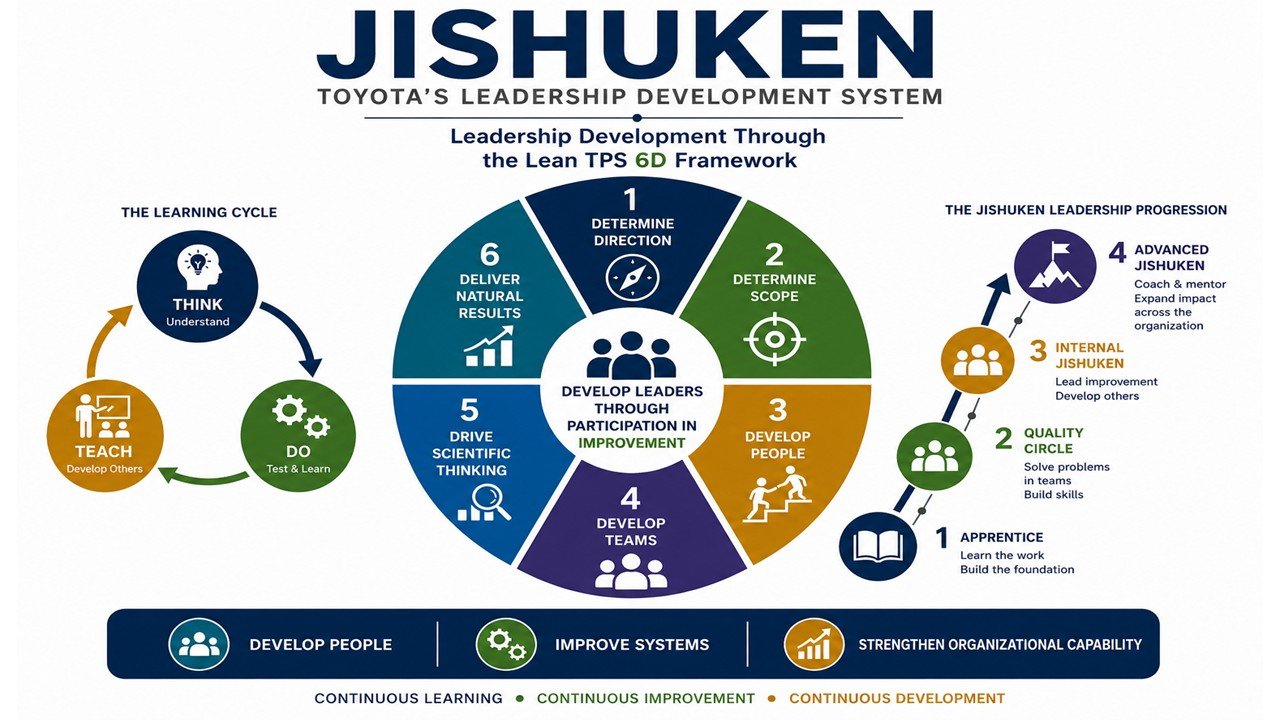
Jishuken: Leadership Governance Through Direct System Engagement examined how Toyota preserved Quality by requiring leaders to engage directly in system diagnosis, escalation, and correction, and how removal of this obligation disconnects improvement from responsibility.
https://leantps.ca/jishuken/
Why Dashboards and Scorecards Cannot Replace Andon in Lean TPS analyzed governance failure at the operational layer. When visibility tools replace stop authority and structured escalation, Quality becomes informational rather than controlled.
https://leantps.ca/why-dashboards-and-scorecards-cannot-replace-andon-in-lean-tps/
Lean TPS Disruptive SWOT: Governing Strategic Direction Through Quality and Leadership Obligation examined governance at the strategic layer. When direction is not anchored to explicit operating conditions, ownership, cadence, and defined response, persuasion substitutes for leadership obligation.
https://leantps.ca/lean-tps-disruptive-swot/
Governance Sequencing in Digital Operations Architecture examined how digital systems increase computational precision while leaving authority location undefined, producing optimization without boundary control.
https://leantps.ca/governance-sequencing-digital-operations-architecture/
Across these analyses, a consistent structural pattern emerges. Governance is replaced by visibility, certification, routine, or computational sophistication. Activity increases while control weakens.
Lean TPS restores Quality by governing operating conditions before work proceeds. Quality is protected through defined standards, enforced stop authority, structured escalation, and institutionalized review.