Stability, Quality Protection, and Disciplined Improvement Within Lean TPS Governance Architecture
Executive Summary
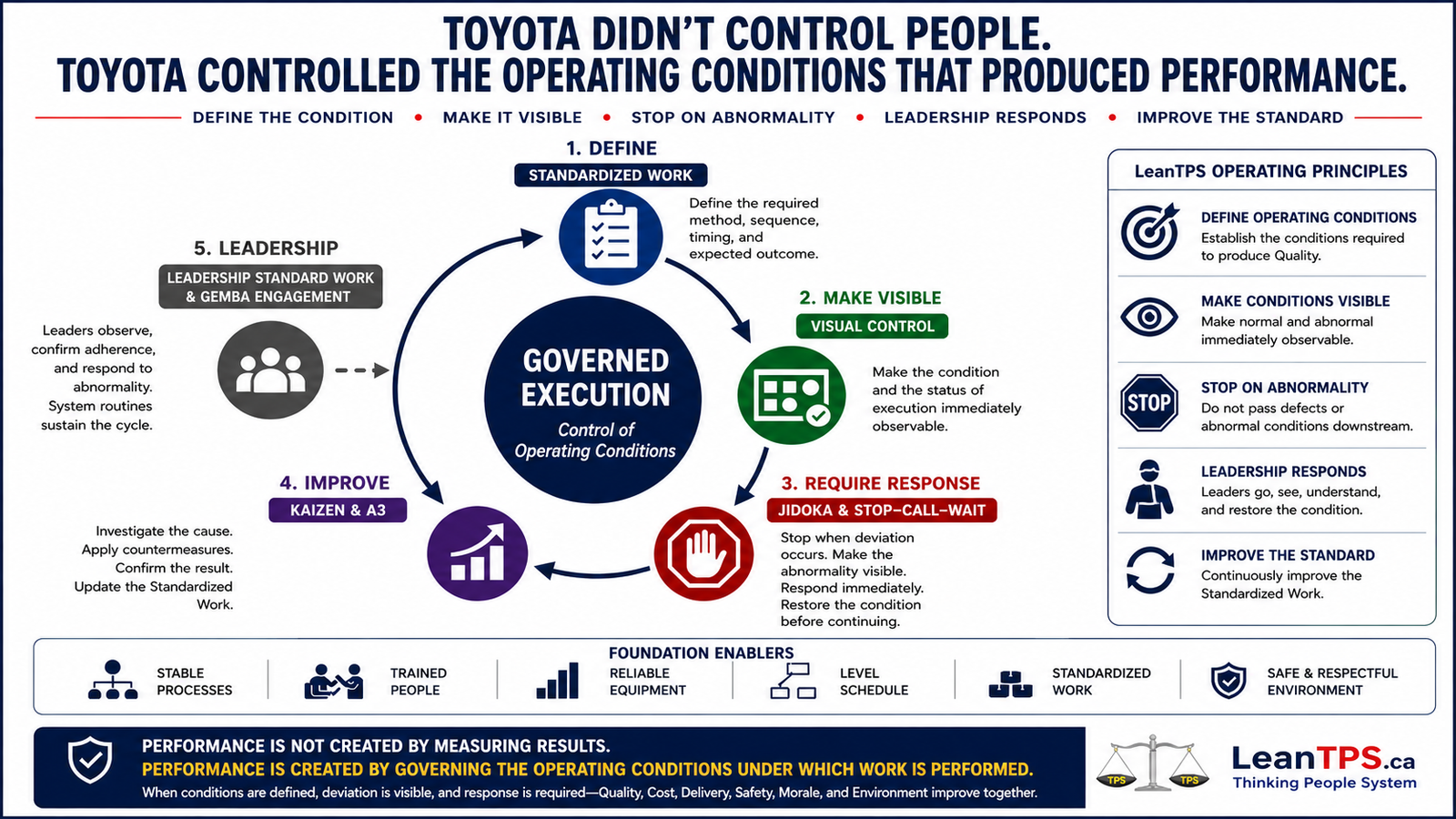
The Toyota Production System was constructed as a governed operating architecture, not as a collection of improvement routines. Lean TPS defines normal condition through Standardized Work, aligns pace through Takt and Heijunka, enforces binary response to abnormality through Jidoka, and institutionalizes learning by revising standards. Quality is protected structurally through defined operating boundaries and leadership obligation. Stability is engineered, not assumed, and improvement is required to reinforce the defined normal.
Kata (post-2009) was introduced as a structured method for developing disciplined experimentation and scientific thinking. The Improvement cycle trains individuals to define a current condition, establish a target condition, identify obstacles, and advance through iterative PDCA cycles. The method strengthens behavioral discipline, prediction before action, and reflection grounded in evidence. Its contribution lies in capability development at the level of thinking and coaching practice.
These two constructs operate at different structural layers. Lean TPS governance defines operating boundaries, escalation logic, and institutional learning. Kata structures adaptive movement within a defined space. Behavioral discipline alone does not establish system integrity. Governance architecture alone does not ensure adaptive capability.
When Kata operates without defined governance boundaries, improvement may occur, but sustainability depends on individual discipline and local interpretation. Target conditions risk drifting from system signals, and learning may remain personal rather than institutional. When Kata is embedded within Lean TPS governance, target conditions derive from defined system indicators such as repeated Jidoka triggers, Standardized Work instability, Heijunka imbalance, Quality risk exposure, or strategic deployment priorities. Experiments are constrained by operating conditions that protect Quality. Escalation follows established leadership tiers, and validated learning results in revised Standardized Work and updated review cadence.
Governance prevents drift by defining non-negotiable boundaries. Disciplined experimentation prevents stagnation by enabling structured advancement within those boundaries. Sustainable improvement emerges when adaptive movement operates inside defined operating architecture. Lean TPS remains the governing system. Kata can strengthen capability when anchored within that architecture. Quality remains the governing condition.
1. Framing the Relationship Between Kata and Lean TPS Governance
Improvement disciplines are frequently presented as if they can operate independently of system architecture. Organizations introduce behavioral routines, train managers in coaching cycles, and implement structured questioning practices with the expectation that sustained improvement will follow. Results vary because disciplined behavior alone does not define operating conditions, escalation rules, or institutional learning mechanisms. Without defined boundaries, improvement activity may increase while system stability remains unchanged.
Kata (post-2009) develops disciplined improvement behavior. It structures movement from a current condition toward a defined target condition through iterative PDCA experimentation. Participants are trained to articulate predictions before action, evaluate outcomes against those predictions, and navigate obstacles sequentially rather than pursuing broad solution jumps. The method strengthens adaptive thinking under uncertainty and reinforces structured reflection grounded in evidence.
Lean TPS governance defines and regulates the operating system within which any behavioral discipline must function. Normal condition is specified through Standardized Work. Abnormality is defined through Jidoka and enforced through binary stop logic. Pace is stabilized through Takt and Heijunka. Review cadence is institutionalized through Leader Standard Work. Escalation is structured through tiered response mechanisms. Learning becomes structural when revised standards replace informal insight. Quality is protected through non-negotiable operating rules rather than discretionary interpretation.
The distinction between the two constructs is architectural. Kata governs improvement behavior at the level of individual and team practice. Lean TPS governs operating conditions at the level of system design and leadership obligation. One addresses disciplined movement. The other defines the boundaries within which movement is permitted.
Behavioral discipline operating without governance architecture risks producing localized optimization, uneven capability transfer, and detachment from long-term system intent. Governance architecture operating without disciplined experimentation risks rigidity, delayed adaptation, and extended learning cycles. Neither layer alone produces durable capability.
Sustained performance emerges when behavioral discipline is anchored within defined operating boundaries. Lean TPS governance establishes direction, constraints, and Quality protection. Kata provides structured movement within those constraints. Target conditions must originate from system signals rather than discretionary preference. Experiments must respect operating rules that protect stability and escalation discipline. Learning must result in updated Standardized Work and reinforced review cadence.
The central issue is not whether Kata replaces Lean TPS, nor whether governance architecture eliminates the need for behavioral discipline. The structural question concerns how disciplined experimentation achieves sustained impact when embedded inside a governance architecture that defines normal, abnormal, escalation logic, and institutional learning. The remainder of this article examines that integration and its implications for long-term Quality performance.
2. Defining Lean TPS Governance as the Operating Boundary
Lean TPS governance begins with a precise definition of normal condition. Normal is not aspiration, preference, or informal understanding. Normal is specified, documented, and observable. It defines how work must be performed, at what pace, under what constraints, and with what Quality expectations.
Normal condition is expressed through clearly defined operating elements, including Takt time, Standardized Work sequence, work-in-process limits, Quality specifications, Heijunka leveling patterns, and defined escalation thresholds. These elements establish the operating boundary of the system. They determine what is acceptable, what is unstable, and what must trigger immediate response. The boundary distinguishes controlled variation from deviation that threatens system integrity.
Abnormality within Lean TPS is binary. Deviation from defined condition requires action. Jidoka removes discretion at the moment of breach by enforcing stop authority when defect conditions or parameter violations occur. Work does not continue under defect conditions. Escalation is not optional, and review cadence is institutionalized through Leader Standard Work. Daily Asaichi review and tiered leadership structures prevent normalization of deviation and reinforce accountability for response.
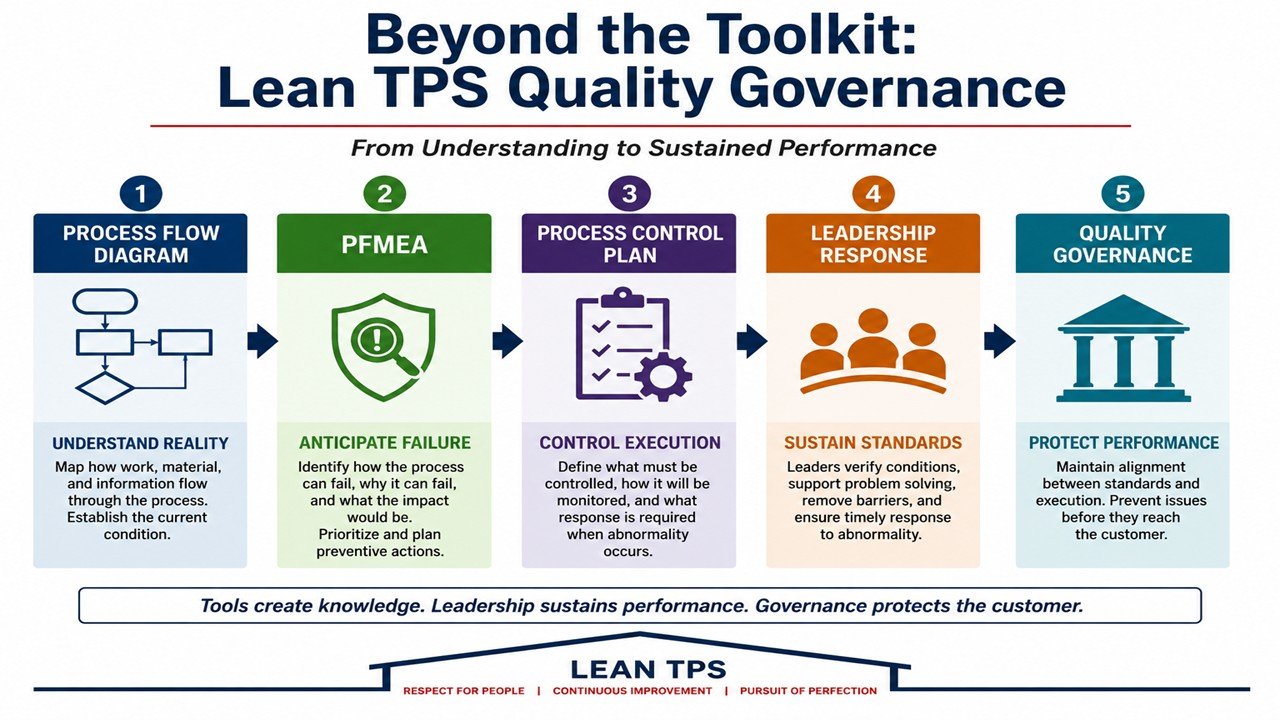
Lean TPS governance also incorporates layered risk containment through the Lean TPS Swiss Cheese Model. Risk protection is not concentrated in a single control. It is distributed across sequential layers designed to prevent defect propagation and system erosion. Prevention is embedded in Standardized Work design. Detection is enforced through Jidoka mechanisms. Escalation thresholds activate leadership tiers. Review cadence institutionalizes oversight and correction.
Each layer functions as a containment barrier. When one layer weakens, exposure increases. When multiple layers degrade, defect escape becomes probable. Erosion within any layer generates governance signals. Repeated detection failures, delayed escalation, incomplete countermeasure validation, or drift in review discipline indicate weakening containment. These conditions require structural response rather than discretionary improvement activity.
The Lean TPS Swiss Cheese Model therefore operates as risk governance architecture. It protects Quality by ensuring that failure cannot propagate without detection, containment, and leadership engagement. Improvement activity must reinforce these layers rather than bypass them.
Improvement in this environment is not discretionary activity. It is a structural obligation. Repeated abnormality demands structured root cause analysis. Countermeasures are validated against defined operating conditions. Successful learning results in revision of Standardized Work and clarification of operating rules. Institutional learning occurs when the defined normal is updated, documented, and integrated into training and review processes.
Governance architecture answers four essential questions. It specifies what defines normal. It clarifies what defines abnormal. It assigns responsibility for response. It determines how learning is captured, revised, and sustained. Without clear answers to these questions, improvement routines lack structural anchor and may operate independently of system stability.
Lean TPS governance therefore establishes direction through long-term philosophy and strategic deployment, stability through Standardized Work and leveling discipline, protection of Quality through binary stop logic, and institutional learning through documented revision and enforced cadence. This boundary is protective rather than restrictive. It enables adaptive movement without destabilizing the operating system.
Within this defined boundary, disciplined experimentation can occur without eroding Quality or creating unmanaged variation. Outside this boundary, improvement efforts risk introducing local optimization, process inconsistency, and gradual erosion of system integrity. Kata, when embedded within Lean TPS, must operate inside this defined operating boundary. It cannot redefine normal independently, and its Target Conditions must derive from the signals generated by the governance system.
The following section examines how Kata functions behaviorally and identifies the integration points between disciplined experimentation and defined operating architecture.
3. Defining Kata as Structured Behavioral Discipline
Kata (post-2009) is a structured routine for navigating from a defined current condition toward a defined target condition through iterative experimentation. The method organizes improvement activity into a disciplined sequence intended to strengthen scientific thinking and reduce reactive decision making. Movement occurs through repeated PDCA cycles rather than broad solution deployment.
The core elements follow a predictable progression. A long-term direction or challenge is articulated to provide orientation. The current condition is grasped through observation and fact-based description. A near-term target condition is defined to narrow the learning horizon. The next obstacle is identified relative to that target. A PDCA experiment is designed and executed. Reflection compares the predicted outcome to the actual result, and the cycle repeats.
The discipline lies in sequence, prediction, and structured reflection. A prediction is made before action occurs. The outcome is compared to that prediction after execution. Learning is extracted from the gap between expected and observed results. This cycle reinforces evidence-based thinking and reduces reliance on intuition or authority-driven direction.
Kata strengthens several behavioral capabilities. It discourages solution jumping by forcing obstacle-by-obstacle progression. It reduces command-and-control instruction by shifting focus from directives to questions. It emphasizes process condition rather than outcome metrics alone. It develops thinking through structured questioning rather than prescriptive answers.
Coaching is central to this discipline. The coach reinforces the cycle by asking patterned questions aligned to the improvement sequence. Guidance is provided through inquiry rather than instruction. The objective is capability development through repeated disciplined experimentation. Over time, practitioners internalize the structure and apply it with increasing autonomy.
However, Kata does not define the operating system within which experimentation occurs. The routine does not specify what constitutes abnormality, when escalation is mandatory, how Quality is structurally protected, how standards are revised, or how cross-functional integration is governed. The method trains adaptive navigation, but it does not establish structural boundaries.
Without defined operating boundaries, target conditions may become aspirational rather than system-driven. Obstacles may be selected based on local preference rather than governance signals. Learning may remain personal rather than institutional. Behavioral discipline can improve thinking quality while leaving system stability undefined.
The strength of Kata lies in disciplined behavior. Its limitation, when applied in isolation, is the absence of governance architecture. The structural question therefore concerns integration. Target conditions must derive from Lean TPS signals, and learning must be institutionalized through Standardized Work revision, leadership review cadence, and escalation discipline. The following section examines the mechanism by which disciplined experimentation is embedded within defined governance boundaries.
4. Embedding Kata Within Lean TPS Governance
Kata achieves sustained impact when its Target Conditions are derived from Lean TPS governance signals rather than personal preference or isolated ambition. In a governed system, direction does not emerge from initiative alone. Direction is generated by structural indicators that reveal instability, risk exposure, or strategic requirement.
Target Conditions must originate from defined system signals. These include repeated Jidoka triggers, instability in Takt performance, variance from Standardized Work, imbalance in Heijunka leveling, recurring Quality escape patterns, erosion within Lean TPS Swiss Cheese risk layers, or formally deployed Hoshin objectives. Lean TPS defines the problem field through these signals. Kata structures disciplined movement within that defined field.
Embedding Kata within governance architecture changes the meaning of a Target Condition. Outside governance, a Target Condition may represent improvement ambition or local optimization. Inside governance, a Target Condition represents stabilization, containment, or advancement of defined system integrity. Movement is not discretionary. It is anchored to structural necessity and Quality protection.
Effective integration requires four forms of alignment.
Trigger alignment ensures that Kata cycles begin in response to governance indicators or formally deployed strategy. Selection of focus is determined by system signals rather than personal choice.
Ownership alignment ensures that the individual conducting the Kata operates within defined Leader Standard Work responsibilities. Coaching is connected to management obligation and documented accountability. Capability development reinforces the governance system rather than operating beside it.
Escalation alignment ensures that obstacles exceeding local authority are elevated through established Lean TPS tier structures. Problem solving does not stall at the point of resistance. Escalation follows predefined pathways that preserve cross-functional integration and leadership responsibility.
Institutionalization alignment ensures that validated Target Conditions result in revision of Standardized Work, updates to training content, and adjustment of review cadence. Improvement is incomplete until the defined normal is updated and integrated into the governance architecture. Without institutionalization, learning remains local and temporary.
Under these conditions, Kata does not operate as an independent routine layered onto the organization. It becomes a disciplined mechanism for navigating within Lean TPS architecture. Governance defines non-negotiable operating boundaries and protects Quality. Kata enables structured advancement within those boundaries.
Behavioral discipline strengthens governance when anchored to system signals. Governance multiplies behavioral impact when learning is institutionalized through standards. The next section examines how this integration elevates coaching practice and enables durable capability transfer across roles and time.
5. Elevating Coaching Through Lean TPS Governance
Coaching within Kata is designed to build disciplined thinking. The coach reinforces the structure of the Improvement cycle through patterned questions that guide observation, prediction, experimentation, and reflection. The objective is capability development through guided experimentation rather than directive instruction.
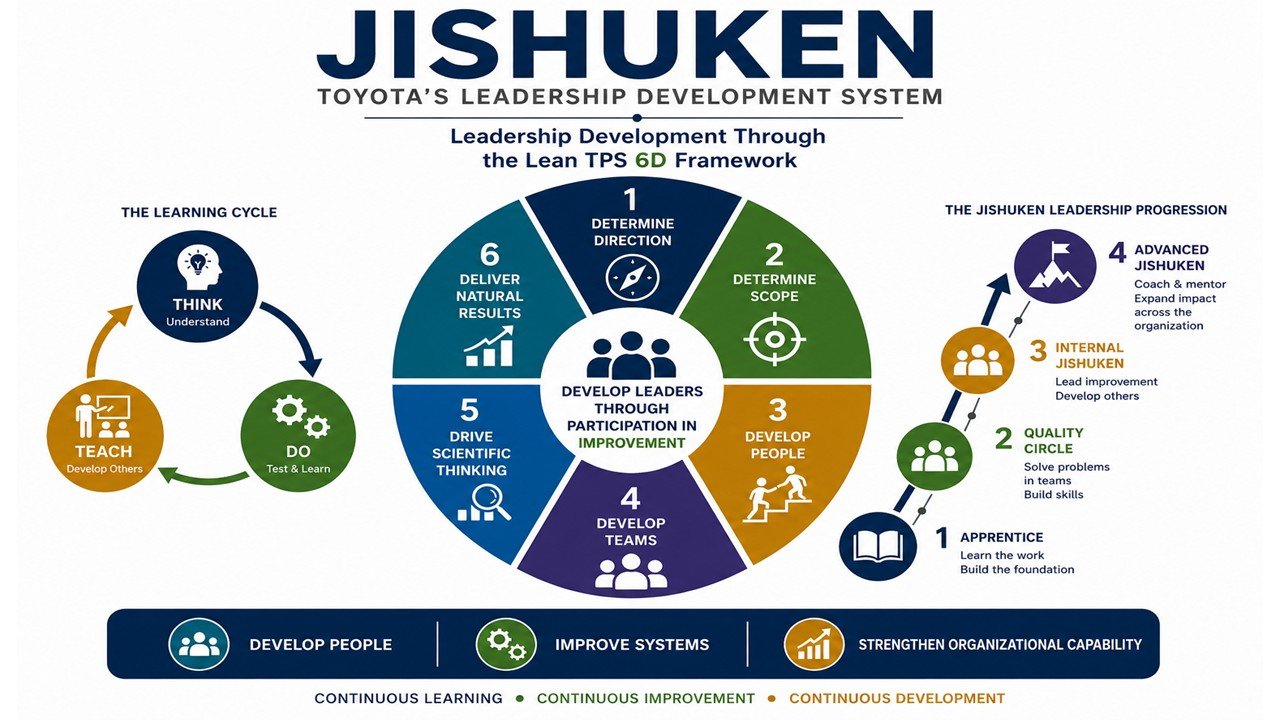
Inside Lean TPS governance, coaching must operate at a higher structural level. Coaching cannot exist as a parallel activity detached from defined operating conditions. In Lean TPS practice, development is inseparable from leadership obligation. Sensei guidance, Jishuken participation, Leader Standard Work review, and A3 reflection are embedded within the management system itself. Learning occurs within defined operating boundaries and documented standards rather than alongside them.
Embedding Kata inside Lean TPS governance elevates coaching in three structural ways.
Coaching anchored to defined normal requires that questions reference Standardized Work, Takt alignment, Quality specifications, and escalation thresholds. Reflection is evaluated against documented operating conditions rather than abstract aspiration. The learner is trained to recognize deviation relative to a specified normal, not relative to opinion. Discipline begins with clarity of condition.
Coaching anchored to Quality protection ensures that experimentation does not compromise system stability. Jidoka conditions remain non-negotiable. Experiments must respect stop logic, defined escalation, and risk containment rules. The coach verifies that adaptive movement remains subordinate to system integrity. Improvement does not justify unmanaged variation.
Coaching anchored to institutional learning ensures that validated Target Conditions result in revision of Standardized Work, adjustment of review cadence, and clarification of accountability. Learning becomes structural only when it is documented, trained, and enforced through Leader Standard Work. Personal insight is insufficient without institutional integration.
Under this governance structure, coaching evolves from behavioral reinforcement to leadership development aligned with architectural control. Jishuken provides structured, cross-functional problem solving under senior guidance. Kata provides short-cycle adaptive experimentation within defined boundaries. Leader Standard Work enforces cadence and accountability. A3 formalizes cross-functional learning and documentation. Each layer contributes to capability transfer at a different scale.
These layers are complementary rather than competitive. Governance establishes the environment. Disciplined experimentation advances capability within it. Coaching connects both layers by ensuring that behavior aligns with operating architecture.
Coaching without governance develops individuals who may adapt locally but lack systemic leverage. Coaching embedded within governance develops the system itself. The distinction determines whether improvement capability transfers across roles and time or remains dependent on individual initiative. The final section synthesizes how Lean TPS governance and disciplined experimentation combine to produce sustained capability and Quality protection.
6. Stability and Adaptability: A Unified Model
Lean TPS governance and Kata discipline address complementary requirements of a high-performing system. Lean TPS defines structural stability. Kata develops adaptive capability. Sustainable performance requires both, governed in sequence.
Lean TPS provides stability by defining normal condition and enforcing operating limits. Standardized Work specifies normal. Jidoka establishes binary abnormality and stop authority. Takt and Heijunka align pace. Escalation pathways assign responsibility. Learning is institutionalized through revision of standards and enforced review cadence. Stability is controlled variation within limits that protect Quality and prevent drift.
Kata provides adaptability through disciplined experimentation. It structures obstacle-by-obstacle progression, requires prediction before action, and anchors reflection in evidence. Movement toward defined Target Conditions occurs through repeated PDCA cycles. Adaptability is structured advancement within operating limits, not improvisation.
Adaptability without stability produces unmanaged variation and local optimization. Stability without adaptability produces stagnation and delayed learning. Kata operating outside governance produces improvement dependent on individual discipline. Governance without structured experimentation slows adaptation and extends learning cycles.
A unified model integrates both layers in sequence. Lean TPS defines boundary, direction, and non-negotiable conditions. Kata enables disciplined movement within those conditions. Target Conditions derive from governance signals. Experiments respect Quality protection and escalation logic. Validated learning updates Standardized Work and reinforces review cadence.
Stability protects system integrity. Adaptability advances capability. Improvement becomes embedded rather than episodic. Quality remains the governing condition. Sustainable performance emerges when disciplined experimentation operates inside governance architecture.
7. Application Through Lean TPS Risk Governance and Lean TPS Swiss Cheese Integration
Lean TPS governance defines more than process performance. It defines risk containment. Protection of Quality is achieved through layered controls that prevent defect propagation and systemic erosion. The Lean TPS Swiss Cheese model illustrates this protection through prevention design, detection control, escalation logic, and leadership governance. Each layer functions as a containment barrier. When one layer weakens, risk exposure increases. Governance requires identification of erosion, containment of impact, and reinforcement of the compromised layer.
Kata, when embedded within this architecture, becomes a disciplined mechanism for restoring containment integrity. Improvement cycles are not initiated for abstract efficiency gains. They are triggered by structural signals indicating risk within a defined layer.
Application begins when governance signals reveal erosion. Recurring detection failures, repeated Jidoka triggers, delayed escalation, or instability in Standardized Work indicate structural weakness. These signals define the field of concern.
A Target Condition is then defined relative to the weakened layer. The condition must be specific, measurable, and aligned with Quality protection. Movement is directed toward restoring structural integrity rather than achieving isolated output gains.
Obstacles are identified within the affected layer. Each obstacle becomes the focus of a controlled PDCA experiment. Prediction precedes action. Experiments are designed to strengthen the compromised barrier without weakening adjacent controls. Risk containment remains subordinate to overall system stability.
Results are evaluated against defined operating conditions. Learning is documented relative to the established normal. When validated, Standardized Work, escalation thresholds, detection controls, or review cadence are revised to reinforce containment. Institutional memory is updated. Leadership cadence stabilizes the revised condition.
Within this integration, Kata does not operate as abstract improvement. It functions as governance reinforcement. The Lean TPS Swiss Cheese architecture ensures that experimentation strengthens structural protection rather than bypassing it in pursuit of local efficiency.
Disciplined experimentation provides adaptive movement. Lean TPS provides the risk boundary and institutional memory that preserve system integrity. Integration prevents two failure patterns: local optimization that erodes systemic stability, and compliance-based governance that resists adaptation.
When embedded within Lean TPS risk architecture, improvement strengthens protection rather than fragmenting it. Governance generates signals. Disciplined experimentation navigates correction and advancement. Standards are revised. Leadership cadence stabilizes the updated normal. Quality remains the governing outcome.
8. Interpreting the Architecture: Governance First, Discipline Within
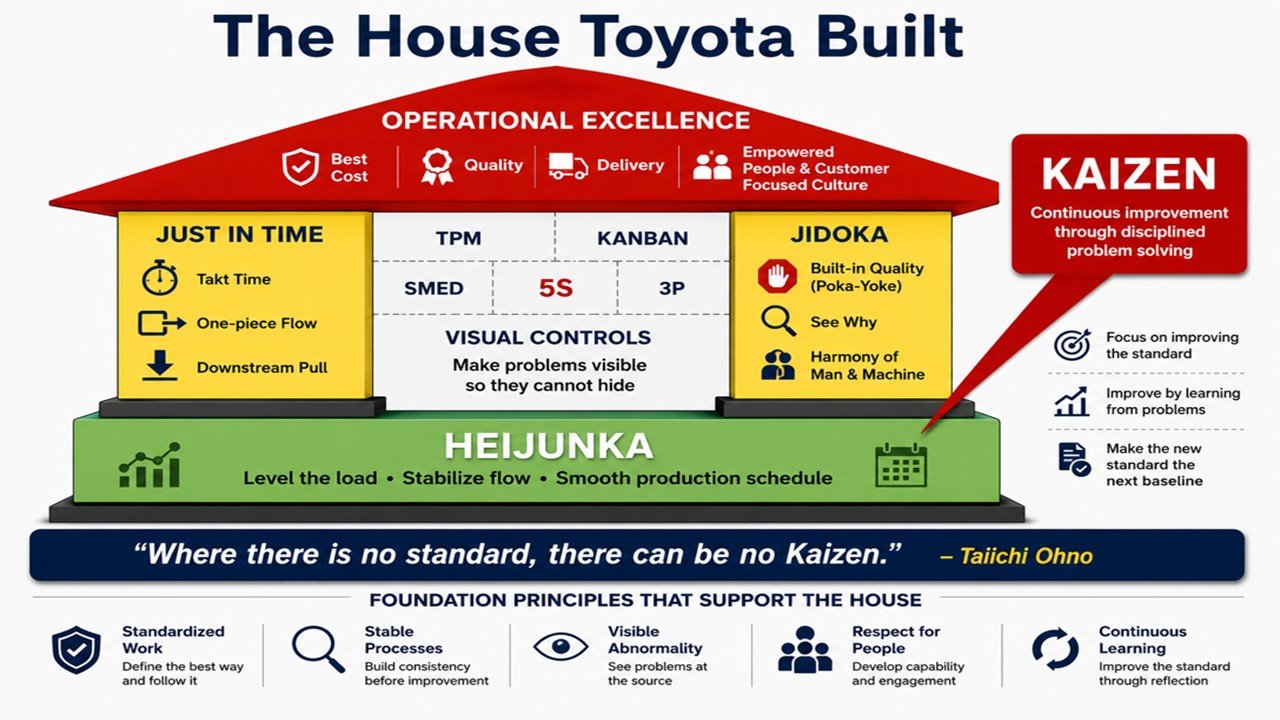
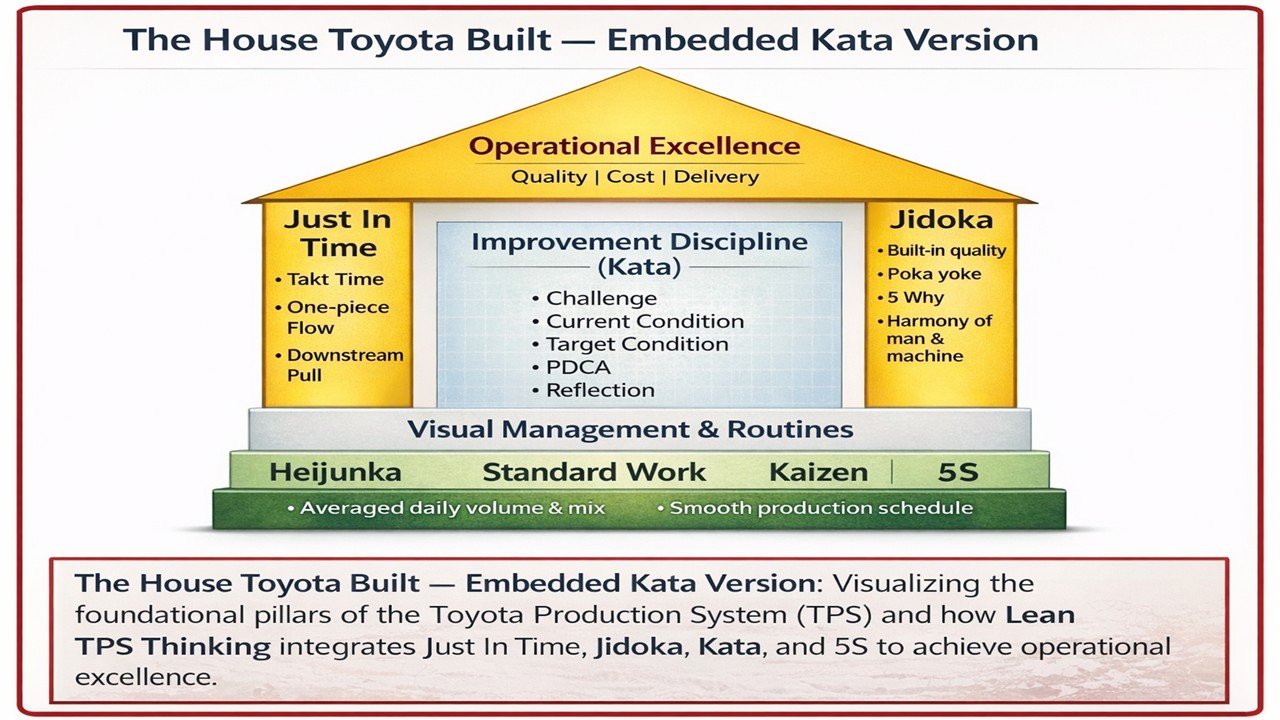
The diagram represents a layered governance architecture rather than a collection of tools. Lean TPS forms the structural boundary of the system. Governance defines operating conditions, protects Quality, and enforces leadership obligation. Standardized Work specifies normal condition. Jidoka establishes binary abnormality and stop authority. Just-In-Time stabilizes pace through Takt and leveling. Leader Standard Work institutionalizes review cadence. Learning becomes structural only when validated improvement results in revision of standards.
The Kata cycle is positioned inside this architecture. Placement is deliberate. Kata does not replace foundational pillars or redefine normal. It operates within established operating limits and derives direction from governance signals.
Target Conditions originate from system indicators such as repeated abnormality, instability in Takt performance, imbalance in leveling, detection failures, or erosion of risk containment layers. Governance defines the field of concern. The Kata loop structures disciplined experimentation within that field.
The circular loop represents adaptive movement through prediction, experimentation, and reflection. The architectural boundary represents non-negotiable control. Experiments must respect Jidoka protection, leveling discipline, and escalation logic. Validated learning results in revision of Standardized Work and reinforcement of review cadence.
Governance without disciplined experimentation produces stagnation. Disciplined experimentation without governance produces drift. Sustainable improvement requires sequence. Governance defines integrity. Disciplined experimentation advances capability within established limits. Standards institutionalize validated learning.
Quality remains the governing condition. Sustainable impact occurs when adaptive movement operates inside governance architecture.
9. Closing Position: Toyota, Quality, and Sustained Improvement
The Toyota Production System was not constructed as a collection of techniques layered onto operations. It was developed as a governed operating architecture designed to protect Quality, stabilize flow, and develop people through disciplined engagement with defined conditions. Governance precedes routine. Structure precedes activity.
Quality within Lean TPS is not a downstream metric. Quality is a governing condition that determines whether work may proceed. Abnormality requires response. Work does not continue under defect conditions. Escalation follows defined pathways. Standards are revised when learning is validated. Leadership obligation is embedded within daily cadence and documented responsibility.
Improvement within this architecture is inseparable from governance. Structured experimentation contributes value only when it operates inside defined operating boundaries. Kata (post-2009), understood as behavioral discipline, strengthens adaptive thinking, reduces solution jumping, and reinforces prediction followed by evidence-based reflection. These capabilities enhance navigation under uncertainty.
Sustained system performance does not emerge from behavioral discipline alone. Undefined operating boundaries produce localized and personality-driven improvement. Absence of disciplined experimentation produces rigidity and slow adaptation. Stability and adaptability must operate together under structured sequence.
Lean TPS governance defines the operating environment and institutionalizes learning through revision of Standardized Work and enforced leadership cadence. Kata strengthens disciplined movement when embedded within that architecture. Target Conditions derive from governance signals. Experiments respect Jidoka protection, Takt alignment, and leveling discipline. Validated learning updates standards and review structures.
Quality remains the governing condition. Sustained improvement requires architecture before routine. When disciplined experimentation operates within Lean TPS governance, capability transfer becomes systemic rather than situational. Long-term performance depends on integration of governance architecture and structured behavioral discipline.
10. Strategic Implications for Leaders
Leaders seeking sustained improvement must distinguish clearly between behavioral routines and governance architecture. Structured experimentation and coaching practices can enhance capability, but they do not replace the need for a defined operating system. Confusion between these layers produces fragmented effort and inconsistent results.
Introducing disciplined experimentation without first defining operating boundaries produces localized learning that may not transfer across roles or time. Establishing governance architecture without structured experimentation produces controlled stagnation and slow adaptation. The sequence is structural and non-negotiable.
The first responsibility is to define the operating system. Normal condition must be specified through Standardized Work. Abnormality must be binary and enforced through Jidoka logic. Escalation pathways must be clear and mandatory. Review cadence must be institutionalized through Leader Standard Work. Quality must be protected through non-negotiable stop authority rather than discretionary judgment.
The second responsibility is to embed disciplined experimentation within those defined boundaries. Target Conditions must originate from governance signals such as instability, repeated abnormality, or strategic deployment objectives. Experiments must respect Jidoka constraints, Takt alignment, and leveling discipline. Learning must result in revision of Standardized Work and reinforcement of leadership review routines.
The third responsibility is to align coaching with governance architecture. Coaching is not general encouragement or informal mentoring. Structured questioning must reference defined operating conditions and escalation rules. Capability development must strengthen the system rather than bypass it.
The fourth responsibility is to institutionalize learning. Improvement is incomplete until Standardized Work is revised, training materials are updated, and Leader Standard Work reflects the new normal. Without institutionalization, gains decay and variation returns.
The implication is structural rather than tactical. Quality-driven systems require architecture first and disciplined movement second. Behavioral routines such as Kata can accelerate learning and strengthen adaptive capability, but only when anchored inside governance that defines and protects system integrity. Sustained performance emerges from disciplined behavior operating within a defined operating system. Quality remains the governing condition.
Continuity With the Earlier Articles in This Series
This article extends a consistent structural examination developed across LeanTPS.ca: how governance was progressively separated from system behavior as the Toyota Production System was translated into portable improvement routines.
Earlier articles analyzed this separation at distinct enterprise layers.
Six Sigma (post-1990s) and Lean Six Sigma (post-2010s): How Quality Governance Was Replaced
https://leantps.ca/six-sigma-lean-six-sigma-quality-governance/
Examines how certification systems, project structures, and belt hierarchies displaced direct leadership ownership of Quality, producing technical capability without durable operating control.
Kaizen (post-1980s): How Governance Was Removed from the Toyota Production System
https://leantps.ca/kaizen-post-1980s-how-governance-was-removed-from-the-toyota-production-system/
Traces how Kaizen became portable by detaching from Jishuken, escalation discipline, and leadership obligation, allowing improvement activity to persist while governance eroded.
Jishuken: Leadership Governance Through Direct System Engagement
https://leantps.ca/jishuken/
Examines how Toyota preserved Quality by requiring leaders to engage directly in system diagnosis, escalation, and correction, and how removal of this obligation disconnects improvement from responsibility.
Why Dashboards and Scorecards Cannot Replace Andon in Lean TPS
https://leantps.ca/why-dashboards-and-scorecards-cannot-replace-andon-in-lean-tps/
Analyzes governance failure at the operational layer. When visibility tools replace stop authority and structured escalation, Quality becomes informational rather than controlled.
Lean TPS Disruptive SWOT: Governing Strategic Direction Through Quality and Leadership Obligation
https://leantps.ca/lean-tps-disruptive-swot/
Examines governance at the strategic layer. When direction is not anchored to explicit operating conditions, ownership, cadence, and defined response, persuasion substitutes for leadership obligation.
Governance Sequencing in Digital Operations Architecture
https://leantps.ca/governance-sequencing-digital-operations-architecture/
Examines how digital systems increase computational precision while leaving authority location undefined, producing optimization without boundary control.
Across these analyses, a single structural failure pattern appears. Governance is replaced by visibility, certification, routine, or computational sophistication. Activity increases while control weakens. Lean TPS restores Quality by governing operating conditions before work proceeds, not by reporting outcomes after deviation has already occurred.
Kata (post-2009) extends this examination to behavioral discipline. The question is not whether structured experimentation improves thinking. The question concerns whether routine can substitute for architecture. Lean TPS answers clearly. Governance defines the boundary. Discipline operates within it. Quality remains the governing condition.