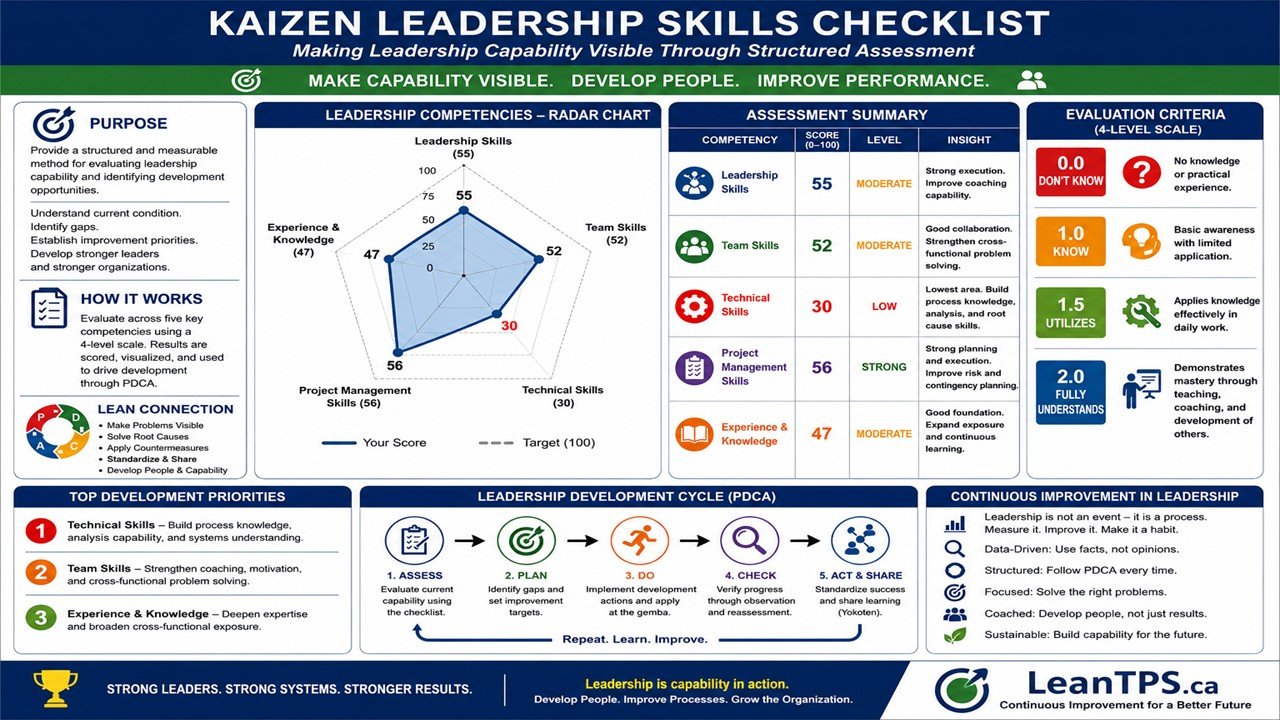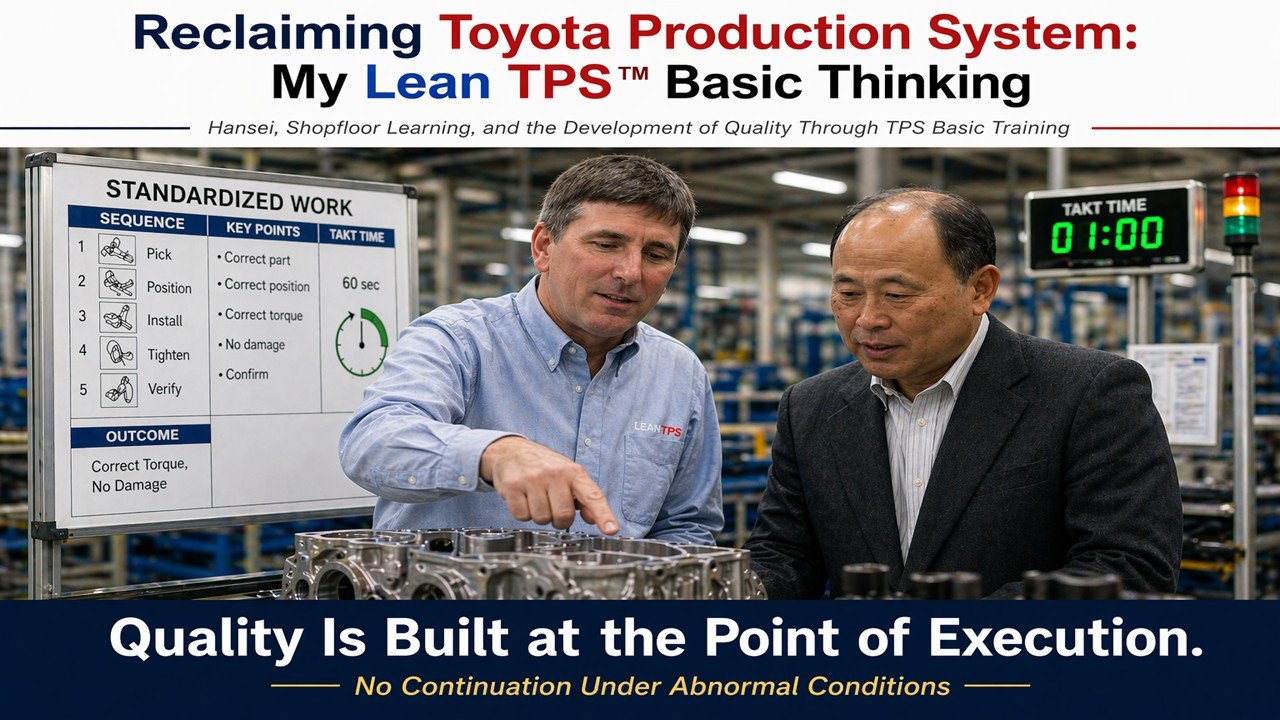
TPS Basic Thinking establishes the conditions required to build Quality through governed execution, structured training, and disciplined response.
Lean TPS Basic Thinking defines how Quality is built through governed execution. It is not a description of tools or principles. It is a structured approach to establishing the conditions under which work must be performed so that variation is prevented and abnormality is exposed.
Hansei is the starting condition. It is not reflection as a periodic activity. It is a disciplined method to examine actual conditions, identify gaps between expected and actual performance, and reset the system to reality. Hansei prevents drift by forcing alignment between what is defined and what is occurring. Without this condition, improvement is based on assumption rather than fact.
Learning occurs at the shop floor. Capability is developed through direct observation and execution, not through classroom explanation. Work is studied at the point of occurrence, where conditions can be defined, abnormality can be seen, and response can be required. This establishes a direct connection between learning and system behavior.
TPS Basic Training is structured to build this capability. It does not explain concepts. It establishes the conditions required to execute work with stability, expose abnormality, and respond in a way that protects Quality. Just In Time, Jidoka, and Standardized Work are applied as an integrated system that governs how work is performed, how flow is controlled, and how deviation is handled.
Quality is not inspected into the process. It is determined by the conditions under which execution occurs. When those conditions are defined and enforced, variation is prevented at its source and work proceeds within controlled limits. When those conditions are absent, variation enters during execution and must be managed after the fact.
TPS Basic Thinking begins by establishing these conditions and enforcing them at the point of work.
Hansei: The Starting Condition for Learning
Lorem ipsum dolor sit amet,
Hansei is not reflection as a concept. It is a disciplined method to examine actual conditions, confront gaps, and restore alignment between execution and expected performance.
Hansei begins when results are compared to the defined condition of work. The purpose is not to explain outcomes. The purpose is to identify where execution deviated from the required condition and why that deviation was allowed to occur. This requires direct observation of the process, not interpretation through reports or summary data.
The mechanism of Hansei is reset. It interrupts assumptions, exposes drift, and forces a return to actual conditions. When drift is not confronted, it becomes normalized. Work continues under variation, and the system adapts to instability rather than correcting it. Hansei prevents this by making deviation visible and requiring that it be addressed.
This process is not optional. Without Hansei, there is no reference point for learning. Each cycle of work moves further from the intended condition, and variation becomes embedded in execution. Correction becomes reactive, and improvement is based on unstable conditions.
Hansei establishes the starting condition for learning by reconnecting execution to reality. It defines the gap between what is occurring and what is required, and it creates the basis for corrective action.
Quality depends on this condition. If execution is not examined against defined standards, defects are treated as outcomes rather than signals of system failure. Hansei shifts the focus from results to conditions, ensuring that Quality is addressed at the source of execution rather than after the fact.
Shopfloor Learning and the Development of Capability
Capability is developed at the point of execution. It is not built through classroom instruction or conceptual explanation. It is built by working within the process, under actual conditions, where performance must meet defined requirements.
Learning occurs where work is performed. The process provides the reference. Standardized Work defines the expected method, sequence, timing, and outcome. Deviation from that condition becomes visible only when work is executed in real time. This creates the basis for understanding. Without this reference, learning is disconnected from execution and cannot be validated.
Classroom training separates learning from the conditions that determine performance. It explains concepts without exposing the constraints that govern behavior. As a result, knowledge does not translate into capability. Work is performed based on interpretation rather than defined conditions, and variation persists.
Shopfloor learning removes this separation. It places the individual within the process, where real demand, real constraints, and real consequences are present. Problems are not simulated. They occur as part of execution. This forces engagement with actual conditions and requires response within the system.
The condition for learning is direct exposure to the process under pressure. Real work, real pace, and real problems create the environment where deviation can be seen, understood, and addressed. This is where capability is formed.
Quality depends on this method. When learning is grounded in execution, the relationship between condition and outcome becomes clear. Defects are traced to the conditions that produced them, and correction is applied at the source. Capability is not defined by knowledge of concepts. It is defined by the ability to execute work within controlled conditions and respond when those conditions are not met.
TPS Basic Training: Building Execution Capability
TPS Basic Training is not designed to explain concepts. It is designed to build the capability to execute work under defined and controlled conditions.
The purpose of training is to establish how work must be performed, how abnormality is identified, and how response is triggered. Knowledge is not the objective. Controlled execution is the objective.
The training is structured around three integrated pillars: Just In Time, Jidoka, and Standardized Work. These are not independent topics. They operate together as a single system that defines, controls, and protects execution.
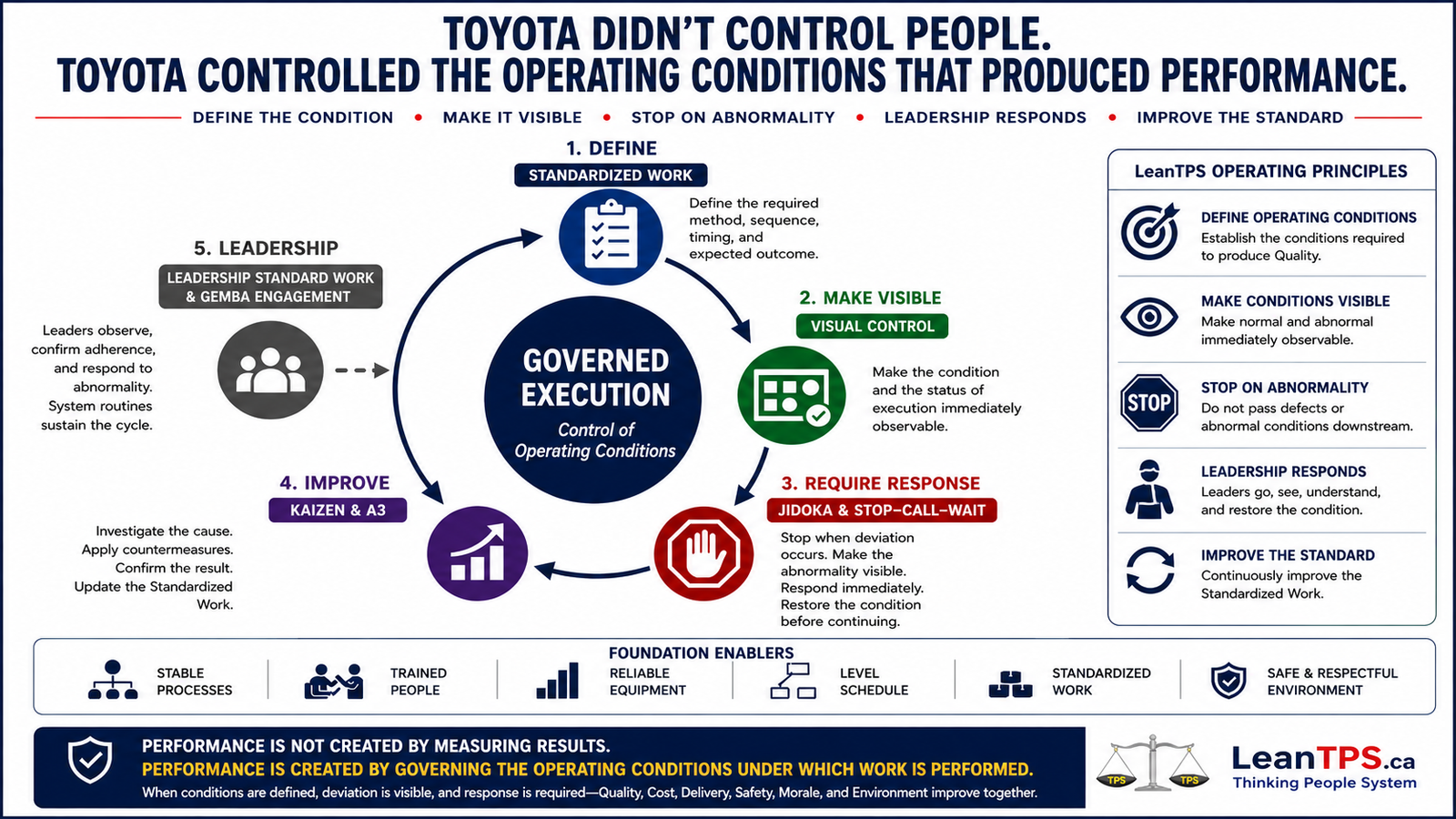
Standardized Work establishes the normal condition. It defines the method, sequence, timing, and expected outcome. Without this condition, there is no reference for execution and no basis for identifying abnormality.
Jidoka enforces interruption. When execution deviates from the defined condition, work must stop. This prevents continuation under abnormal conditions and forces immediate recognition of the problem.
Just In Time establishes flow as a controlled condition. Work proceeds only in alignment with demand, making disruption visible and preventing overproduction from masking instability.
Training is built on the interaction of these three mechanisms. Execution is defined, interruption is enforced, and flow is controlled. Together, they create the conditions required to protect Quality at the point of work.
This is not tool training. It is system training. Capability is developed by learning how to operate within these conditions, recognize when they break down, and respond in a way that restores control.
Training Design: Learning Through Application
Training is designed for application at the point of work. It does not separate learning from execution. It uses the process itself as the environment for developing capability.
Visual controls establish the immediate condition of the process. They define what is normal and make deviation visible without interpretation. When conditions change, the change is seen at once.
Work sequence defines how the task must be performed. It establishes the correct order of operations and removes variation in execution. Deviation from sequence exposes instability in the process.
Takt alignment connects work to demand. It defines the required pace and reveals imbalance when work cannot be completed within that condition. This makes disruption visible in real time.
Stop conditions enforce response. When the defined condition is violated, work does not continue. Interruption creates the requirement to identify the cause and restore the correct condition before proceeding.
The mechanism is learning through doing. Individuals operate within defined conditions, encounter real problems, and respond within the system. Understanding is developed through direct interaction with the process, not through explanation.
Quality is established through this structure. When learning occurs under controlled conditions, the relationship between execution and outcome becomes clear. Capability is built by performing work correctly, recognizing abnormality, and restoring the condition before continuation.
Nomura Validation: Standard of Evaluation
Mr. Sadao Nomura, Senior Advisor at Toyota Industries Corporation, reviewed the TPS Basic Training directly at the point of application. His evaluation was not based on presentation or explanation. It was based on whether the system could function under real conditions.
His criteria were explicit.
Stability. The process had to operate within defined conditions without relying on adjustment or interpretation. Execution had to be repeatable and controlled.
Abnormality exposure. Deviation from the defined condition had to be visible at the moment it occurred. Problems could not be hidden within the process or discovered after the fact.
Response discipline. When abnormality occurred, the system had to trigger immediate response. Interruption was required. Leadership action was not optional.
This evaluation was not recognition. It was system validation. The question was not whether the training explained TPS correctly. The question was whether the system produced stable execution, exposed abnormality, and enforced response in a way that protected Quality.
This standard established the reference point. If these conditions were not present, the system was not functioning as the Toyota Production System, regardless of the tools or language being used.
The Shift to Shopfloor-Based Observation
Improvement begins with direct observation at the point of execution. Muda is identified at its source, not through reports or summarized data.
Report-based analysis separates the observer from the process. It presents results after conditions have already changed and removes the context in which variation occurs. This delays recognition of problems and shifts focus to outcomes rather than causes.
Shopfloor observation restores the connection to actual conditions. Work is studied as it is performed, under real demand and real constraints. Deviation from Standardized Work becomes visible in sequence, timing, and flow. Problems are seen where they occur, not inferred after the fact.
This is a requirement, not a preference. Without direct observation, there is no accurate understanding of the process. Decisions are made on incomplete information, and countermeasures address symptoms rather than the conditions that produce them.
Quality depends on this shift. When muda is identified at the source, correction can be applied at the point of occurrence. The system is adjusted based on actual conditions, and learning is grounded in reality rather than interpretation.
Defining the Normal Condition
The normal condition defines how work must be performed. It is not a guideline. It is the required state of execution.
Standardized Work establishes this condition. It specifies the method, sequence, timing, and expected outcome. It creates a single reference for execution so that any deviation can be identified immediately. Without this definition, there is no basis for control.
Takt establishes the governing pace. It aligns work to demand and defines the allowable time for each cycle. When work cannot be completed within takt, the condition is broken. This exposes imbalance and makes disruption visible.
The normal condition must be enforced. When execution deviates from Standardized Work or falls outside takt, work cannot continue. Interruption is required. This prevents variation from moving forward and forces the system to respond at the point of occurrence.
Quality depends on this structure. When the normal condition is defined and enforced, deviation is contained immediately. When it is not, variation enters execution, propagates through the system, and is addressed only after it has already affected output.
Leadership Role in System Function
The role of leadership in the Toyota Production System is to enforce the conditions required for execution. It is not to facilitate activity or promote improvement. It is to ensure that the system operates within defined conditions and responds immediately when those conditions are violated.
In roles such as TPS Coordinator, Kaizen Manager, and Jishuken Core Member, the responsibility was not to introduce tools or run events. The responsibility was to establish Standardized Work, confirm adherence to takt, and ensure that abnormality triggered interruption and response. Leadership functioned within the system, not outside it.
Leadership operates as the response mechanism. When deviation occurs, the system requires action. Work must stop, the condition must be examined, and the cause must be addressed before continuation. This response is not discretionary. It is a required part of system operation.
When leadership does not act, the system does not hold its condition. Work continues under variation, and problems are carried forward. Improvement becomes reactive, and stability depends on individual effort rather than system control.
Quality is protected through this role. Leadership ensures that conditions are maintained, deviation is addressed at the point of occurrence, and the system is restored before work continues.
Toyota Mentorship: System-Level Discipline
Guidance from Sadao Nomura, Seiji Sakata, and Susumu Toyoda established the operating standard. The focus was not on concepts or tools. It was on whether the system functioned under real conditions.
Their evaluation centered on four conditions.
Conditions. Work had to be defined through Standardized Work so that normal and abnormal could be clearly distinguished.
Flow. Execution had to align with demand through takt and pull, exposing disruption when conditions broke down.
Stability. The process had to operate without reliance on adjustment or interpretation. Variation had to be removed, not managed.
Immediate response. Abnormality had to trigger interruption and action at the point of occurrence. Delay was not acceptable.
Questions were used as a control mechanism. Where is the abnormality. What is the normal condition. Why is the process allowing this condition to continue. What is the required response.
These questions removed ambiguity. They forced direct examination of the process and required that every answer be tied to system conditions. If the process allowed defects, delay, or variation to pass forward, the conclusion was direct. The system was not designed correctly.
This discipline established the standard. Execution had to be defined, abnormality had to be visible, and response had to be immediate. Quality depended on meeting these conditions.
Jidoka: Control Through Interruption
Jidoka is not automation. It is a control condition that enforces interruption when execution deviates from the defined state.
The process must stop when abnormality occurs. This is not a signal to investigate later. It is a requirement to prevent continuation under conditions that cannot produce Quality. Without interruption, defects are allowed to move forward and become embedded in the system.
Jidoka establishes the stop condition. When Standardized Work is not met, when takt is broken, or when an abnormal state is detected, work cannot continue. The system forces recognition of the problem at the point of occurrence.
This creates a requirement for leadership response. Action must be immediate. The cause of the abnormality must be identified, and the correct condition must be restored before work proceeds. This response is not optional. It is part of system operation.
Quality is built at the point of interruption. Each stop contains the defect, prevents propagation, and creates the opportunity to correct the underlying condition. The system is strengthened through response, and recurrence is prevented by adjusting the conditions of execution.
Jidoka ensures that execution cannot continue outside defined conditions. It converts abnormality into action and establishes control at the point of work.
Just In Time: Flow as a Condition
Just In Time is not a scheduling method. It is a condition that governs how work flows through the system.
Flow is defined by takt and controlled through pull. Takt establishes the required pace based on demand. Pull ensures that work is produced only when it is needed and in the quantity required. Together, they define when work should occur and prevent overproduction from masking instability.
When flow is aligned to these conditions, problems become visible. Delays, imbalance, and variation cannot be hidden because work is directly connected to demand. Any disruption to flow exposes a breakdown in the system.
When flow is not defined or controlled, instability is concealed. Excess inventory, early production, and local adjustments allow work to continue while problems accumulate. The system appears to function, but variation is embedded within it.
Just In Time creates visibility. It exposes whether the process can meet demand under defined conditions. When it cannot, the gap is immediately apparent.
Quality depends on this condition. When flow is correct, abnormality is visible and can be addressed at the point of occurrence. When flow is not controlled, problems are hidden, and correction is delayed. Just In Time ensures that execution reveals the true condition of the system.
Standardized Work: Foundation of Control
Standardized Work defines the normal condition of execution. It establishes the required method, sequence, timing, and expected outcome for each activity. It is not documentation. It is the condition under which work must be performed.
This definition creates a single reference for execution. When work follows this condition, performance is predictable. When it does not, the deviation is immediately visible. Without this reference, there is no way to distinguish normal from abnormal, and variation becomes embedded in the process.
Standardized Work enables abnormality detection. Any change in sequence, timing, or method signals that the condition has been broken. This makes deviation observable at the point of occurrence rather than after results are produced.
Detection alone is not sufficient. Standardized Work also enables response. When the condition is violated, interruption is required, and corrective action must be taken to restore the defined state before work continues.
Quality depends on this structure. When the normal condition is defined and enforced, defects are prevented at the source. When it is not, variation enters execution and is addressed only after it has already affected output.
Heijunka: Stability as a Requirement
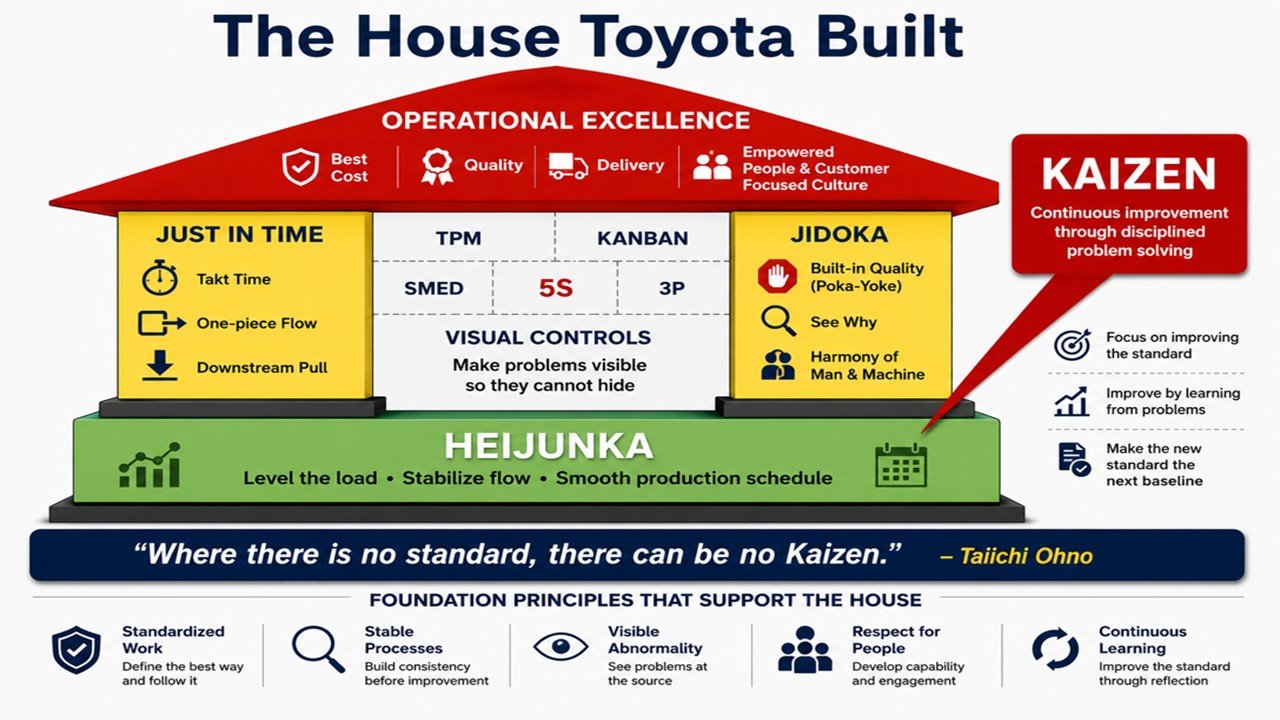
Heijunka establishes stability as a required condition of the system. It controls variation by leveling workload and production mix so that execution can occur within defined limits.
Variation disrupts flow. When demand is uneven, work becomes unbalanced, overburden increases, and delays propagate through the system. Local adjustments are introduced to maintain output, and variation becomes embedded in execution.
Heijunka prevents this condition. It distributes demand evenly over time and across the process, aligning workload to available capacity. This creates a consistent operating pattern where deviations are visible and manageable.
Load leveling enables control. When work is balanced, Standardized Work can be maintained, takt can be achieved, and abnormality can be identified immediately. Without leveling, instability is introduced at the system level, and downstream control becomes ineffective.
Quality depends on stability. When variation is controlled, problems can be detected and addressed at the point of occurrence. When variation is not controlled, disruption spreads, and defects are managed after the fact. Heijunka ensures that the system operates within conditions that allow control to be maintained.
Jishuken: Structural Correction
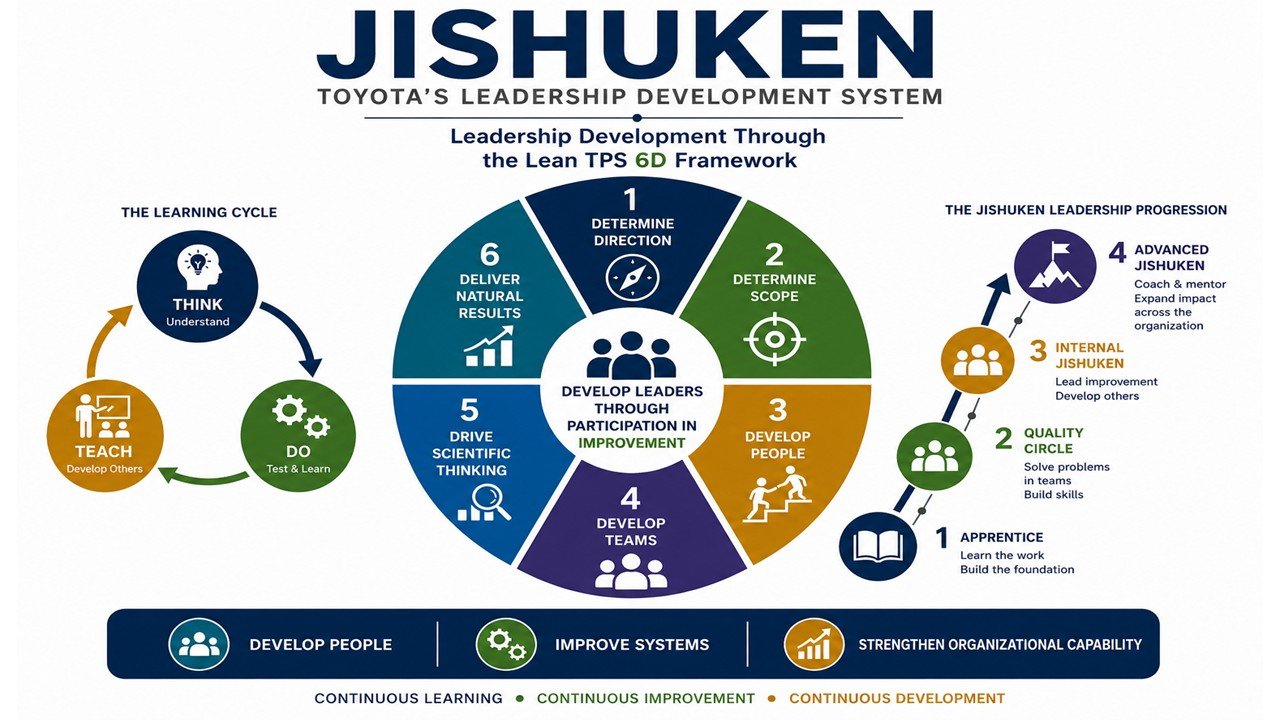
Jishuken is not an event. It is not improvement activity. It is a disciplined method for structural correction of the system.
The purpose is to redesign conditions based on direct observation of the process. Work is studied at the point of execution, and problems are traced to the conditions that allow them to occur. The objective is not to apply countermeasures to symptoms. The objective is to change the system so that the condition producing the problem no longer exists.
This requires clear definition of the normal condition. Standardized Work establishes the reference. Deviation from that condition exposes where the system is not functioning as required. Observation focuses on sequence, timing, flow, and response to abnormality.
Jishuken operates at the system level. It examines how processes interact, how flow is maintained, and how leadership responds when conditions break down. Changes are made to restore control, not to improve isolated outcomes.
The result is structural correction. Problems are eliminated by changing the conditions that produce them. Learning is embedded into Standardized Work, and the system is strengthened so that the same condition cannot recur.
Quality depends on this approach. When correction is structural, defects are prevented. When it is not, improvement becomes temporary, and variation returns.
Lean TPS Basic Thinking: System Integration
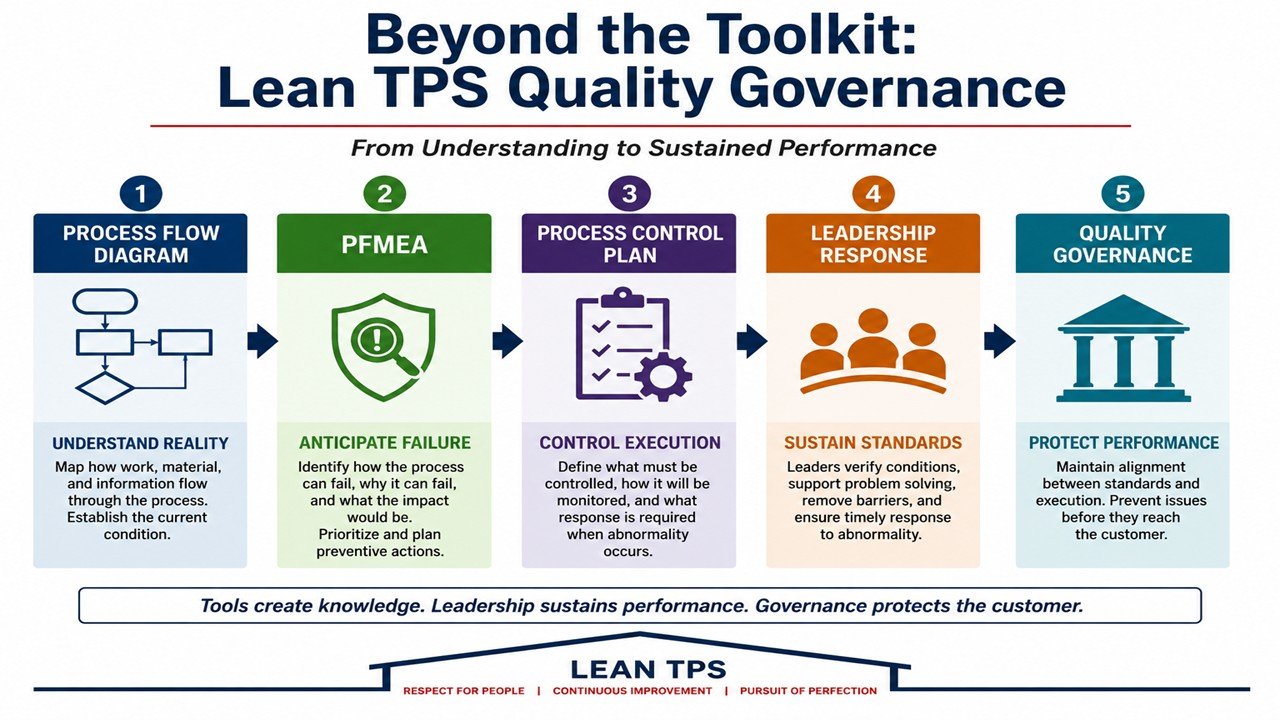
Lean TPS Basic Thinking is not a collection of tools. It is not a philosophy. It is a structured thinking system that governs how work is defined, executed, and corrected.
Each element operates as part of an integrated system. Standardized Work defines the condition of execution. Jidoka enforces interruption when that condition is violated. Just In Time controls flow and exposes disruption. Heijunka stabilizes workload to maintain control. Jishuken corrects the system when conditions fail. These elements do not function independently. They operate together to define, enforce, and restore the conditions required for execution.
This integration removes interpretation. Work is not performed based on individual judgment or preference. It is performed within defined conditions that are visible, enforced, and confirmed through response. When those conditions break down, the system requires action.
The purpose of Lean TPS Basic Thinking is to establish this structure. It connects purpose, process, and people through defined conditions and required response. Learning is not separate from execution. It occurs within the system as conditions are applied, tested, and corrected.
Quality depends on this integration. When the system operates as a whole, execution is controlled and variation is prevented. When elements are separated or treated as tools, control is lost and performance depends on interpretation rather than system design.
Quality as a System Condition
Quality is defined by the conditions under which work is performed. It is not an outcome, and it is not established through measurement.
When execution occurs within defined conditions, results are predictable. Standardized Work specifies the method, sequence, timing, and expected outcome. Jidoka enforces interruption when those conditions are not met. This prevents defects from being produced and ensures that execution remains within control.
Measurement evaluates results after the fact. It can identify defects, but it cannot prevent the conditions that produce them. When Quality is treated as an outcome, attention shifts to detection and reporting rather than control. This introduces delay between defect creation and response, allowing variation to propagate through the system.
Quality must be established during execution. It depends on whether the defined conditions are maintained and whether deviation triggers immediate response. If work is allowed to continue outside those conditions, defects become unavoidable.
Quality is not achieved through inspection or performance tracking. It is achieved by controlling how work is performed. When conditions are defined and enforced, defects are prevented at the source. When they are not, Quality becomes dependent on detection and correction after the fact.
Leadership Obligation at Point of Occurrence
Leadership is obligated to respond at the point of occurrence. It is not a role that can be deferred, delegated, or performed after the fact. It is a required function of the system.
When abnormality occurs, the system demands action. Work must stop, the condition must be examined, and the cause must be addressed before continuation. This response is immediate. Delay allows variation to propagate and embeds instability in the process.
Leadership cannot defer this responsibility. Escalation does not replace response. Reporting does not restore the condition. The system depends on direct action where the problem occurs.
This obligation defines how the system operates. Standardized Work establishes the condition. Jidoka enforces interruption. Leadership restores the condition. Without this sequence, execution continues under variation and control is lost.
Quality depends on this response. When leadership acts at the point of occurrence, defects are contained and prevented from moving forward. When response is delayed, problems accumulate and correction becomes reactive.
The system functions only when leadership fulfills this obligation.
Continuous Improvement as System Requirement
Continuous improvement is not a project and not an initiative. It is a requirement of the system.
Improvement occurs within execution. It is triggered when the defined condition breaks and a response is required to restore control. Each interruption exposes a gap between the current state and the required condition. Correction closes that gap and updates the system so that the same condition does not recur.
This process is embedded in daily work. Standardized Work defines the condition. Jidoka enforces interruption. Leadership responds and restores the condition. The standard is then revised to reflect the improved state. Improvement is not scheduled or separate from execution. It is part of how the system operates.
When improvement is treated as a project, it is removed from execution. Work continues under variation while improvement activity occurs in parallel. This separates learning from the conditions that require it and delays correction.
Quality depends on improvement being embedded in execution. When each deviation triggers response and correction, the system strengthens continuously. When it does not, variation accumulates and performance depends on periodic intervention rather than controlled operation.
Closing Condition
Hansei is never complete. Each cycle of execution reveals new gaps between the defined condition and actual performance. These gaps require response. Without response, drift becomes embedded and the system degrades.
The system is strengthened through this sequence. Standardized Work defines the condition. Jidoka enforces interruption when that condition is violated. Leadership responds at the point of occurrence. The condition is restored, and the standard is revised to prevent recurrence.
This process is continuous. Learning is not separate from execution. It occurs as conditions are applied, tested, and corrected. Each response improves the system by eliminating the cause of deviation and reinforcing control.
Quality is sustained through governed execution. When conditions are defined and enforced, defects are prevented at the source. When they are not, variation enters the system and is managed after the fact.
The Toyota Production System is maintained through this discipline. Execution is controlled, abnormality is addressed immediately, and the system is strengthened through response.