How Knowledge Is Transferred and Capability Is Developed Through Jishuken and Direct Observation
Sensei role in Toyota Production System defines how capability is developed and sustained.
The Toyota Production System is sustained through capability, not knowledge.
It is often explained through tools, methods, and results. This does not explain how the system is learned or sustained. In TPS, knowledge is not transferred through instruction. It is developed through the role of the Sensei.
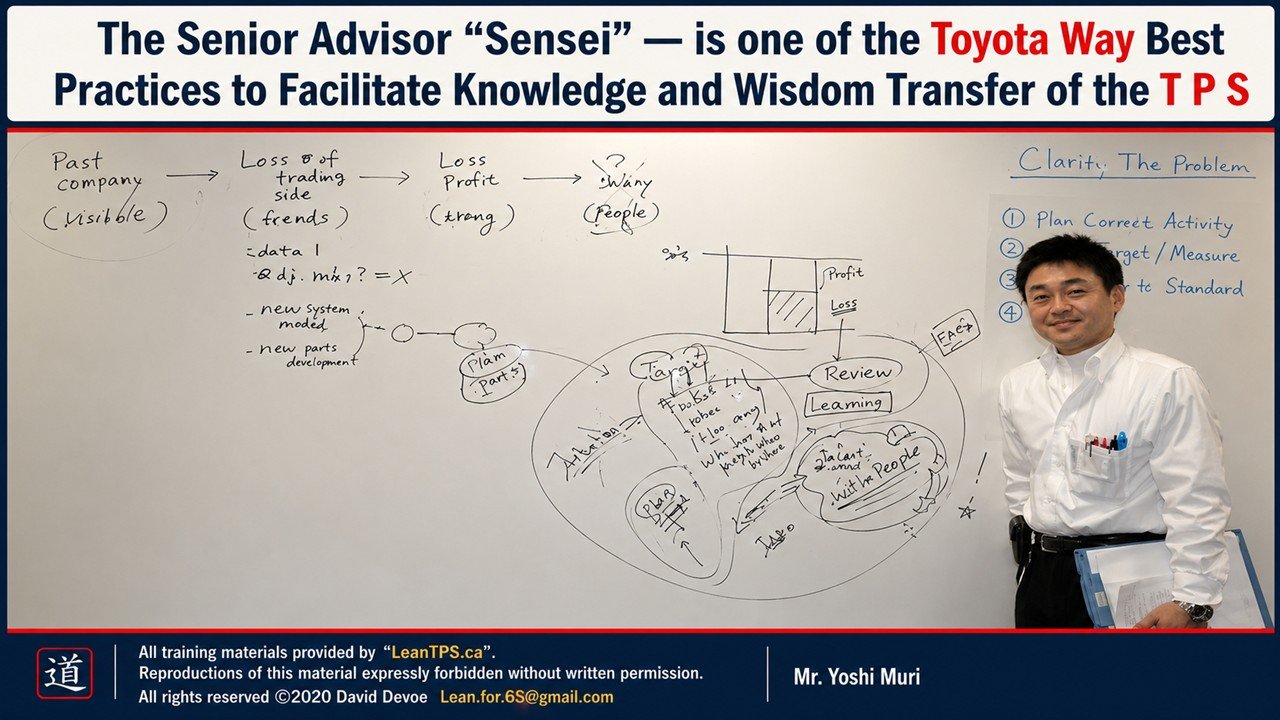
It is a privilege to share the influence of Mr. Yoshiyasu “Yoshi” Mori, one of my Toyota Production System Sensei. Yoshi led Jishuken activities at Toyota Material Handling Manufacturing North America and was recruited by Mr. Susumu “Sonny” Toyoda. His role was not to implement improvement activity or deliver solutions. His role was to develop people who could understand, sustain, and govern the system through their own capability.
This distinction defines the difference between TPS and most continuous improvement approaches.
In many systems, improvement is driven through analysis, solution development, and implementation. Performance may improve while intervention is active, but the capability to recognize abnormality and respond at the point of execution is not developed. When attention is removed, conditions drift and performance degrades.
Yoshi did not approach improvement as knowledge transfer or tool deployment. He approached it as capability development. Jishuken was not structured as a project. It was structured as a learning system in which work was observed directly, conditions were defined, gaps were exposed, and response was required. The objective was not to complete an improvement activity. The objective was to develop the ability to see and respond to abnormality in real time.
When Yoshi led a Jishuken, he did not begin with explanation. He began with questions. What is the expected condition. What is the actual condition. Where is the gap. These questions required direct observation at the Gemba and engagement with the work itself. The gap was not interpreted. It was seen. The objective was not to solve the problem for the team. The objective was to develop the team’s ability to see and solve it.
This defines the role of the Sensei. The Sensei does not fix problems. The Sensei establishes the conditions under which people learn to see them. By directing attention to the relationship between condition and outcome, the Sensei develops the capability required to maintain control of execution.
Working with Yoshi demonstrated that real TPS learning occurs through direct experience. Classroom explanation cannot replicate actual conditions. Data cannot substitute for observation. Standing at the Gemba, tracing flow, and repeatedly asking why converts knowledge into capability.
This is how knowledge is transferred in TPS. It is not transferred through explanation. It is developed through guided observation and required response at the point of execution.
Yoshi Mori’s influence continues to shape how Lean TPS is practiced and taught. Respect for people is demonstrated through the development of capability. Continuous improvement is sustained through the ability to see and respond. This remains the foundation for how Lean TPS is applied.
Jishuken as a System for Developing Capability
Jishuken establishes the structure under which capability is developed.
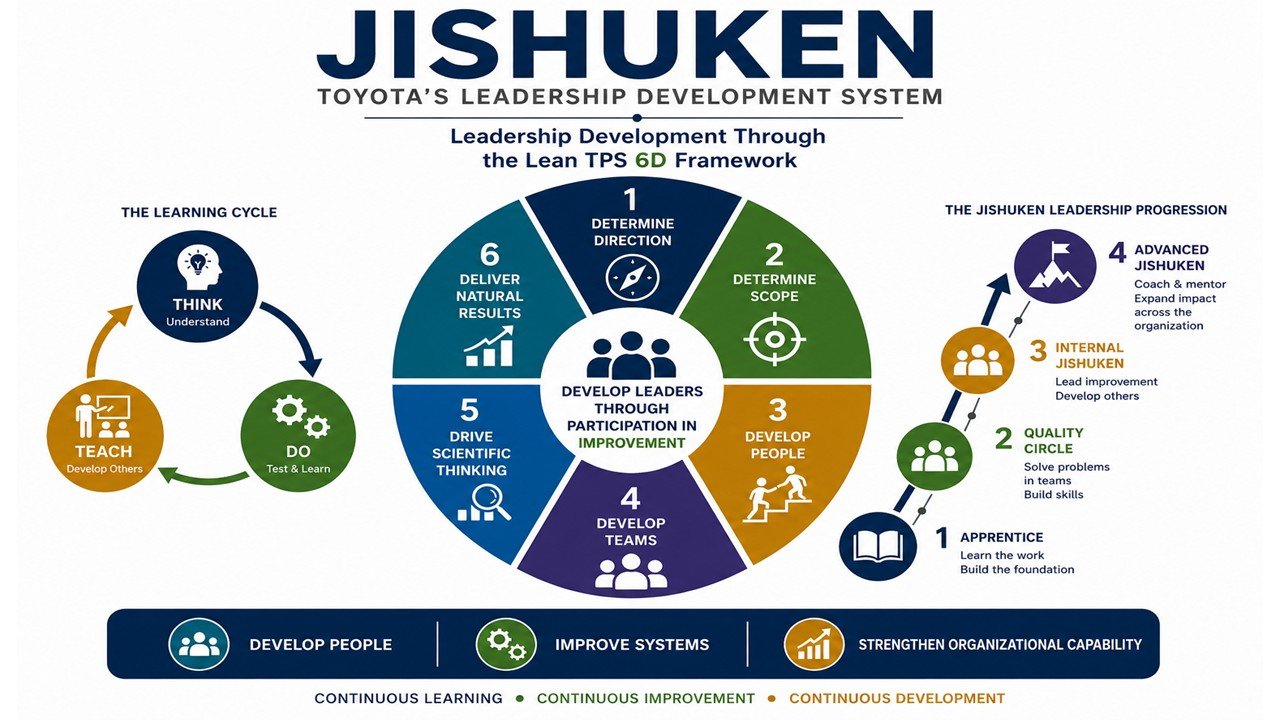
Jishuken is often translated as “self-study,” but within the Toyota Production System it operates under controlled conditions to develop capability at the point of execution. It is not an informal exercise and it is not a project methodology. Jishuken establishes a defined environment in which individuals are required to observe work directly, verify conditions, recognize abnormality, and respond in a disciplined manner. The purpose is not knowledge acquisition. The purpose is capability development at the point of execution.
Yoshi did not approach Jishuken as a project with deliverables, timelines, or outcomes measured by completed actions. He approached it as a learning system governed by condition. Work was not analyzed from a distance. It was observed directly at the Gemba where conditions could be verified. The expected condition was defined through Standardized Work. The actual condition was observed through direct engagement with the process. The gap between the two was made visible and could not be explained through interpretation or reporting.
This structure established a sequence that could not be bypassed. Observation verified the condition. The defined condition exposed the gap. The gap required response. Response was followed by reflection to confirm whether the condition had been restored and whether the understanding was correct. Each step was connected to execution. Learning was embedded in the work itself.
The role of the Sensei within Jishuken was to maintain this structure. Questions were used to direct attention to the condition of the work and to require evidence. What is the expected condition. What is the actual condition. Where is the gap. Why does the gap exist. These questions prevented assumption and forced observation. Individuals were required to see the condition rather than describe it. This is where capability begins to develop.
The objective of Jishuken was not to complete an improvement activity or implement a solution. It was to develop the ability within the team to recognize abnormality and respond correctly without external direction. Improvement was a byproduct of this process, not the primary aim.
This is the mechanism that builds capability. Repeated exposure to defined conditions, direct observation of actual execution, and required response to abnormality establish the ability to control work as it occurs. Over time, reliance on interpretation is reduced, response becomes consistent, and execution stabilizes.
Jishuken creates this capability by linking observation, recognition, and response into a single continuous process. Thinking and doing are not separated. Both occur together under defined conditions at the point of execution. This is why capability developed through Jishuken sustains. It is not based on retained knowledge. It is based on practiced response.
Within TPS, this defines the difference between understanding and control. Jishuken does not increase understanding alone. It develops the ability to act on that understanding in real time. That ability is what allows the system to sustain performance and protect Quality.
Seeing Before Solving
This discipline governs how problems are approached within that structure.
When Yoshi led a Jishuken, he did not begin with solutions. He began with questions that established the condition of the work and required direct observation.
What is the expected condition.
What is the actual condition.
Where is the gap.
These questions were not rhetorical. They required the individual to go to the Gemba, observe the work as it was performed, and verify conditions against Standardized Work. The expected condition was defined, the actual condition was observed, and the gap was identified in the work itself. It was not assumed, reported, or discussed in abstraction.
This sequence established a discipline. Seeing preceded solving. Without this discipline, any solution introduced would be based on interpretation rather than condition.
Yoshi used these questions to direct attention away from explanation and toward verification. Answers given without evidence were challenged. Conclusions drawn without direct observation were rejected. The objective was not to arrive at a quick answer. The objective was to develop the ability to recognize abnormality at the moment it occurs.
This exposes a structural weakness in most continuous improvement systems. Problems are identified through data, analysis, and reporting after performance has already been produced. The system then moves to solution development and implementation. Performance may improve temporarily, but the capability to see the problem at the point of occurrence is not developed.
When the ability to see is not established, detection is delayed and response becomes inconsistent. Solutions are applied to symptoms rather than conditions. The system becomes dependent on analysis to explain what has already happened instead of controlling what is happening.
Seeing at the point of execution connects understanding to control. When the expected condition is clearly defined and the actual condition is directly observed, abnormality becomes visible without interpretation. This visibility enables immediate response while the condition exists.
Without this capability, improvement cannot be sustained. Conditions drift, variation increases, and performance degrades once attention is removed. The system may continue to generate data and analysis, but it does not maintain control.
Yoshi’s method ensured that seeing was not optional. It was required. By establishing the discipline of seeing before solving, he developed the capability necessary to sustain improvement and protect Quality at the point of execution.
The Limitation of Knowledge Transfer
Most organizations attempt to improve performance by increasing knowledge. Training programs are expanded, tools are introduced, and methods are standardized. Participation increases and understanding improves across the organization.
Execution does not change.
The limitation is structural. Knowledge does not define how work must proceed at the point of execution. It informs decisions, but it does not constrain behavior. Individuals interpret what they have learned, decide when to apply it, and determine how to respond. This introduces variation in timing, consistency, and effectiveness.
As a result, the system becomes more capable of explaining performance than controlling it. Deviation is identified, analyzed, and discussed, but the conditions that allow deviation to continue are not governed. Detection occurs after the fact. Response becomes discretionary. Improvement depends on interpretation rather than defined action.
Yoshi did not focus on increasing knowledge. He focused on developing capability.
Capability is developed when individuals are required to observe conditions directly, identify abnormality at the moment it occurs, and respond immediately to restore the defined state. This requires structure, discipline, and repeated engagement with the work under conditions where deviation is visible and response is required.
This cannot be achieved through explanation. Classroom instruction can introduce concepts, but it cannot establish behavior. Behavior is established through practice under guidance at the point of execution, where conditions can be verified and response can be enforced.
Within Jishuken, knowledge is not treated as the objective. It is treated as input. The objective is the development of capability to act on that knowledge without delay or interpretation. This is achieved by linking observation, recognition, and response into a single continuous process.
When capability is developed in this way, execution becomes consistent because behavior is defined by condition rather than by choice. Variation is reduced because response is no longer dependent on individual judgment. Control is established because action is tied directly to the condition of the work.
Without this structure, knowledge remains separate from execution, and performance continues to vary.
This is the limitation of knowledge transfer. It increases understanding, but it does not create control.
The Role of the Sensei
The Sensei governs the process through which capability is developed within the Toyota Production System. This role is not defined by authority over results or ownership of improvement activity. It is defined by control over how learning occurs at the point of execution.
The Sensei does not solve problems.
The Sensei does not provide answers.
Intervention at that level prevents the development of capability within the team. If the Sensei resolves the problem, the condition may improve temporarily, but the system becomes dependent on external expertise. The objective of TPS is not dependence. The objective is internal capability to recognize abnormality and respond without delay.
The Sensei defines the conditions under which learning occurs.
At the Gemba, attention is directed to the work itself, not to explanations about the work. The expected condition is established through Standardized Work. The actual condition is verified through direct observation. The gap between the two is made visible and cannot be resolved through interpretation or discussion alone. It must be understood in the work.
Questions are used to govern this process. What is the expected condition. What is the actual condition. Where is the gap. Why does the gap exist. These questions require evidence. They require the individual to verify the condition rather than describe it. Responses based on assumption or incomplete observation are challenged until the condition is clearly established.
This structure cannot be bypassed. Observation establishes the condition. Recognition identifies abnormality. Response restores the defined state. Reflection confirms whether the condition has been restored and whether the understanding is correct. Each step is directly connected to execution.
Responsibility for seeing and acting remains with the people performing the work. The Sensei does not remove this responsibility. The Sensei enforces it. By maintaining this structure, learning is not abstract. It is tied directly to the conditions under which work is performed.
This establishes capability.
Repeated exposure to defined conditions, direct observation of actual execution, and required response to abnormality establish consistent behavior. Individuals no longer rely on interpretation to determine when to act. The condition defines the action. Variation is reduced and control is established at the point of execution.
Within TPS, this role is essential. Without the Sensei governing how learning occurs, improvement activity becomes disconnected from execution. Knowledge may increase, but capability does not develop. With the Sensei, learning remains structured, disciplined, and directly linked to the work, allowing capability to form and sustain.
This is how the Toyota Production System transfers knowledge and develops the people required to maintain it.
Learning at the Point of Execution
Yoshi demonstrated that real learning in the Toyota Production System occurs only at the point of execution. Learning is not separated from work. It is embedded within the conditions under which work is performed and controlled. This determines whether knowledge becomes actionable or remains abstract.
Classroom training cannot replicate the conditions of actual work. Training environments simplify variables, remove constraints, and present scenarios that do not reflect real execution. Individuals may understand concepts and methods, but they are not required to apply them under actual conditions where timing, variability, and consequence are present.
Data cannot substitute for observation. Data represents performance after it has occurred. It aggregates results and supports analysis, but it does not expose the condition of the work as it is being performed. By the time data is available, the opportunity to act at the point of occurrence has passed.
Analysis cannot replace direct engagement with the process. Analysis interprets results and proposes explanations, but it operates at a level removed from execution. Without direct observation, it is based on assumptions about how work is performed rather than verification of actual conditions.
At the Gemba, these limitations are removed.
At the point of execution, the expected condition is defined through Standardized Work and the actual condition is verified through observation. The gap between the two is visible without interpretation. Conditions are not assumed. They are confirmed. Abnormality is not explained. It is seen. Response is not delayed. It occurs while the condition exists.
This is where understanding becomes actionable.
When individuals repeatedly observe conditions, identify abnormality, and respond to restore the defined state, knowledge is applied rather than retained. The relationship between condition and outcome becomes clear because it is experienced directly.
Over time, this repeated practice establishes capability. Individuals develop the ability to recognize abnormality as it occurs and respond without hesitation. Reliance on interpretation is reduced and delay between detection and action is removed.
This is where capability is formed.
Within TPS, learning at the point of execution is required to establish control. Without it, knowledge remains separate from behavior and execution continues to vary. With it, behavior becomes consistent because it is governed by defined conditions and immediate response.
This is the foundation for sustaining performance and protecting Quality in the Toyota Production System.
Sustaining Improvement Through Capability
Improvement that depends on external direction will not sustain. When performance is maintained through oversight, escalation, or periodic intervention, the system becomes dependent on those mechanisms to function. Results may improve while attention is applied, but once that attention is removed, conditions drift and performance degrades. The underlying issue is not effort. It is the absence of capability at the point of execution.
Yoshi did not consider improvement complete unless the people responsible for the work could maintain the condition without intervention. Completion was not defined by the implementation of a change. It was defined by the ability of the team to recognize when conditions deviated and to restore the defined state immediately and consistently.
This requires more than knowledge. Individuals may understand the intended process and the rationale for change, but without the capability to observe actual conditions and respond in real time, that understanding does not translate into sustained performance. Variation re-enters through delayed detection, inconsistent response, and reliance on interpretation.
Within TPS, sustaining improvement depends on controlling execution as it occurs. The expected condition is defined through Standardized Work. The actual condition is verified through direct observation. Any deviation requires immediate response. The connection between condition, detection, and action is maintained without interruption.
When this capability is present, improvement is not dependent on external support. It is sustained by the people performing the work. Abnormality is recognized at the moment it occurs. Response is immediate and required. The condition is restored before work continues.
This is where TPS differs from most improvement systems. Many systems define improvement by changes implemented, metrics achieved, or solutions deployed. These measures reflect outcome, not control. They do not indicate whether the system can maintain those outcomes without continued intervention.
In TPS, improvement is defined by the capability developed. The question is not whether the process has been improved. The question is whether the people responsible for the process can maintain that condition under normal operating conditions without external direction.
When capability is developed in this way, performance stabilizes because behavior is governed by defined conditions and required response. When capability is absent, improvement remains temporary and the system returns to managing variation after it occurs.
Sustaining improvement through capability ensures that performance is not dependent on attention or intervention. It is maintained through structure, discipline, and the ability to act at the point of execution. This is the mechanism that protects Quality and allows the system to perform consistently over time.
Influence on Lean TPS Practice
The influence of Yoshi Mori continues to shape how Lean TPS is practiced. His approach did not position TPS as a collection of tools or a sequence of improvement activities. It established TPS as a system for developing people who can govern execution through defined conditions. This distinction determines whether performance is sustained or degrades once attention is removed.
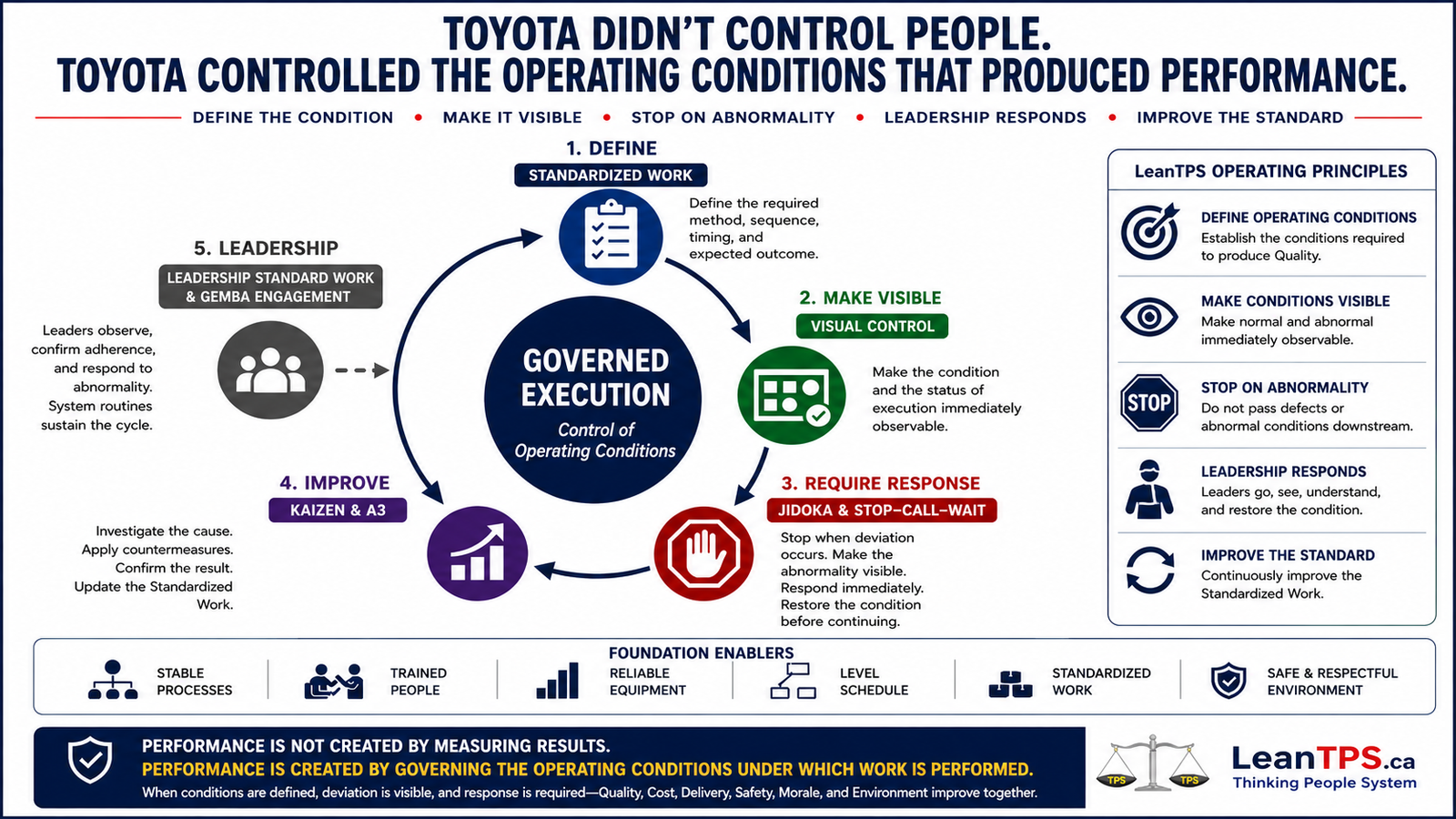
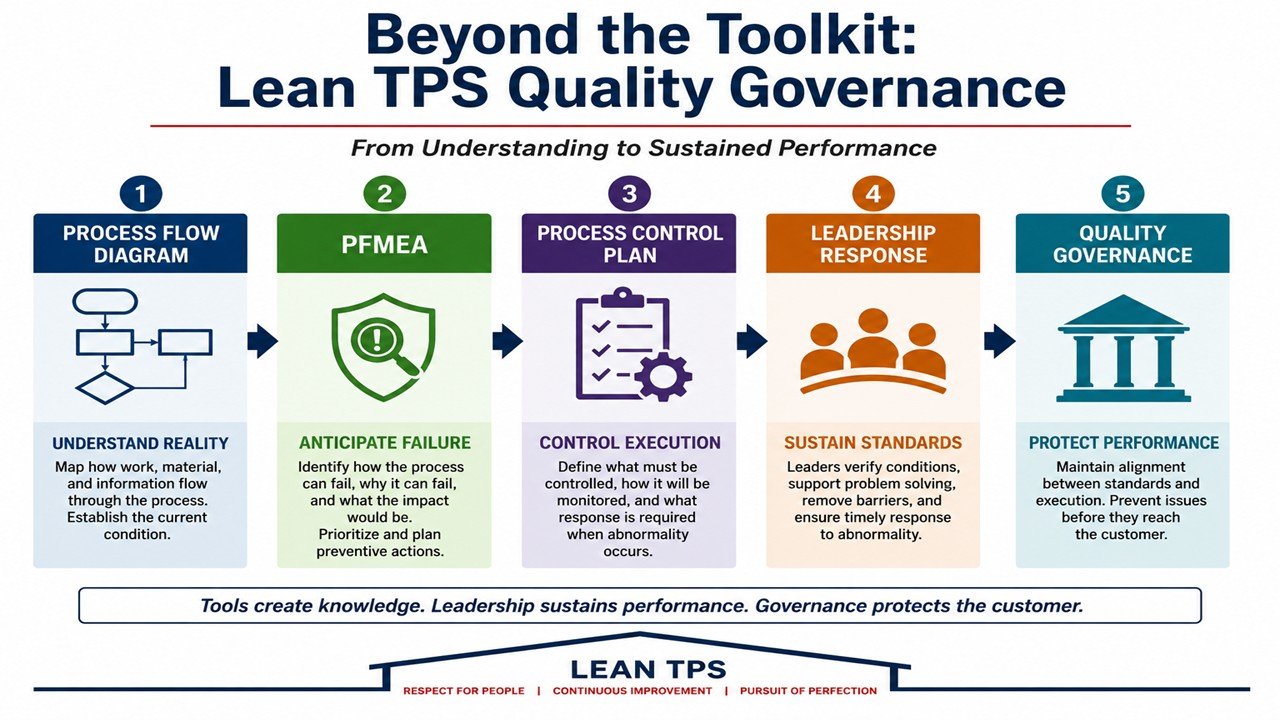
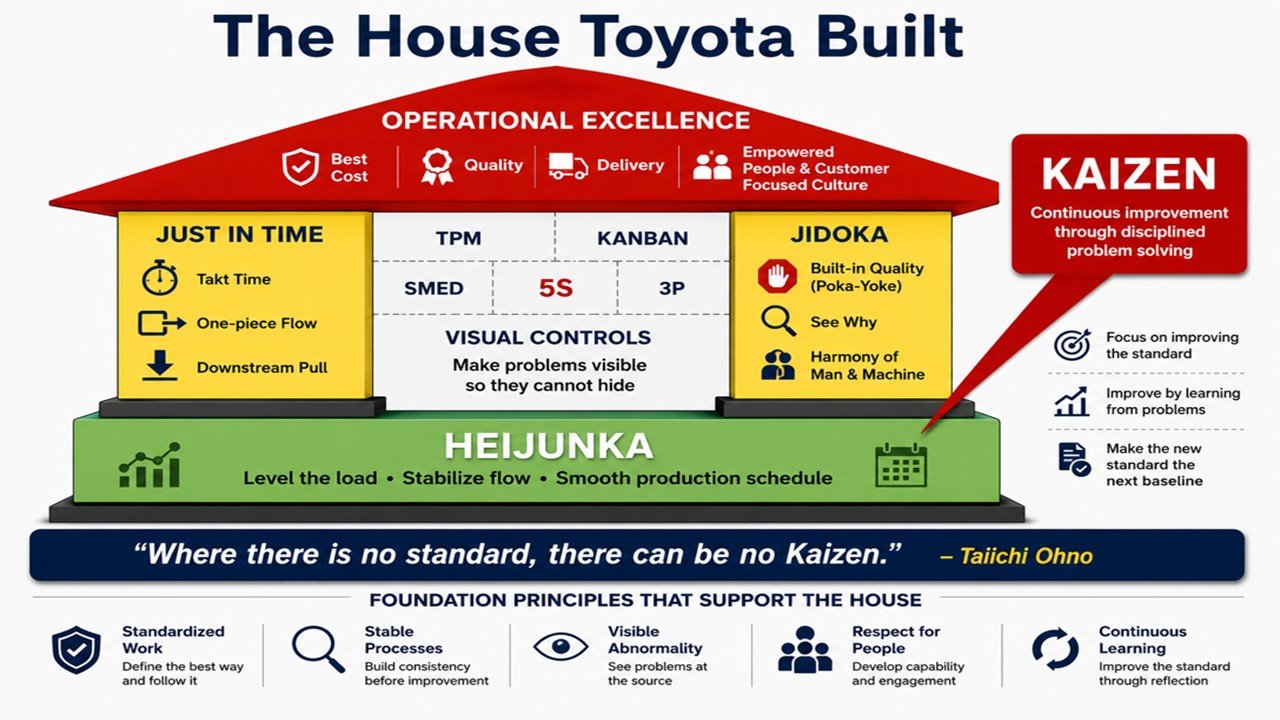
In practice, this shifts the focus from tool deployment to condition control. Standardized Work defines the expected condition of execution. Visual control makes that condition observable at the point of work. Jidoka enforces interruption when conditions are not met. These elements operate together to define, detect, and restore conditions in real time. Control is established during execution, not after performance is produced.
This approach defines how leadership operates within Lean TPS. Leaders are not responsible for reviewing results after the fact. They are responsible for ensuring that conditions are clearly defined, visible, and enforced as work is performed. Leader Standard Work requires direct engagement with the work, verification of conditions, and immediate response to abnormality. This is how control is maintained.
Respect for people is demonstrated through the development of capability. It is not expressed through communication or encouragement. It is demonstrated by establishing conditions that enable success, making abnormality visible, and requiring response in a way that develops consistent behavior. By developing the ability to see and act, the system reduces ambiguity and overburden and aligns execution to the defined condition.
Continuous improvement is sustained through the ability to see and respond at the point of execution. It does not rely on periodic initiatives, external expertise, or accumulated knowledge. It is maintained through the daily application of defined conditions, direct observation, and required response. As capability develops, reliance on interpretation decreases and execution becomes consistent.
Yoshi Mori’s influence reinforces that Lean TPS is not implemented. It is practiced. Practice requires discipline, repetition, and adherence to defined conditions. It requires leaders and teams to engage directly with the work and to respond when those conditions are not met. This is how improvement is sustained and how Quality is protected.
This understanding continues to guide how Lean TPS is taught, coached, and applied. The objective is not to introduce tools or improve metrics. The objective is to develop the capability within the organization to govern execution and sustain performance through defined conditions and immediate response.
Closing
The role of the Sensei defines how the Toyota Production System is learned and sustained. It establishes the conditions under which knowledge is converted into capability and ensures that learning is directly connected to execution.
Without this role, TPS is reduced to tools, methods, and outcomes that cannot be maintained. Improvement becomes dependent on analysis, intervention, and continued oversight. Performance may improve temporarily, but without the capability to recognize abnormality and respond at the point of execution, conditions drift and variation returns.
With the Sensei governing how learning occurs, TPS operates as a system for developing people who can control execution through defined conditions. Abnormality is recognized as it occurs. Response is immediate and required. The defined condition is restored before work continues. This capability sustains performance because it is embedded in how work is performed, not applied after the fact.
This is the difference between understanding and control. Understanding explains the system. Control governs how the system behaves.
This is where Lean TPS begins.