Quality Produced Through Controlled Execution
Dantotsu Quality defines how Quality is produced through controlled execution. This paper establishes Dantotsu Quality as a governed system that defines, enforces, and sustains the conditions required to produce Quality at the point of execution. Dantotsu is not presented as an improvement method, a collection of tools, or a performance target. Dantotsu is defined as a system condition in which execution is controlled, abnormality is not allowed to continue, response is required, and learning is structured and stabilized.
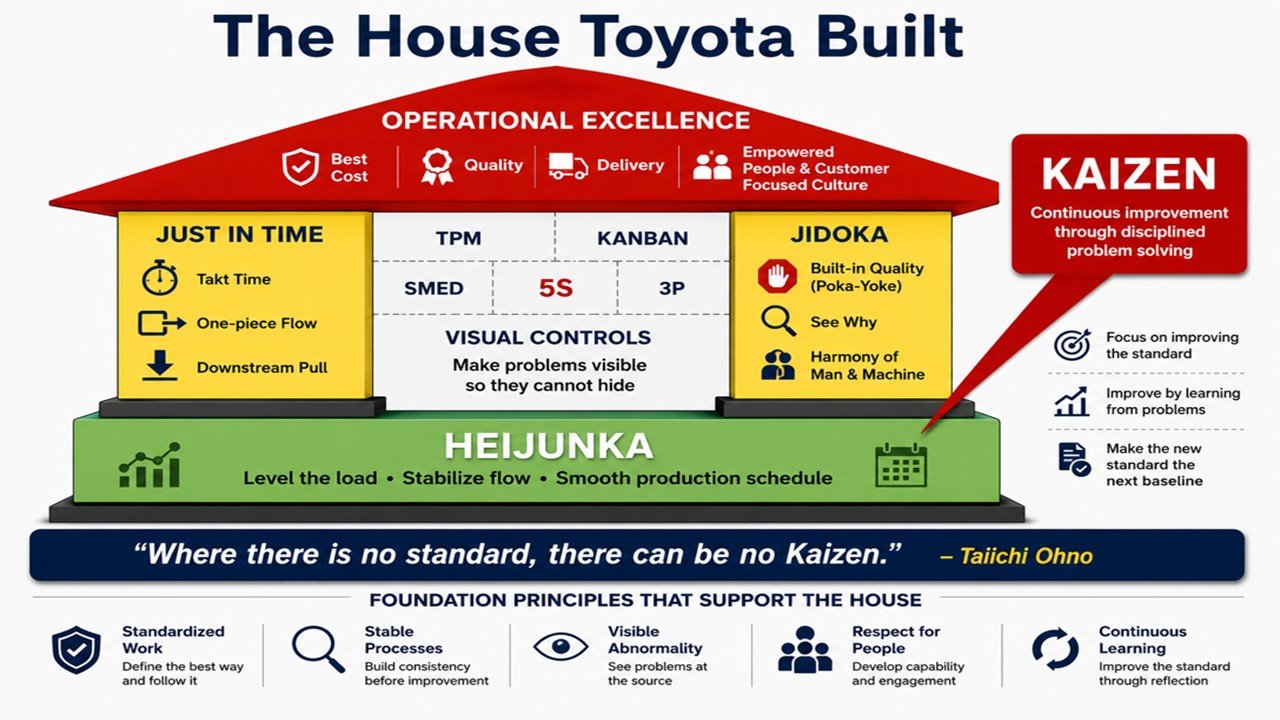
The argument is built by first establishing the failure of conventional approaches that apply control after execution has occurred. The required control point shift is then defined to position Quality creation at the point of execution. The system architecture is formalized by integrating Standardized Work, Jidoka, Andon, Kaizen, PDCA, and Jishuken into a single operating condition that governs how work is performed.
Application is demonstrated through Nomura’s integration of Quality control, daily management, and leadership development, with Jishuken functioning as the mechanism that develops leadership capability through direct engagement with execution.
The position is validated through observed system behavior and performance outcomes, followed by analysis of why Dantotsu does not transfer under typical conditions and the constraints required for application beyond manufacturing environments. The paper closes by establishing that Quality is not improved through activity, but produced through controlled execution.
Introduction: Quality Without Control
Most organizations treat Quality as an outcome evaluated after work has been completed. Defects are measured after production, and performance is reviewed through reports that summarize results rather than govern execution. Improvement is organized as a separate activity, while the conditions under which work is performed remain unchanged.
Execution proceeds without control at the point where Quality is created. Required conditions are not defined with sufficient precision, are not made visible during execution, and are not enforced as requirements for continuation. Standards may exist, but they do not function as operating constraints. Deviation is observed, but execution continues. Response to abnormality is delayed, inconsistent, or disconnected from leadership responsibility at the point where the condition fails.
This creates a separation between intent and execution. Improvement operates alongside the process rather than governing it. Leadership reviews results after completion instead of controlling execution in real time. Learning occurs after failure has already propagated instead of at the moment the condition breaks.
Under these conditions, Quality is not produced through control. Variation enters the process, spreads across operations, and accumulates over time. Defects are detected and managed downstream after they have already impacted flow and output. The outcome is predictable. Execution is allowed to continue outside the conditions required to produce Quality.
Dantotsu Quality establishes a different system condition. Quality is not treated as a result of completed work. Quality is established as a requirement that must be satisfied during execution. Work does not proceed unless the defined condition is met. Abnormality is not allowed to remain within the process, and any deviation from the required condition triggers immediate response at the point of occurrence. Leadership is required to act where the condition fails and to restore the defined state before execution continues.
This redefines the role of improvement within the system. Improvement is not a separate activity applied to the process. Improvement becomes the method for defining, enforcing, and refining the conditions under which work is performed.
Dantotsu Quality is not an improvement method. Dantotsu Quality is a governed system that requires a different control point.
Control Point Shift: Where Quality Is Created
Conventional systems apply control after execution has occurred.
Control is positioned downstream of execution. Quality is verified after the fact, and defects are managed rather than prevented. Variation enters the process, propagates across operations, and accumulates before it is addressed. Correction follows failure, and learning occurs after the condition has already broken.
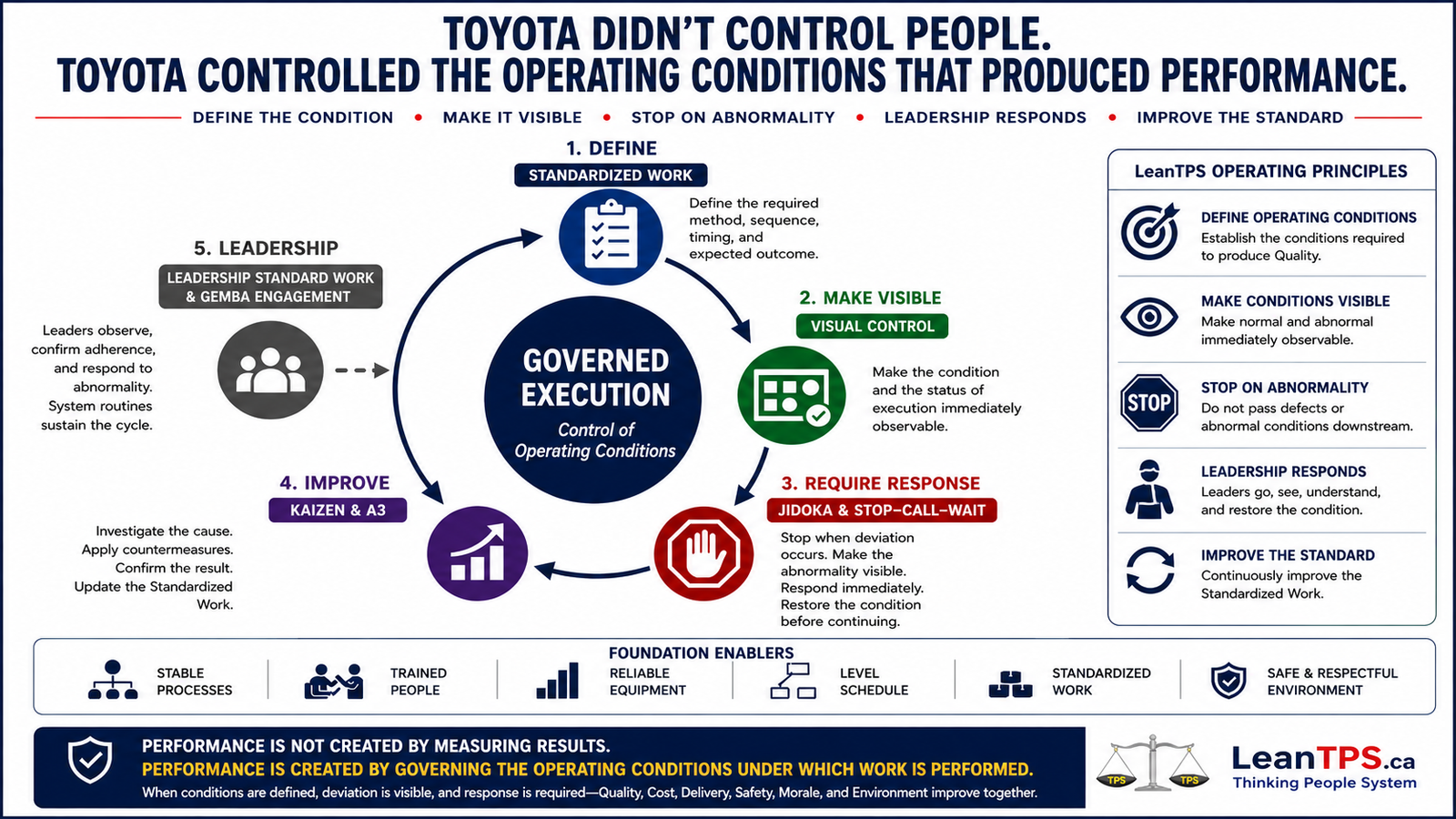
The Toyota Production System establishes control at the point of execution. Work does not proceed under undefined conditions. Method, sequence, timing, and expected outcome are specified before execution begins, and these elements define the required condition for producing Quality. Execution is governed by adherence to this condition.
This shift positions control at the point where Quality is created. Quality is not verified after completion. Quality is produced during execution through enforcement of the required condition.
Three requirements define this control system.
The defined condition must be specified with sufficient precision to establish what constitutes normal execution. Standardized Work provides the reference for method, sequence, timing, and expected outcome at the point of work.
Deviation must be visible at the moment it occurs. Variation must be observable during execution so that failure to meet the defined condition can be identified immediately.
Continuation must be prevented when the condition is not met. Execution must not proceed under abnormal conditions. Jidoka enforces interruption, and Andon and Stop–Call–Wait require response before work resumes.
These requirements establish a different operating logic. Execution is constrained by the required condition, deviation triggers immediate response, and work does not continue until the required condition is restored.
This is the control point shift. Quality is created only when the defined condition is defined, deviation is visible, and continuation is prevented. This position is not adjustable.
Failure Analysis: Why Dantotsu Does Not Transfer
Dantotsu Quality does not fail as a concept. Failure occurs in application when the conditions required to govern execution are not established and enforced. Most organizations adopt visible elements of improvement without implementing the system conditions necessary to control how work is performed. Tools are introduced and activity increases, but results are inconsistent because execution is not governed. The failure is structural.
Execution is allowed to continue when required conditions are not met. Abnormality may be identified, but production proceeds without interruption. Without enforced stop, defects are created and passed forward, and variation accumulates across the system. Jidoka is not applied as a control mechanism that prevents continuation. Jidoka is reduced to detection without enforcement, which allows abnormal conditions to persist.
The required condition for execution is not defined with sufficient precision. Standardized Work is incomplete, inconsistently applied, or not treated as an operating requirement. Method, sequence, timing, and expected outcome are not specified at the level necessary to produce Quality. Without a defined condition, abnormality cannot be identified with accuracy, and variation becomes accepted as normal behavior within the process.
Leadership is not accountable to abnormality at the point of execution. Signals may exist, but response is delayed, inconsistent, or not required. Leaders review results after completion rather than controlling execution in real time. Without immediate response, the defined condition is not restored. Without restoration, instability remains within the system and continues to generate variation.
Improvement is detached from execution. Kaizen is conducted as a separate activity rather than as a method for governing daily work. Events are completed and reports are generated, but the underlying conditions of execution remain unchanged. Improvements are not integrated into Standardized Work, and learning is not stabilized through PDCA. The process continues to operate under the same uncontrolled conditions.
These failures follow a consistent pattern. Conditions are not defined, control is not enforced, response is not required, and learning is not sustained. Under these conditions, improvement becomes effort applied without constraint, and results cannot be maintained.
Kaizen applied without control cannot produce Dantotsu Quality.
Definition of Dantotsu Quality
Dantotsu Quality exists under a defined system condition that governs execution at the point of work. This condition exists when defects are not permitted to pass forward, abnormality is not allowed to continue within the process, response occurs immediately at the point where the condition fails, and learning is structured, captured, and repeated.
Execution occurs under the defined condition, and continuation is not permitted when that condition is not met. Abnormality is treated as a failure to meet the required condition and is addressed at the moment it occurs. Response is not discretionary and is required at the point of failure. Learning is integrated into execution through structured cycles of correction and standardization.
Dantotsu Quality is not achieved through effort, intent, or isolated improvement activity. It is produced through consistent enforcement of the required condition at the point of work.
Each element is required for the condition to be sustained. Removal of any element allows deviation to persist, prevents restoration of the required condition, or interrupts the stabilization of learning.
Dantotsu Quality does not describe performance results. It defines how execution is governed under controlled conditions. The term does not represent a target, a benchmark, or a level of improvement.
Dantotsu Quality is the result of sustained control.
System Architecture of Dantotsu Quality
This system operates through a defined set of control functions that govern execution at the point of work. Each element performs a defined function within this system and is required to sustain control.
Standardized Work establishes the defined condition for execution. Method, sequence, timing, and expected outcome are specified with precision at the point of work. These elements establish the state under which Quality can be produced and provide the reference against which execution is evaluated.
Jidoka interrupts violation of the defined condition. When execution deviates from method, sequence, timing, or outcome, the process is stopped. Continuation is not permitted under abnormal conditions. Interruption prevents defects from being created and passed forward.
Andon and Stop–Call–Wait enforce response. The interruption generates a visible signal that identifies the location and nature of the abnormality. Responsibility is defined, and leadership is required to respond at the point where the condition failed. Execution does not resume until the required condition is restored.
Kaizen improves the condition. The cause of the interruption is identified at the point of occurrence, and corrective action eliminates the source of deviation. The condition is modified to prevent recurrence and applied to future execution.
PDCA stabilizes learning. The improvement is tested under actual conditions, confirmed to produce the required outcome, and standardized as the method of execution. The updated condition becomes the required state for future work.
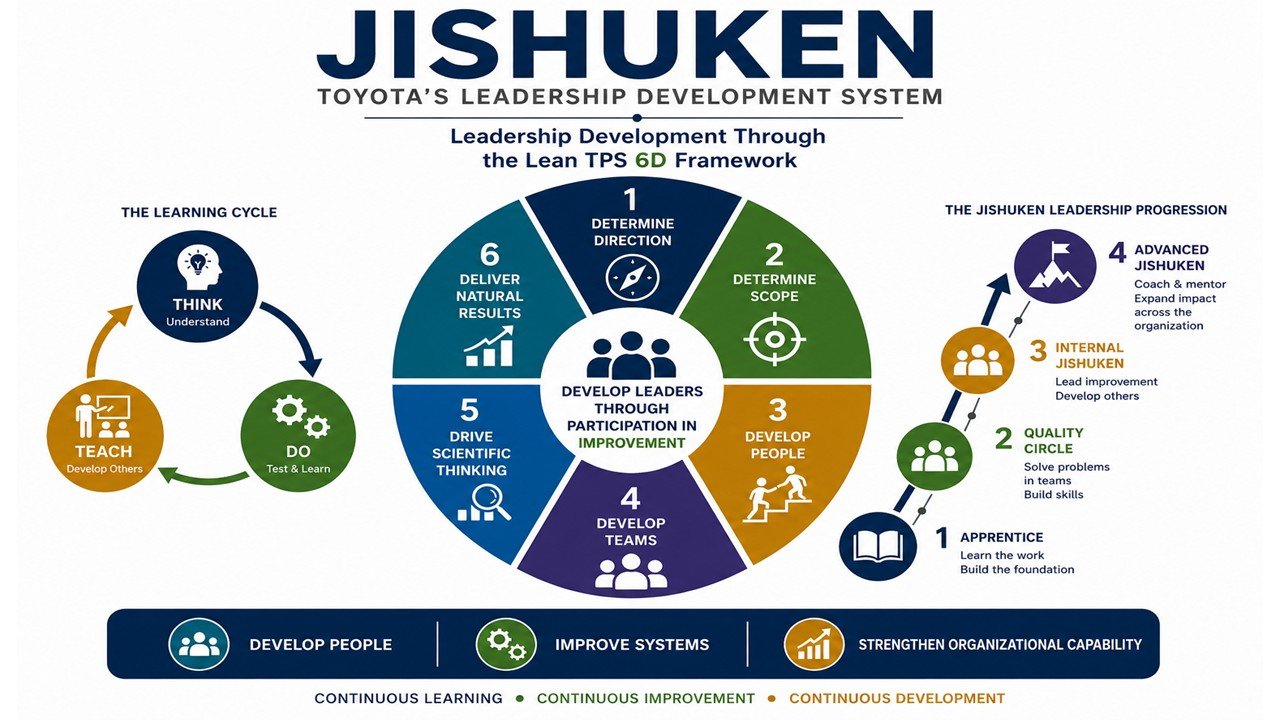
Jishuken develops leadership capability. Leaders engage directly in defining conditions, observing execution, responding to abnormality, and stabilizing improvements. Capability is built through repeated cycles of observation, intervention, correction, and standardization under real operating conditions.
These elements operate as a single system. Standardized Work without Jidoka allows deviation to continue. Jidoka without enforced response delays restoration of the condition. Response without Kaizen results in repeated failure. Kaizen without PDCA prevents stabilization of learning. PDCA without Jishuken does not develop the leadership capability required to sustain control.
No element operates independently. If any element is missing, the control loop breaks. When the control loop breaks, Dantotsu Quality cannot be sustained.
Nomura’s Contribution: System Integration, Not Tools
Mr. Sadao Nomura did not invent the Toyota Production System. His contribution was the enforcement of system discipline at the highest level of execution.
The Toyota Production System already defined the core elements required to produce Quality. These elements were not consistently integrated or applied with the discipline required to sustain stable performance across operations. Tools were implemented, results were achieved in isolated areas, and variation persisted because execution was not governed as a unified system.
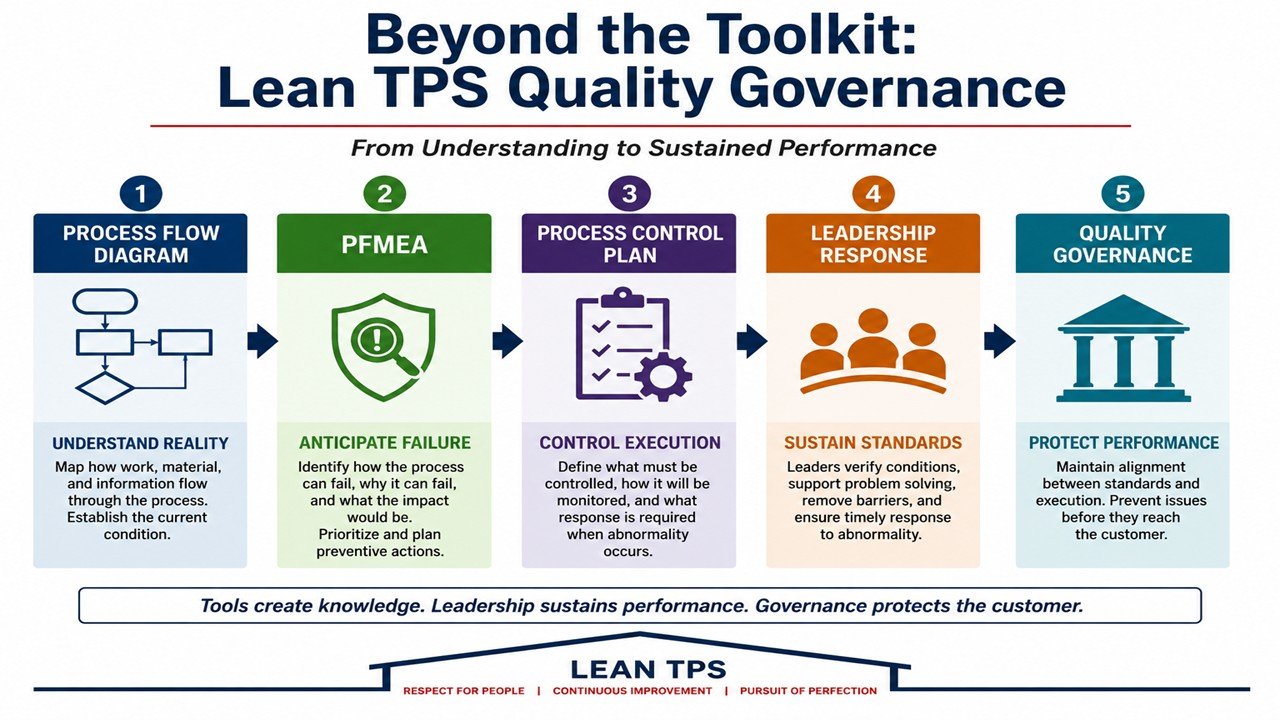
Nomura established integration at the point of execution. He required that Quality control, daily management, and leadership development operate as a single system rather than as separate functions. Quality control was not treated as inspection or post-process verification. Quality was enforced through definition of conditions, detection of abnormality, and immediate response. Daily management governed execution through visibility of conditions, assignment of responsibility, and required action when deviation occurred. Leadership capability was developed through direct engagement with actual conditions, real problems, and responsibility for restoring control.
Jishuken functioned as the execution mechanism that enabled this integration. Leaders were placed within the process and required to define the expected condition, observe actual execution, identify deviation, respond to abnormality, and stabilize improvements through standardization. Each cycle reinforced the relationship between condition, execution, and response.
This integration removed the separation between thinking and doing. Quality was produced through controlled execution under defined conditions.
Nomura’s contribution was not the introduction of new methods. His contribution was the unification of existing Toyota Production System elements into a single operating condition in which execution was governed, abnormality could not continue, leadership was required to respond, and learning was continuous and structured. Under these conditions, Dantotsu Quality was produced as a result of system control.
Jishuken as the Engine of Leadership Development
Jishuken operationalizes leadership development within the system. Jishuken is a structured method for developing leadership capability through direct engagement with uncontrolled conditions at the point of work. Leaders define conditions, observe execution, correct deviation, and restore control within the process.
Jishuken operates without separation between development and execution. Leadership capability is built through repeated exposure to conditions where execution does not meet the defined requirement and where correction occurs before work can continue.
The method is fixed and executed without variation. The expected condition is defined through Standardized Work, which specifies method, sequence, timing, and expected outcome before observation begins. The actual condition is observed directly at the point of execution, where work is seen as it is performed rather than as it is reported.
Deviation is identified as the measurable difference between the defined condition and the observed condition. The gap is treated as a failure to meet the required condition and is addressed at the point where it occurs.
Action is taken at the point of occurrence. Abnormality is addressed where it appears, and execution does not continue outside the defined condition. Restoration of the required state is completed before work proceeds.
Reflection and standardization follow correction. The cause of the deviation is identified, the condition is improved to prevent recurrence, and the new method is defined as the required state through Standardized Work. The updated condition becomes the basis for future execution.
This method is repeated under real operating conditions. Each cycle reinforces the relationship between defined condition, observed execution, required response, and stabilized learning. Leaders develop the ability to recognize deviation without delay, act at the point of failure, and establish control through standardization.
Jishuken builds capability within leaders through repeated correction under actual conditions of work. Leadership capability is produced through these cycles of condition definition, observation, response, and standardization.
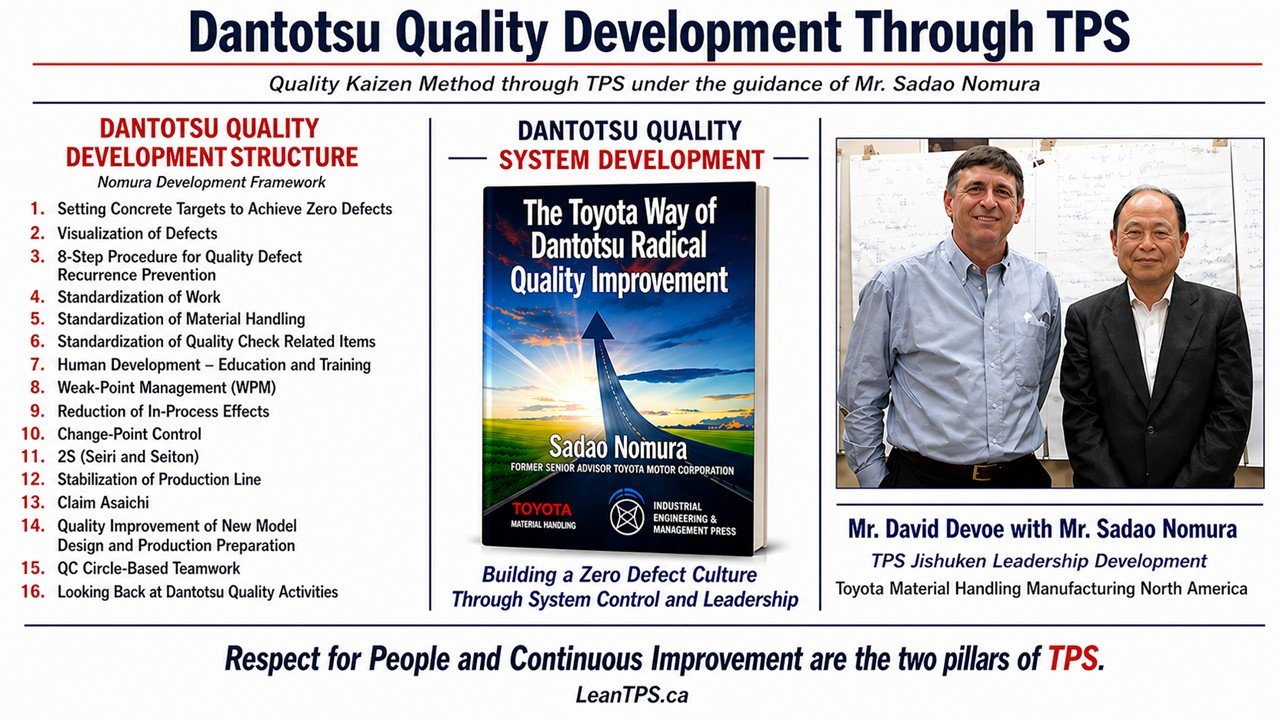
The Dantotsu Quality Development Structure
The Dantotsu Quality development structure defines the progressive expansion of system control across the production system. The structure expands control across the system and increases stability through progressive reduction of variation. Each phase builds on the prior state and extends control to a broader scope of execution.
The structure begins with the definition of the required condition. Zero defects establishes the operating requirement and defines that defects are not permitted to pass forward under any condition.
Visibility is established at the point of occurrence. Defects and abnormalities are made observable during execution so that deviation can be identified immediately.
Recurrence prevention is established as a system requirement. Problems are addressed through identification of cause, elimination of recurrence, and standardization of countermeasures.
Condition definition expands across the system. Standardized Work defines execution, material handling is aligned to prevent upstream variation, and Quality checks confirm required conditions.
Control extends into people development. Capability is developed through repeated execution under defined conditions and direct engagement with the process.
Instability is addressed at its source. Weak Point Management identifies recurring failure conditions, in-process effects are reduced, and change-point control governs modification to method, material, and equipment.
Environmental control supports visibility and repeatability. 5S ensures abnormality can be detected immediately and cannot remain hidden.
System stability is achieved as variation is contained and execution becomes predictable and repeatable under controlled conditions.
Feedback loops connect system performance to field conditions. Claim analysis links field failure to process conditions, and new model preparation ensures Quality is established before production.
Team-based problem solving is structured through QC Circle activity, aligning participation with defined methods and system conditions.
Reflection completes the structure. Learning is captured, conditions are refined, and control is strengthened through each cycle.
The structure represents progressive expansion of control from individual tasks to the full production system.
The structure operates within the Dantotsu system architecture. Each phase depends on Standardized Work, Jidoka, Andon and Stop–Call–Wait, Kaizen, PDCA, and Jishuken.
Without these elements, the structure becomes activity. With them, it produces Dantotsu Quality.
Empirical Validation: System Behavior Under Dantotsu Conditions
Dantotsu Quality is demonstrated through observable system behavior under controlled conditions. Application within Toyota Material Handling Manufacturing North America under the guidance of Mr. Sadao Nomura provided direct exposure to how the system operates when execution is governed at the point of work.
Execution was constrained by the defined condition. Standardized Work specified method, sequence, timing, and expected outcome for each process. Deviation from the defined condition was immediately visible at the point of execution. When the defined condition was not met, execution did not continue. Abnormality was addressed at the moment it occurred. Output became repeatable under these conditions. Quality was produced within the process rather than verified through inspection after the fact.
Leadership response followed a consistent and enforced pattern. Leadership responded at the point of abnormality. When an Andon signal was activated, response was immediate and occurred at the location where the condition failed. Leaders confirmed the defined condition, identified the deviation, and restored execution to the defined state before work resumed. Responsibility for response was clear and non-transferable. Execution did not continue until the condition was corrected. Through repeated exposure, leaders developed the ability to recognize deviation without delay and act at the point of failure.
Condition enforcement was achieved through interruption and structured response. When Standardized Work was not followed, the process was stopped. When material conditions were not correct, execution did not proceed. When Quality could not be confirmed, production was halted. Each interruption initiated a response that required identification of the cause, correction of the condition, and update of the standard. Changes to method, material, or process were not adopted without verification that the condition could be sustained during execution. Learning was integrated into Standardized Work as part of future execution.
These observations confirm the system condition under Dantotsu Quality. Dantotsu Quality is observable and repeatable system behavior.
System Performance Outcomes
System performance outcomes are the direct result of defined and enforced conditions at the point of execution. These outcomes do not represent isolated achievements or temporary gains. Performance reflects the consistency with which execution is governed under the defined condition.
Under Dantotsu conditions, performance follows a consistent and predictable pattern.
Defect reduction occurs because continuation is prevented when the required condition is not met. Defects do not pass forward, and abnormality is addressed at the point of occurrence. Defect reduction is produced within execution.
Productivity increases as variation is removed. Execution becomes stable and repeatable, and flow becomes predictable. Output increases without additional effort because instability is reduced. Productivity is achieved through stability.
Warranty reduction occurs when defects are prevented at the source. Field failures are traced to process conditions and corrected within execution. Warranty reduction is achieved through prevention.
Participation scale increases because engagement is required within the system. Response occurs at the point of abnormality, and individuals are involved in correction and stabilization of conditions. Contribution is embedded in execution.
These outcomes occur when execution is governed under the required condition.
System Implications for Modern Enterprise
Dantotsu Quality transfers only where execution can be governed. Applicability is determined by the ability to govern execution at the point of work. Transfer is possible only when execution can be defined, made visible, and enforced.
Three requirements must be satisfied in any domain. Execution must occur under clearly defined conditions, deviation must be visible at the moment it occurs, and response must be enforced so that work does not continue under abnormal conditions. Where these requirements cannot be established, the system cannot operate.
Service environments contain variability in demand and human interaction, but execution still follows repeatable patterns. Service work is defined by sequence of interaction, expected response time, and required outcome. Missed response times, incorrect handling, and incomplete transactions are identified at the point of occurrence. Execution does not continue when conditions are not met. Escalation occurs immediately, and responsibility for response is clear. Without enforced response, defects are absorbed and repeated.
Healthcare systems operate under high variability and high consequence, which increases the requirement for controlled execution. Clinical procedures, patient flow, and handoffs are specified by method and outcome. Errors in medication, delays in treatment, and breakdowns in communication are identified in real time. Execution does not continue under abnormal conditions. Response is enforced at the point of care, and escalation occurs without delay. Execution proceeds only after the required condition is restored.
Software development and delivery environments often separate development from execution in production systems. Code standards, integration requirements, and deployment criteria define execution. Build failures, test failures, and integration conflicts identify deviation. Execution does not proceed when conditions fail. Defective code is not merged, unverified changes are not deployed, and release is stopped until conditions are met. Response occurs immediately before execution continues.
Dantotsu Quality transfers only where execution can be governed. Where execution is defined, visible, and enforced, the system operates. Where it is not, Dantotsu Quality cannot be achieved.
Final Position
Quality is not improved. Quality is produced.
Dantotsu Quality exists only when execution is governed at the point of work, where the defined condition is enforced, deviation does not continue, response is immediate, and learning is not deferred.
When execution is governed, Quality is produced within the process. When it is not, variation enters, defects propagate, and performance degrades.
Dantotsu Quality is not achieved through effort, activity, or intent. It exists only where execution is controlled at the point of work.