Toyota’s TPS: The Foundation of Continuous Improvement

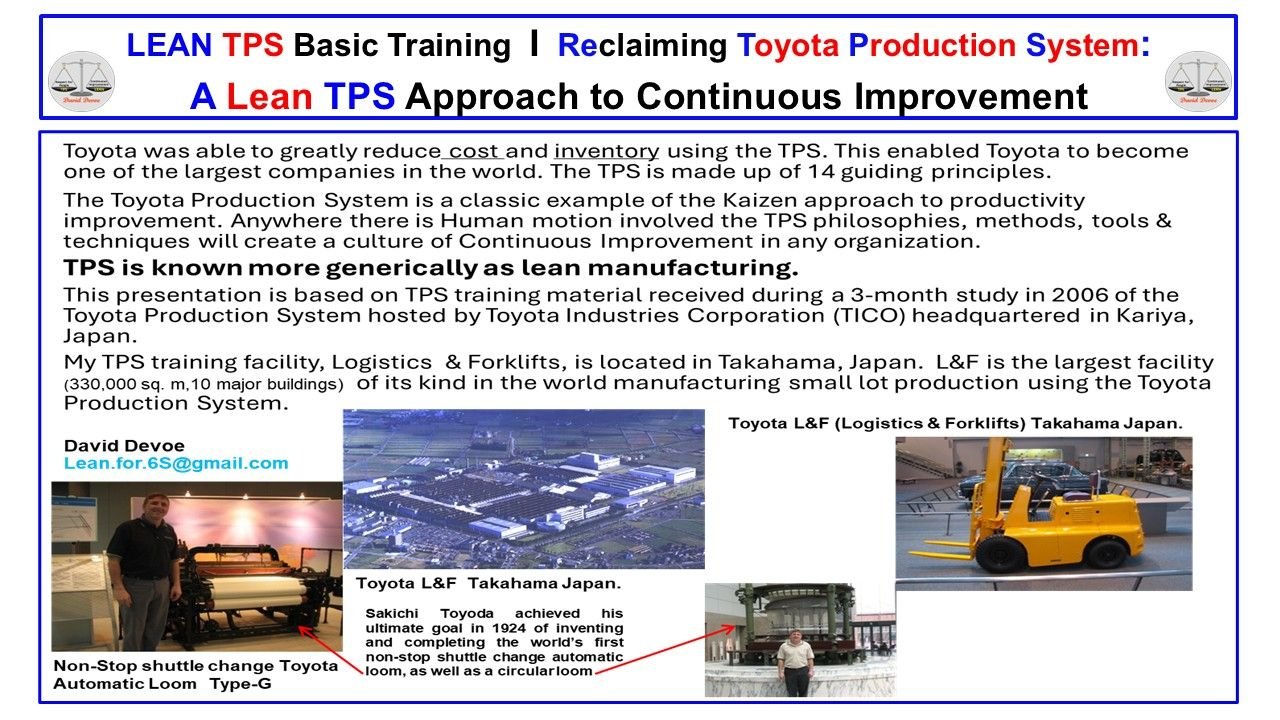
Visual slide summarizing Toyota’s TPS foundations, showing Toyota L&F Takahama layout and equipment images representing real-world TPS application.
TPS is more than Lean. It is a system of thinking and discipline that connects people, process, and leadership to achieve stability, quality, and continuous improvement.

Toyota’s rise to global leadership was built on a system that fundamentally changed how the world views manufacturing. The Toyota Production System (TPS) is not just a method for reducing cost. It is a system of disciplined thinking designed to achieve continuous improvement through respect for people, stability, and flow.

TPS dramatically reduced cost and inventory by connecting people, processes, and purpose into one integrated framework. Through this approach, Toyota transformed variability into stability and developed one of the most consistent and reliable production systems in the world.

The System Behind the Success

TPS is often described as the foundation of Lean manufacturing, but it goes far deeper than that. Where many organizations apply Lean as a project or initiative, TPS is a living system. It teaches leaders and teams to see waste, design flow, and continuously improve their work.

At its core, TPS is built around Kaizen, the habit of small, continuous improvements, and the systematic elimination of waste. Every motion, every process, and every connection is analyzed, standardized, and improved. The result is not only higher productivity but also stronger capability in the people who do the work.

Wherever human motion exists, TPS principles and methods create learning and improvement. The system is designed to evolve with the conditions of the workplace. It adapts to new challenges, technologies, and customer expectations without losing its foundation.

From Kariya to Takahama: Learning TPS at Its Source

My understanding of TPS comes from direct experience. In 2006, I completed a three-month study at Toyota Industries Corporation (TICO) in Kariya, Japan. This was a structured TPS training program taught by Toyota leaders who had applied the system for decades.

The study combined classroom instruction, Gemba visits, and practical problem-solving at Toyota Logistics and Forklifts (L&F) in Takahama, Japan. Seeing the system in daily operation revealed what cannot be learned from textbooks or toolkits: TPS is a management system built on behavior and discipline.

Toyota L&F Takahama: A Model of TPS in Action

The Takahama facility remains one of the largest and most advanced TPS-based operations in the world. Covering over 330,000 square meters and ten major buildings, it produces a wide range of small-lot and high-mix forklift products. Every area of the plant reflects the structure of TPS:

  • Heijunka to level production and balance workload.
  • Just-In-Time to synchronize flow and eliminate excess inventory.
  • Jidoka to ensure quality is built in at every step.
  • Standardized Work to maintain consistency and reveal abnormalities.
  • Visual Management to keep performance transparent and problems visible.

At Takahama, improvement is not driven by audits or compliance. It is built into the daily rhythm of the system. Leaders confirm standards, review abnormalities, and develop people through observation and questioning. This is how learning becomes part of daily work.

The Real Meaning of TPS

The Toyota Production System is often summarized by its two pillars: Just-In-Time and Jidoka. But these are supported by a foundation of disciplined behavior and long-term thinking. TPS is not about cost-cutting or temporary gains. It is about building systems that sustain performance and enable people to think and act scientifically.

Many organizations today implement Lean tools without understanding this deeper intent. They achieve short-term results but fail to sustain improvement because the system logic and leadership behaviors are missing. TPS succeeds because it integrates both.

The question for every organization is not whether it uses Lean tools, but whether it applies Lean TPS thinking. The difference determines whether improvement becomes temporary or permanent.

A Living System for Improvement

TPS continues to evolve across Toyota facilities worldwide, but its principles remain constant:

  • See waste before it causes failure.
  • Stabilize processes to build flow.
  • Engage people to solve problems.
  • Lead by confirming reality at the site.

This is the system that created Toyota’s reputation for quality, efficiency, and resilience. It is not just a method of production. It is a way of thinking that builds capability across generations.
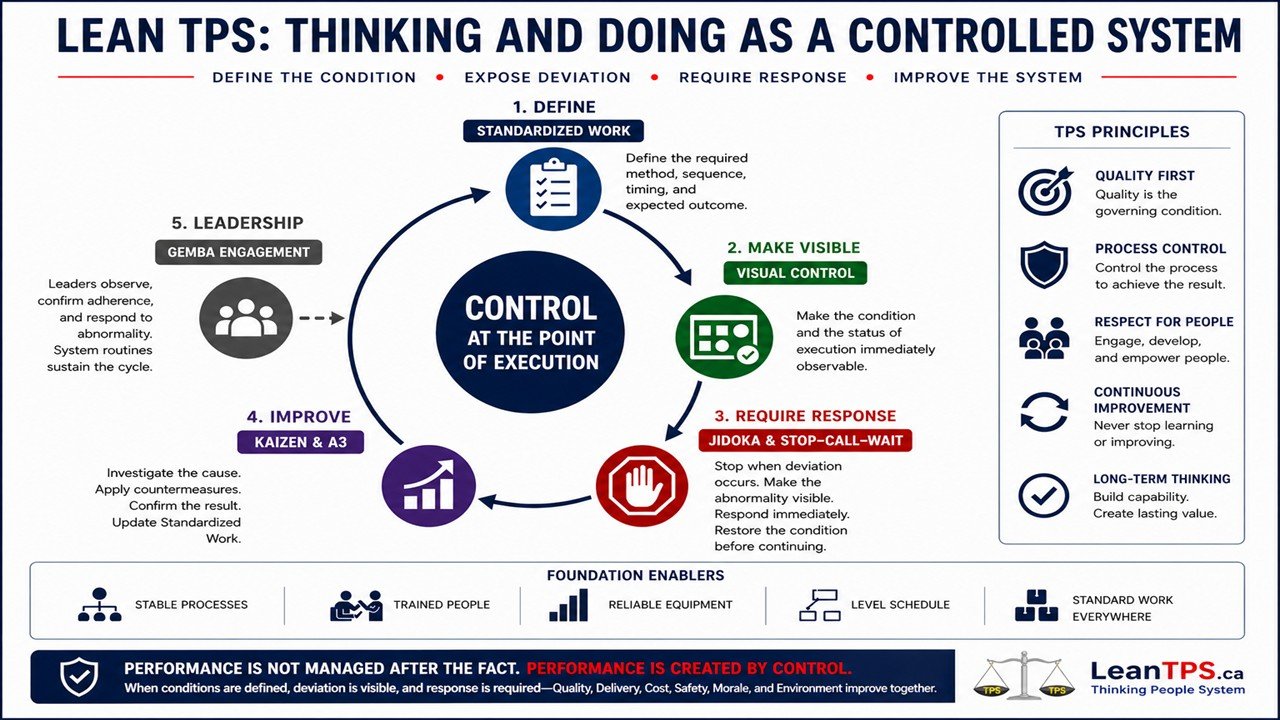
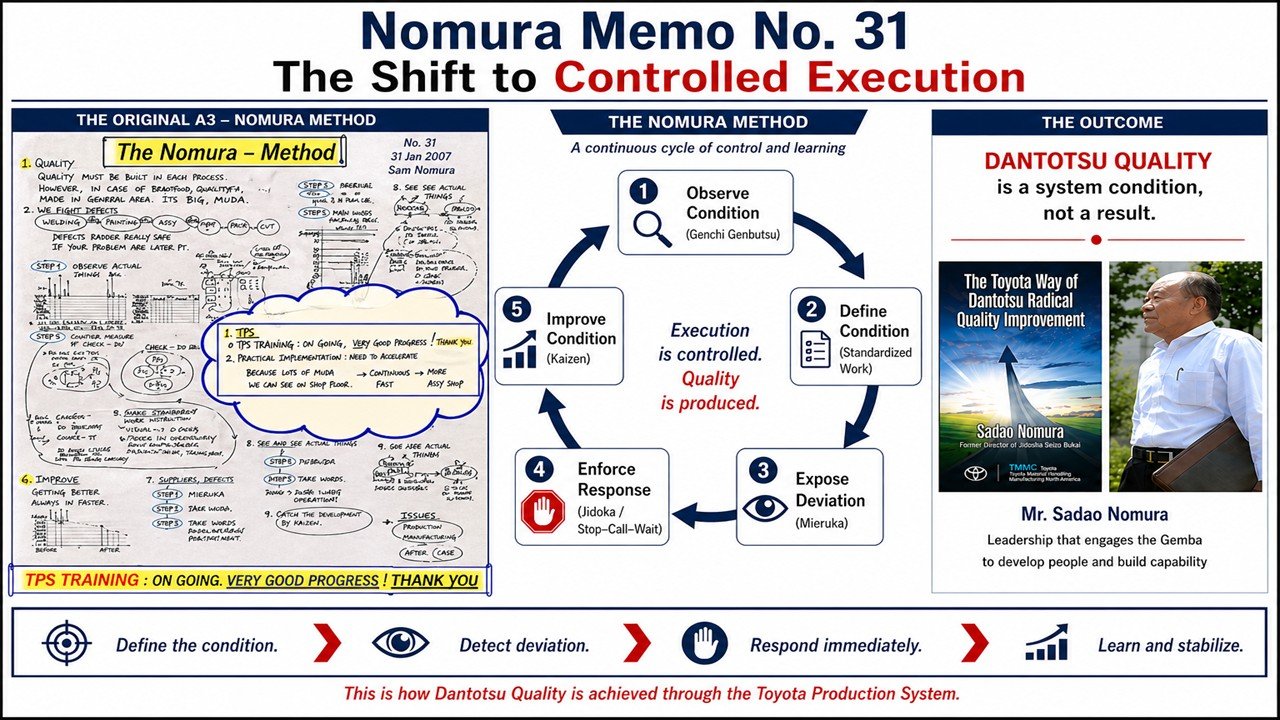
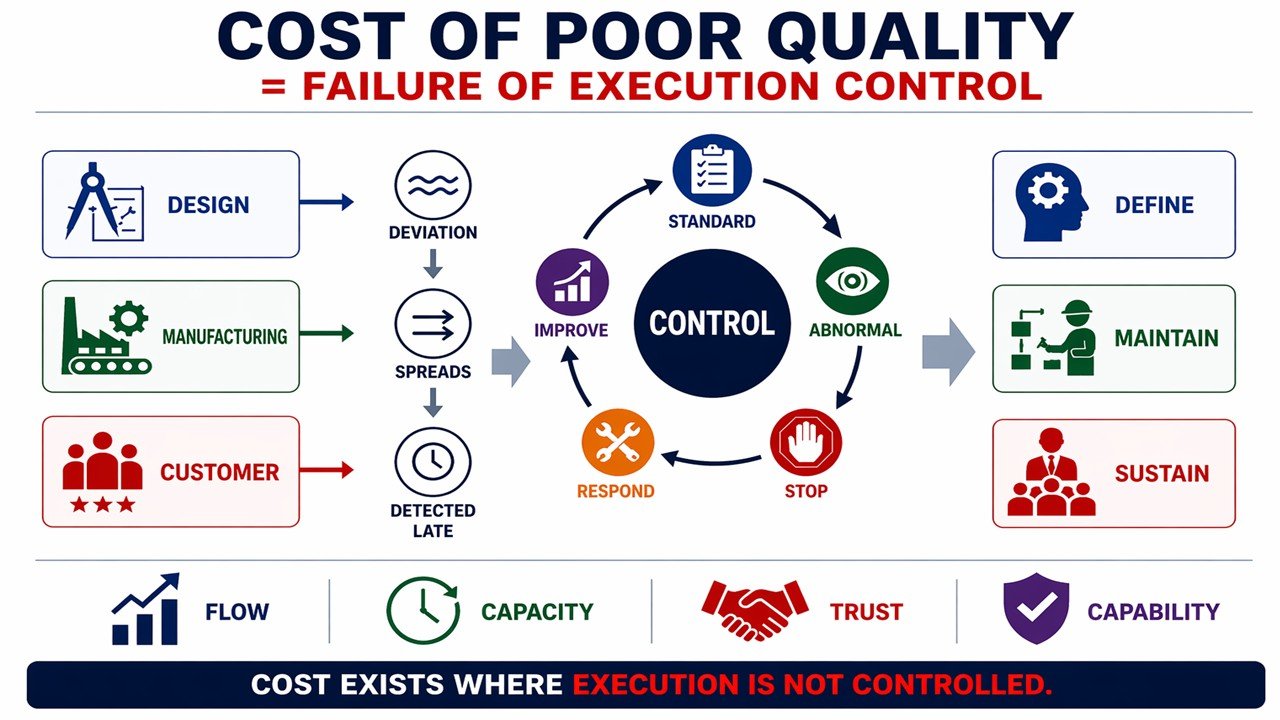
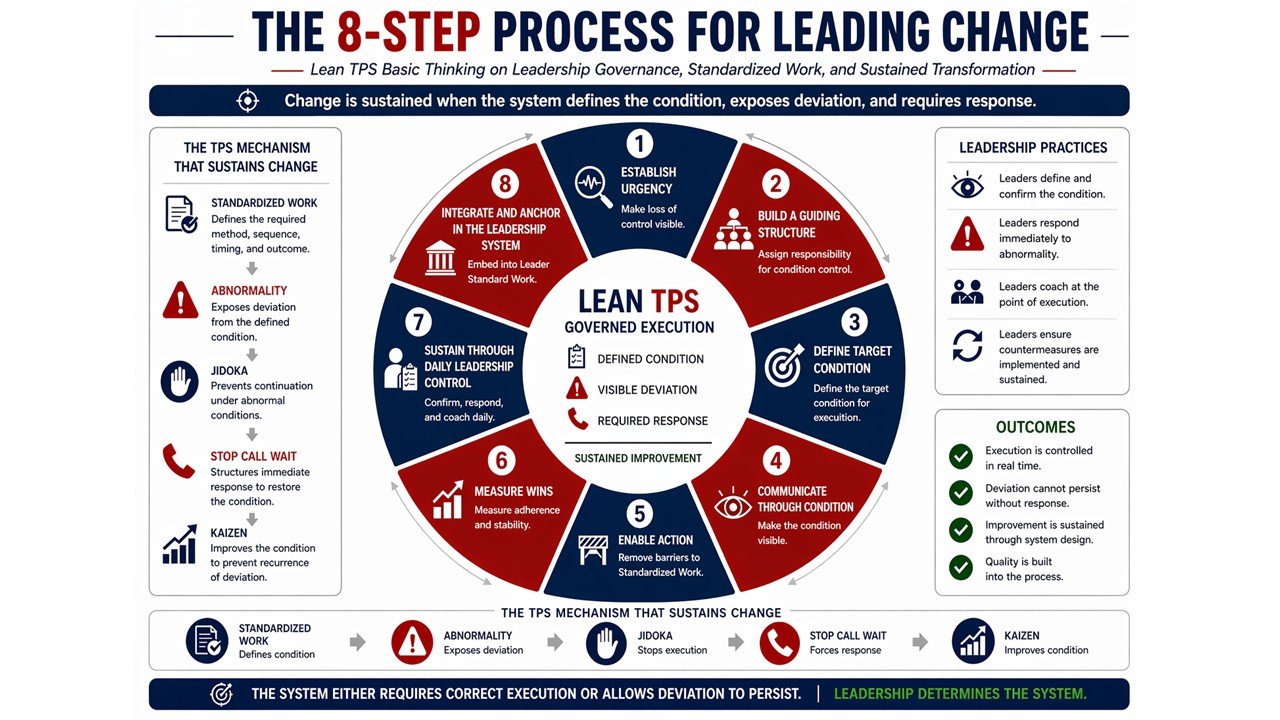
A Lean TPS system requires that execution is governed by three questions that define control. The required condition for execution must be explicitly defined through method, sequence, timing, and outcome. The point at which the condition is violated must be immediately recognizable during execution. The response required when the condition is not met must be enforced without delay. When these three elements operate together, execution is controlled and Quality is maintained as a condition of the system. Control precedes improvement because improvement depends on a stable and defined state of execution. When conditions are not defined, exposed, and enforced, improvement activity operates on an unstable system and results do not hold. Work continues under abnormal conditions, variation accumulates, and outcomes remain inconsistent. When control is established, improvement operates within defined boundaries and reinforces the condition that governs execution. Quality exists only when the required condition is maintained during each cycle of work. Quality is not achieved through measurement or inspection after execution. Quality is protected through enforcement of conditions during execution. When the condition is not met, work does not continue, and response restores the defined state before execution resumes. This enforcement prevents deviation from propagating and maintains stability at the source. A Lean TPS system requires that continuation under abnormal conditions is not permitted. When work continues despite violation of method, sequence, timing, or outcome, control does not exist and the system becomes dependent on judgment. Deviation is absorbed into normal work, and Quality is degraded. When continuation is prevented, the system enforces the boundary between normal and abnormal states and maintains control of execution. The system extends beyond individual elements and requires integration across condition definition, exposure, response, and learning. When these elements are aligned, execution is governed, leadership responds as required, and learning is embedded through repeated cycles of confirmation and correction. This integration establishes a system that maintains control and protects Quality as a condition of execution. Further development of this system requires expansion into condition design, response structure, and leadership integration at scale. The next stage addresses how conditions are constructed, how response is embedded across functions, and how governance is sustained across the organization.
Lean TPS governance image showing how conditions, deviation detection, and enforced response control execution.
Industrial Engineering and Toyota Production System comparison showing governance, stop authority, and no continuation under abnormal conditions in Mixed-Model Human–Humanoid environments
Industrial Engineering develops system capability through analysis and optimization. The Toyota Production System governs execution in Mixed-Model Human–Humanoid environments by enforcing stop authority and preventing continuation under abnormal conditions.
Governance as the missing link in continuous improvement systems showing standard operating procedures, visual control, Andon stop, Jidoka, and required leadership response to protect Quality
Continuous improvement systems fail when governance is absent. Standard operating procedures, visual control, Andon, and Jidoka must function together to stop execution, require leadership response, and protect Quality at the source
Toyota Production System Quality progression showing governing conditions, abnormality detection, and enforced response across operations
Quality in the Toyota Production System governs execution. Work continues only when conditions are met, abnormality is visible, and response is required.
Diagram illustrating Jishuken as deliberate buffer reduction within Lean TPS governance, showing how reduced manpower, inventory, and cycle time expose management behavior and test Quality protection under disciplined control.
Improvement without governance amplifies variation. Jishuken deliberately reduces buffer to expose whether leadership discipline can protect Quality under tighter operating conditions. Stability under compression confirms governance maturity.
Lean TPS Swiss Cheese Model showing four aligned cheese slices representing Organizational Systems, Leadership Governance, Task Conditions, and Point of Execution, with layered penetration paths demonstrating Quality containment.
A visual representation of the Lean TPS Swiss Cheese Model™, demonstrating how layered governance architecture progressively protects Quality from Organizational Systems through to Point of Execution.