At Toyota, Standardized Work was never a form or a document. It was a discipline. It defined how learning, stability, and improvement were sustained every day.
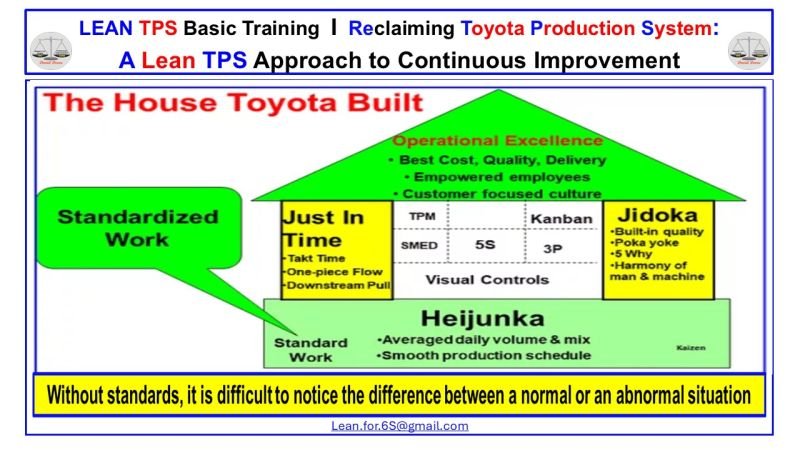
In Lean TPS, Standardized Work is the foundation of the system. It is the structure that allows continuous improvement to function. Without a standard, there is no baseline to detect abnormalities, measure change, or sustain progress.
Taiichi Ohno taught that “without a standard, there can be no improvement.” This statement reflects the purpose behind every Lean TPS activity. Standardized Work provides the consistent framework that connects people, process, and performance into one living system.
The Three Elements of Standardized Work
- Takt Time — Aligns the pace of work with customer demand. It establishes rhythm and defines how often products or services should be completed.
- Work Sequence — Defines the exact steps in the correct order to perform the work safely and efficiently.
- Standard Work-In-Process (SWIP) — Specifies the minimum amount of material or information needed to maintain flow.
Together, these elements make the difference between chaos and control. They are not abstract principles. They are observable, teachable, and measurable practices.
Visual Tools That Support Standardized Work
Two visual tools form the foundation of Standardized Work inside Toyota.
- Standardized Work Chart (SWC):
Shows layout, motion, and material locations. It exposes unnecessary travel, poor flow, and ergonomic risks. - Standardized Work Combination Table (SWCT):
Breaks down work into value-added, non-value-added, walking, waiting, and machine time. It reveals hidden imbalance and wasted effort.
These tools were not created to monitor people. They were designed to make problems visible. At Toyota, the goal was to empower each worker to recognize deviation and participate in improvement.
The 9-Step Method to Create Standardized Work
- Define the human sequence of activity.
- Capture standard time, safety, and quality points.
- Calculate takt time from real demand.
- Balance total work content across the process.
- Create a Standard Work Element Sheet.
- Train and practice until the standard is stable.
- Audit through Genchi Genbutsu—go and see.
- Visualize and contain abnormalities.
- Revise standards through Yokoten—sharing improvements laterally.
This sequence repeats continually. Every new condition requires review, confirmation, and renewal. In Lean TPS, the standard is not the end point. It is the baseline for the next improvement.
Why Standardized Work Sustains Improvement
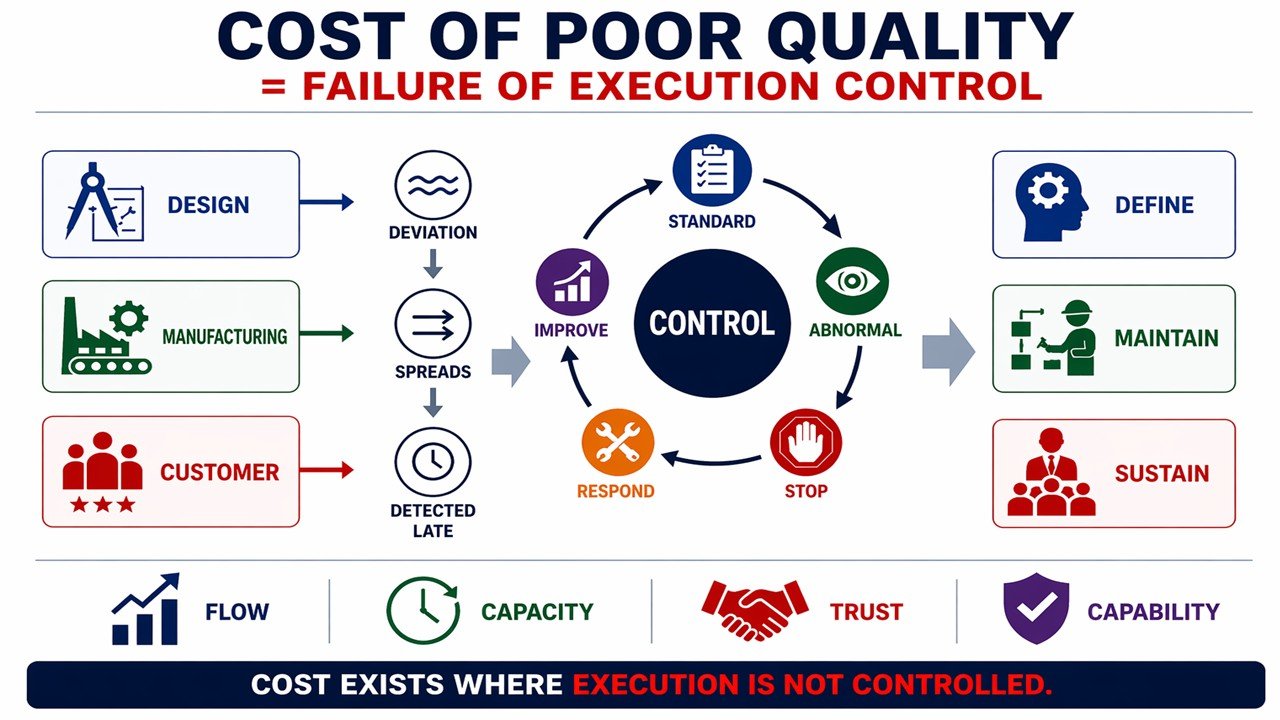
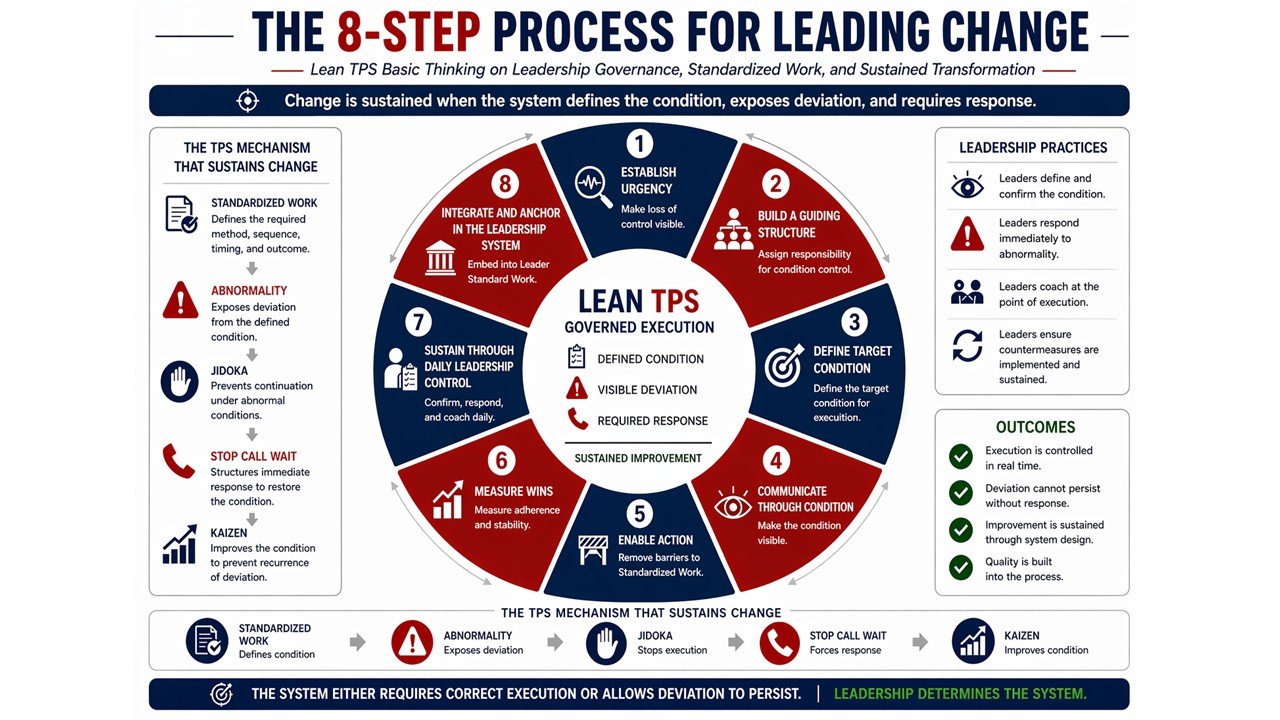
Without Standardized Work, leaders cannot distinguish between normal and abnormal conditions. Without that distinction, improvement becomes random, and learning stops. Standardized Work creates the foundation for Just-In-Time, Jidoka, Heijunka, Kaizen, and Jishuken.
Every major TPS function depends on it:
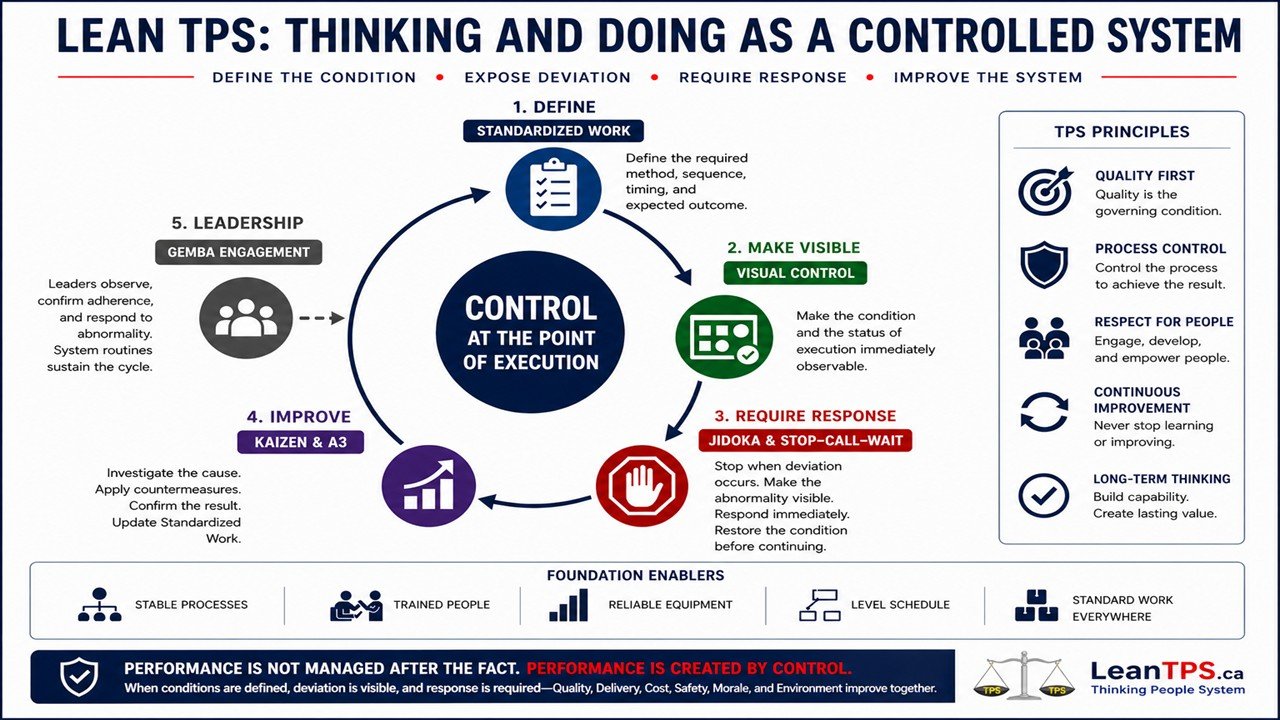
- Jidoka uses standards to define when to stop and respond.
- Heijunka relies on standards to level work and mix.
- Kaizen requires a clear starting point for change.
- Jishuken develops leadership through direct improvement of standardized systems.
In Lean TPS, the purpose of Standardized Work is not control but capability. It is the structure that teaches teams how to maintain flow, identify instability, and learn from real experience.
A stable process is not the goal. It is the starting point. When every person understands what normal looks like, they can recognize problems before failure occurs. That is how Lean TPS builds quality into the system and develops people who think.