Kaizen Leadership Skills Checklist
Making Leadership Capability Visible Through Structured Assessment and Continuous Improvement
Organizations routinely measure performance in areas such as Quality, safety, delivery, cost, productivity, and financial results. Performance indicators, audits, reports, and reviews are used to establish current conditions, identify gaps, and monitor improvement efforts. These activities provide visibility into organizational performance and support fact-based decision making.
Leadership capability often receives far less structured evaluation.
Many organizations assess leadership through observation, annual reviews, management judgment, or demonstrated business results. While these approaches may provide useful feedback, they often fail to establish a clear understanding of current leadership capability or identify specific areas requiring development. As a result, leadership growth frequently depends upon individual experience, personal initiative, or informal coaching rather than a structured development process.
Lean TPS approaches leadership development differently. The Toyota Production System recognized that long-term organizational performance depends upon the capability of its people and the effectiveness of its leaders. Quality, operational stability, problem solving, continuous improvement, and employee development are all influenced by leadership behavior. For this reason, leadership development is treated as a process that can be observed, evaluated, improved, and sustained.
This philosophy reflects a fundamental principle of Lean TPS. Improvement begins with understanding the current condition. Before Quality can be improved, current performance must be measured. Before operational instability can be reduced, abnormal conditions must be identified and understood. Before leadership capability can be strengthened, current capability must become visible.
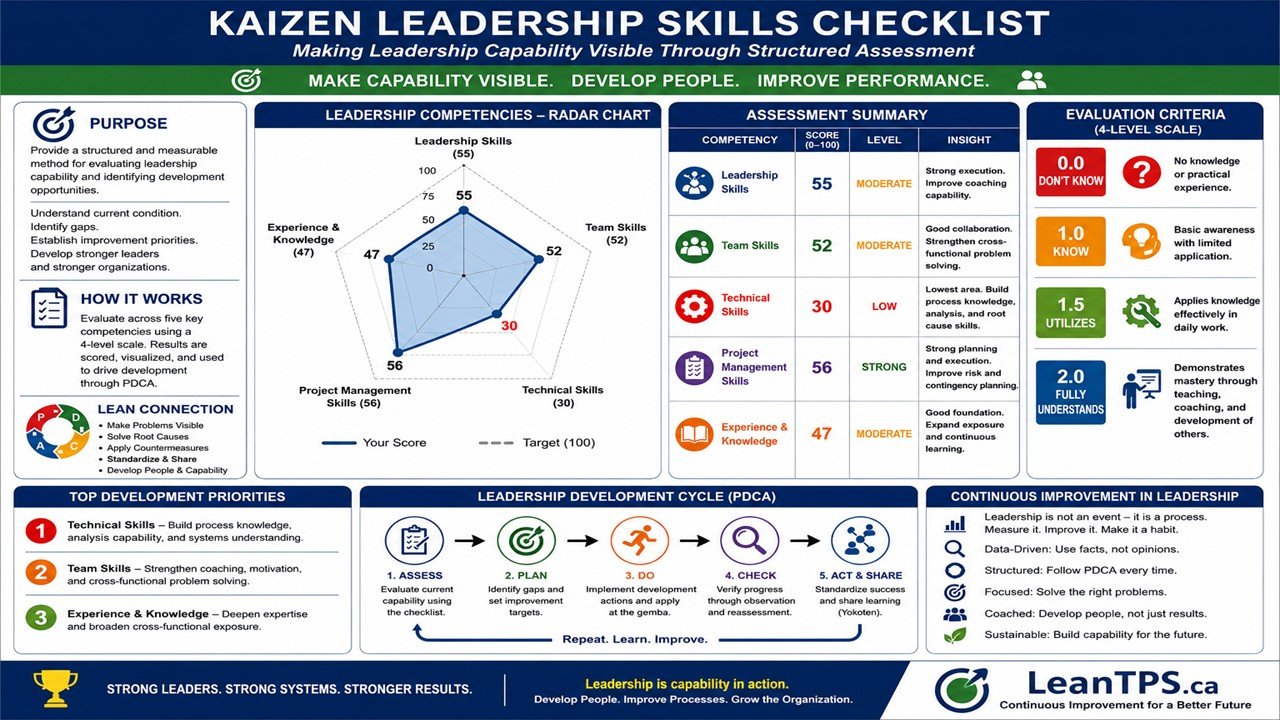
The Kaizen Leadership Skills Checklist was developed to support this objective. The assessment provides a structured method for evaluating leadership capability across multiple competency areas including Leadership Skills, Team Skills, Technical Skills, Project Management Skills, and Experience and Knowledge. Assessment results are compiled and displayed visually, allowing leaders and organizations to identify strengths, recognize development opportunities, and establish improvement priorities.
The purpose of the assessment is not to rank individuals or create comparison between employees. The purpose is to establish a clear understanding of current leadership capability and provide a fact-based foundation for development. By making capability visible, organizations can apply the same principles of Kaizen, PDCA, Genchi Genbutsu, and continuous improvement that support Quality improvement and operational excellence throughout Lean TPS.
The assessment shown below demonstrates how structured evaluation can transform leadership development from a subjective activity into a measurable process focused on learning, coaching, capability development, and continuous improvement.
1. Why Leadership Development Often Fails
Most organizations recognize the importance of leadership development, yet few approach leadership capability with the same discipline applied to Quality, safety, delivery, cost, and operational performance. Significant resources are invested in leadership courses, workshops, mentoring programs, and performance reviews, but the results are often inconsistent. Some leaders continue to develop while others stagnate, and many organizations struggle to understand why leadership performance varies so widely despite similar training investments.
One of the primary reasons leadership development fails is that organizations frequently focus on training activities rather than capability development. Training transfers information. Capability is developed through application, practice, coaching, reflection, and continuous improvement. A leader may attend a course and gain new knowledge, but knowledge alone does not improve organizational performance. Improvement occurs only when that knowledge influences daily decisions, behaviors, coaching practices, and operational execution.
The Toyota Production System recognized this distinction decades ago. Toyota never viewed training as the objective. Training was a mechanism used to develop capability. The objective was always to strengthen the organization’s ability to achieve stable performance, improve Quality, solve problems, and develop people. For this reason, Lean TPS leadership development focuses on observable capability rather than attendance, certification, or classroom participation.
Many organizations unintentionally promote individuals into leadership positions based primarily on technical expertise, years of service, or past performance results. While these factors may demonstrate competence within a specific role, they do not necessarily indicate leadership capability. A highly skilled engineer does not automatically become an effective manager. A successful supervisor does not automatically become an effective coach. Leadership requires additional competencies including communication, decision making, problem solving, conflict resolution, team development, and the ability to create conditions where others can succeed.
A second challenge is the reliance on subjective evaluation methods. Leadership assessments are often based on personal impressions, annual reviews, or generalized statements such as “strong leader,” “good communicator,” or “shows potential.” Although these observations may contain some truth, they rarely provide sufficient detail to support meaningful improvement. Leaders cannot improve capability gaps that have not been clearly identified, measured, and communicated.
This challenge directly conflicts with one of the most fundamental principles of Lean TPS. Improvement begins with understanding the current condition. Before Quality can be improved, current performance must be measured. Before process variation can be reduced, variation must be made visible. Before operational problems can be solved, abnormal conditions must be identified and understood. Leadership development follows the same logic. Before leadership capability can be improved, current capability must be evaluated and made visible.
The absence of visible leadership standards creates additional challenges. Most organizations establish standards for production processes, Quality requirements, safety expectations, financial controls, and project management activities. Leadership expectations, however, are often left undefined. As a result, leaders receive inconsistent feedback and development becomes dependent upon individual interpretation rather than organizational standards. Without clearly defined expectations, leadership capability becomes difficult to assess and even more difficult to improve.
Toyota addressed this problem by treating leadership development as a structured process. Leadership capability was not assumed. It was continuously developed through observation, coaching, practical application, reflection, and improvement. Leaders were expected to learn through direct experience at the gemba, participate in problem-solving activities, support Kaizen efforts, and develop the capability of others. Leadership became a skill that could be practiced, evaluated, and improved rather than a position that was simply assigned.
The Kaizen Leadership Skills Checklist supports this philosophy by providing a structured method for evaluating leadership capability across multiple dimensions. Rather than relying on intuition or opinion, the assessment creates a measurable view of current leadership performance. Strengths become visible. Development opportunities become visible. Improvement priorities become visible. Leaders gain a clearer understanding of their current condition and organizations gain a more objective foundation for coaching and development.
This approach aligns directly with the principles that support Lean TPS, Quality management, and continuous improvement. Current condition is established. Gaps are identified. Countermeasures are developed. Progress is verified. Leadership development becomes a continuous process governed through PDCA rather than an isolated training event. As a result, organizations are able to develop leadership capability with the same discipline they apply to improving Quality, operational stability, and organizational performance.
2. Leadership Development Through the Toyota Production System
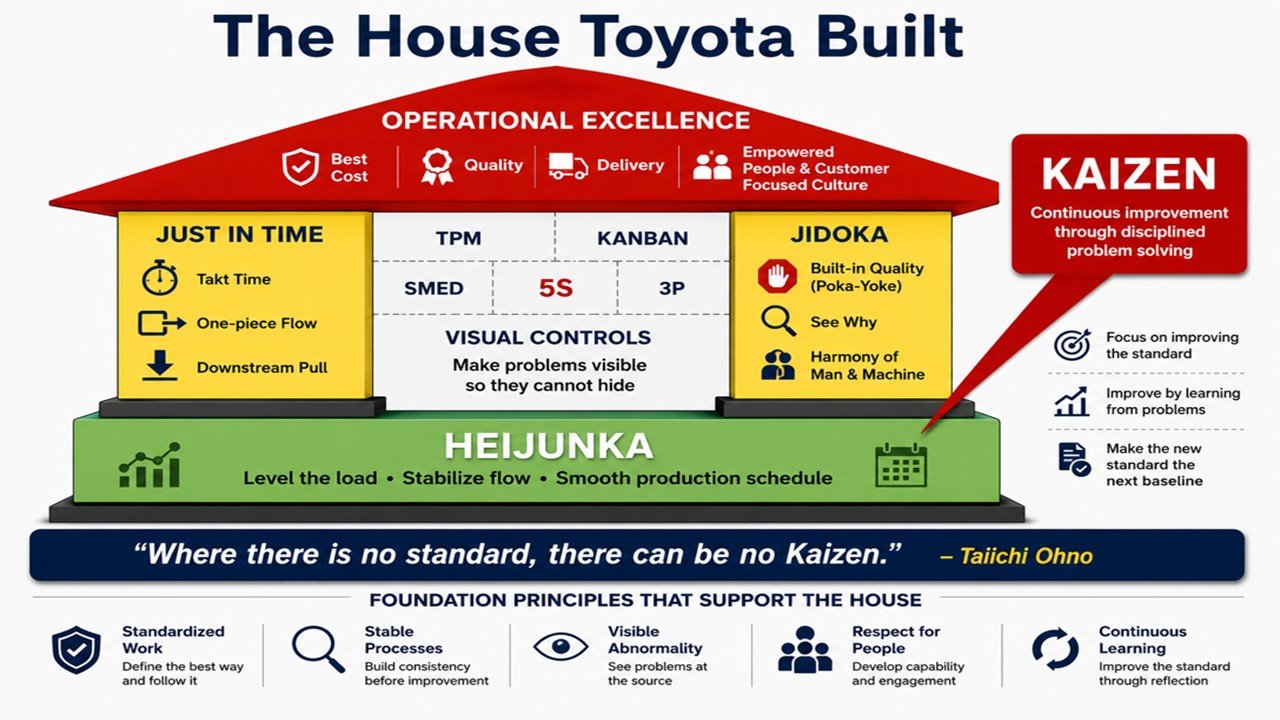
The Toyota Production System is often associated with concepts such as Just-in-Time, Jidoka, Standardized Work, Kaizen, and continuous improvement. While these elements are important, they are only part of the system. Toyota’s long-term success was not built solely upon tools, methods, or operational processes. It was built upon the systematic development of people capable of sustaining and improving those systems.
Toyota understood a fundamental principle that many organizations overlook: tools do not improve organizations. People improve organizations.
Processes improve because people improve them. Quality improves because people learn to identify and respond to abnormal conditions. Operational stability improves because leaders establish standards, confirm execution, and support problem solving. Continuous improvement becomes sustainable only when leaders possess the capability to develop others.
For this reason, leadership development became an integral part of the Toyota Production System rather than a separate human resources activity.
Many organizations approach leadership development through training programs, workshops, and classroom instruction. While these methods may increase awareness, they often fail to create lasting behavioral change because learning remains disconnected from daily work. Lean TPS approaches development differently. Leadership capability is strengthened through direct observation, coaching, problem solving, reflection, and practical application at the gemba.
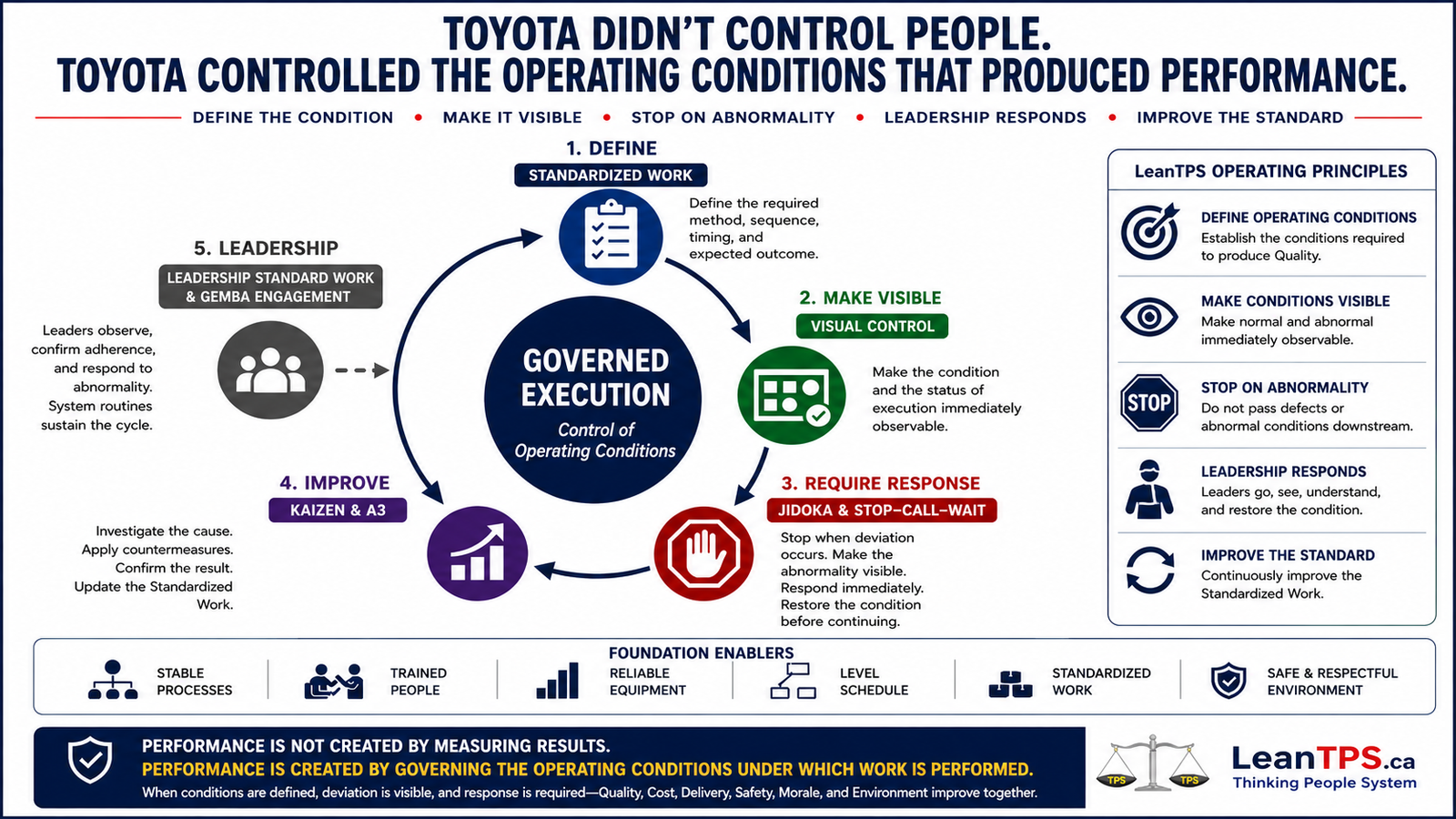
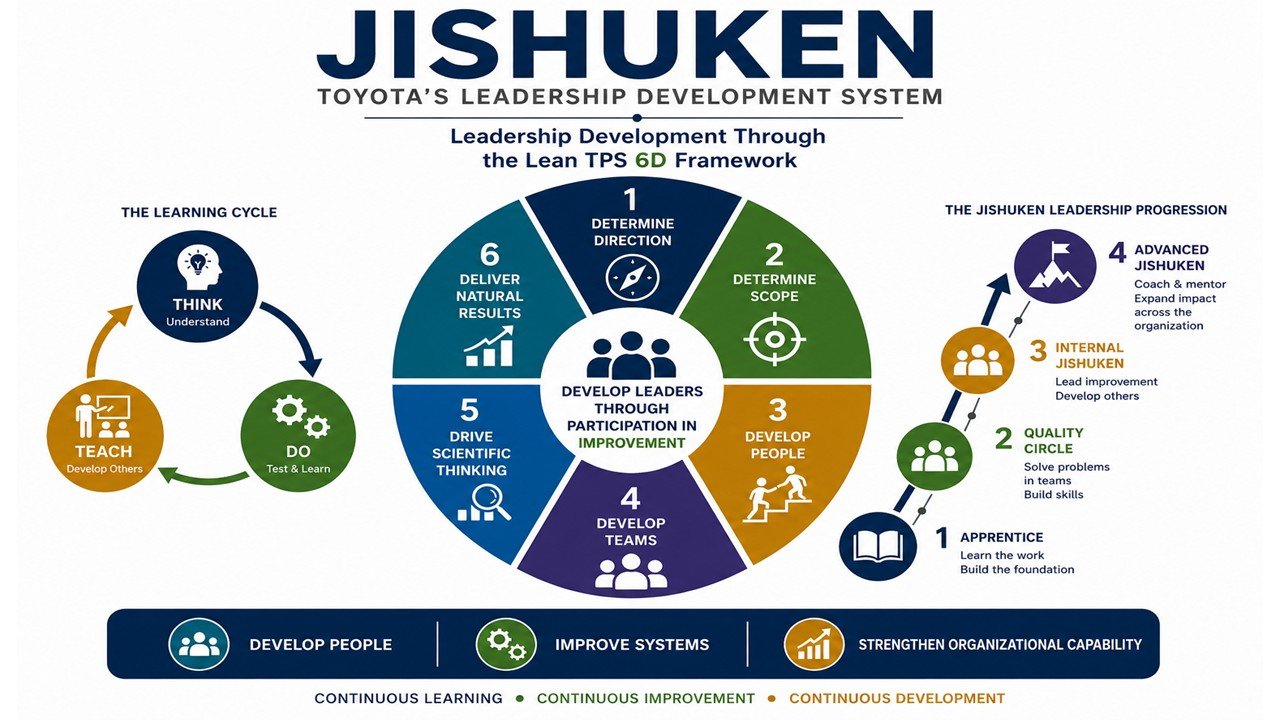
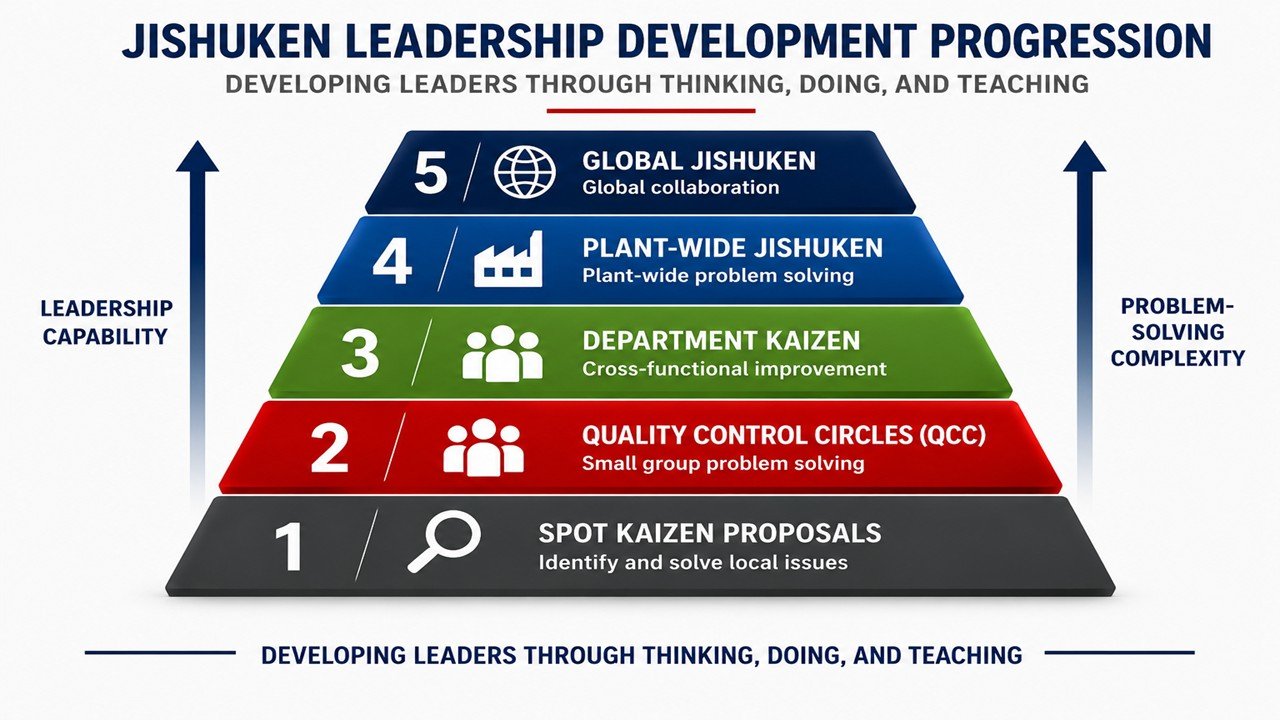
This philosophy is reflected throughout the Toyota Production System. Standardized Work depends upon leaders who confirm adherence to standards. Jidoka depends upon leaders who respond appropriately to abnormal conditions. Just-in-Time depends upon leaders who understand flow and recognize instability. Kaizen depends upon leaders who challenge the current condition and support improvement. Jishuken develops leadership capability through direct observation, problem solving, experimentation, and continuous learning.
These principles demonstrate that leadership development is embedded throughout Lean TPS. Leadership capability is not separate from operational performance. It directly influences Quality, process stability, employee engagement, and organizational learning.
This perspective differs significantly from traditional management approaches. Many organizations focus leadership development primarily on communication, delegation, and performance management. While these capabilities are important, Lean TPS places equal emphasis on technical understanding, problem solving, coaching, and direct observation.
The objective is not to create managers who supervise work from a distance. The objective is to develop leaders who understand the relationship between people, processes, Quality, and organizational performance.
Toyota recognized that sustainable improvement requires both technical capability and people development. Leaders must understand the systems they govern while simultaneously developing the capability of those who operate and improve those systems.
The Kaizen Leadership Skills Checklist reflects this philosophy. By evaluating leadership capability across multiple dimensions, the assessment helps organizations understand current capability, identify development opportunities, and support a continuous improvement approach to leadership growth.
Within Lean TPS, leadership development is not viewed as an event or an annual review activity. It is a continuous process integrated into daily work. Leaders learn through observation, coaching, problem solving, and practical application. Capability develops through repeated cycles of learning and improvement.
The Kaizen Leadership Skills Checklist supports this process by making leadership capability visible and providing a foundation for continuous development. Like every other aspect of Lean TPS, leadership capability improves when current conditions are understood, improvement opportunities are identified, and progress is continuously evaluated.
3. Purpose of the Kaizen Leadership Skills Checklist
The primary purpose of the Kaizen Leadership Skills Checklist is to provide a structured and measurable method for evaluating leadership capability.
Within Lean TPS, improvement begins with understanding the current condition. Before processes can be improved, current performance must be understood. Before Quality can be strengthened, sources of variation must be identified. Before leadership capability can be developed, current strengths and development opportunities must become visible.
Many organizations invest significant resources in leadership development without first establishing a clear understanding of current capability. Training programs are assigned, workshops are conducted, and development plans are created, yet improvement efforts are often based on assumptions rather than objective evaluation.
The Kaizen Leadership Skills Checklist addresses this problem by creating visibility. Rather than relying on opinion or perception, leaders are evaluated using defined competency categories and consistent assessment criteria. The results provide a fact-based view of current capability and establish a foundation for improvement.
This approach reflects the same principles used throughout Lean TPS. Quality improvement begins with understanding current performance. Problem solving begins with observation and fact gathering. Leadership development follows the same philosophy.
Current capability is evaluated.
Strengths become visible.
Development opportunities become visible.
Improvement priorities become visible.
The assessment evaluates leadership capability across five categories: Leadership Skills, Team Skills, Technical Skills, Project Management Skills, and Experience and Knowledge. Together these categories provide a balanced view of the capabilities required to support Quality, operational performance, continuous improvement, and people development.
The purpose of the assessment is not to determine whether an individual is a good or bad leader. The purpose is to understand current capability and identify opportunities for growth. Every leader possesses strengths. Every leader also possesses areas requiring further development. The assessment simply makes those conditions visible.
This visibility supports more effective coaching, more focused development planning, and better organizational understanding of leadership capability. Most importantly, it reinforces one of the foundational principles of Lean TPS: visible conditions support improvement.
Leadership capability cannot be improved when strengths and development opportunities remain hidden. The Kaizen Leadership Skills Checklist makes capability visible and transforms leadership development from a subjective activity into a structured process of continuous improvement.
By establishing a clear understanding of current condition, the assessment provides the foundation for developing stronger leaders, stronger teams, and stronger organizations.
4. The Five Leadership Competencies
The Kaizen Leadership Skills Checklist evaluates leadership capability across five competency categories. Together, these categories provide a balanced view of the capabilities required to support Quality, operational performance, continuous improvement, and organizational development.
Effective leadership cannot be reduced to a single characteristic. Communication, technical knowledge, teamwork, project execution, and practical experience all influence a leader’s ability to achieve results and develop others. The assessment evaluates these competencies collectively to establish a clear understanding of current capability and identify development opportunities.
4.1 Leadership Skills
Leadership Skills evaluate a leader’s ability to establish direction, communicate expectations, influence performance, and develop people.
Typical competencies include communication, decision making, coaching, motivation, accountability, and strategic thinking. Within Lean TPS, leadership is not defined by authority or position. Leadership is demonstrated through actions that support Quality, continuous improvement, and people development.
Strong leadership capability creates alignment, reinforces standards, and establishes the conditions necessary for sustainable improvement.
4.2 Team Skills
Team Skills evaluate a leader’s ability to work effectively with others and support collaboration across the organization.
Typical competencies include teamwork, facilitation, negotiation, relationship building, cross-functional coordination, and structured problem solving. Lean TPS places significant emphasis on teamwork because most operational problems cross departmental boundaries and require cooperation to resolve effectively.
Strong Team Skills help create environments where information is shared openly, problems are addressed constructively, and improvement efforts benefit from diverse perspectives.
4.3 Technical Skills
Technical Skills evaluate a leader’s understanding of the processes, systems, and operating conditions they are responsible for governing.
Typical competencies include process knowledge, Quality systems understanding, data analysis, root cause analysis, Standardized Work, and continuous improvement methods. Lean TPS expects leaders to understand the work, not simply manage the work.
Technical capability helps leaders recognize abnormal conditions, support problem solving, make fact-based decisions, and strengthen Quality performance.
4.4 Project Management Skills
Project Management Skills evaluate a leader’s ability to plan, organize, coordinate, and execute activities effectively.
Typical competencies include planning, scheduling, resource allocation, risk management, coordination, and follow-up. These capabilities help ensure that improvement efforts move from ideas to implementation and that objectives are achieved consistently.
Within Lean TPS, project management supports the disciplined execution of improvement activities and organizational change.
4.5 Experience and Knowledge
Experience and Knowledge evaluate the practical learning and professional understanding accumulated throughout a leader’s career.
Typical competencies include industry knowledge, business understanding, adaptability, continuous learning, cross-functional experience, and professional development. Experience provides perspective, while ongoing learning helps leaders adapt to changing conditions and support future improvement efforts.
Lean TPS recognizes that sustainable leadership development requires both experience and a commitment to continuous learning.
Balanced Leadership Capability
One of the most important lessons provided by the Kaizen Leadership Skills Checklist is that leadership effectiveness depends upon balance across multiple competency areas.
A leader may possess strong communication skills but limited technical understanding. Another may possess extensive technical knowledge but struggle to coach and develop others. Long-term success requires a balanced combination of competencies that support Quality, operational performance, people development, and continuous improvement.
The purpose of the assessment is not to achieve perfection in every category. The purpose is to understand current capability, identify development opportunities, and establish priorities for improvement. By evaluating these five competencies together, organizations gain a more complete understanding of leadership capability and create a stronger foundation for continuous development.
5. The Four-Level Assessment Scale
An assessment system is only effective when evaluation criteria are clearly defined and consistently applied. Without a common scoring methodology, leadership assessments become subjective, making it difficult to identify development priorities or measure improvement over time.
The Kaizen Leadership Skills Checklist uses a four-level assessment scale that reflects the progression of capability development within Lean TPS. The purpose is not to rank individuals. The purpose is to establish a clear understanding of current capability and identify the next stage of development.
5.1 Level 0.0 – Don’t Know
This level represents little or no knowledge, understanding, or practical experience.
The individual has not yet developed sufficient awareness of the subject to explain it or apply it within daily work activities. This condition should not be viewed negatively. Every capability begins with a lack of knowledge, and improvement starts by recognizing the current condition.
Development at this stage focuses on awareness, education, and foundational learning.
5.2 Level 1.0 – Know
This level represents basic knowledge and awareness.
The individual understands fundamental concepts and terminology and can discuss the subject with reasonable accuracy. Training may have been completed and the purpose of the method is generally understood. However, practical application remains limited.
Many leadership development programs stop at this level. Individuals gain knowledge but receive limited opportunities to apply what they have learned.
Within Lean TPS, knowledge is important, but knowledge alone does not create capability.
5.3 Level 1.5 – Utilizes
This level represents practical application.
The individual consistently applies knowledge within daily work activities to support decision making, problem solving, coaching, and operational execution. Concepts are no longer understood only in theory. They are actively used to improve performance.
At this stage, capability is demonstrated through action. Knowledge is producing measurable results and contributing to organizational performance.
5.4 Level 2.0 – Fully Understands
This level represents mastery.
The individual not only understands and applies the competency effectively but can also teach, coach, and develop the capability of others.
Within Lean TPS, true understanding extends beyond personal performance. Leaders who fully understand a concept can explain it clearly, adapt it to different situations, identify gaps in understanding, and help others develop the same capability.
This reflects one of the most important principles of the Toyota Production System: knowledge creates individual capability, while teaching creates organizational capability.
Leadership Development as a Progression
The four-level assessment scale reinforces an important Lean TPS principle: capability develops progressively through learning, application, coaching, and continuous improvement.
The objective is not to achieve perfect scores across every competency category. The objective is to understand current capability, identify development opportunities, and establish a structured path for improvement.
By using a consistent assessment scale, organizations gain a common language for discussing leadership capability. Assessment results become easier to understand, coaching becomes more focused, and progress becomes easier to verify. Most importantly, leadership development becomes aligned with the same disciplined approach used to improve Quality, operational performance, and organizational capability throughout Lean TPS.
6. Making Leadership Capability Visible Through the Radar Chart
One of the most valuable features of the Kaizen Leadership Skills Checklist is the Radar Chart. While numerical scores provide useful information, they often make it difficult to understand the overall relationship between leadership competencies. The Radar Chart transforms assessment data into a visual representation of leadership capability, allowing strengths and development opportunities to become immediately visible.
This approach reflects a fundamental principle of Lean TPS: improvement begins with understanding the current condition. Just as production boards, Andon systems, Standardized Work, and Quality metrics make operational conditions visible, the Radar Chart makes leadership capability visible.
The chart displays performance across five competency areas:
- Leadership Skills
- Team Skills
- Technical Skills
- Project Management Skills
- Experience and Knowledge
Together these categories create a visual profile of current leadership capability. Larger areas indicate relative strengths, while narrower areas identify opportunities for development. The objective is not to create a perfectly balanced profile. Leadership development is rarely uniform. Most leaders possess strengths in some areas and require additional development in others.
The example assessment presented in this article illustrates this principle clearly. Leadership Skills, Team Skills, and Project Management Skills demonstrate relatively strong performance, while Technical Skills represent the greatest opportunity for improvement. When viewed as individual scores, this observation may not be immediately obvious. When displayed on the Radar Chart, the development priority becomes clear.
This visibility supports more effective development planning. Rather than attempting to improve every competency simultaneously, leaders can focus attention on the areas most likely to strengthen overall capability. The chart helps transform assessment results into actionable improvement priorities.
The Radar Chart also supports coaching and mentoring activities. Development discussions become more objective because both leaders and coaches can review the same visual representation of current capability. Improvement opportunities become easier to explain, development objectives become easier to establish, and progress becomes easier to verify.
Perhaps most importantly, the Radar Chart reinforces the Lean TPS principle that visible conditions improve decision making. Organizations cannot improve Quality when defects remain hidden. Organizations cannot improve operational performance when abnormalities remain hidden. Leadership capability follows the same principle. Improvement opportunities must first become visible before meaningful development can occur.
The Radar Chart therefore serves as more than a reporting tool. It functions as a visual management system for leadership development. By making capability visible, it helps transform leadership development from a subjective activity into a structured process of continuous improvement.
7. Interpreting the Assessment Results
The purpose of the Kaizen Leadership Skills Checklist is not simply to generate scores. The purpose is to understand current leadership capability and identify development priorities. When combined with the Radar Chart, the assessment provides a visual representation of strengths, development opportunities, and overall leadership balance.
The assessment example produced the following results:
Competency Area | Score |
Leadership Skills | 55 |
Team Skills | 52 |
Technical Skills | 30 |
Project Management Skills | 56 |
Experience and Knowledge | 47 |
The results indicate strong capability in Leadership Skills, Team Skills, and Project Management Skills. These scores suggest effective communication, collaboration, decision making, planning, and execution. Leaders with strengths in these areas are often capable of aligning teams, coordinating activities, and supporting improvement initiatives.
Experience and Knowledge achieved a solid score of 47, indicating a strong foundation of practical learning and professional development. Continued growth through cross-functional experience, Quality improvement activities, and ongoing learning can further strengthen this capability.
Technical Skills achieved the lowest score at 30 and represent the most significant development opportunity. Within Lean TPS, technical understanding supports effective problem solving, Quality improvement, process analysis, and data-driven decision making. Leaders are expected to understand the systems they govern and the conditions that influence performance.
The lower Technical Skills score should not be viewed as a weakness. It should be viewed as a development priority. Strengthening process knowledge, Quality systems understanding, root cause analysis, Standardized Work, and continuous improvement methods will improve overall leadership effectiveness while supporting stronger operational decision making.
Viewed collectively, the assessment reveals a balanced leadership profile with strong execution capability and a clear opportunity for technical development. This illustrates one of the greatest benefits of structured assessment. Development priorities become visible.
Without a structured assessment, improvement efforts often focus broadly across multiple areas. With the Kaizen Leadership Skills Checklist, leaders can focus their development efforts where they will have the greatest impact. This approach aligns with Lean TPS principles by directing attention toward the conditions most likely to improve organizational capability, Quality performance, and leadership effectiveness.
The assessment therefore serves as more than a measurement tool. It provides a fact-based foundation for leadership development and supports continuous improvement through targeted learning, coaching, and capability building.
8. Leadership Development Through PDCA
The Kaizen Leadership Skills Checklist provides a structured method for evaluating leadership capability, but assessment alone does not create improvement. Improvement occurs when assessment results are used to guide development activities. Within Lean TPS, leadership development follows the same PDCA methodology used to improve Quality, strengthen operational performance, and solve organizational problems.
The assessment establishes the current condition by identifying strengths, capability gaps, and development priorities. The Radar Chart makes these conditions visible and helps leaders focus on the areas most likely to improve overall effectiveness. For example, a lower Technical Skills score may indicate a need to strengthen process knowledge, Quality systems understanding, root cause analysis, or problem-solving capability.
Once the current condition is understood, a target condition can be established. Development objectives should be realistic, measurable, and aligned with both individual growth and organizational needs. The objective is not to achieve perfect scores. The objective is to strengthen leadership capability.
Development occurs through practical application. Lean TPS recognizes that capability develops through experience rather than knowledge alone. Activities such as leading Kaizen events, participating in Jishuken activities, coaching team members, conducting problem solving, supporting Quality improvement initiatives, and practicing Leader Standard Work provide opportunities to convert knowledge into capability.
Progress must then be verified. Follow-up assessments, coaching discussions, direct observation, and performance reviews help determine whether meaningful improvement has occurred. Periodic reassessment allows leaders to compare current results against previous evaluations and measure growth over time.
As improvement occurs, successful practices should become part of normal leadership behavior. New capabilities are reinforced through daily application, coaching, and continuous learning. The cycle then begins again as new development opportunities emerge.
This approach reflects one of the most important principles of Lean TPS: improvement applies to people as much as it applies to processes. The Kaizen Leadership Skills Checklist establishes the current condition, while PDCA provides the framework for continuous leadership development. Together they create a structured system for strengthening leadership capability, supporting Quality improvement, and developing organizational excellence through continuous learning.
9. Integrating Leadership Development into Lean TPS
The Kaizen Leadership Skills Checklist is most effective when integrated into the broader Lean TPS leadership development system. Assessment alone does not create improvement. Improvement occurs when assessment results are used to guide learning, coaching, problem solving, and daily leadership activities.
Within Lean TPS, leadership capability is developed through practical application rather than classroom instruction alone. Leaders strengthen capability by observing work, solving problems, supporting Quality improvement, coaching others, and participating directly in continuous improvement activities.
A3 Problem Solving provides a structured framework for leadership development because it begins by establishing the current condition, identifying gaps, investigating causes, implementing countermeasures, and verifying results. The Kaizen Leadership Skills Checklist supports this process by helping leaders understand their current capability and identify development priorities.
Jishuken provides opportunities to strengthen leadership capability through direct observation and practical learning. Leaders develop technical understanding, problem-solving capability, and improvement skills by working directly at the gemba. The assessment can be used before and after Jishuken activities to establish a baseline, verify learning, and measure capability growth.
Leader Standard Work provides the daily discipline necessary to sustain development. Activities such as gemba walks, process confirmation, Quality reviews, coaching discussions, and problem-solving follow-up create opportunities to practice and strengthen leadership competencies. Development becomes integrated into daily work rather than treated as a separate activity.
This reflects one of the most important principles of Lean TPS. Leadership capability is not developed through training alone. Leadership develops through observation, coaching, problem solving, reflection, and continuous improvement. A3 develops structured thinking. Jishuken develops learning through practice. Leader Standard Work develops consistency and discipline.
Together these elements transform the Kaizen Leadership Skills Checklist from an assessment tool into a leadership development system. Current capability becomes visible, improvement priorities become clear, and development becomes integrated into the same operating system used to improve Quality, strengthen organizational capability, and support continuous improvement throughout Lean TPS.
10. Leadership Development as a Continuous Improvement Process
One of the most important principles of Lean TPS is that improvement is never viewed as a destination. Improvement is a continuous process of learning, application, reflection, and development. The same principle applies to leadership capability.
The Kaizen Leadership Skills Checklist provides a structured method for evaluating current capability, identifying development opportunities, and establishing priorities for improvement. By making leadership capability visible, the assessment transforms leadership development from a subjective activity into a measurable process.
The true value of the assessment lies not in the scores themselves but in the actions that follow. Assessment results create visibility. Visibility creates understanding. Understanding provides direction for improvement.
This approach reflects the same thinking used throughout Lean TPS to improve Quality, strengthen operational performance, and develop organizational capability. Leadership development becomes a continuous cycle of assessment, learning, application, coaching, and improvement rather than a periodic event conducted only during performance reviews.
As leadership capability improves, the benefits extend beyond the individual leader. Teams become stronger, problem solving becomes more effective, Quality performance improves, and continuous improvement activities become more sustainable. Leadership development therefore contributes directly to organizational capability.
This is why Lean TPS places such strong emphasis on coaching, mentoring, Genchi Genbutsu, Yokoten, and people development. The highest level of leadership capability is not personal achievement. It is the ability to develop the capability of others.
The Kaizen Leadership Skills Checklist supports this objective by helping leaders understand their current condition and providing a structured foundation for growth. Through Kaizen, PDCA, A3 Problem Solving, Jishuken, and Leader Standard Work, leadership development becomes integrated into the operating system itself.
Strong leaders develop strong people. Strong people improve strong processes. Strong processes produce sustainable Quality and operational excellence.
Leadership development is therefore not separate from Lean TPS. Leadership development is one of its most important outcomes.