Leadership Development Through the Lean TPS 6D Framework
Leadership development remains one of the most important and least understood challenges facing modern organizations. Organizations invest significant resources in leadership courses, certifications, executive coaching, personality assessments, workshops, and management development programs. Participants often leave with new terminology, new tools, and greater awareness of leadership concepts. Long-term improvements in leadership capability, however, frequently remain difficult to achieve.
A fundamental difference exists between training and development. Training transfers information. Development builds capability.
Information can be delivered in a classroom, but leadership capability develops through experience, responsibility, reflection, coaching, and repeated application under real operating conditions. Leadership requires judgment, and judgment develops through direct engagement with problems, decisions, consequences, and continuous learning.
Many organizations separate leadership development from operational execution. Leadership training occurs in conference rooms while operational challenges remain on the shop floor, in the office, at construction sites, or throughout the value stream. Learning often becomes disconnected from the work itself because development occurs away from the conditions leaders are expected to manage.
The Toyota Production System follows a different path.
Leadership development is embedded within daily work rather than operating alongside it. Problem solving, Standardized Work, Quality assurance, daily management, Genchi Genbutsu, PDCA, and continuous improvement function as mechanisms for developing people. Learning occurs at the Gemba where work is performed, abnormalities become visible, and improvement opportunities can be investigated directly.
Many Lean practitioners view TPS primarily as a production system. Discussions often focus on Just-in-Time, Jidoka, Heijunka, Kanban, Standardized Work, and Kaizen. Improvements in productivity, Quality, delivery, and cost are frequently presented as the primary outcomes of TPS implementation.
Operational performance has always been important, but Toyota recognized that sustainable performance ultimately depends upon organizational capability. Sustainable performance depends upon the capability of the people responsible for sustaining and improving the system. Processes require improvement. Standards require maintenance. Abnormalities require response. Future challenges require capable leaders. Equipment, procedures, standards, and technology can support performance, but long-term success ultimately depends upon people capable of understanding conditions, solving problems, developing others, and continuously improving the organization.
Jishuken reflects this understanding.
Jishuken (自主研修) is commonly translated as “self-motivated study group.” The translation captures only part of the concept. Within Toyota, Jishuken functions as a structured leadership development system built around real improvement work. Participants learn by investigating processes, identifying waste, studying abnormalities, developing countermeasures, verifying results, and teaching others. Process improvement remains important, but leadership development remains the larger objective.
Personal experience with Jishuken during my years at Toyota BT Raymond, a Toyota Industries Corporation company, reinforced this perspective repeatedly. Improvement reviews rarely focused exclusively on operational results. Leaders challenged observations, questioned assumptions, examined cause-and-effect relationships, and required teams to explain how conclusions had been reached. Discussions often focused on the quality of thinking behind a decision rather than the decision itself. Learning received as much attention as performance because developing people was considered essential to improving processes.
Toyota leaders understood that future challenges could not be predicted with certainty. Markets change. Customer expectations evolve. Technologies advance. Competitive pressures increase. Organizations therefore require leaders capable of learning, adapting, teaching, and improving rather than simply following established procedures.
Jishuken serves as one of the primary mechanisms through which Toyota develops those capabilities.
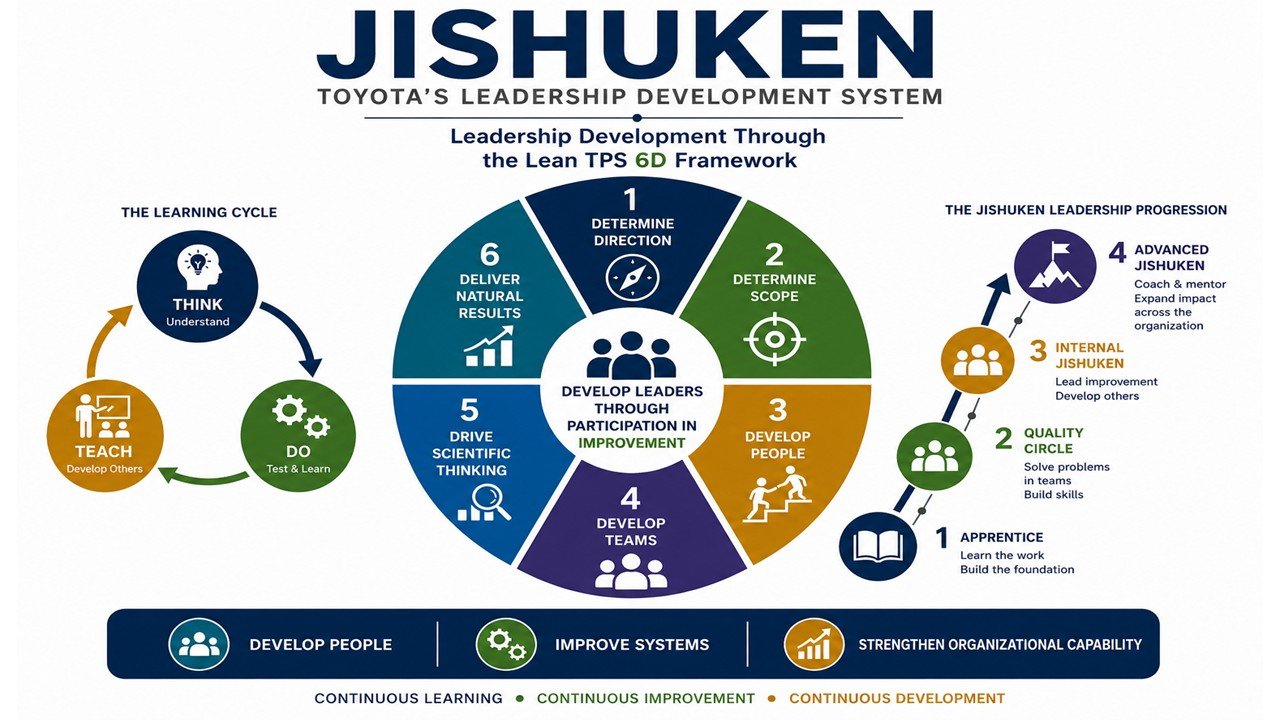
The Lean TPS 6D Leadership Framework provides a practical model for understanding how Toyota develops leadership capability through Jishuken. The framework draws upon recurring practices found throughout Toyota leadership development, Toyota Business Practices (TBP), PDCA, Genchi Genbutsu, and continuous improvement activities. Leadership capability develops through six interconnected dimensions: determining direction, determining scope, developing people, developing teams, driving scientific thinking, and delivering natural results.
Together, these dimensions transform daily operational challenges into opportunities for learning, capability development, and leadership growth at the Gemba. Leadership development and process improvement occur simultaneously because leaders develop through participation rather than position. Organizations improve while people improve, and performance improves as capability improves.
Within Lean TPS, leadership is not defined by title, authority, or organizational level. Leadership develops through direct engagement with problems, responsibility for improvement, and the ability to develop others. Jishuken provides the structured pathway through which that development occurs.
1. Leadership Development Was Built Into TPS
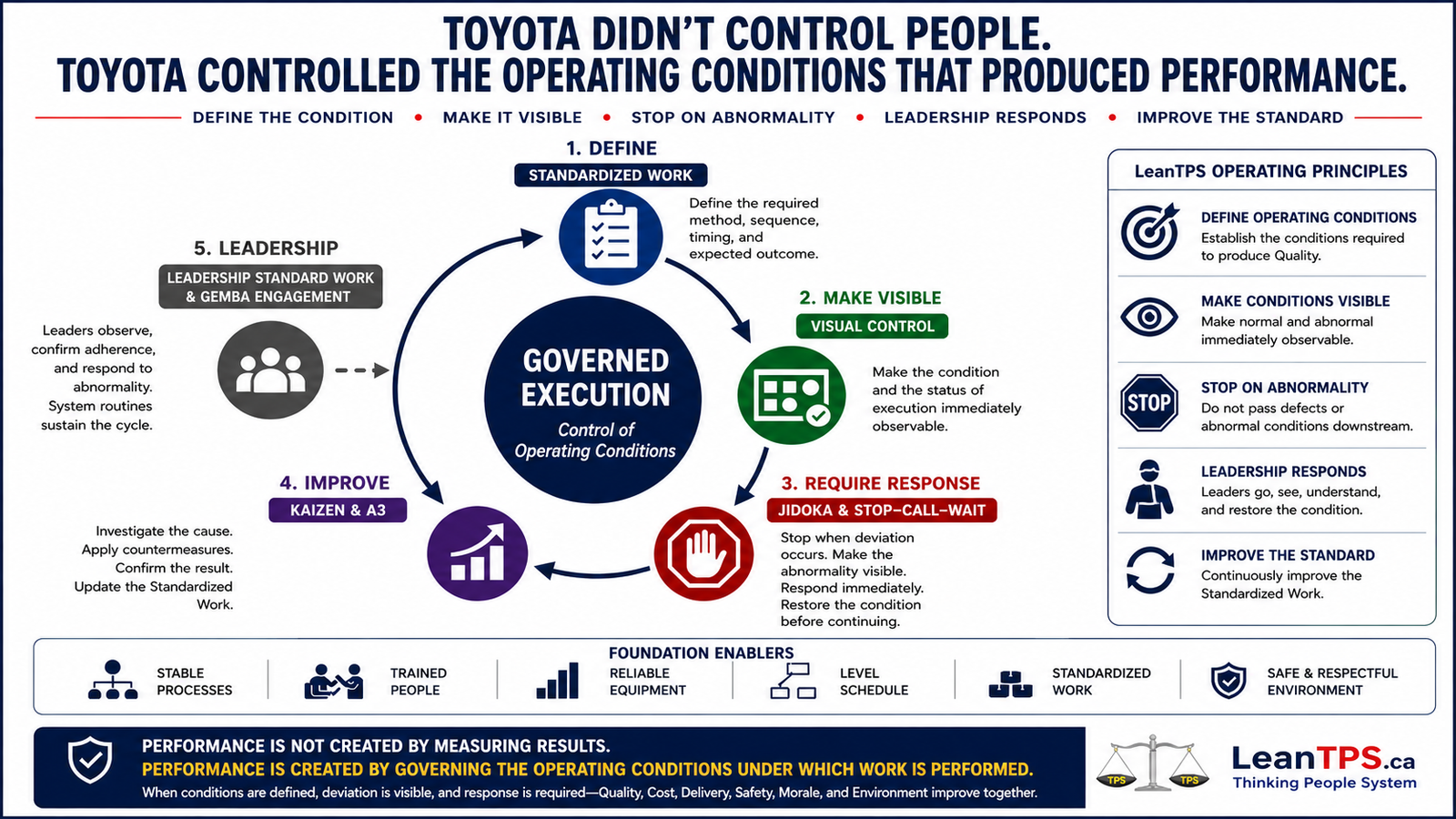
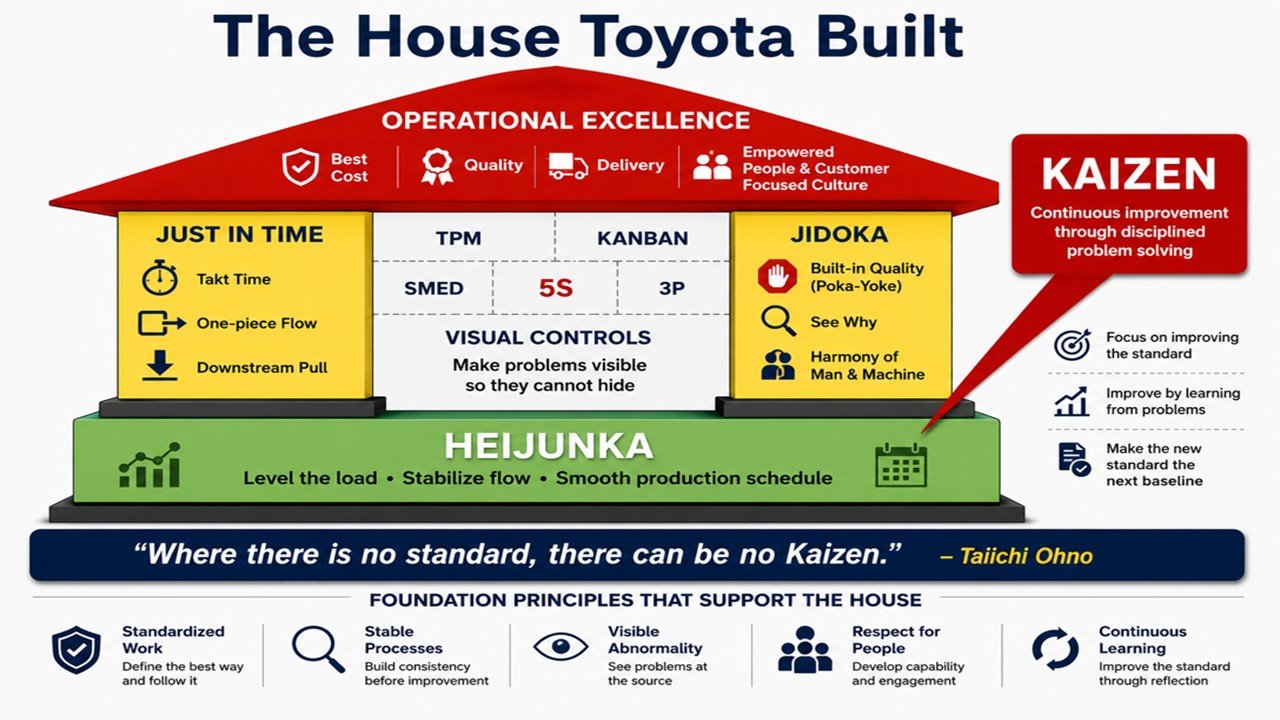
Many organizations view the Toyota Production System primarily as a production methodology. Discussions often focus on Just-in-Time, Jidoka, Standardized Work, Kanban, Heijunka, Kaizen, and waste elimination. Improvements in productivity, Quality, delivery performance, and cost frequently become the visible outcomes associated with Lean TPS implementation.
Operational performance remains important, but Toyota recognizes that long-term performance is ultimately constrained by leadership capability.
Every operating system eventually becomes limited by the capability of the people responsible for leading it. Processes require improvement, standards require maintenance, problems require investigation, and abnormal conditions require response. Sustainable performance therefore depends upon people capable of understanding, sustaining, and continuously improving the system.
Leadership development is embedded within the Toyota Production System because technical systems alone cannot guarantee long-term success. Equipment can automate tasks, procedures can define expectations, standards can establish operating conditions, and technology can increase capability. None of those elements can independently identify emerging problems, adapt to changing conditions, develop future leaders, or continuously improve organizational performance.
Those responsibilities cannot be delegated to technology, procedures, or standards. They remain fundamentally human responsibilities.
For this reason, leadership development is treated as an operational requirement rather than a separate administrative activity. Capability develops through participation in daily management, problem solving, improvement activities, coaching, and direct observation at the Gemba. Learning occurs where value is created and where problems can be studied firsthand.
The integration of improvement and people development remains one of the defining characteristics of the Toyota Production System.
Many organizations treat improvement as a project with a defined beginning and end. Success is often measured by completion of the project itself. Toyota approaches improvement differently. Every improvement effort represents an opportunity to strengthen both the operating system and the people responsible for managing it.
Process improvement generates operational benefits, but improvement activity also strengthens analytical capability, problem-solving discipline, technical understanding, teamwork, communication skills, and leadership judgment. Development of people and improvement of processes occur simultaneously. Improvement therefore serves not only as a mechanism for improving performance, but also as a mechanism for strengthening organizational capability.
Personal experience at Toyota BT Raymond reinforced this principle repeatedly. Improvement activities rarely focused exclusively on operational results. Leaders routinely challenged observations, questioned assumptions, and required teams to explain how conclusions had been reached. Discussions often focused on the thinking process behind decisions rather than the countermeasure itself. Reviews were designed to develop understanding, strengthen judgment, and improve problem-solving capability. Learning received as much attention as performance because developing people was considered essential to improving processes.
Toyota leaders also understand that future challenges cannot be predicted with certainty. Market conditions change. Customer expectations evolve. Technologies advance. Competitive pressures increase. Organizations therefore require leaders capable of learning, adapting, teaching, and improving rather than simply following established procedures.
Jishuken provides one of the most effective mechanisms for developing those capabilities.
Jishuken connects improvement activity, leadership development, coaching, and organizational learning into a single system. Participants learn by solving real problems under real operating conditions. Responsibility creates engagement. Reflection strengthens understanding. Teaching transfers learning to others. Improvement activity becomes a vehicle for developing future leaders while simultaneously improving operational performance.
Process improvement remains important, but leadership capability creates the lasting advantage. Processes require further improvement. Technologies change. Markets evolve. Leaders capable of improving systems, developing people, and adapting to changing conditions continue creating value long after individual projects have ended.
The Toyota Production System is designed to build both operational excellence and leadership capability because sustainable performance ultimately depends upon both.
2. What Is Jishuken?
Jishuken (自主研修) is commonly translated as “self-motivated study group” or “self-directed learning.” The translation provides useful context, but the meaning within Toyota extends far beyond a study group, training course, or improvement event.
Jishuken functions as a structured method for building capability through direct participation in improvement activities. Participants learn by observing processes, identifying abnormalities, investigating causes, testing countermeasures, reflecting upon results, and teaching others. Learning occurs through action rather than instruction alone because leadership capability develops most effectively when responsibility and learning occur together.
Many organizations attempt to develop leaders through classroom training, presentations, case studies, and management development programs. Such approaches can increase awareness and provide useful knowledge, but effective leadership develops through direct responsibility, problem solving, and experience. Real problems create real learning opportunities because participants must observe conditions, make decisions, test assumptions, accept responsibility for outcomes, and learn from the consequences of those decisions.
Jishuken reflects Toyota’s broader commitment to continuous learning and organizational development. As Toyota grew, product complexity increased, customer expectations evolved, and operations expanded across facilities, regions, and supply chains. Sustaining performance under those conditions required leaders capable of solving problems, improving systems, and developing other people. Sustaining performance under those conditions requires leaders capable of solving problems, improving systems, and developing other people.
For this reason, leadership development became embedded directly within the Toyota Production System rather than being treated as a separate training activity.
Future leaders gain practical experience through Jishuken by investigating processes, studying operating conditions, identifying waste, improving flow, strengthening Quality, and establishing better standards. Process improvement remains important, but development of people remains the larger objective.
Personal experience with Toyota-led Jishuken activities revealed an important distinction. Improvement projects rarely focused solely on achieving a result. Equal attention was placed on how observations were made, how causes were investigated, how conclusions were reached, and how learning could be transferred to others. Development of the participant received as much attention as development of the process because Toyota viewed learning as inseparable from improvement.
The relationship between Jishuken and the Toyota Production System is often misunderstood. Many Lean practitioners associate TPS primarily with operational tools such as Kanban, Standardized Work, Heijunka, Just-in-Time, Jidoka, and Andon systems. Those tools remain important because they create stability, visibility, flow, and Quality. Long-term success, however, depends upon people capable of understanding, applying, sustaining, and improving those systems.
Jishuken develops that capability by bringing together several of the core practices that define Lean TPS.
Kaizen provides the mechanism for improvement.
PDCA provides the scientific learning cycle.
Genchi Genbutsu provides direct understanding of actual conditions.
Standardized Work establishes the baseline against which improvement can be measured.
Within Toyota, these practices function together as an integrated learning system rather than as independent tools. Jishuken provides the environment in which they are applied simultaneously through real improvement work. Participants learn to observe conditions at the Gemba, distinguish normal from abnormal, investigate causes rather than symptoms, test countermeasures through PDCA, improve standards through Kaizen, and transfer learning through coaching and teaching.
The outcome extends far beyond process improvement. Standards establish expectations and create a basis for comparison. Direct observation reveals reality. Problem solving develops understanding. Improvement strengthens performance. Reflection develops judgment. Teaching transfers learning to future leaders while expanding organizational capability.
Leadership capability cannot be transferred through instruction alone. It develops through experience, responsibility, reflection, coaching, and repeated engagement with increasingly complex challenges. Jishuken provides the structure through which leaders develop while simultaneously strengthening the systems they are responsible for improving.
3. Why Toyota Developed Jishuken
Jishuken was not created because Toyota needed additional training programs. Jishuken was created because organizational growth produced a leadership challenge that training alone could not solve.
As Toyota expanded, operations became increasingly complex. New facilities were constructed, product lines multiplied, customer expectations evolved, and supply chains expanded across regions and countries. Every stage of growth increased the demand for people capable of maintaining standards, solving problems, developing teams, and improving performance.
Growth required more than additional production capacity. Sustainable expansion required leadership capability capable of growing alongside the organization.
Production systems can be replicated through equipment, procedures, standards, and technology. Leadership capability cannot. Future leaders must learn how to make decisions, solve problems, develop people, and improve systems under real operating conditions. Leadership capability develops differently. Future leaders must learn how to make decisions, solve problems, develop people, and improve systems under real operating conditions.
Traditional training methods provide knowledge, but knowledge alone rarely creates capability. Classroom instruction can explain problem solving, leadership principles, and continuous improvement concepts. Classroom instruction cannot create the experience required to apply those concepts under actual operating conditions where decisions carry consequences and outcomes matter.
Leadership capability develops through responsibility, decision making, reflection, and direct engagement with results. Judgment develops through application rather than observation.
Toyota addresses this challenge by integrating leadership development directly into operational improvement. Learning becomes part of the work itself rather than a separate activity. Participants investigate processes, identify abnormalities, analyze causes, develop countermeasures, verify results, and reflect upon outcomes. Responsibility for learning remains with the participant rather than the instructor, and improvement activity becomes the vehicle through which leadership capability develops.
Personal experience with Toyota-led improvement activities demonstrated this principle repeatedly. Reviews often focused less on the countermeasure itself and more on the thinking process that produced the countermeasure. Leaders challenged assumptions, questioned observations, and required participants to explain how conclusions had been reached. Development of problem-solving capability frequently received as much attention as operational results because Toyota understood that future performance depends upon future capability.
Genchi Genbutsu forms an essential part of this learning process. Problems are studied where they occur rather than where they are reported. Conditions are observed directly. Facts are verified firsthand. Countermeasures are evaluated against reality rather than assumptions. Direct observation often reveals a different understanding of a problem than reports, presentations, or performance metrics alone suggest. Learning accelerates because participants engage directly with the work and develop a deeper understanding of actual conditions.
Leadership development involves more than learning how to solve problems. Future leaders must also learn how to develop other people.
Individual expertise creates limited organizational benefit when knowledge remains concentrated within a few individuals. Sustainable improvement requires leaders capable of coaching, mentoring, teaching, and developing future leaders. Organizational learning depends upon knowledge moving throughout the system rather than remaining with a small group of experts.
Jishuken therefore incorporates collaboration, coaching, reflection, and knowledge transfer into the learning process. Participants learn how to improve processes while simultaneously learning how to develop others. Experienced leaders develop future leaders, creating a continuous cycle of capability development throughout the organization.
The objective extends far beyond improving individual projects. Toyota seeks to create an organization capable of continuously developing people, strengthening systems, and adapting to changing conditions. Improved people strengthen processes. Stronger processes improve performance. Improved performance creates new opportunities for learning, development, and further improvement.
Jishuken remains one of Toyota’s most effective leadership development mechanisms because it transforms daily operational challenges into opportunities for learning, coaching, organizational capability development, and continuous improvement.
4. The Lean TPS 6D Leadership Framework
Observation of Toyota leadership development practices reveals a consistent pattern. Successful Jishuken activities rarely begin with tools, solutions, or improvement events. Participants are first expected to understand the problem, the business impact, the people involved, and the conditions that must change. Leadership development follows a structured progression that aligns learning, problem solving, capability development, and organizational objectives.
The Lean TPS 6D Leadership Framework provides a practical model for understanding that progression. The framework draws upon recurring practices found throughout Toyota leadership development, Toyota Business Practices (TBP), PDCA, Genchi Genbutsu, and continuous improvement activities. Each dimension contributes to leadership growth while simultaneously improving organizational performance. Together, the six dimensions create a governance structure for developing leadership capability through real work rather than isolated training activities.
Determine Direction
Every Jishuken activity begins with purpose because activity without direction rarely produces meaningful progress. Teams become busy, projects move forward, resources are consumed and results frequently remain disconnected from broader organizational objectives.
Effective leaders establish direction before pursuing solutions.
Direction answers a fundamental question: What problem are we trying to solve, and why does it matter?
Customer requirements, business priorities, operational performance, safety, Quality, delivery, and long-term organizational objectives all influence the answer. Improvement exists to close meaningful gaps between current conditions and future requirements rather than simply generating activity.
Toyota frequently describes this concept through challenge conditions. Challenge conditions define a future state that does not yet exist but must be achieved. The challenge creates purpose, focus, and a basis for evaluating progress.
Personal experience with Toyota-led improvement activities reinforced the importance of this step repeatedly. Significant time was often spent understanding the business problem and clarifying objectives before discussions turned toward potential solutions. Clear direction prevented teams from solving the wrong problem.
Determine Scope
Direction establishes purpose. Scope establishes focus.
Many initiatives fail because the problem has not been clearly defined. Teams attempt to improve broad systems, multiple processes, and numerous objectives simultaneously. Complexity increases while learning decreases.
Toyota places significant emphasis on understanding the actual problem before pursuing countermeasures. Scope defines where the problem exists, which processes are involved, what conditions must be studied, who is affected, and how success will be measured. Clear boundaries allow participants to focus their efforts while maintaining alignment with broader organizational objectives.
A3 Thinking reinforces this discipline by requiring participants to understand current conditions, identify performance gaps, and define measurable objectives before proposing solutions. Well-defined scope improves learning because cause-and-effect relationships become easier to observe, test, and verify.
Develop People
People development remains the central purpose of Jishuken.
Operational improvement remains important, but improvement alone cannot sustain organizational performance. Future success depends upon capable people who can identify problems, improve systems, develop others, and adapt to changing conditions.
Leadership capability therefore develops through participation rather than observation.
Coaching plays a critical role within this process. Experienced leaders challenge assumptions, ask questions, encourage reflection, and guide learning without providing every answer. Participants learn how to think rather than simply what to do.
Personal experience at Toyota BT Raymond demonstrated this principle repeatedly. Improvement reviews often focused less on the proposed solution and more on the thinking process behind the solution. Leaders wanted participants to explain observations, justify conclusions, and demonstrate how decisions had been reached. Development occurred through responsibility, participation, reflection, and direct engagement with operational challenges.
Jishuken transforms operational improvement into leadership development.
Develop Teams
Leadership development within Toyota extends beyond individual capability because most organizational challenges cross departmental and functional boundaries. Quality issues affect production. Production issues affect logistics. Logistics issues affect customers. Sustainable improvement therefore requires collaboration across functions and disciplines.
Jishuken creates opportunities for people to learn together while solving shared problems. Cross-functional participation improves understanding of the broader value stream, reveals interactions between processes, and exposes causes that may remain hidden when problems are viewed from a single perspective.
Respect for People remains fundamental throughout this process. Every participant contributes knowledge, experience, and perspective. Effective leaders create conditions where those contributions can be challenged constructively, evaluated objectively, and incorporated into the learning process.
Individual capability remains important, but organizational capability creates long-term advantage.
Drive Scientific Thinking
Scientific thinking forms the foundation of Jishuken because effective decisions depend upon an accurate understanding of reality.
Many organizations develop managers who can defend opinions. Toyota develops leaders who can investigate reality.
PDCA provides the primary learning cycle. Planning establishes direction and assumptions. Doing tests those assumptions. Checking evaluates actual results. Acting incorporates learning into future standards and future decisions.
Genchi Genbutsu strengthens this process by requiring direct observation at the source. Conditions are studied firsthand. Facts are verified directly. Decisions are grounded in reality rather than assumptions.
A3 Thinking provides a structured method for organizing observations, analysis, countermeasures, and learning, while root cause analysis helps participants move beyond symptoms to understand underlying causes.
Personal experience with Toyota-led reviews consistently revealed the same expectation. Conclusions required evidence. Opinions required verification. Assumptions required testing.
Scientific thinking slows premature decision making while accelerating organizational learning.
Deliver Natural Results
Most organizations focus primarily on results. Toyota focuses on the conditions that make results possible.
Jishuken does not ignore performance. Operational improvement remains an important objective. Sustainable performance, however, emerges from capable people operating within effective systems.
Improved standards create greater stability. Greater stability improves visibility. Better visibility strengthens problem solving. Better problem solving improves performance. Improved performance creates new opportunities for learning, development, and further improvement.
The relationship is cumulative rather than isolated.
Results emerge naturally when direction is clear, scope is defined, people are developed, teams collaborate effectively, and scientific thinking guides decision making. The objective therefore extends beyond individual projects, individual improvements, or short-term performance gains.
Toyota seeks to develop an organization capable of learning, adapting, teaching, and improving continuously.
The Lean TPS 6D Leadership Framework provides a practical model for understanding how Jishuken develops organizational capability and why leadership development remains inseparable from continuous improvement within Lean TPS.
5. Leadership Through Thinking, Doing, and Teaching
Many leadership development programs emphasize knowledge acquisition. Participants attend training sessions, complete certifications, study leadership models, and learn new management techniques. Knowledge remains important, but knowledge alone rarely changes behavior. Awareness can be created in a classroom. Capability develops through application, reflection, and experience.
Toyota recognized this distinction decades ago, and Jishuken continues to reflect it today.
Understanding a concept is not the same as applying a concept. Reading about problem solving is not the same as solving problems. Studying leadership is not the same as leading people through uncertainty, conflicting priorities, and operational challenges. Leadership develops through a continuous cycle of thinking, doing, and teaching, with each element reinforcing and strengthening the others. Thinking without action produces theory. Action without reflection produces repetition. Teaching without understanding transfers misunderstanding. Sustainable leadership development requires all three.
Thinking: Learning Through Scientific Problem Solving
Toyota develops leaders by teaching them how to think before teaching them how to act.
Scientific thinking forms the foundation of Jishuken because effective decisions depend upon an accurate understanding of reality. Participants learn to observe conditions directly, separate facts from assumptions, investigate causes, test hypotheses, and evaluate results. PDCA, Genchi Genbutsu, A3 Thinking, and root cause analysis provide the structure for this learning process.
Personal experience within Toyota-led improvement activities revealed that leaders frequently focused more attention on the thinking process than the final answer. Participants were expected to explain observations, justify conclusions, and demonstrate how decisions had been reached. Reviews often explored why a conclusion had been reached rather than whether the conclusion appeared correct.
The objective was never simply to arrive at an answer. The objective was to develop the ability to think systematically, investigate conditions thoroughly, and understand the relationship between cause and effect before taking action. Leadership begins with understanding the actual condition before attempting to improve it.
Doing: Learning Through Direct Experience
Scientific thinking provides the foundation, but development occurs only when knowledge is applied under real operating conditions where outcomes matter and consequences are visible.
Jishuken places participants directly into the improvement process. Teams investigate actual problems, analyze current conditions, develop countermeasures, verify results, and establish improved standards. Responsibility for learning remains with the participant rather than the instructor.
Direct experience accelerates learning because reality provides immediate feedback. Successful countermeasures confirm understanding. Unsuccessful countermeasures expose assumptions, reveal gaps in knowledge, and create opportunities for deeper learning. Both outcomes contribute to development.
The Gemba becomes the learning environment where participants experience firsthand how decisions influence performance. Real operational problems provide the context for learning, and improvement activity becomes the method through which capability develops. Participants learn how to make decisions, adapt to changing conditions, and respond to uncertainty in ways that cannot be replicated through classroom instruction alone.
Teaching: Learning Through Developing Others
Teaching occupies an equally important role within Jishuken because it reveals the depth of understanding.
Participants often discover weaknesses in their own thinking when attempting to explain concepts to others. Teaching requires clarity, understanding, patience, and the ability to translate experience into learning that others can apply.
Jishuken therefore extends beyond personal development. Participants are expected to share knowledge, coach team members, transfer learning, and help others improve. Experienced leaders develop future leaders, allowing knowledge and capability to move throughout the organization rather than remaining concentrated within a few individuals.
This aspect of Jishuken reflects a broader Toyota principle. Individual expertise creates limited organizational benefit when knowledge remains isolated. Sustainable improvement depends upon an organization’s ability to transfer learning, strengthen capability, and develop people at every level. Teaching therefore strengthens both the learner and the teacher.
The Toyota Learning Cycle
Thinking, doing, and teaching are not independent activities. Together they form a continuous learning cycle that strengthens both individual capability and organizational capability.
Thinking develops understanding. Doing transforms understanding into experience. Teaching converts experience into organizational learning.
Teaching transfers experience into organizational learning.
Each cycle expands capability and creates the foundation for the next cycle of learning. Over time, participants develop the judgment, discipline, adaptability, and leadership capability required to address increasingly complex challenges.
Toyota built Jishuken around this learning cycle because sustainable improvement depends upon more than technical expertise. Organizations require leaders capable of understanding conditions, acting effectively, developing others, and continuously improving the systems for which they are responsible.
Jishuken provides the structure through which leadership development becomes part of the Toyota Production System, transforming daily operational challenges into opportunities for learning, organizational capability development, and continuous improvement.
6. The Jishuken Leadership Progression
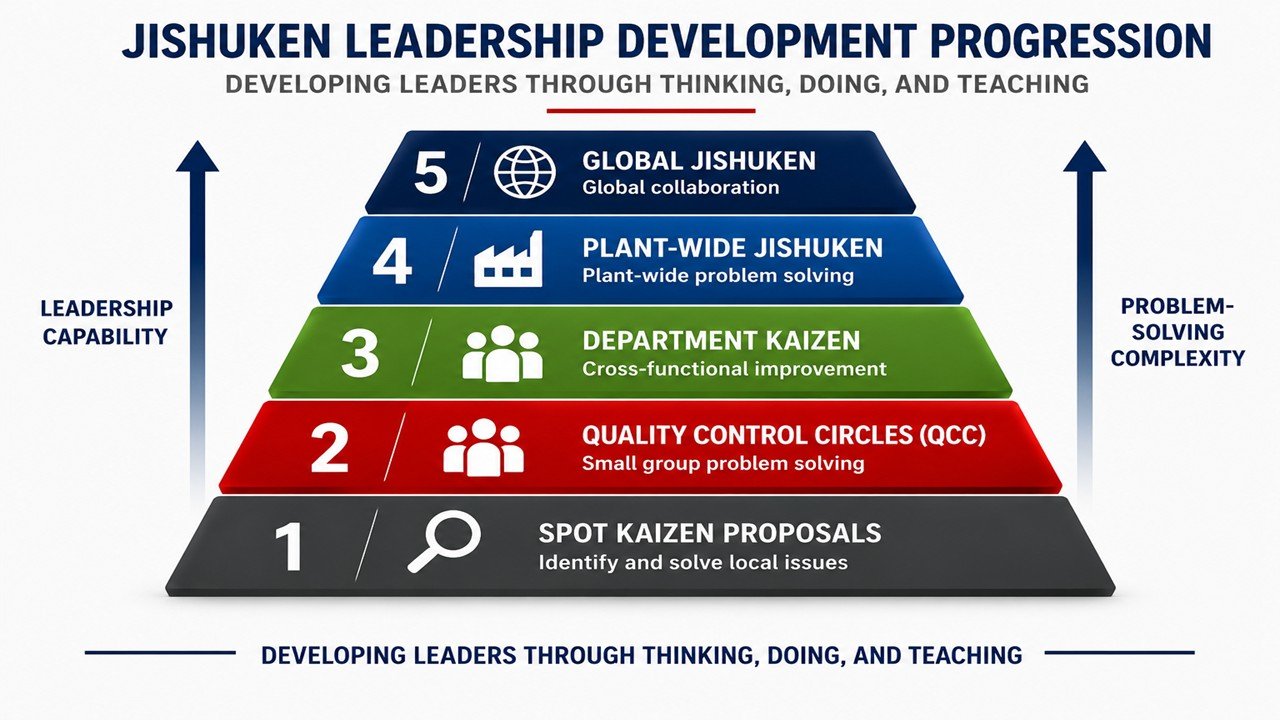
Leadership development within Toyota does not occur through a single event, certification, or training program. Capability develops progressively through increasing levels of responsibility, complexity, and organizational contribution.
Jishuken provides a structured pathway through which participants develop the knowledge, judgment, and experience required to improve increasingly complex systems. Each stage builds upon the previous stage. Technical understanding develops first. Responsibility expands over time. Coaching, mentoring, and organizational influence emerge as experience grows.
The progression reflects a fundamental Toyota principle: responsibility should expand only as capability is developed through experience. Responsibility increases as capability increases, creating a natural progression from learning the work, to improving the work, to leading improvement efforts, and ultimately to developing others.
Apprentice Level
Development begins with understanding the work.
Participants learn Standardized Work, process discipline, workplace organization, and the fundamentals of waste recognition. Observation skills develop through direct exposure to operating conditions at the Gemba. Participants learn how to distinguish normal from abnormal conditions and how to recognize activities that fail to create value.
Basic Kaizen activities often provide the first opportunity to participate in improvement efforts. Small improvements help participants understand the relationship between standards, abnormalities, problem solving, and performance. Learning remains focused on developing awareness, observation, and discipline rather than implementing large-scale change.
Many organizations attempt to introduce advanced improvement tools before developing this foundation. Toyota follows the opposite approach. Understanding the work precedes improving the work because improvement without understanding often produces activity without meaningful learning.
Quality Circle Level
As capability develops, responsibility expands.
Quality Circle activities introduce participants to team-based problem solving and structured improvement efforts. Small groups investigate problems, collect data, analyze causes, develop countermeasures, and present results.
Development begins to move beyond individual performance. Participants learn how to facilitate discussions, build consensus, communicate ideas, and coordinate improvement efforts involving multiple people. Technical problem-solving capability continues to develop while interpersonal and leadership skills become increasingly important.
Many future Toyota leaders gain their first practical leadership experience through Quality Circle activities because responsibility extends beyond personal performance and begins to include the performance of the team. Participants learn that improvement is not simply about solving problems. Improvement also requires the ability to engage people, align efforts, and create shared understanding.
Internal Jishuken Level
Internal Jishuken expands both scope and responsibility.
Improvement activities move beyond local processes and departmental boundaries. Participants begin addressing larger operational challenges involving multiple functions, broader value streams, and more complex organizational interactions.
Cross-functional collaboration becomes essential because decisions made within one area frequently influence performance elsewhere in the system. Problems are studied from a broader organizational perspective, and improvement efforts increasingly focus on flow, Quality, operational stability, and value-stream performance rather than isolated process improvements.
Expectations increase accordingly. Participants are expected to guide improvement activities, facilitate learning, coordinate resources, and support the development of others. Technical expertise remains important, but leadership becomes increasingly visible through the ability to influence, align, and develop teams across organizational boundaries.
Personal experience within Toyota environments revealed that many of the most valuable learning opportunities occurred at this level. Larger challenges exposed limitations in thinking, communication, and problem-solving approaches that smaller projects often concealed. Complexity became a powerful teacher because success depended upon understanding the interactions between people, processes, systems, and organizational objectives.
Advanced Jishuken Level
Advanced Jishuken shifts the focus from improving processes to developing organizational capability.
Experienced participants increasingly assume coaching, mentoring, and leadership-development responsibilities. Improvement activities frequently extend beyond departmental or facility boundaries and may include supplier development, value-stream improvement, and broader organizational initiatives.
Success is no longer measured solely by the participant’s ability to solve problems. Success is increasingly measured by the ability to develop others who can solve problems, improve systems, and develop future leaders.
Coaching becomes a primary responsibility. Experienced practitioners challenge assumptions, guide learning, transfer knowledge, and help future leaders develop judgment through direct experience. Leadership increasingly depends upon influence, teaching, and capability development rather than positional authority.
Supplier development activities often provide powerful examples of this progression. Toyota’s long-term success has depended not only upon improving internal operations but also upon strengthening the capability of suppliers and partners throughout the value stream. Leadership therefore extends beyond organizational boundaries and into the broader network of relationships that support performance.
The progression from apprentice to advanced practitioner reflects the fundamental purpose of Jishuken. Participants do not simply learn how to improve processes. Participants learn how to develop people, strengthen systems, and create the conditions for continuous learning throughout the organization.
The highest expression of leadership within Lean TPS is not the ability to solve problems personally. The highest expression of leadership is the ability to develop people who can solve problems, improve systems, develop others, and sustain the cycle of learning long into the future.
7. Jishuken and the Development of Future Leaders
Many organizations approach leadership development as a succession-planning activity. High-potential employees are identified, development plans are created, and selected individuals receive additional training in preparation for future leadership positions.
Toyota approaches leadership development from a fundamentally different perspective.
Leadership is not viewed as a program designed for a small group of future managers. Leadership is treated as an organizational capability that must be developed throughout the system. The objective extends beyond preparing individuals for promotion. The objective is to create a continuous process through which people develop the ability to solve problems, improve systems, develop others, and assume greater responsibility over time.
Leadership therefore becomes a capability rather than a position.
Many organizations associate leadership primarily with authority, titles, reporting relationships, and organizational hierarchy. Within Toyota, leadership is demonstrated through the ability to understand conditions, identify problems, develop countermeasures, improve performance, and help others learn. These capabilities can be demonstrated by team members, supervisors, managers, executives, and senior leaders alike.
Jishuken develops those capabilities progressively throughout a person’s career.
Future supervisors learn how to improve processes.
Future managers learn how to improve systems.
Future executives learn how to improve organizations.
Although responsibilities expand, the underlying development process remains remarkably consistent. Observation develops understanding. Problem solving develops judgment. Responsibility develops leadership. Teaching develops future leaders. The progression continues throughout every level of the organization because learning never ends.
Developing leaders in this manner creates a sustainable organizational advantage.
Organizations routinely encounter situations that existing procedures cannot address. Market conditions change. Customer expectations evolve. New technologies emerge. Competitive pressures increase. Established methods eventually become insufficient. Long-term success therefore depends upon people capable of learning and adapting faster than conditions change.
Jishuken was designed to develop leaders capable of responding to uncertainty rather than simply managing routine activities.
Personal experience within Toyota environments consistently reinforced this long-term perspective. Improvement activities rarely focused solely on solving the immediate problem. Equal attention was given to developing the people responsible for solving future problems. Leaders understood that today’s countermeasure would eventually become tomorrow’s standard, and tomorrow’s standard would eventually require further improvement. Development of people and improvement of processes were inseparable activities.
The relationship between Jishuken and organizational learning is particularly important.
Many organizations possess talented individuals but struggle to transfer knowledge throughout the organization. Expertise becomes concentrated within a small number of people. Retirement, promotion, turnover, or organizational change can quickly erode capability and create performance gaps.
Toyota sought to prevent this condition by creating structured mechanisms for transferring knowledge, developing problem-solving capability, and strengthening leadership at every level. Jishuken serves as one of the primary mechanisms through which that transfer occurs.
Learning moves from experienced leaders to developing leaders. Developing leaders become future coaches and mentors. Knowledge spreads throughout the organization rather than remaining concentrated within a few individuals. Over time, problem-solving capability expands, organizational learning strengthens, and leadership capability grows because learning becomes embedded within the operating system itself.
This characteristic helps explain why Toyota has sustained improvement across generations of leaders. Knowledge is not preserved primarily through procedures, documentation, or databases. Knowledge is preserved through people who learn, practice, teach, and develop others.
Sustainable success depends upon more than products, equipment, technology, or operational systems. Sustainable success depends upon people capable of learning, teaching, adapting, and improving continuously.
Jishuken was designed to develop exactly those capabilities.
The result is not simply better leaders. The result is an organization capable of continuously developing leaders, strengthening organizational capability, and sustaining improvement across generations of change.
8. Jishuken in the Age of AI and Humanoid Robotics
Artificial Intelligence, advanced automation, autonomous systems, and humanoid robotics are rapidly transforming how organizations operate. Significant attention is being directed toward machine learning, predictive analytics, robotics, digital manufacturing, and intelligent automation platforms. Technology is advancing at an extraordinary pace, while organizational learning and leadership development often advance more slowly.
This imbalance creates an important challenge.
Many organizations approach technological advancement primarily as an engineering, information technology, or capital investment issue. New software can be purchased. New equipment can be installed. New systems can be integrated. Technical capability can often be acquired faster than the organizational capability required to apply it effectively.
Toyota recognized a similar challenge long before Artificial Intelligence existed.
New technology does not eliminate the need for leadership. New technology increases the need for leadership.
Greater automation creates greater complexity. More interconnected processes create more interactions. Larger volumes of data create more opportunities for misinterpretation. Faster operating speeds reduce the time available to recognize and respond to abnormal conditions. As complexity increases, the ability to understand cause-and-effect relationships becomes more difficult and more important.
The management challenge therefore becomes more demanding rather than less demanding.
Mixed-model human-humanoid environments provide a useful example. Future operating systems will increasingly require people and intelligent machines to work together within shared processes. Human operators, automated equipment, Artificial Intelligence systems, and humanoid robots will increasingly exchange information, influence decisions, and affect operational performance simultaneously.
Under these conditions, the principles that have always supported Lean TPS become even more important.
Standardized Work becomes more important because operating expectations must be clearly defined.
Abnormality detection becomes more important because deviations must be recognized before they propagate through increasingly interconnected systems.
Problem solving becomes more important because causes become more difficult to identify as complexity increases.
Leadership becomes more important because effective responses require judgment, learning, coordination, and adaptation.
Technology can execute tasks.
Technology cannot replace organizational learning.
Organizations must still understand conditions, identify abnormalities, investigate causes, develop countermeasures, and continuously improve performance. Future systems may generate more information than any previous generation of technology, but information alone does not create understanding. Data can support decisions. Understanding still requires observation, analysis, reflection, and judgment.
The speed of learning therefore becomes a competitive advantage.
Organizations capable of identifying problems, testing countermeasures, and adapting rapidly will outperform organizations that rely solely upon technological capability. Competitive advantage increasingly depends upon learning faster than conditions change.
This relationship explains why Jishuken becomes increasingly important in advanced operating environments.
Jishuken develops the capabilities required to operate effectively within uncertainty. Participants learn how to observe conditions directly, separate facts from assumptions, test ideas scientifically, reflect upon outcomes, and transfer learning to others. These capabilities remain essential regardless of whether work is performed by people, machines, or a combination of both.
Personal experience within Lean TPS environments consistently reinforced a simple principle. Stable execution must exist before advanced capability can create sustainable value. Technology performs within the operating system that already exists. Unstable systems simply execute instability faster.
The same principle applies to Artificial Intelligence, advanced automation, and humanoid robotics.
Organizations that struggle with Standardized Work, problem solving, leadership development, and continuous improvement today will encounter greater challenges as operational complexity increases tomorrow. Technology may increase capability, but technology does not eliminate the need for disciplined management systems, scientific thinking, or leadership development.
Jishuken addresses this challenge by strengthening the human capability required to manage complexity, uncertainty, and change. Future leaders will need to understand technology, but they must also understand people, systems, learning, and organizational capability. Success will increasingly depend upon the ability to integrate all of these elements into operating systems capable of adapting continuously as conditions evolve.
The fundamental leadership challenge remains remarkably consistent with the challenge Toyota faced decades ago.
How does an organization continue to improve when the conditions that created its success are constantly changing?
Jishuken provides a practical answer by developing leaders capable of learning, adapting, and improving faster than the environment around them changes.
For this reason, Jishuken becomes more important, not less important, as organizations navigate the increasing complexity created by Artificial Intelligence, advanced automation, and humanoid robotics.
9. Leadership Development as a Competitive Advantage
Many organizations measure success through visible outcomes. Productivity improves. Costs decrease. Quality improves. Delivery performance strengthens. Financial results increase.
These outcomes matter because they reflect the performance of the organization. Toyota, however, viewed them through a different lens. Most organizations focus primarily on results. Toyota focuses on the capability that produces results.
This distinction helps explain why many improvement efforts achieve short-term gains but struggle to sustain long-term performance. New initiatives generate enthusiasm. Improvement projects produce measurable benefits. Results improve for a period of time. Performance eventually plateaus or declines because the ability required to sustain improvement was never fully developed.
Toyota follows a different approach.
Operational performance remains important, but development of people receives equal attention. Improvement activities are designed to strengthen both the operating system and the people responsible for the operating system. Every problem becomes an opportunity to improve performance while simultaneously strengthening future capability.
The long-term perspective is deliberate.
Processes change.
Products change.
Technologies change.
Markets change.
Organizations capable of learning, adapting, teaching, and improving continue to create value regardless of how operating conditions evolve. Sustainable success therefore depends upon developing people who can strengthen the organization long after individual improvement projects have ended.
Personal experience within Toyota environments consistently reinforced this perspective. Improvement reviews often focused on questions that extended beyond the immediate problem. Leaders wanted to understand what had been learned, how learning would be transferred, and how understanding would be strengthened throughout the organization. Solving the problem mattered. Developing the ability to solve future problems mattered even more.
This perspective also helps explain why many organizations struggle to sustain improvement.
Improvement tools can be implemented quickly.
New standards can be documented.
Technology can be purchased.
Results can improve rapidly.
Judgment develops more slowly.
Problem-solving capability develops more slowly.
Organizational learning develops more slowly.
Many organizations invest heavily in systems, technology, and improvement initiatives while investing less attention in the people responsible for sustaining those improvements. Performance often improves temporarily before returning toward previous levels because organizational capability has not improved at the same rate as the operating system.
Toyota approaches people development as an organizational strategy rather than a supporting activity.
Jishuken serves as one of the primary mechanisms through which that strategy is executed. Participants learn how to solve problems, improve systems, develop others, and transfer knowledge throughout the organization. Leadership development does not operate alongside improvement. Leadership development becomes part of the improvement process itself.
The result extends far beyond stronger individual leaders.
Problem-solving capability expands.
Organizational learning strengthens.
Adaptability increases.
Improvement becomes more sustainable because the people responsible for improvement become more capable.
Toyota’s long-term success is often attributed to production systems, operational excellence, and continuous improvement. Those achievements remain important. Sustaining them across decades requires something deeper than operational tools alone.
Toyota develops systems that improve performance.
Toyota develops people who improve systems.
The combination creates one of the most powerful competitive advantages an organization can possess.
An organization capable of continuously developing leaders, strengthening organizational capability, and learning faster than conditions change.
Final Thought
Many organizations measure success through visible outcomes. Productivity improves. Costs decrease. Quality improves. Delivery performance strengthens. Financial results increase.
These outcomes matter because they reflect organizational performance. Toyota, however, viewed them through a different lens. Most organizations focus primarily on results. Toyota focuses on the capability that produces results.
This distinction helps explain why many improvement efforts achieve short-term gains but struggle to sustain long-term performance. New initiatives generate enthusiasm. Improvement projects produce measurable benefits. Results improve for a period of time. Performance eventually plateaus or declines because the capability required to sustain improvement was never fully developed.
Toyota follows a different approach.
Operational performance remains important, but development of people receives equal attention because performance ultimately reflects capability. Improvement activities are designed to strengthen both the operating system and the people responsible for the operating system. Every problem becomes an opportunity to improve performance while simultaneously strengthening future capability.
The long-term perspective is deliberate.
Processes change.
Products change.
Technologies change.
Markets change.
Organizations capable of learning, adapting, teaching, and improving continue to create value regardless of how technologies, markets, or operating conditions evolve. Sustainable success therefore depends upon developing people who can strengthen the organization long after individual improvement projects have ended.
Personal experience within Toyota environments consistently reinforced this perspective. Improvement reviews often focused on questions that extended beyond the immediate problem. Leaders wanted to understand what had been learned, how learning would be transferred, and how understanding would be strengthened throughout the organization. Solving the problem mattered. Developing the ability to solve future problems mattered even more.
This perspective also helps explain why many organizations struggle to sustain improvement.
Improvement tools can be implemented quickly.
New standards can be documented.
Technology can be purchased.
Results can improve rapidly.
Judgment develops more slowly.
Problem-solving capability develops more slowly.
Organizational learning develops more slowly.
Many organizations invest heavily in systems, technology, and improvement initiatives while investing comparatively less in the people responsible for sustaining those improvements. Performance often improves temporarily before returning toward previous levels because organizational capability has not improved at the same rate as the operating system.
Toyota approaches people development as an organizational strategy rather than a supporting activity.
Jishuken serves as one of the primary mechanisms through which that strategy is executed. Participants learn how to solve problems, improve systems, develop others, and transfer knowledge throughout the organization. Leadership development does not operate alongside improvement. Leadership development is embedded within the improvement process itself.
The result extends far beyond stronger individual leaders. Problem-solving capability expands. Organizational learning strengthens. Adaptability increases. Organizational capability grows.
Improvement becomes more sustainable because the people responsible for improvement become more capable.
Toyota’s long-term success is often attributed to production systems, operational excellence, and continuous improvement. Those achievements remain important. Sustaining them across decades requires something deeper than operational tools alone.
Toyota develops systems that improve performance. Toyota develops people who improve systems. The combination creates one of the most powerful competitive advantages an organization can possess.