Why Most Leadership Development Fails
Jishuken is one of the most important leadership development mechanisms within the Toyota Production System.
Organizations invest significant resources in leadership development. Training programs, workshops, executive seminars, certification courses, coaching initiatives, and succession planning systems have become standard practice across most industries. Despite these investments, many organizations continue to struggle with leadership effectiveness, employee engagement, succession readiness, and the successful execution of improvement initiatives.
The underlying problem is rarely a lack of training opportunities. Most organizations provide more leadership training today than at any point in history. The challenge is that leadership development is frequently treated as the transfer of knowledge rather than the development of capability.
Traditional leadership development typically occurs outside the workplace. Participants attend courses, study leadership models, discuss case studies, and review management theories. While these activities may increase awareness and introduce useful concepts, they often remain disconnected from the realities of daily operations. Individuals return to their organizations with new information but limited opportunity to repeatedly apply, test, and refine what they have learned under actual operating conditions.
This distinction between knowledge and capability is critical. Knowledge allows individuals to explain a concept, describe a process, or discuss a leadership principle. Capability is demonstrated through action. Reading about problem solving does not create a skilled problem solver. Studying communication techniques does not create an effective coach. Attending a course on continuous improvement does not develop the ability to identify abnormal conditions, conduct root-cause analysis, implement countermeasures, and sustain results in a complex operating environment.
Leadership capability develops through practice, reflection, and experience. Judgment is strengthened by making decisions under real conditions. Problem-solving ability develops through repeated exposure to actual problems. Coaching capability grows through direct interaction with people facing challenges, resistance, and uncertainty. These capabilities cannot be fully developed through instruction alone because they require application within the context of real work.
Toyota recognized this reality decades ago. The company understood that future leaders could not be developed solely through classroom training, regardless of how well designed the curriculum might be. Leadership within the Toyota Production System requires observation, discipline, critical thinking, problem-solving ability, and the capacity to develop others. These capabilities emerge through experience and practice rather than theoretical study.
For this reason, Toyota embedded leadership development directly into the daily management and continuous improvement activities of the Toyota Production System. Learning occurs while solving actual problems. Development occurs while improving actual processes. Leaders gain capability by observing work, understanding conditions, identifying abnormalities, applying countermeasures, confirming results, and teaching others through the same process.
This approach reflects one of the most important principles within Lean TPS: people develop through participation. Improvement activities are not conducted solely to improve Quality, productivity, delivery performance, or cost. They are also designed to strengthen the capability of the people responsible for achieving those outcomes. Every Kaizen activity, every PDCA cycle, every root-cause investigation, and every improvement effort serves as an opportunity to develop leadership capability while simultaneously improving operational performance.
Rather than separating learning from work, Toyota integrates learning into work. Rather than viewing leadership development as a human resources function, Toyota treats leadership development as an operational responsibility embedded within the management system itself.
This philosophy led to the creation of one of Toyota’s most important leadership development mechanisms: Jishuken.
Jishuken provides a structured environment where leadership capability is developed through continuous improvement activity. Participants learn by engaging directly with operational challenges, applying disciplined problem-solving methods, working across organizational boundaries, and coaching others through the same process. Leadership development and process improvement occur together because both are achieved through direct participation in improvement work.
The purpose of Jishuken extends far beyond process improvement. While measurable gains in Quality, safety, delivery, productivity, and cost are important outcomes, they are not the primary objective. Toyota created Jishuken to develop people capable of sustaining and improving the system itself.
The ultimate purpose of Jishuken is not simply to improve processes.
The ultimate purpose of Jishuken is to develop leaders capable of improving processes for the rest of their careers.
1. The Toyota View of Leadership Development
Toyota approaches leadership development differently than most organizations. Leadership is not defined primarily by position, authority, title, or organizational status. Within the Toyota Production System, leadership is viewed as a capability that must be developed through experience, disciplined practice, continuous learning, and direct engagement with the work itself.
This distinction is significant because positions can be assigned, while capability must be developed. An individual may receive a promotion, assume management responsibilities, or hold a senior title without possessing the ability to lead improvement, solve complex problems, or develop the capability of others. Toyota therefore places greater emphasis on demonstrated performance and practical leadership capability than on organizational rank.
The Toyota Production System measures leadership through action. Leaders are expected to understand operating conditions, recognize abnormalities, support Quality, improve processes, and develop people. Leadership is not exercised from a distance through reports, metrics, and directives alone. Effective leaders create the conditions that allow people, processes, and systems to perform successfully while continuously improving those conditions over time.
This perspective fundamentally changes the role of management. Rather than functioning primarily as decision-makers who provide answers, leaders become teachers who develop thinking. Rather than acting solely as supervisors who monitor performance, they become coaches who strengthen capability throughout the organization. Achieving results remains important, but equal attention is given to developing the systems and people responsible for producing those results.
Responsibility occupies a central role within this philosophy. Authority provides the ability to make decisions, but responsibility requires leaders to understand the consequences of those decisions and take ownership of the conditions influencing performance. Leadership therefore extends beyond responding to problems after they occur. Leaders establish standards, confirm execution, identify gaps between expected and actual conditions, and support improvement before instability becomes chronic.
These responsibilities begin at the point of work. Toyota expects leaders to understand actual conditions directly rather than relying exclusively on reports or assumptions. Decisions are grounded in observation, evidence, and firsthand knowledge of the process. This expectation reflects the principle of Genchi Genbutsu, which requires leaders to go and see for themselves in order to understand reality before taking action.
For this reason, Toyota develops leaders through improvement activity rather than classroom instruction alone. Improvement work exposes leaders to operational realities that cannot be fully understood through theory. Quality problems become visible. Abnormal conditions must be investigated. Root causes must be identified. Countermeasures must be tested, verified, and adjusted based upon actual results. Each improvement effort becomes a practical learning experience that strengthens judgment, problem-solving capability, and leadership discipline.
Continuous improvement and leadership development therefore operate as a single system. Every PDCA cycle strengthens analytical thinking. Every root-cause investigation improves problem-solving capability. Every Kaizen activity develops communication, teamwork, and coaching skills. Leaders learn how to think scientifically while simultaneously improving operational performance.
Toyota recognized that long-term success depends less upon equipment, technology, or facilities than upon the capability of people to learn, adapt, and improve. Products evolve, markets shift, technologies advance, and customer expectations change. Organizations that cannot develop people capable of responding to those changes eventually lose the ability to compete effectively.
As a result, people development became a core objective of the Toyota Production System rather than a separate human resources function. Continuous improvement exists to improve operational performance, but it also exists to develop the individuals responsible for sustaining and advancing that performance. Every Kaizen activity, Quality improvement effort, problem-solving exercise, and Jishuken activity serves both objectives simultaneously.
This integration of process improvement and people development remains one of the defining characteristics of the Toyota Production System. Operational performance improves because people improve the processes. Long-term organizational capability improves because people learn how to observe, analyze, teach, and lead.
Jishuken was created to accelerate this development. It provides a structured environment where leaders learn through direct participation in improvement activity, strengthen their capability through practical application, and develop others through the same process. The result is a leadership development system that connects learning, continuous improvement, Quality, and operational performance into a single integrated approach.
2. The Purpose of Jishuken
The word Jishuken (自主研修) is commonly translated as “self-motivated study” or “self-directed learning.” While the translation is accurate, it does not fully capture the role Jishuken plays within the Toyota Production System. Jishuken is not a training course, workshop, or classroom exercise. It is a structured leadership development process that combines learning, problem solving, and continuous improvement through direct participation in actual work.
Toyota developed Jishuken from a simple but powerful understanding of how people learn. Knowledge can be transferred through instruction, but capability develops through experience. Problem-solving ability is strengthened by solving problems. Coaching capability develops through developing others. Leadership grows when individuals accept responsibility for understanding conditions, improving performance, and supporting organizational learning.
The origins of Jishuken can be traced to Toyota’s recognition that sustainable improvement depends upon the capability of people rather than the capability of tools. During the development of the Toyota Production System, leaders such as Taiichi Ohno understood that methods alone could not guarantee long-term success. Standardized Work, Just-in-Time, Jidoka, visual management, and Kaizen provided essential operating mechanisms, but those mechanisms required people capable of understanding, sustaining, and continuously improving them.
As the Toyota Production System expanded across departments, plants, suppliers, and international operations, Toyota faced a challenge that could not be solved through procedures alone. The company required leaders capable of understanding TPS principles deeply enough to apply, sustain, improve, and teach them under different operating conditions.
Taiichi Ohno and other Toyota leaders understood that the long-term success of TPS would depend upon the organization’s ability to continuously develop people. A small group of experts could not personally support every improvement activity, coach every manager, or solve every operational problem. Leadership capability had to be distributed throughout the enterprise.
Jishuken emerged as one of the primary mechanisms used to achieve that objective. Rather than relying exclusively on classroom instruction, Toyota created opportunities for leaders to learn through direct participation in improvement activities. Managers, engineers, supervisors, and team leaders worked together to study actual processes, identify abnormalities, test countermeasures, and share their learning with others.
These activities frequently extended beyond individual departments. Participants learned from different functions, facilities, suppliers, and operating environments. The objective was not simply to improve a specific process but to accelerate the development of people capable of improving any process.
The approach strengthened organizational learning while simultaneously improving operational performance. Knowledge could be transferred across facilities, successful practices could be shared, and future leaders could be developed through direct participation in improvement work. Jishuken therefore became more than a method for continuous improvement. It became an essential component of Toyota’s leadership development system.
Traditional management development methods were insufficient for this purpose. Classroom instruction could explain concepts, but it could not create the judgment required to respond to changing conditions. Reading about problem solving could not replicate the experience of standing at the point of work, observing abnormal conditions, gathering facts, testing ideas, and guiding teams through root-cause analysis. Leadership capability had to be developed within the environment where leadership would ultimately be practiced.
Rather than separating learning from operations, Toyota integrated learning directly into improvement activity. Participants studied actual processes, identified opportunities for improvement, tested countermeasures, evaluated results, and shared their learning with others. The process produced measurable operational improvements while simultaneously developing the capability of the individuals involved.
This integration of learning and improvement remains one of the defining characteristics of Jishuken. In many organizations, improvement projects and leadership development programs operate independently. Improvement activities focus on performance metrics while leadership programs focus on individual growth. Toyota viewed these objectives as inseparable because every improvement effort creates opportunities to strengthen observation skills, analytical thinking, experimentation, coaching capability, and organizational learning.
This relationship reflects a fundamental principle of Lean TPS. Continuous improvement is not pursued solely to improve Quality, reduce cost, increase productivity, or improve delivery performance. Continuous improvement also serves as a mechanism for developing the capability of the people responsible for achieving those outcomes. Operational improvements may generate immediate benefits, but the development of people creates the long-term capability required to sustain and expand those benefits over time.
Jishuken reinforces this principle by requiring participants to engage directly with actual conditions. Teams do not work from assumptions or hypothetical scenarios. They observe processes firsthand, collect data, analyze causes, develop countermeasures, and confirm results. Learning occurs through direct interaction with reality rather than through abstract discussion.
The discipline is closely aligned with Genchi Genbutsu. Participants are expected to understand actual conditions before proposing solutions. Facts take precedence over assumptions. Observation precedes analysis. Understanding precedes action. These disciplines strengthen both technical problem-solving capability and leadership judgment.
The structure of Jishuken also creates an environment where experienced leaders develop future leaders. Senior participants coach less experienced members through observation, questioning, analysis, and reflection. Knowledge is transferred through direct interaction rather than formal instruction alone, allowing improvement activities to serve as vehicles for both organizational learning and leadership succession.
Over time, Toyota expanded Jishuken beyond individual departments and facilities. Joint activities involving multiple plants, suppliers, and operating divisions created opportunities for broader learning and knowledge transfer. Participants gained exposure to different processes, operating conditions, and management approaches while maintaining a common commitment to continuous improvement and people development.
For these reasons, Jishuken became one of Toyota’s primary leadership development mechanisms. It provided far more than technical training. It created a practical system for developing observation skills, analytical thinking, coaching capability, communication effectiveness, and continuous improvement discipline. Participants learned how to improve processes while simultaneously learning how to develop people.
The significance of Jishuken extends far beyond the results of any individual improvement activity. Process improvements may increase Quality, reduce waste, improve flow, and strengthen operational performance, but the deeper value lies in the development of people capable of sustaining those improvements and leading future improvement efforts.
Toyota understood that long-term success would never be determined solely by the effectiveness of current systems. It would depend upon the organization’s ability to continuously develop leaders capable of improving those systems as conditions changed.
The purpose of Jishuken has never been limited to improving processes.
The purpose of Jishuken is to develop people capable of improving processes, developing others, and strengthening the Toyota Production System for generations to come.
Jishuken in Practice
During my time with Toyota Industries Corporation and participation in TMHMNA Jishuken activities, I observed firsthand that Jishuken was never treated as a classroom exercise. Managers, engineers, supervisors, and team leaders were expected to study actual processes, challenge assumptions, identify abnormalities, and develop improvements through direct observation. The objective was never simply to complete projects. Improvement results were important, but the greater objective was to strengthen the capability of the people involved. Leaders were expected to learn, apply, teach, and develop others through the same process. Over time, it became clear that Toyota viewed process improvement and leadership development as inseparable activities.
3. Leadership Through Real Problems
One of the defining characteristics of Jishuken is that leadership development occurs through direct engagement with actual problems. Participants do not learn primarily through lectures, simulations, hypothetical case studies, or classroom exercises. They develop capability by working within real operating environments where Quality issues, flow disruptions, equipment failures, communication breakdowns, safety concerns, and process abnormalities influence daily performance.
Toyota adopted this approach because leadership capability cannot be separated from the realities of the work itself. Effective leaders must understand how processes operate under actual conditions, how abnormalities emerge, and how decisions influence outcomes. These capabilities develop most effectively through direct involvement with the work rather than through observation from a distance.
This philosophy reflects a core principle of the Toyota Production System: improvement begins with understanding reality.
Many organizations attempt to solve problems through reports, dashboards, presentations, and performance summaries. While these tools can provide useful information, they rarely reveal the complete story. Metrics may indicate that performance has deteriorated, but they seldom explain why. Reports may identify trends, but they cannot replace direct observation of the process itself.
For this reason, Toyota relies heavily on Genchi Genbutsu, often translated as “go and see.” Leaders are expected to observe actual conditions directly before drawing conclusions or making decisions. Rather than relying exclusively on second-hand information, they visit the workplace, observe the process, verify facts, and develop an understanding of the conditions influencing performance. The practice reduces assumptions, improves decision quality, and strengthens the connection between leadership and operations.
Within Jishuken activities, Genchi Genbutsu serves as the starting point for learning. Participants spend significant time observing work, studying process flow, reviewing standards, and identifying abnormalities. The objective extends beyond finding problems. Participants must understand the relationship between process conditions and operational outcomes before improvement can begin.
Direct observation frequently reveals a significant difference between perception and reality. Problems that appear obvious from a conference room often have entirely different causes when examined at the point of work. What initially appears to be an employee performance issue may actually reflect weaknesses in Standardized Work. A recurring Quality defect may originate from unstable process conditions rather than operator error. Production delays may result from workflow design rather than scheduling decisions. Observation allows leaders to distinguish symptoms from causes and assumptions from facts.
Once conditions are understood, Jishuken participants apply structured problem-solving methods to investigate the factors contributing to performance gaps. Central to this process is PDCA, the scientific improvement cycle that became deeply embedded within the Toyota Production System. PDCA provides a disciplined framework for learning through experimentation rather than relying on opinion or assumption.
The planning phase begins by defining the problem, understanding current conditions, establishing objectives, and identifying potential causes. Proposed countermeasures are then tested under controlled conditions and evaluated against expected results. Successful improvements become standardized, while unsuccessful approaches provide valuable learning that guides future experimentation. The process transforms problem solving into a structured cycle of observation, learning, verification, and improvement.
Root-cause analysis forms an essential part of this learning process. Toyota recognized that many organizations devote significant effort to correcting symptoms while leaving underlying causes unchanged. Temporary fixes may restore performance for a short period, but recurring problems often indicate that the source of instability remains unresolved.
The 5 Whys methodology was developed to address this challenge. By repeatedly asking why a problem occurred, participants move beyond immediate symptoms and investigate the system conditions that allowed the problem to emerge. The objective is not simply to identify a single cause but to understand the chain of relationships that contributed to the outcome.
A Quality defect, for example, may initially appear to result from operator error. Further investigation may reveal unclear work instructions, inadequate training, ineffective visual controls, unstable process conditions, equipment variation, or weaknesses in Standardized Work. The analysis shifts attention away from blame and toward understanding the conditions that influenced performance.
This distinction is particularly important for leadership development. Leaders who focus on symptoms often create short-term solutions that require constant intervention. Leaders who understand root causes strengthen the system itself. They learn to identify weaknesses in standards, communication, process design, training systems, visual management, and operational controls. Their decisions become more effective because they address the conditions that produce problems rather than the consequences that problems create.
Jishuken creates repeated opportunities to practice these disciplines. Participants observe processes through Genchi Genbutsu, investigate causes through structured analysis, test countermeasures through PDCA, and confirm results through direct observation. Each cycle strengthens technical understanding while simultaneously developing leadership capability.
Over time, participants begin viewing problems differently. Problems are no longer treated as disruptions to be avoided or hidden. Abnormalities become opportunities to learn, strengthen processes, and improve organizational understanding. Improvement activities become vehicles for developing both operational performance and human capability.
This relationship explains why real problems create real leaders.
Leadership develops when individuals accept responsibility for understanding conditions, making decisions under uncertainty, guiding improvement efforts, and helping others learn through the process. These experiences cannot be replicated fully through classroom instruction because they require direct engagement with reality.
Toyota understood that future leaders would face challenges that could not be predicted in advance. New technologies, changing customer expectations, workforce shortages, supply chain disruptions, and increasing operational complexity would require leaders capable of learning their way forward. Jishuken prepares leaders for that responsibility by placing them in direct contact with actual problems and teaching them how to think scientifically about improvement.
The result is not simply better problem solving. The result is the development of leaders capable of continuously improving Quality, strengthening processes, and developing others throughout their careers.
4. The Jishuken Learning Progression
Leadership development within the Toyota Production System does not occur through a single training event, certification program, or promotion. Capability develops through experience gained while solving increasingly complex problems under actual operating conditions. As individuals participate in improvement activities, they encounter broader systems, more challenging situations, and greater responsibility for both performance and people development.
Jishuken provides the framework for this progression.
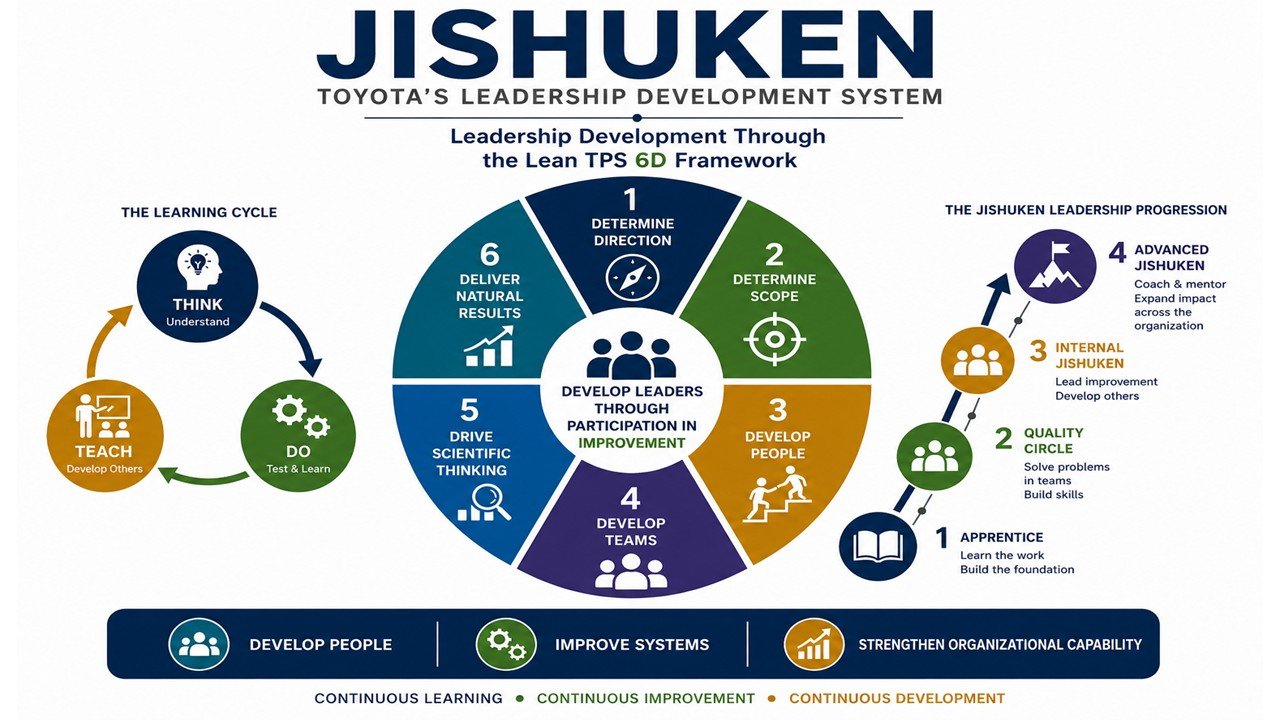
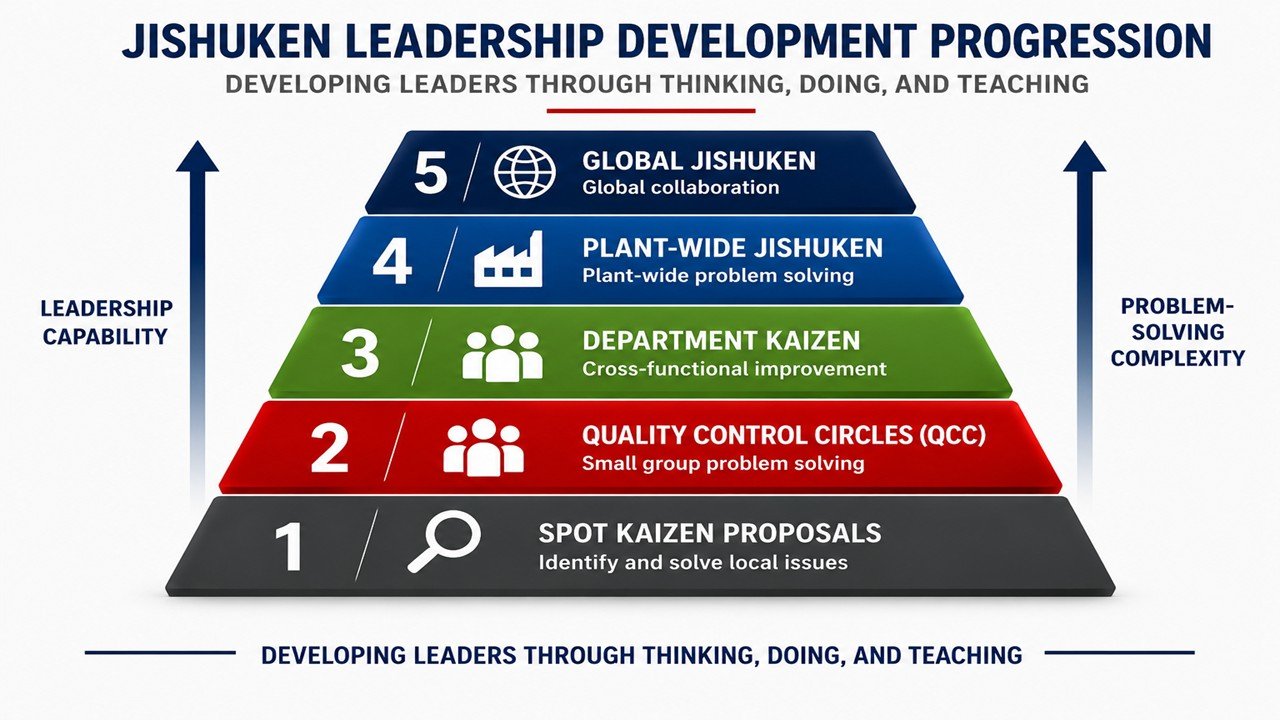
The learning path illustrated within the Jishuken model reflects Toyota’s belief that leadership is developed through participation rather than position. Effective leaders are not created by organizational authority alone. They emerge through repeated cycles of observation, problem solving, improvement, reflection, and teaching. Each stage of the progression expands an individual’s understanding of how Quality, flow, Standardized Work, Kaizen, and leadership interact within the broader operating system.
The progression begins at the point of work and gradually expands to encompass departments, facilities, suppliers, and eventually global operations.
4.1 Spot Kaizen Proposals
The foundation of the Jishuken learning journey begins with Spot Kaizen activities. At this stage, participants focus on small-scale improvements within their immediate work area where problems are visible, localized, and directly connected to daily operations. Typical activities may involve reducing unnecessary motion, improving workplace organization, strengthening visual controls, eliminating minor sources of waste, or addressing basic Quality concerns.
Although the scope is limited, the learning is significant. Participants develop the ability to observe work systematically, recognize abnormalities, and identify opportunities for improvement. They begin questioning existing conditions rather than accepting them as fixed and learn that improvement requires observation, experimentation, and verification rather than opinion or assumption.
Most importantly, Spot Kaizen establishes the understanding that leadership begins with personal responsibility for improvement. Before individuals can improve larger systems, they must first learn how to improve the work directly in front of them.
4.2 Quality Control Circles (QCC)
Quality Control Circles introduce a more structured approach to team-based problem solving. Small groups work together to investigate defined problems using established Quality methods and analytical tools. Participants learn how to collect data, identify patterns, evaluate causes, and communicate findings using factual evidence.
Tools such as Pareto Charts, Fishbone Diagrams, process mapping, control charts, and the 5 Whys become part of the learning process. Participants move beyond observation and begin developing the analytical capability required to understand the relationship between causes and outcomes.
QCC activities also strengthen collaboration. Team members learn how to evaluate evidence collectively, challenge assumptions constructively, and build consensus around improvement opportunities. These experiences develop communication skills and disciplined problem-solving habits that become increasingly important as responsibilities expand.
4.3 Department Kaizen Activities
Department Kaizen expands improvement activity beyond individual work areas and introduces participants to cross-functional problem solving. Improvements frequently affect multiple processes, roles, and stakeholders, requiring participants to understand how decisions influence broader operational performance.
Problems become more complex because solutions must account for interactions between people, equipment, information flow, material movement, scheduling requirements, and Quality objectives. Success depends not only on technical analysis but also on communication, coordination, facilitation, and organizational alignment.
At this stage, participants begin developing systems thinking. They learn that optimizing a single activity does not necessarily improve overall performance and that sustainable improvement requires understanding how processes interact throughout the department.
4.4 Plant-Wide Jishuken
Plant-Wide Jishuken expands learning beyond departmental boundaries and introduces participants to the broader operating system. Improvement activities may focus on production flow, takt alignment, Quality systems, equipment reliability, material management, lead time reduction, or facility-wide operational stability.
Participants gain a deeper understanding of organizational interdependence. Decisions made within one area frequently influence performance elsewhere, requiring improvements to be evaluated from a value-stream perspective rather than a departmental perspective.
Collaboration becomes increasingly important as leaders work with individuals from different technical disciplines and operational functions. Improvement activities must support both immediate operational objectives and the long-term capability of the facility as a whole.
4.5 Global Jishuken Joint Activities
The highest level of the Jishuken progression extends beyond a single facility and incorporates learning across multiple plants, suppliers, business units, and global operations.
Global Jishuken activities allow experienced leaders to study different operating environments, compare management systems, and share learning across organizational boundaries. Participants observe how common TPS principles are applied under different conditions while identifying opportunities to strengthen performance through shared knowledge and experience.
These activities reinforce one of Toyota’s greatest competitive advantages: organizational learning. Knowledge developed in one facility can be transferred to another. Successful practices can be adapted and shared. Common challenges can be addressed collectively rather than independently.
Exposure to different facilities also reinforces humility. Experienced leaders frequently discover alternative approaches, new perspectives, and opportunities for further improvement. Learning remains continuous regardless of organizational level or years of experience.
The objective extends beyond improving individual operations. The objective is to strengthen the capability of the entire enterprise.
Leadership Capability Through Progressive Development
The Jishuken progression demonstrates that leadership capability develops through experience rather than instruction. Each stage introduces new challenges that expand technical understanding, organizational awareness, communication capability, coaching ability, and systems thinking.
Participants continually build upon the lessons learned at earlier stages while applying those lessons to increasingly complex situations. Observation learned through Spot Kaizen supports Quality Control Circle activities. Analytical skills developed through QCC support Department Kaizen. Systems thinking developed through Department Kaizen becomes essential during Plant-Wide and Global Jishuken activities.
The progression is not intended to create experts in improvement tools. It is intended to develop leaders capable of improving systems, developing people, and sustaining continuous improvement under changing conditions.
Its purpose is to develop leaders capable of understanding systems, improving performance, developing people, and sustaining the Toyota Production System over the long term.
This progression explains why Jishuken became far more than an improvement methodology.
It became a leadership development system.
5. Thinking, Doing, and Teaching
The development of leadership within Jishuken extends beyond technical problem solving. Participants learn how to improve processes, reduce waste, strengthen Quality, and improve operational performance, but the deeper objective is the development of leadership behaviors that can be applied throughout an individual’s career. Toyota develops these capabilities through repeated cycles of thinking, doing, and teaching, creating a learning process that strengthens both individual capability and organizational performance.
These three activities are inseparable. Thinking without action produces ideas that are never tested. Action without reflection creates activity without learning. Teaching without personal experience lacks credibility and depth. Sustainable leadership capability emerges when all three are practiced together through continuous improvement activity.
Thinking
Toyota believes effective leadership begins with understanding actual conditions before taking action. While many organizations encourage rapid decisions and immediate responses, the Toyota Production System places equal importance on observation, fact gathering, and understanding process conditions. Leaders are expected to distinguish symptoms from causes before developing countermeasures.
Within TPS, observation is an active discipline rather than a passive activity. Leaders learn to compare actual conditions against expected conditions, identify abnormalities, and understand how work is performed. Standardized Work provides the baseline against which abnormalities become visible. Without standards, observation becomes subjective. With standards, gaps between expected and actual performance become measurable and actionable.
Fact-based decision making naturally follows observation. Toyota emphasizes direct evidence rather than assumptions, opinions, or speculation. Genchi Genbutsu reinforces this principle by requiring leaders to understand actual conditions firsthand before drawing conclusions. Decisions are expected to be grounded in observation, process knowledge, data, and confirmed facts.
The thinking process continues through root-cause analysis. Operational problems often appear as visible symptoms such as defects, delays, equipment failures, inventory accumulation, missed deliveries, or customer complaints. Effective leaders learn to investigate beyond those symptoms and identify the conditions that created them. Tools such as the 5 Whys, cause-and-effect analysis, process mapping, and PDCA strengthen analytical thinking while helping participants understand the relationship between causes and outcomes.
Over time, leaders discover that sustainable improvement depends less upon finding quick answers and more upon asking better questions. The ability to understand conditions, identify causes, evaluate evidence, and think scientifically becomes a foundational leadership capability.
Doing
Understanding a problem does not create improvement. Improvement occurs when knowledge is translated into action and tested under actual operating conditions.
For this reason, Jishuken places significant emphasis on implementation. Participants move beyond analysis and apply what they have learned through experimentation, countermeasure development, and verification. Improvements may involve changes to Standardized Work, visual management, process flow, Quality controls, workplace organization, communication methods, equipment conditions, or management practices. The objective is not simply to generate recommendations but to achieve measurable improvement within the actual process.
Toyota also recognizes that implementation alone provides little value unless results are confirmed. Many organizations assume that completed actions automatically produce the desired outcome. Within Lean TPS, leaders are expected to verify whether countermeasures produced the expected improvement, determine whether unintended consequences emerged, and evaluate whether further adjustment is required. This discipline strengthens learning by connecting actions directly to results.
Successful improvements are then incorporated into Standardized Work. Standardization establishes a new baseline condition, prevents regression, and creates consistency across people, shifts, and departments. It also provides the foundation for future improvement because stable processes make abnormalities easier to detect and performance easier to evaluate.
Through repeated cycles of implementation, confirmation, and standardization, leaders learn how to transform ideas into sustainable operational results.
Teaching
Leadership development reaches its highest level when individuals learn how to develop the capability of others.
Toyota recognized that organizational learning cannot expand if knowledge remains concentrated within a small group of experts. Sustainable improvement requires the continuous transfer of experience, problem-solving capability, and operational knowledge throughout the organization. For this reason, Jishuken places significant emphasis on coaching, knowledge transfer, and people development.
Coaching represents the primary mechanism for accomplishing this objective. Rather than providing answers, leaders guide others through observation, questioning, reflection, and problem solving. This approach encourages independent thinking and strengthens the learner’s ability to understand conditions and develop solutions. Over time, coaching creates greater organizational capability because more individuals become capable of solving problems without constant supervision.
Knowledge transfer extends beyond formal training. Participants share lessons learned, successful countermeasures, improvement methods, and practical experience gained through direct participation. Learning becomes part of the organization’s collective capability rather than remaining the property of individual experts.
Ultimately, Toyota evaluates leadership not only by operational results but also by the ability to develop others. Leaders who strengthen the capability of their teams create a multiplying effect throughout the organization. Problem-solving capability expands, improvement activity accelerates, and organizational learning becomes self-sustaining.
The Integration of Thinking, Doing, and Teaching
The power of Jishuken lies in the integration of these three activities. Thinking develops understanding. Doing converts understanding into measurable improvement. Teaching transfers capability to others and strengthens organizational learning.
Together they create a continuous cycle of leadership development. Participants learn how to observe conditions, analyze causes, implement countermeasures, verify results, establish standards, coach others, and transfer knowledge throughout the organization. These experiences develop leaders capable of sustaining Quality, supporting continuous improvement, and strengthening the Toyota Production System over the long term.
The objective is not simply to create better problem solvers.
The objective is to develop leaders capable of thinking critically, acting effectively, and developing others continuously.
6. The Spiral of Continuous Learning
Many leadership development programs are built around a linear model of progression. Participants attend training, complete certifications, advance to positions of greater responsibility, and then move to the next stage of development. Learning is often viewed as a sequence of steps where one level is completed before another begins.
The Toyota Production System approaches learning differently.
Toyota recognized that leadership capability does not develop in a straight line. As leaders assume greater responsibility, the challenges they face become more complex, interconnected, and uncertain. New situations rarely require entirely new principles. More often, they require a deeper understanding of the same principles applied under different conditions. Learning therefore becomes a continuous cycle of observation, reflection, application, and improvement that repeats throughout an individual’s career.
This philosophy is reflected throughout Jishuken.
The progression from Spot Kaizen to Quality Control Circles, Department Kaizen, Plant-Wide Jishuken, and Global Jishuken may appear to be a traditional hierarchy of advancement. In practice, participants do not leave earlier lessons behind as they move to higher levels. They continually return to the same foundations while applying them to increasingly complex challenges.
The ability to identify waste remains important at every level. Observation remains essential. Root-cause analysis remains necessary. Standardized Work continues to provide stability, and PDCA remains the primary learning cycle. What changes is not the principle itself but the scope, complexity, and organizational impact of the problems being addressed.
A participant involved in Spot Kaizen may focus on improving a single workstation. A leader participating in Plant-Wide Jishuken may be addressing Quality performance across multiple departments. A senior leader involved in Global Jishuken may be working across facilities, suppliers, and operating systems in different regions of the world. The challenges become larger, but the underlying disciplines remain remarkably consistent.
This characteristic explains why learning within Jishuken is best understood as a spiral rather than a ladder.
A ladder suggests that each stage is left behind as an individual moves upward. A spiral reflects a different reality. Participants repeatedly revisit the same concepts, but each cycle occurs with greater experience, broader responsibility, and deeper understanding. Earlier lessons are reinforced rather than replaced.
The pattern can be observed throughout the Toyota Production System. A new team member may learn to identify abnormalities through visual management and Standardized Work. Years later, an experienced manager still relies upon the same concepts while evaluating complex operational systems. The principles remain unchanged, but the depth of understanding continues to grow through repeated application.
The same progression occurs with problem solving. Early improvement activities focus on learning the mechanics of PDCA, the 5 Whys, and basic root-cause analysis. As experience develops, participants apply those same methods to increasingly complex situations involving multiple variables, organizational boundaries, competing priorities, and long-term business objectives. The tools remain familiar, but the level of thinking required becomes progressively more sophisticated.
Repeated practice plays a critical role in this development. Toyota understands that capability is strengthened through application rather than exposure. Observing a process once does not develop observation skills. Conducting a single root-cause analysis does not create a skilled problem solver. Leading one improvement activity does not create a capable coach. Capability develops through repeated cycles of practice, reflection, adjustment, and learning.
Each improvement activity reinforces previous learning while exposing participants to new situations that challenge their understanding. Successes build confidence. Failures create opportunities for reflection. Unexpected outcomes strengthen judgment. Over time, repeated application transforms knowledge into capability.
This process explains why experienced Toyota leaders often demonstrate a deep understanding of seemingly simple concepts. Their expertise does not come from memorizing tools or methodologies. It emerges from years of applying the same principles under a wide variety of operating conditions and learning from the results.
The Jishuken spiral also strengthens organizational learning. As individuals gain experience, they begin coaching others who are earlier in their development journey. Teaching reinforces their own understanding while accelerating the development of new participants. Knowledge is continually transferred, challenged, refined, and expanded through direct involvement in improvement activities.
The organization therefore benefits from multiple levels of learning occurring simultaneously. New participants gain practical experience. Developing leaders strengthen their problem-solving capability. Experienced leaders refine their coaching skills. Each group contributes to a cycle of learning that strengthens both individual capability and organizational performance.
This dynamic helps explain why Toyota has been able to sustain continuous improvement across multiple generations. The system does not depend upon a small group of experts. Learning is embedded within daily operations, improvement activities, and leadership development processes. Each generation develops the next while continuing to deepen its own understanding.
The Jishuken spiral ultimately reflects one of the most important principles of Lean TPS: improvement never ends because learning never ends. Regardless of experience, there are always new conditions to understand, new challenges to address, and new opportunities to develop others.
The objective is not to reach the top of the spiral.
The objective is to continue learning, improving, and developing others throughout a lifetime of leadership.
The Toyota Production System was never intended to be a collection of improvement tools. It was designed as a leadership system capable of learning and adapting continuously.
Explore additional Lean TPS articles, leadership development resources, and Toyota Production System content at LeanTPS.ca.
7. Building a Culture of Leadership Development
Lorem ipsum dolor sit amet, consectetur adipiscing elit. Ut elit tellus, luctus nec ullamcorper mattis, pulvinar dapib
One of the most significant contributions of Jishuken is its ability to transform leadership development from an individual activity into an organizational capability. Many organizations approach leadership development primarily as a succession planning exercise designed to prepare a small group of high-potential individuals for future management positions. While succession planning remains important, Toyota’s approach extends far beyond preparing selected individuals for promotion.
The Toyota Production System was designed to develop leadership capability throughout the organization.
This objective reflects a fundamental understanding of how performance is created. Quality, safety, delivery, cost, and continuous improvement are influenced by thousands of decisions made every day at every level of the enterprise. Operational performance depends not only upon senior executives but also upon supervisors, team leaders, engineers, technicians, operators, and support personnel. Sustainable improvement cannot be achieved if leadership capability exists only at the top of the hierarchy.
Toyota therefore treats leadership development as a responsibility shared throughout the organization rather than a specialized management activity.
Jishuken supports this objective by creating opportunities for participation across multiple organizational levels. Individuals learn how to identify abnormalities, investigate causes, apply structured problem-solving methods, implement improvements, and support the development of others regardless of their position. Leadership capability grows through participation in improvement activities rather than through title alone.
This perspective creates an important cultural shift. Leadership becomes associated with responsibility, contribution, learning, and capability rather than authority. Individuals are encouraged to observe conditions, solve problems, support improvement, and help others develop the same capabilities. Improvement becomes less dependent upon a small group of experts because problem-solving capability is distributed throughout the enterprise.
Senior leaders play a critical role in creating this environment.
Within many organizations, senior leadership is associated primarily with decision making, resource allocation, and performance review. Toyota expects something more. Senior leaders are responsible for developing the capability of the organization itself. Their role extends beyond establishing direction and evaluating results. They serve as teachers, coaches, and mentors who help strengthen the thinking and problem-solving ability of others.
This responsibility often requires a significant shift in leadership behavior. Rather than providing immediate answers, effective leaders ask questions that encourage observation and reflection. Rather than solving every problem personally, they guide others through the process of understanding conditions, identifying causes, and developing countermeasures. Rather than focusing exclusively on short-term results, they invest time in building the capability required to sustain long-term performance.
Jishuken creates a practical environment where this coaching relationship can develop naturally. Senior leaders participate in improvement activities, challenge assumptions, review analysis, and encourage deeper understanding of process conditions. Participants gain technical knowledge while simultaneously observing how experienced leaders approach learning, decision making, and continuous improvement.
Middle management occupies an equally important position within this system.
Supervisors, managers, and department leaders often determine whether standards are followed, whether abnormalities are addressed promptly, and whether continuous improvement becomes part of daily work. They serve as the connection between organizational objectives and operational execution. Their actions strongly influence whether improvement activities become isolated events or part of the organization’s normal operating behavior.
Through participation in Jishuken, middle managers strengthen their ability to analyze performance, coordinate cross-functional efforts, facilitate problem solving, and develop the capability of their teams. They learn how to balance immediate operational requirements with long-term organizational development while gaining a deeper understanding of how individual processes contribute to overall system performance.
Frontline participation represents another defining characteristic of the Toyota approach.
Many organizations reserve improvement activity for specialists, engineers, consultants, or management personnel. Toyota recognizes that the individuals performing the work often possess the deepest understanding of process conditions, recurring abnormalities, and opportunities for improvement. Excluding them from improvement activities limits both learning and performance.
Jishuken encourages participation by those closest to the work. Operators, technicians, team leaders, and support personnel contribute observations, identify problems, test improvements, and participate directly in problem-solving activities. Their involvement strengthens process understanding while creating opportunities for leadership development that might not otherwise exist.
The benefits extend beyond operational improvement. Individuals gain confidence in their ability to contribute. Communication improves across organizational levels. Problem-solving capability expands throughout the workforce. Continuous improvement becomes part of daily behavior rather than a periodic management initiative.
Over time, these interactions create the conditions for a learning culture.
Knowledge is shared more openly. Problems are viewed as opportunities for improvement rather than sources of blame. Coaching becomes a normal leadership responsibility rather than a special activity. Employees become more comfortable identifying abnormalities, proposing improvements, and participating in problem solving. The organization’s capacity to learn, adapt, and improve grows steadily over time.
This cultural transformation represents one of the most important outcomes of Jishuken.
The objective is not simply to create better managers or improve individual projects. The objective is to establish an environment where leadership development occurs continuously through daily work, structured improvement, coaching, and collaborative learning.
Within such an environment, leadership is no longer viewed as the responsibility of a small number of individuals occupying senior positions. Leadership becomes a shared organizational capability supported by observation, problem solving, continuous improvement, and the development of others at every level of the enterprise.
This principle has become increasingly important as organizations face accelerating technological change, workforce shortages, demographic shifts, increasing operational complexity, and growing demands for Quality and operational excellence. Sustainable success depends less upon the actions of individual leaders and more upon the organization’s collective ability to develop capable people throughout the enterprise.
Jishuken provides a practical mechanism for achieving that objective. By integrating leadership development directly into continuous improvement activities, Toyota created a system that strengthens operational performance while simultaneously developing the people responsible for sustaining that performance in the future.
The result is not simply a culture of continuous improvement.
The result is a culture of continuous leadership development.
us leo.
8. Jishuken and the Future of Lean TPS
The business environment facing organizations today differs significantly from the environment that existed when the Toyota Production System was first developed. Advances in Artificial Intelligence, automation, digital manufacturing, connected systems, data analytics, and humanoid robotics are reshaping how work is performed across nearly every industry. At the same time, organizations are confronting workforce shortages, demographic shifts, supply chain volatility, increasing customer expectations, regulatory pressures, and growing operational complexity.
Many organizations view these challenges primarily as technology problems. As a result, considerable attention is directed toward software platforms, automation investments, machine learning systems, robotics, and digital transformation initiatives. Technology alone does not create operational stability, improve Quality, or develop organizational capability.
Technology executes within the system that already exists.
Technology can amplify capability, but it cannot replace leadership.
Artificial Intelligence can process information, identify patterns, and support decision making. Automation can increase consistency and reduce manual effort. Humanoid robotics may eventually perform a growing range of physical tasks within manufacturing, logistics, healthcare, construction, and service environments. Yet each of these technologies depends upon stable operating conditions, clearly defined processes, effective governance, and leaders capable of understanding how systems function. Without those conditions, technology often accelerates existing problems rather than solving them.
Toyota confronted a similar challenge decades ago. The company recognized that sustainable performance depends upon more than tools, equipment, and methods. Long-term success requires people capable of understanding conditions, identifying abnormalities, solving problems, developing others, and continuously improving the system itself. This principle remains as relevant today as it was during the development of TPS.
Artificial Intelligence may assist with analysis, but leaders must still understand the significance of the information being presented. Automated systems may execute work with remarkable precision, but leaders must still establish standards, respond to abnormalities, and ensure that Quality requirements are maintained. Humanoid robotics may eventually perform increasingly complex tasks, but leaders must still understand workflow, process stability, Standardized Work, and the conditions required for successful execution.
The challenge facing organizations is therefore not simply technological adoption. The greater challenge is developing the leadership capability required to govern increasingly complex systems.
Future operating environments will involve greater interaction between people, machines, software, automation, and intelligent systems. Decisions will increasingly require balancing Quality, safety, productivity, flexibility, cybersecurity, regulatory requirements, customer expectations, and operational risk simultaneously. Problems will become more interconnected, and the consequences of poor decisions may propagate more rapidly across highly integrated operations.
Traditional leadership development approaches struggle in such environments because future challenges cannot be predicted with certainty. Organizations cannot create procedures for every situation that may arise. Training programs cannot anticipate every future condition, and classroom instruction cannot prepare leaders for every emerging technology. The most effective response is to develop leaders capable of learning their way forward.
This objective sits at the heart of Jishuken.
Jishuken does not teach leaders how to solve a specific problem. It develops the capability to approach any problem systematically. Participants learn how to observe conditions, verify facts, analyze causes, test countermeasures, confirm results, and develop others through the same process. These capabilities remain valuable regardless of how technology evolves because they focus on learning, adaptation, and continuous improvement rather than fixed solutions.
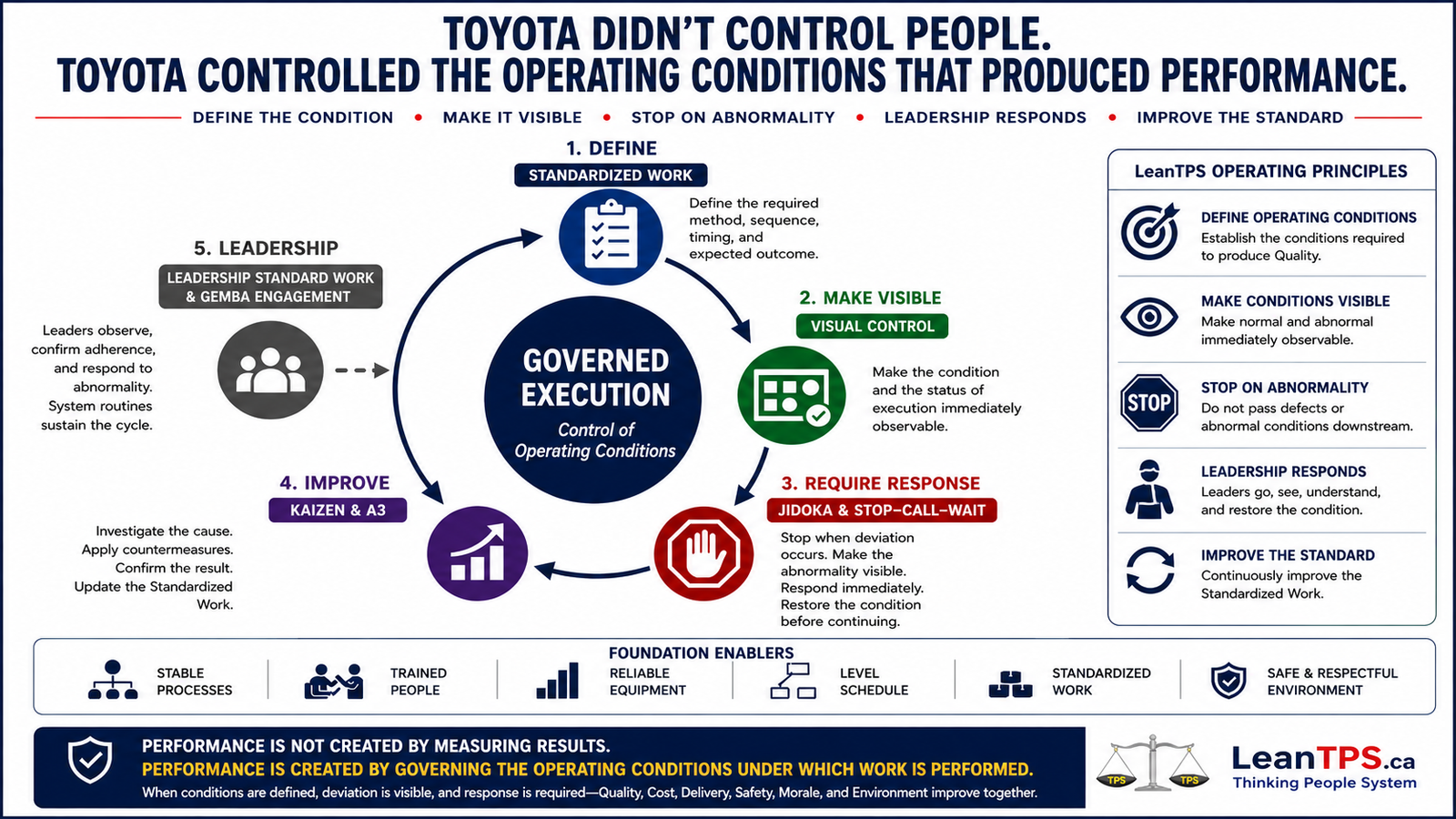
The same leadership disciplines that supported Toyota’s success in traditional manufacturing remain essential in modern operating environments. Genchi Genbutsu continues to provide a framework for understanding actual conditions. PDCA remains a disciplined method for learning and experimentation. Standardized Work continues to establish stable operating conditions. Jidoka continues to expose abnormalities and require response. Kaizen continues to create opportunities for learning and improvement. The principles remain consistent even as the technologies operating within those systems continue to evolve.
In many respects, the need for capable leaders becomes more important as technology advances. Organizations implementing Artificial Intelligence, advanced automation, autonomous systems, and humanoid robotics will require leaders capable of understanding how these technologies interact with operational processes, Quality systems, and human performance. Success will depend not only on technical implementation but also on the ability to identify emerging risks, respond to changing conditions, and continuously improve the system as new challenges emerge.
Toyota developed Jishuken long before Artificial Intelligence, advanced automation, and humanoid robotics existed. Yet the capabilities developed through Jishuken remain directly applicable because the challenge was never technology itself. The challenge was developing people capable of learning, adapting, improving, and teaching under changing conditions. Those requirements have not disappeared. They have become more important.
Jishuken develops these capabilities by creating leaders who are comfortable learning in uncertain environments. Participants learn how to investigate unfamiliar problems, evaluate evidence, challenge assumptions, and develop solutions through structured experimentation. They learn how to teach others and strengthen organizational capability rather than relying solely on individual expertise.
This may be the most important contribution Jishuken makes to the future of Lean TPS.
The future cannot be predicted with certainty. New technologies will continue to emerge. Business conditions will continue to change. Customer expectations will continue to evolve.
Organizations therefore require leaders capable of learning, adapting, teaching, and improving continuously.
Jishuken develops those capabilities.
The purpose of Jishuken has never been limited to solving today’s problems.
Its purpose is to develop leaders capable of solving tomorrow’s problems as well.
Closing Thought
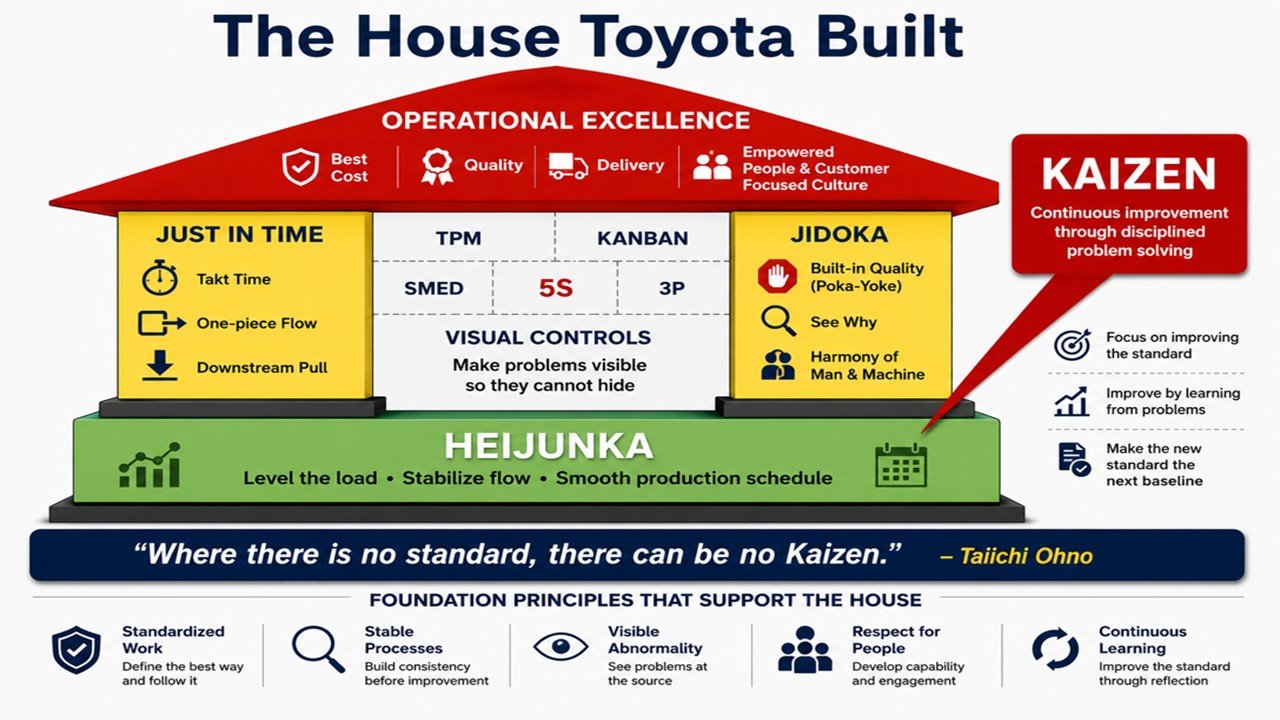
The Toyota Production System is often studied through its visible components. Organizations examine Just-in-Time, Jidoka, Standardized Work, Kaizen, visual management, and continuous improvement in an effort to understand Toyota’s success. While these elements remain essential, they do not fully explain the system’s long-term sustainability.
Toyota understood that every process, every standard, and every improvement ultimately depends upon the capability of people.
Processes improve because people improve them.
Quality improves because people learn to recognize and respond to abnormal conditions.
Standards are sustained because leaders teach, coach, and reinforce disciplined execution.
Continuous improvement becomes sustainable because each generation develops the capability of the next.
Jishuken was created to support this objective.
Toyota did not create Jishuken simply to improve processes, reduce waste, or complete improvement projects. Those outcomes are important, but they are secondary to a larger purpose. Jishuken was designed to develop people capable of understanding systems, solving problems, improving performance, and developing others through the same process.
This philosophy remains as relevant today as it was when the Toyota Production System was first developed. Artificial Intelligence, automation, humanoid robotics, workforce shortages, demographic change, and increasing operational complexity will continue to reshape the way organizations operate. New technologies will emerge. New challenges will appear. Future conditions cannot be predicted with certainty.
Organizations therefore require leaders capable of learning, adapting, teaching, and improving continuously.
Jishuken develops those capabilities.
The ultimate purpose of Jishuken is not better projects.
The ultimate purpose of Jishuken is better leaders.
Better leaders create better systems. Better systems develop better people. Better people strengthen the organization’s ability to learn, adapt, improve, and thrive under changing conditions.
That capability may be Toyota’s greatest competitive advantage and the enduring purpose of Jishuken.