My Lean TPS Staff Training: Beyond the 4P Model

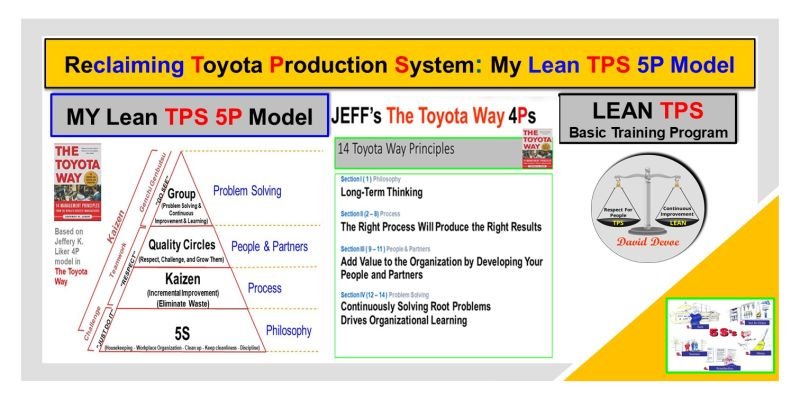
Lean TPS 5P Model visual comparing Toyota’s 4P Model by Jeffrey Liker with David Devoe’s Lean TPS 5P Model for staff-level training.
My Lean TPS 5P Model builds on The Toyota Way 4P framework by adding Performance as a fifth element. Developed through staff-level training at Toyota BT Raymond, this model connects philosophy to practice and makes continuous improvement measurable and sustainable.

Jeffrey Liker’s Toyota Way 4P Model helped the world understand the structure behind the Toyota Production System. It explained how Philosophy, Process, People and Partners, and Problem Solving form the foundation for continuous improvement. But inside Toyota, staff training goes one step deeper.

During my staff-level Lean TPS Basic Training at Toyota BT Raymond, I developed a framework that builds on Liker’s model and connects directly to daily management practice. It is called the Lean TPS 5P Model. This approach was tested, refined, and taught within actual leadership development cycles, linking every P to real Gemba learning.

The Lean TPS 5P Model expands the 4P structure by adding a fifth element that represents measurable results and ongoing learning. The five elements are:

  1. Philosophy – Long-term thinking forms the foundation. Every improvement begins with purpose and alignment to the organization’s mission.
  2. Process – Flow, Standardized Work, and Just in Time define the system structure. Processes are designed for stability, visibility, and learning.
  3. People and Partners – Respect, capability development, and mutual trust are at the core. The goal is not compliance but shared responsibility.
  4. Problem Solving – Genchi Genbutsu, Kaizen, and PDCA drive learning through direct observation and structured reflection.
  5. Performance – The result of disciplined practice. Measured not just in metrics but in the development of people through Jishuken and daily improvement cycles.

This model connects the visible tools of TPS with the invisible thinking that drives them. It helps leaders translate philosophy into action and ensures that improvement efforts create both operational and human growth.

While the 4P Model provided a global explanation, the 5P Model provides a practical system for training and coaching inside Lean TPS organizations. It ensures that Philosophy and People are not overshadowed by Process and Performance, but linked together through disciplined problem solving.

If your organization has reached the limits of awareness training and wants to build capability through structured practice, the Lean TPS 5P Model is a strong foundation to begin. It reflects how Toyota develops people, designs systems, and sustains improvement through daily leadership routines.

Are you ready to move beyond tool training and start building true Lean TPS capability?
Let’s start the conversation.
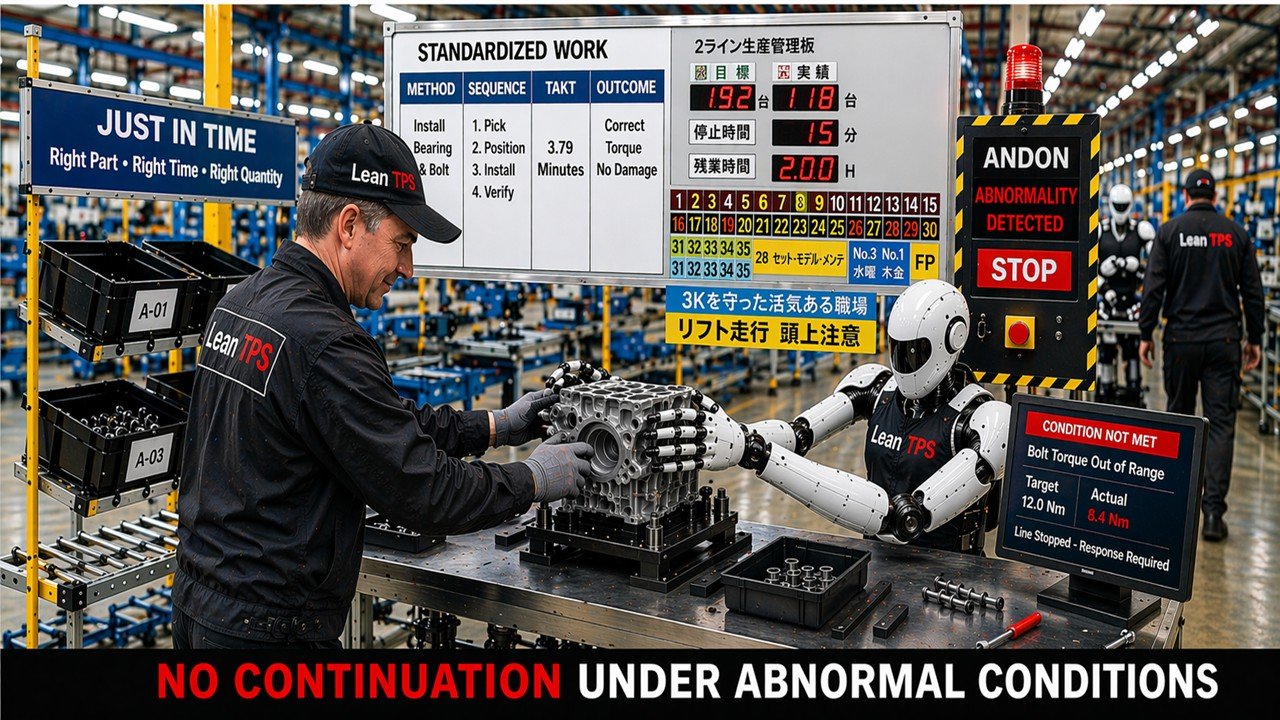
Toyota Production System assembly line with human operator and humanoid robot performing standardized work with Andon stop condition showing abnormality detection and no continuation under abnormal conditions
The Toyota Production System defines the conditions required for stable execution in environments with AI and humanoid robots. Automation depends on control of execution, not technology capability.
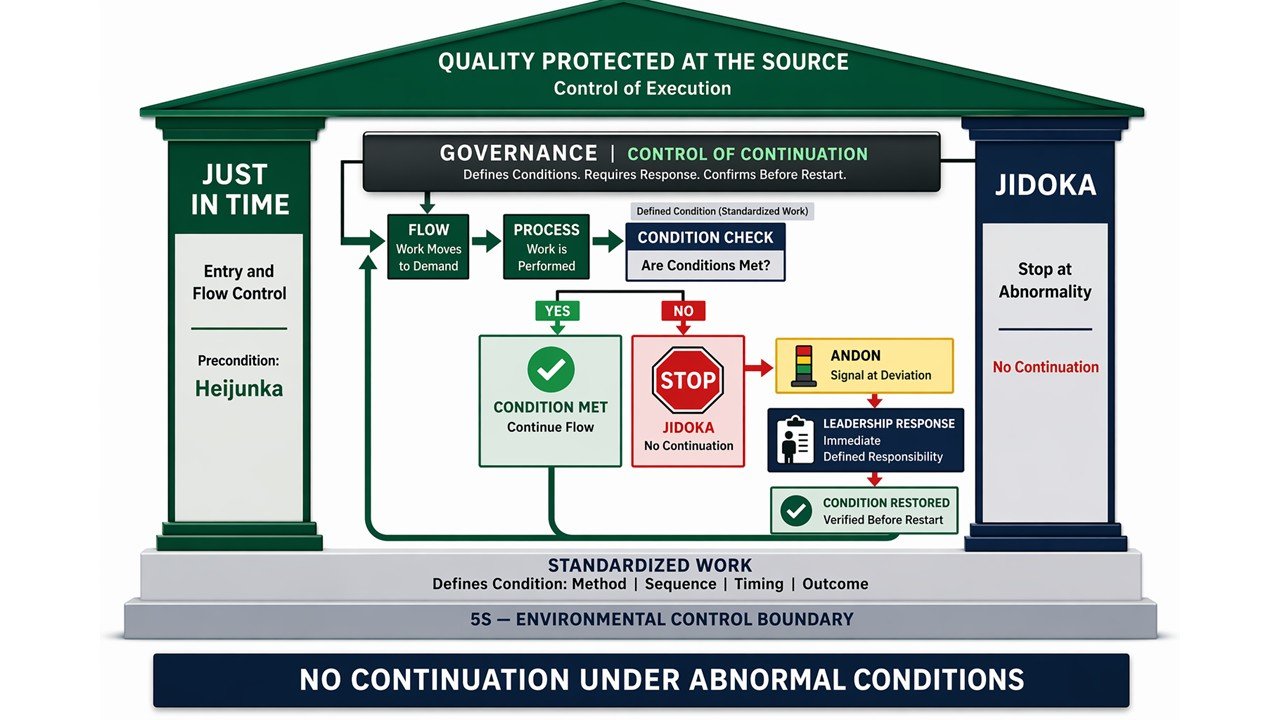
Just In Time and Jidoka integrated within a Toyota Production System house showing governance controlling flow, stop at abnormality, required response, and no continuation under abnormal conditions.
Lean TPS Basic Training teaches how Just In Time and Jidoka work together to prevent failure, reduce stagnation, and build capability in people through the Toyota Production System.
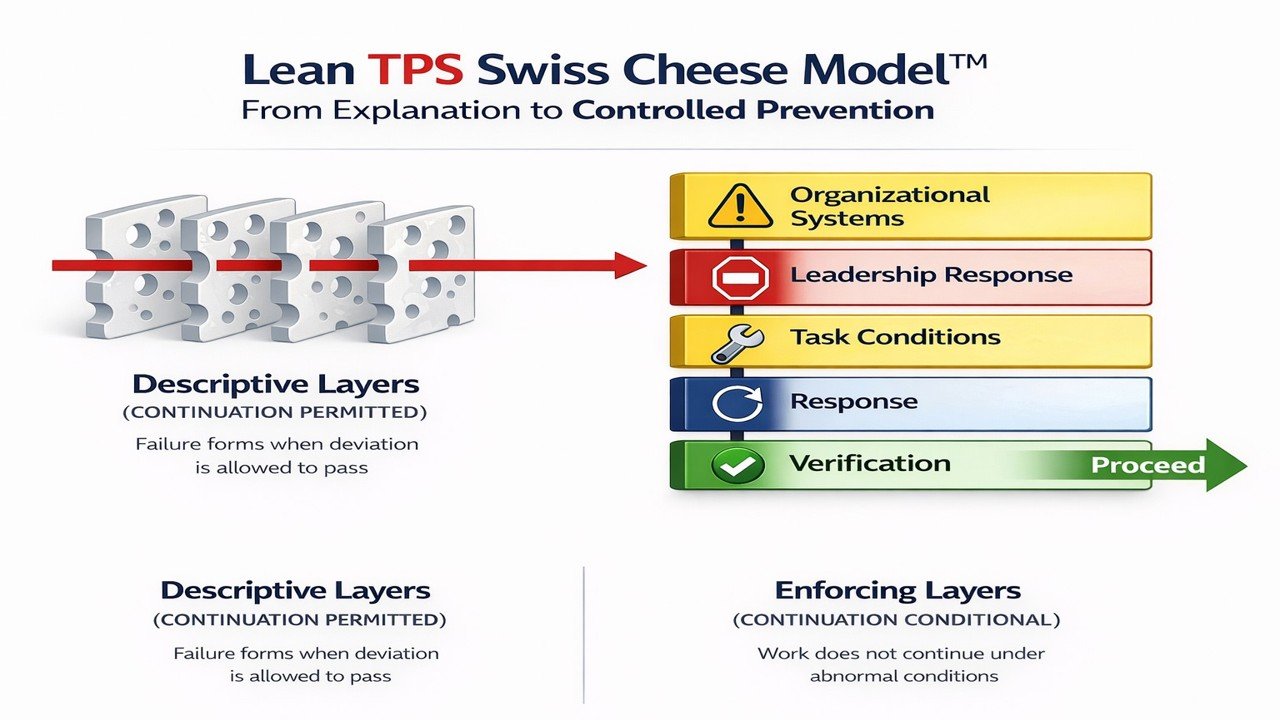
Lean TPS Swiss Cheese Model showing shift from descriptive layers that allow failure to pass to enforcing layers that stop continuation through organizational systems, leadership response, task conditions, response, and verification
Failure forms when deviation is allowed to pass across layers. The Lean TPS Swiss Cheese Model prevents failure by enforcing conditions and stopping continuation under abnormal states.
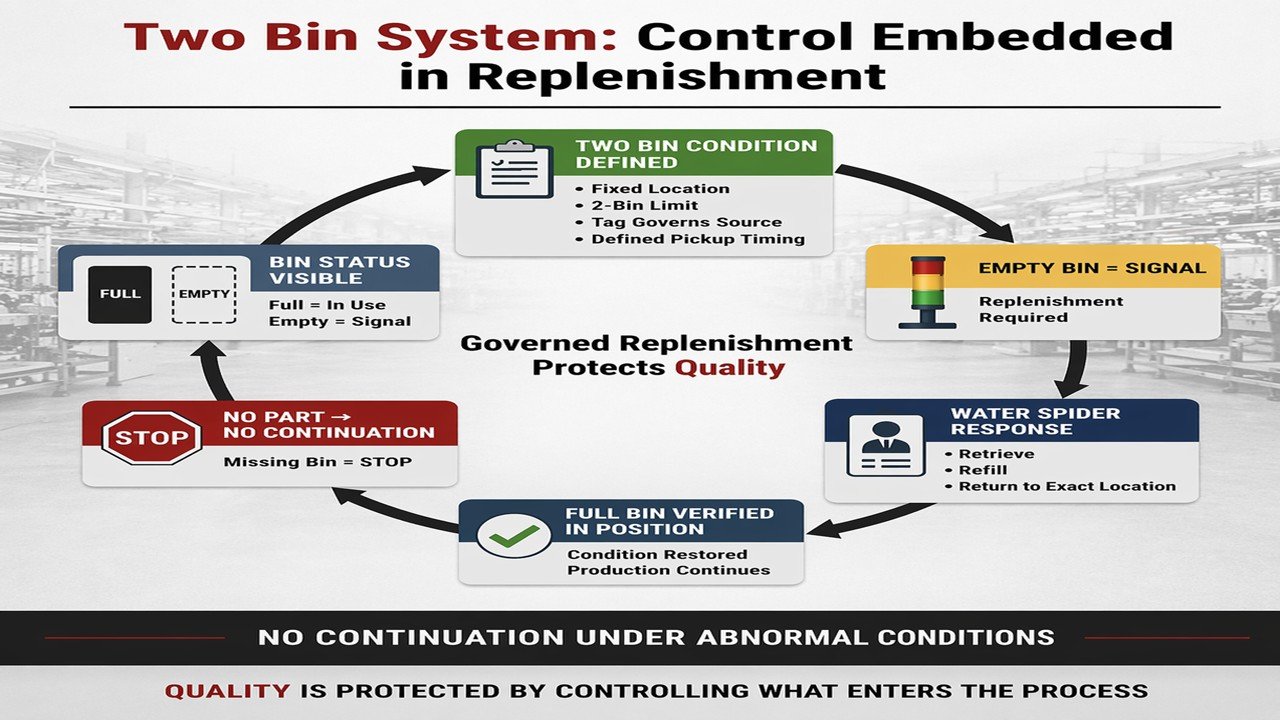
Two bin system shown as a governed replenishment control loop defining signal, response, and condition restoration to protect Quality at the point of use
The two bin system is not a storage method. It is a governed replenishment control that limits inventory, stabilizes flow, and protects Quality at the point of use.
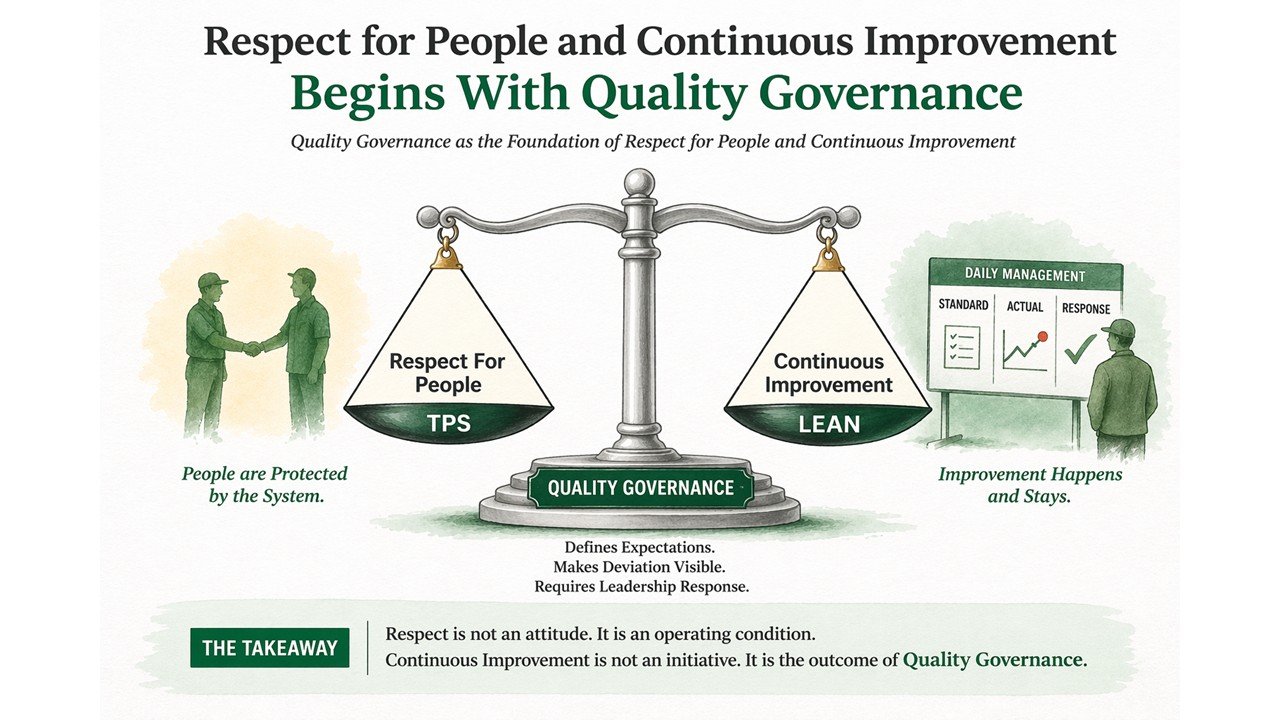
Quality governance as the foundation of Respect for People and Continuous Improvement shown as a balanced scale between TPS and Lean
Quality governance defines the conditions that balance Respect for People and Continuous Improvement in Lean TPS
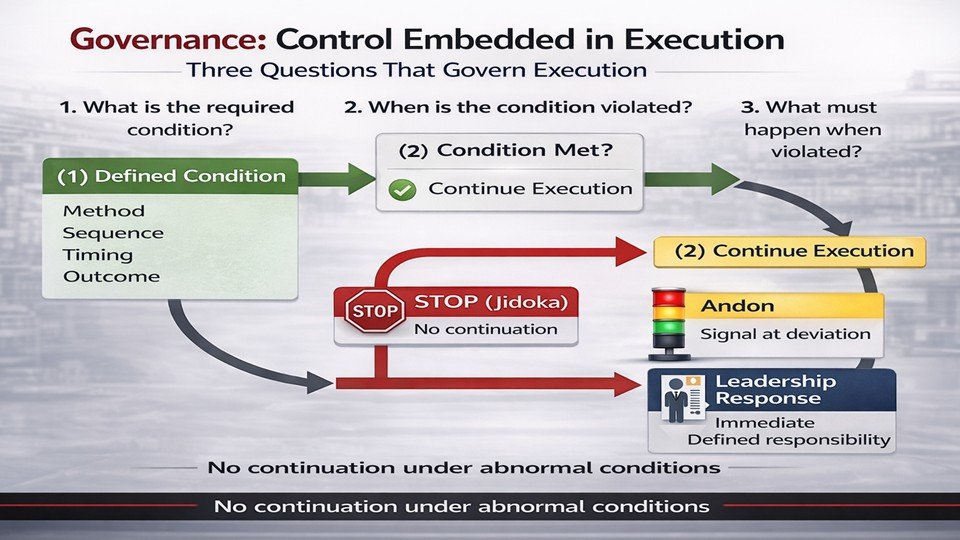
A Lean TPS system requires that execution is governed by three questions that define control. The required condition for execution must be explicitly defined through method, sequence, timing, and outcome. The point at which the condition is violated must be immediately recognizable during execution. The response required when the condition is not met must be enforced without delay. When these three elements operate together, execution is controlled and Quality is maintained as a condition of the system. Control precedes improvement because improvement depends on a stable and defined state of execution. When conditions are not defined, exposed, and enforced, improvement activity operates on an unstable system and results do not hold. Work continues under abnormal conditions, variation accumulates, and outcomes remain inconsistent. When control is established, improvement operates within defined boundaries and reinforces the condition that governs execution. Quality exists only when the required condition is maintained during each cycle of work. Quality is not achieved through measurement or inspection after execution. Quality is protected through enforcement of conditions during execution. When the condition is not met, work does not continue, and response restores the defined state before execution resumes. This enforcement prevents deviation from propagating and maintains stability at the source. A Lean TPS system requires that continuation under abnormal conditions is not permitted. When work continues despite violation of method, sequence, timing, or outcome, control does not exist and the system becomes dependent on judgment. Deviation is absorbed into normal work, and Quality is degraded. When continuation is prevented, the system enforces the boundary between normal and abnormal states and maintains control of execution. The system extends beyond individual elements and requires integration across condition definition, exposure, response, and learning. When these elements are aligned, execution is governed, leadership responds as required, and learning is embedded through repeated cycles of confirmation and correction. This integration establishes a system that maintains control and protects Quality as a condition of execution. Further development of this system requires expansion into condition design, response structure, and leadership integration at scale. The next stage addresses how conditions are constructed, how response is embedded across functions, and how governance is sustained across the organization.
Lean TPS governance image showing how conditions, deviation detection, and enforced response control execution.