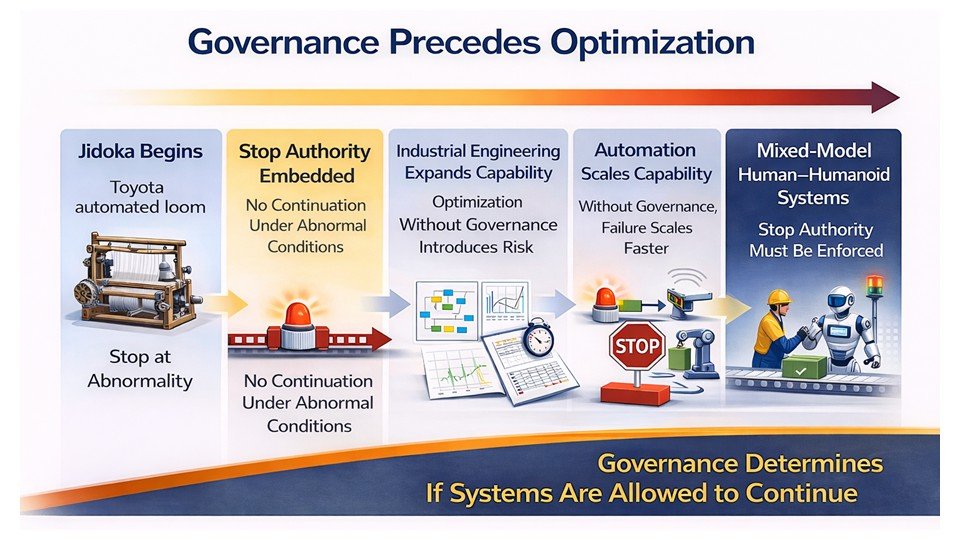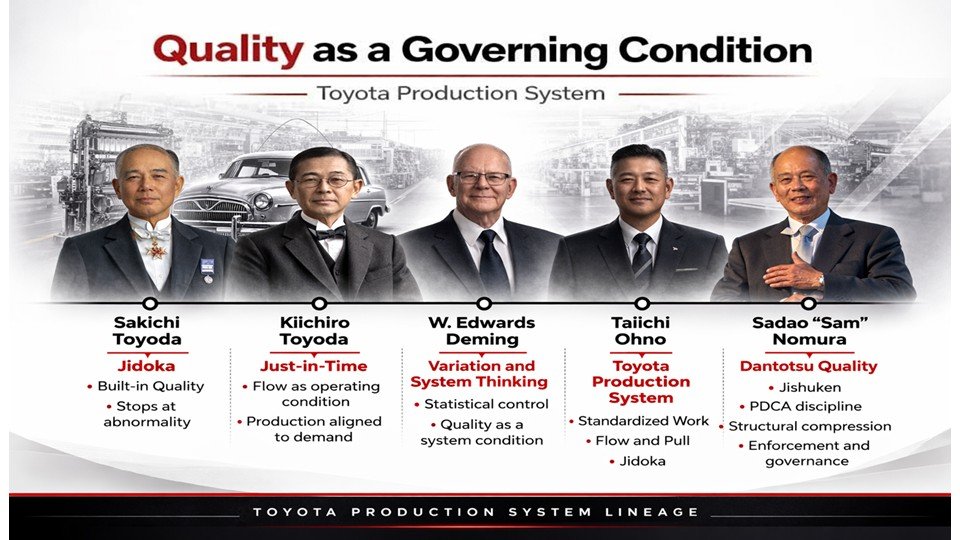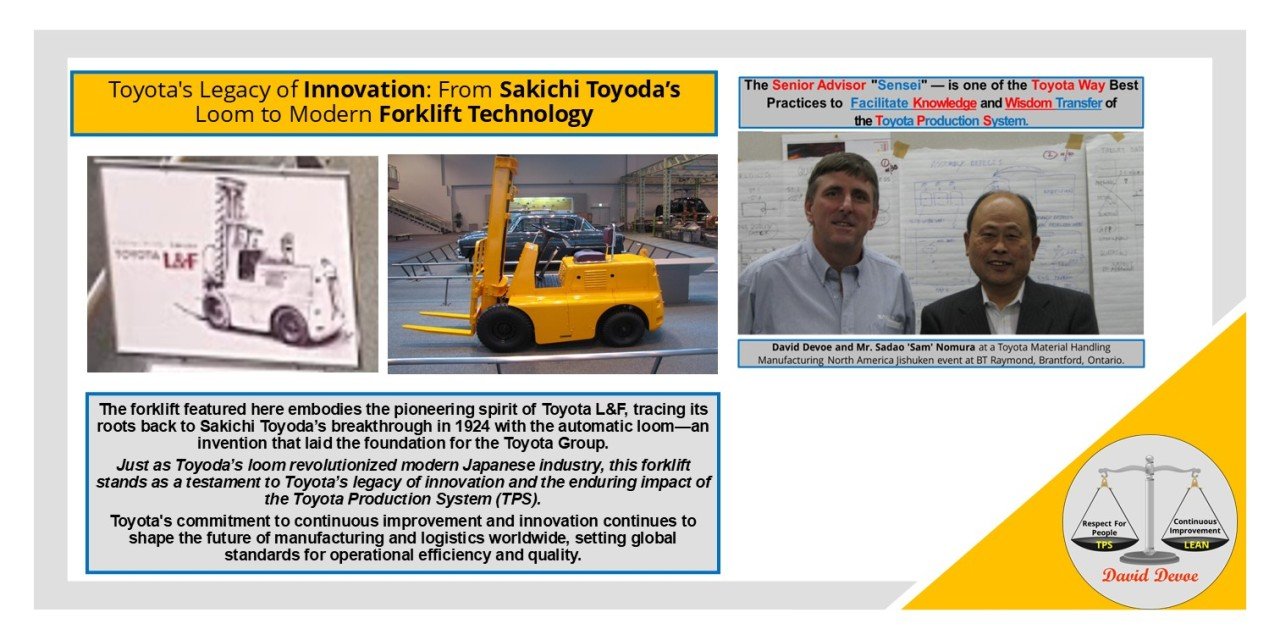
Toyota’s journey from the automatic loom to global logistics leadership is a story of continuity in thinking. Sakichi Toyoda’s 1924 invention of the automatic loom was not only a mechanical breakthrough; it was the foundation of a management philosophy. His focus on designing systems that prevent failure and improve with use became the seed that grew into the Toyota Production System (TPS).
Decades later, that same spirit of innovation lived on in the people who carried TPS forward. Among them was Mr. Sadao “Sam” Nomura, Senior Advisor to Toyota Industries Corporation (TICO). He embodied the philosophy that improvement must never be isolated to one process or one country. His work defined how Toyota’s global leaders learned to see problems, solve them systematically, and teach others to do the same.
From Sakichi Toyoda to the Sensei’s Role
Toyota’s legacy of improvement has always been built on the transfer of wisdom through practice. From loom manufacturing to forklift production, the continuity of thinking remained constant: make problems visible, build quality at the source, and design systems that teach. Nomura carried this principle wherever he went. He believed that the measure of leadership was not how much one improved a process, but how much one improved people.
When he arrived at BT Raymond in Brantford, Ontario, his first task was not to review reports or performance charts. He went to the floor and began asking questions. His presence changed the rhythm of the factory. He spoke little, observed much, and used every visit to test the maturity of our thinking. His intent was not to find fault, but to uncover how deeply we understood cause and effect. He called this “seeing through the process.”
The Meaning of Dantotsu
Dantotsu means “radical improvement” or “best of the best.” For Nomura, it was not a slogan. It was the standard that defined Toyota’s quality leadership worldwide. Achieving Dantotsu meant aiming beyond incremental gains and seeking the root redesign that eliminates problems permanently. It required courage, discipline, and a commitment to truth over convenience.
At Toyota L&F, where he began his work on radical quality improvement, Nomura applied Dantotsu thinking to every process. He studied the flow from design through production and into global logistics. He focused on preventing recurrence rather than correcting symptoms. This mindset later became the structure behind his book, The Toyota Way of Dantotsu Radical Quality Improvement, which codified the principles he had practiced for decades:
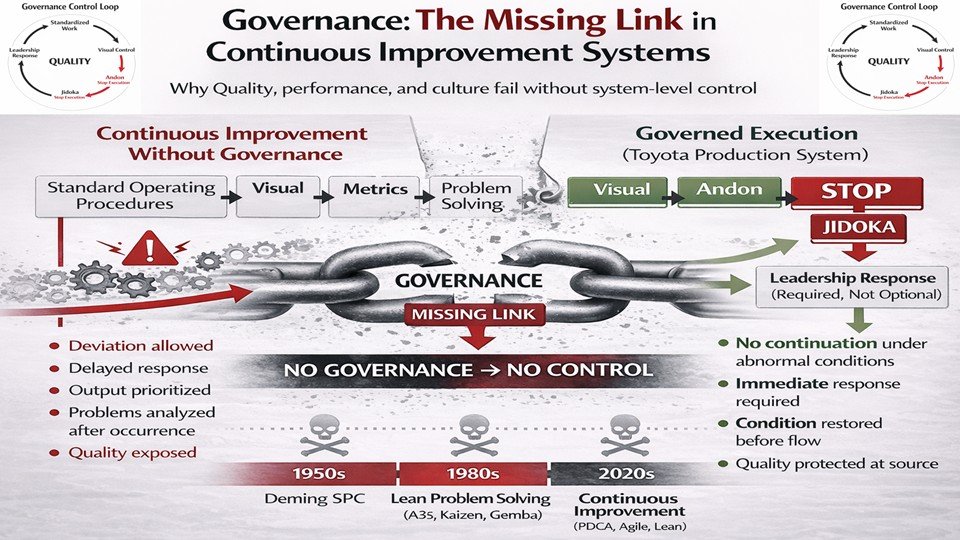
- Make problems visible in real time.
- Stop the process to prevent defects from continuing.
- Solve problems at the root cause.
- Build systems that prevent reoccurrence.
- Develop people through the discipline of continuous improvement.
Transforming Global Manufacturing
Nomura’s influence was not limited to Japan. One of his most notable assignments took him to South Africa, where a Toyota vehicle plant faced severe quality challenges. The workforce was large, diverse, and unionized, and quality performance lagged far behind Toyota’s standards. Nomura approached the problem not through inspection or audits but through leadership structure.
He began by rebuilding trust between management and the workforce. He trained supervisors and line leaders to identify and respond to defects immediately. He installed hourly control boards and implemented daily reflection meetings. The changes were not technical; they were cultural. Within a short period, the plant reached export-level quality certification, becoming one of Toyota’s top-performing facilities worldwide.
This transformation showed that TPS was not dependent on geography or culture. It proved that the same system, when led with respect and consistency, could achieve excellence anywhere.
The Dantotsu Program at Toyota Material Handling North America
In North America, Nomura’s mission was to unify quality improvement across Toyota Material Handling Manufacturing sites. Under the leadership of Mr. Susumu “Sonny” Toyoda, TICO introduced the Dantotsu Program to achieve a 90 percent reduction in Hoshin-level quality issues over three years. Nomura’s assignment was to guide that transformation.
At BT Raymond, his visits became structured learning events. He walked each process with the local team, asking questions that tested understanding and alignment. “Who owns this problem?” “Where do you confirm your countermeasure?” “When do you see this condition?” His goal was to build thinking people who could sustain TPS without constant external direction.
Every meeting concluded with clear expectations. Problems had to be resolved within a defined time frame: same day, one week, or one month. Anything slower was considered a failure of leadership. He reminded us that delay in problem solving equals degradation of quality.
Nomura-Grams: The Art of Capturing Learning
During every Gemba visit, Nomura would quietly jot notes on small pieces of paper. Each observation described one fact about a condition, a missed standard, or an improvement opportunity. At the end of the day, these notes were transcribed into structured A3s, forming what came to be known as Nomura-Grams.
Each Nomura-Gram was a snapshot of cause and countermeasure. Some focused on rework management, others on flow imbalance or visual control. Together, they became a collection of living case studies that captured the discipline of Toyota problem solving.
At Brantford, Nomura-Gram #31 became one of the most meaningful. It documented quality issues and training progress and included his written acknowledgment of the Lean TPS Basic Training program I had been leading. He requested that the program materials be shared across TICO, reinforcing his belief that teaching TPS fundamentals was the highest form of improvement.
Building Leadership Through Problem Solving
Nomura believed leadership was built through structured problem solving. He rejected management by results and focused instead on management by process. He reminded us that no amount of reporting could replace direct observation. “You cannot see quality from an office,” he said. “You can only see it when you are standing with the people doing the work.”
At BT Raymond, this belief reshaped our leadership routines. We implemented daily leader confirmation walks, structured hour-by-hour tracking, and standardized problem response routines. Leaders were expected to coach, not command. Supervisors learned to ask questions instead of issuing instructions. The process became a training system for leadership development.
Through this structure, accountability became visible. Problems no longer hid in email threads or reports. They were posted, discussed, and resolved through team effort. The improvement was not only in metrics but in mindset. Leaders learned to think and act as Sensei for their own teams.
A Legacy of Wisdom Transfer
Nomura’s greatest strength was his ability to transfer wisdom without losing precision. He simplified complex systems into teachable concepts, turning abstract principles into repeatable routines. His method of teaching through A3, visual control, and Genchi Genbutsu made TPS accessible to everyone.
He often said, “If a new member cannot explain the reason behind the standard, the leader has not taught it.” This became the rule by which we measured our own success in training and mentoring others. Knowledge transfer was no longer optional. It was an expectation.
This approach connected directly to the Toyota Way’s fourth P — Problem Solving through Continuous Learning. It also extended into what I later defined as the fifth P — Performance through Jishuken. Nomura’s Dantotsu leadership made Jishuken the bridge between learning and performance, where improvement and people development occurred together.
Dantotsu as a Leadership System
What made Nomura unique was that he practiced what he taught. His Dantotsu model was not theoretical. It was a lived system of leadership built on three disciplines:
- Go and See: Never decide without firsthand observation.
- Teach by Example: Model the standard before expecting others to follow it.
- Reflect and Share: Capture learning and use it to raise organizational capability.
Through these principles, he made Dantotsu a leadership system rather than a quality program. The goal was not to react to defects but to design conditions where they could not occur.
Continuing the Line of Innovation
The image accompanying this article connects the beginning and the continuation of Toyota’s innovation journey. The forklift featured at Toyota L&F is more than a product. It is a symbol of how the spirit of Sakichi Toyoda’s loom evolved into modern logistics technology. Both inventions were designed to eliminate waste, improve flow, and free people from repetitive failure.
In the same way, Nomura’s Dantotsu philosophy extended this legacy of innovation into human systems. His work built leaders capable of improving not just machines, but the thinking behind them.
Toyota’s commitment to continuous improvement continues through this lineage of thought. From loom to forklift, from Japan to Canada, from generation to generation, the connection is clear. The system endures because people are taught to sustain it.
Closing Reflection
Mr. Sadao Nomura’s contribution to TPS leadership cannot be summarized by any single method or tool. His impact lies in how he changed the way people think. He taught that radical improvement is not about doing more, but about doing better with deeper understanding.
His Dantotsu philosophy remains one of Toyota’s greatest legacies. It is the reminder that innovation and respect for people are inseparable, and that leadership, when practiced as a daily discipline, becomes the most powerful improvement system of all.