Quality Governance as the Foundation of Respect for People and Continuous Improvement
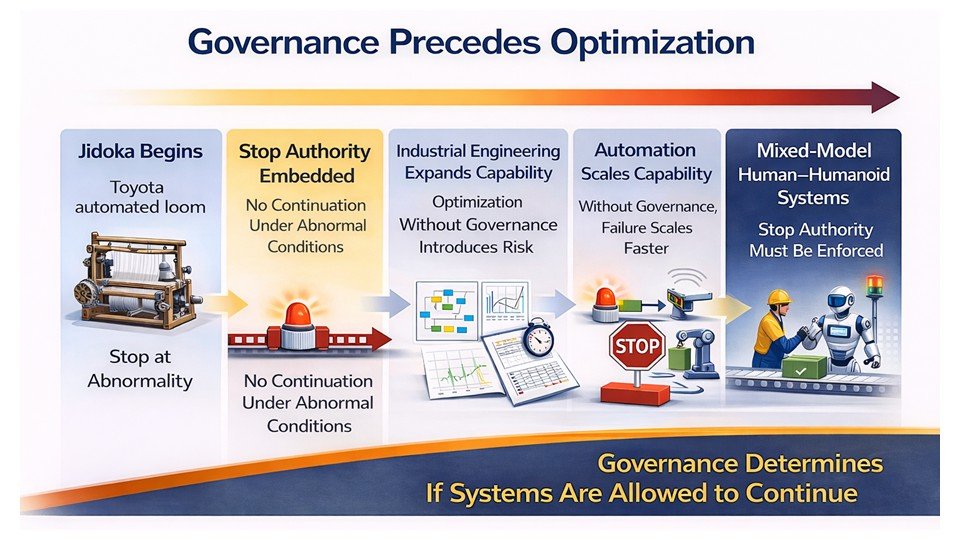
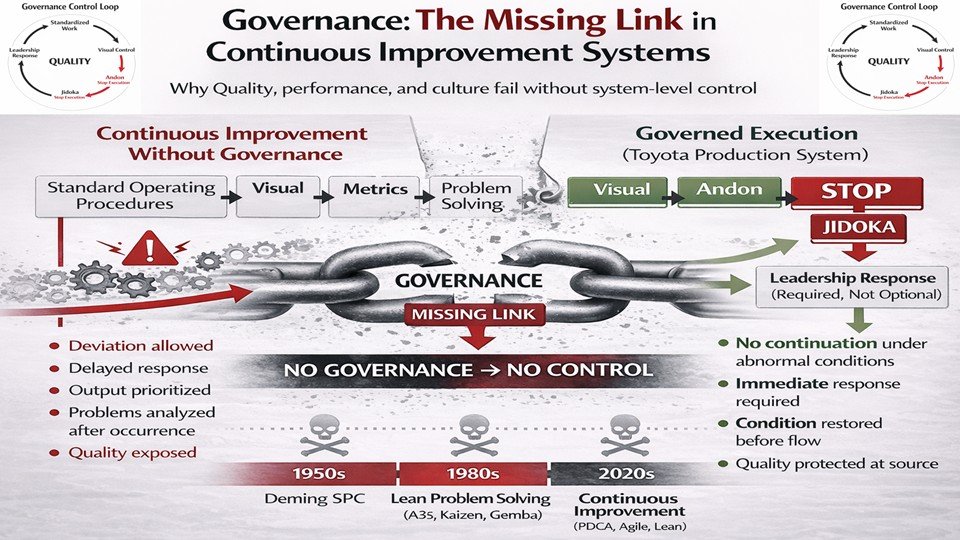
In Lean TPS, Respect for People is not a cultural aspiration, a leadership style, or a communication technique. It is a system design principle. Respect for People is expressed through the deliberate protection of Quality, built into the operating system of the organization and governed every day.
This point is frequently misunderstood. Quality in the Toyota Production System does not refer narrowly to product conformance, defect counts, or customer satisfaction metrics. Quality refers to the governance of conditions under which work is performed. It includes the Quality of work definition, the Quality of information flow, the Quality of decision making, and the Quality of leadership response. Toyota does not manage Quality as an outcome. Toyota manages Quality as a system of expectations, accountability, and immediate response.
At Toyota, people are respected by removing ambiguity from their work. Quality expectations are explicit. Normal conditions are clearly defined. Abnormal conditions are made visible in real time. Leadership is obligated to respond when those conditions are not met. The intent is not motivation, engagement, or inspiration. The intent is to protect people from the burden of operating inside unstable, unclear, or unmanaged systems.
When Quality is governed in this way, people are not forced to compensate for variation through personal effort or experience. They are not required to interpret intent or negotiate priorities. They are not placed in the position of persuading leadership after the fact. Respect for People is operationalized by ensuring that no one is left guessing what good work looks like, how Quality is judged, or who is responsible for restoring stability when Quality is threatened.
This is why, in Lean TPS, Quality is not one objective among many. Quality is the prerequisite. Quality of work enables flow. Quality of information enables coordination. Quality of decisions enables learning. Quality of leadership behavior enables continuous improvement. When Quality governance is absent, discussions about engagement, influence, or communication expand to fill the gap. Those discussions do not strengthen the system. They substitute for system design.
Continuous improvement in Lean TPS does not begin with ideas, tools, or presentations. It begins with Quality governance. Respect for People follows directly from that foundation.
Why the Need to Persuade Signals a System Failure
Much of the prevailing advice directed at Continuous Improvement professionals centers on persuasion. The guidance is familiar. Leaders do not understand Lean (post-1988) language. Leaders are overwhelmed by tools and terminology. Improvement practitioners are advised to simplify their message, focus on outcomes, and avoid explaining methods.
This advice is often well intentioned. It is also diagnostically incorrect.
In Lean TPS, leaders are not persuaded after improvements are made. Leaders own the system before improvement begins. They define Quality expectations. They establish and maintain standards. They participate directly in daily management. They are obligated to respond when Quality deviates from normal. Improvement occurs within this governed context, not outside it.
When improvement requires persuasion after the fact, leadership has already been structurally separated from system governance. Quality ownership has been displaced. Communication then becomes compensatory. Presentations become defensive. Improvement work is reframed as something that must be justified, packaged, and sold upward rather than governed directly.
This separation produces predictable behaviors. Improvement practitioners reduce technical detail to avoid challenge. Outcomes are emphasized over conditions. Before-and-after narratives replace confirmation of stability. The system appears to advance while the underlying Quality governance remains unchanged.
This is not a failure of humility, communication skill, or storytelling. It is a structural failure of Quality ownership.
In organizations where leaders do not govern Quality daily, persuasion becomes necessary because authority is unclear. Decisions are negotiated rather than enforced. Standards are interpreted rather than maintained. Improvement succeeds only when it is compelling, charismatic, or politically acceptable. Under those conditions, continuous improvement cannot be continuous. It is episodic by design.
Lean TPS removes the need for persuasion by restoring leadership responsibility for Quality. When leaders govern Quality directly, communication changes character. It becomes feedback rather than advocacy. It becomes confirmation rather than justification. It becomes learning anchored to defined normal, not persuasion anchored to outcomes.
The presence of persuasion is not a communication problem to be solved. It is a system condition to be corrected.
Lean TPS Is Not About Better Communication
Lean TPS does not eliminate communication. It eliminates the need for persuasion.
This distinction matters. In many organizations, communication is treated as a corrective action. Messages are refined, presentations simplified, and language adjusted in an effort to influence leadership after decisions or improvements have already occurred. Lean TPS operates in the opposite direction. Communication exists because governance already exists.
Practices such as Asaichi and Yuichi meetings, Obeya management, and A3 thinking are often described as communication tools. That description is incomplete and, in practice, misleading. These practices are not designed to persuade leaders or explain results after the fact. They exist because Quality expectations are already defined and leadership accountability for Quality is already established.
Asaichi refers to the daily morning Quality meeting at the point of control. Its purpose is not reporting. Its purpose is Quality protection. Actual conditions are compared against defined normal. Abnormalities are surfaced immediately. Responsibility for response is assigned. Asaichi communicates because it must coordinate action, not because it must convince anyone of outcomes.
Yuichi refers to the later-day follow-up cadence where leaders review how the system responded to earlier abnormalities. It reinforces learning, confirms whether countermeasures were effective, and ensures that Quality restoration was sustained. Yuichi is not a summary meeting. It is a leadership accountability mechanism tied directly to Quality governance.
Obeya is not a collaboration room or alignment forum. It is a system visibility and decision integration mechanism. Information is organized to reflect the governing logic of the system. Trade-offs are made explicit. Decisions are taken in real time by leaders who own the outcomes. Obeya communicates because decisions must be integrated across functions to protect Quality and flow.
A3 thinking is often reduced to reporting. In Lean TPS, it is structured feedback and learning anchored to standards. The A3 documents the gap between actual and normal, the reasoning behind countermeasures, and what was learned. Its audience is not approval. Its purpose is shared understanding and capability development under defined Quality conditions.
These practices communicate because governance exists. They do not exist to convince leaders of results after the fact. When leadership ownership of Quality is intact, communication is frequent, precise, and corrective. It is oriented toward restoring normal, not celebrating outcomes.
When these practices are reduced to reporting forums or influence mechanisms, they lose their purpose. Quality becomes retrospective. Learning becomes optional. Respect for People becomes rhetorical rather than operational. The form remains, but the governing function disappears.
Lean TPS does not succeed because it communicates well. It succeeds because it governs Quality, and communication follows naturally from that governance.
The Core Distinction
Lean TPS does not begin by asking how improvement should be explained to leaders. It begins by asking why leaders are not already governing Quality.
This difference is fundamental. In systems where Quality is governed, communication functions as feedback. Actual conditions are compared to defined normal. Deviations are surfaced. Response is triggered. Information flows because action is required. No persuasion is necessary because responsibility is clear.
In systems where Quality is not governed, communication serves a different purpose. It becomes a substitute for authority. Messages are crafted to gain approval. Results are framed to avoid challenge. Improvement is justified after the fact rather than enforced through system design. Communication shifts from feedback to persuasion because governance is absent.
The consequences are structural. When Quality is governed, improvement stabilizes and compounds. People are protected from compensating for variation. Learning is anchored to standards. Leadership behavior reinforces system integrity. When Quality is not governed, improvement becomes episodic. Success depends on advocacy rather than control. People absorb the burden of instability. Respect for People degrades from an operating condition into a symbolic value.
The distinction between feedback and persuasion is not a matter of language choice. It is a reflection of whether Quality is owned as a management responsibility or treated as an outcome to be negotiated.
Why CI Presentations Proliferate in Ungoverned Systems
The widespread reliance on Continuous Improvement presentations is not accidental. It is a predictable response to the absence of Quality governance.
When leaders do not own Quality as a system responsibility, improvement work becomes episodic by design. Changes are implemented locally, often in isolation. Results are assessed after the fact. Explanations are prepared in anticipation of scrutiny rather than as part of daily control. In this environment, presentation replaces governance.
Under these conditions, Continuous Improvement professionals are pushed into an intermediary role. They become translators between operational reality and leadership expectation. They construct narratives to justify outcomes. They simplify cause and effect to reduce the risk of challenge. Improvement activity shifts from system strengthening to result defense.
This behavior is frequently misdiagnosed as a communication problem. It is not. The failure is structural. Leaders are positioned as recipients of improvement results rather than as owners of Quality. Improvement is treated as a discrete activity rather than as a permanent condition of management.
Once this inversion occurs, several secondary effects follow. Technical detail is removed to avoid debate. Stability is assumed rather than confirmed. Before-and-after comparisons substitute for verification of normal. The appearance of progress increases while the system’s ability to sustain Quality remains unchanged.
In Lean TPS, this condition does not arise. Leaders are present in the system as a matter of obligation. Quality expectations are explicit and shared. Abnormal conditions are visible at the point of occurrence. Feedback is immediate and tied to response. Approval is not granted through presentation. It is embedded in daily governance.
Where Quality is governed, presentations contract to what is necessary for shared understanding.
Where Quality is not governed, presentations expand to compensate for missing authority.
Why Simplification Advice Misses the Root Cause
Advice to simplify Continuous Improvement communication is appealing because it addresses visible friction. Leaders appear disengaged. Presentations stall. Technical detail triggers debate. Simplification feels pragmatic because it reduces immediate resistance and shortens the interaction.
However, simplification does not restore Quality governance. It reduces exposure without correcting the underlying condition.
When Continuous Improvement practitioners remove method, logic, and system context from discussions, they may avoid confrontation. They also remove the very information leaders would require to assume responsibility for Quality. The system remains unchanged. Quality remains unmanaged. Improvement remains fragile and dependent on continued advocacy.
Lean TPS does not simplify responsibility. It clarifies responsibility.
Leaders are not protected from system complexity. They are obligated to understand it at the level that matters for governance. This does not require fluency in tools or terminology. It requires clarity on Quality control. What constitutes normal. What signals abnormal. What demands immediate response. What conditions cannot be accepted.
When leadership is separated from those questions, no degree of simplified reporting will close the gap. Communication may improve appearance. Alignment may seem to increase. Governance remains absent.
In such environments, simplification becomes a coping strategy rather than a solution. It smooths interactions while allowing the underlying Quality control problem to persist. Lean TPS rejects this tradeoff. It restores leadership ownership of Quality rather than masking its absence through better presentation
Quality Governance Removes the Need for Influence
Influence is required only when authority is missing.
In Lean TPS, authority over Quality is explicit and non-negotiable. Leaders define the conditions of acceptable work. They establish the cadence by which those conditions are reviewed. They are obligated to respond when Quality is threatened. Improvement activity operates within this governed framework. It does not sit outside it, and it does not depend on persuasion for legitimacy.
Under these conditions, communication changes character. It functions as feedback rather than persuasion. It serves confirmation rather than justification. It enables learning rather than defense. Information flows because action is required, not because acceptance must be negotiated.
Practices such as Asaichi and Yuichi meetings do not exist to influence leadership. They exist to protect Quality. Asaichi establishes immediate visibility of abnormal conditions and assigns responsibility for response. Yuichi confirms whether that response restored normal and whether learning was captured. These are governance mechanisms expressed through daily cadence, not communication techniques designed to build consensus.
Obeya does not exist to align opinions or create shared understanding through discussion. It exists to integrate decisions across functions under explicit Quality and flow constraints. A3 does not exist to report success or demonstrate competence. It exists to capture learning against defined standards and to make reasoning transparent so capability can be developed.
These practices are frequently copied without their governing logic. When leadership authority over Quality is absent, the practices remain but their purpose shifts. Meetings become updates. Visuals become explanations. A3s become reports. Communication rituals multiply while Quality control weakens. The form is preserved. The function disappears.
Lean TPS restores the function by restoring leadership ownership of Quality. When Quality is governed, influence is unnecessary. Authority is clear. Response is expected. Communication serves the system rather than compensating for its absence.
Tools, Language, and the Persistent Misdiagnosis
When improvement efforts fail to sustain, tools and language are frequently blamed. Frameworks derived from Lean (post-1988) are often criticized for inaccessible terminology or excessive method complexity. Japanese terms are labeled as barriers. Methods are accused of intimidating leadership. The proposed remedies are predictable: translate the language, simplify the terminology, substitute familiar tools, or remove method references altogether.
This diagnosis is convenient. It is also incorrect.
Tools are neutral. Language is neutral. Neither creates nor destroys Quality governance.
In Lean TPS, tools exist to serve defined Quality conditions. They are selected, applied, and adjusted based on whether they support stability, flow, and problem detection. Language exists to describe deviations from those conditions and to coordinate response. When governance is present, tools are used without ceremony and language is shared through daily practice. Neither carries symbolic weight because authority does not depend on them.
When governance is absent, tools and language take on a different role. Tools become symbols of expertise. Terminology becomes a proxy for authority. Methods introduced by improvement specialists appear discretionary because leadership has not claimed ownership of Quality. Under those conditions, every tool can be questioned, negotiated, or dismissed. Standards become suggestions. Quality becomes negotiable. Improvement depends on persuasion rather than obligation.
This is why debates about terminology persist. They are not debates about clarity or accessibility. They are debates about ownership.
When leaders do not govern Quality directly, no shared language can stabilize the system. Translation may reduce friction, but it does not restore authority. Substitution may feel inclusive, but it does not establish control. The system remains vulnerable to reinterpretation and drift because Quality is not anchored in leadership responsibility.
Lean TPS removes this ambiguity by design. Quality is not introduced through language. It is enforced through structure. Standards define normal. Visual controls expose abnormal. Leadership response restores stability. Tools and language then serve their proper function as mechanisms of control and learning, not as instruments of persuasion.
Why Outcome Theater Replaces Quality Control
In organizations without Quality governance, outcomes take precedence over conditions. Results are celebrated without confirming stability. Improvements are declared complete without verifying adherence to standard. Visual artifacts are emphasized over control mechanisms.
This behavior is not malicious. It is adaptive.
When leaders are distant from the system, progress cannot be confirmed through direct observation of normal versus abnormal. The only remaining option is to demonstrate improvement indirectly. Before-and-after images, summary metrics, and executive dashboards become substitutes for Quality control. These artifacts are designed to reassure. They often succeed in doing so. They do not, however, protect Quality.
Lean TPS does not evaluate improvement through presentation. It evaluates improvement through sustained normal. The primary questions are structural. Can the process hold? Does Quality remain stable under load? Are deviations detected immediately? Is response timely and effective? Improvement is not considered complete until these conditions are met repeatedly, not once.
When this discipline is absent, improvement degrades into performance. Apparent success increases while system fragility grows. Variability is absorbed by people rather than corrected by design. Operators compensate through experience, effort, and workarounds. Respect for People erodes quietly as individuals are asked to sustain outcomes that the system cannot reliably produce.
Quality governance prevents this failure mode by shifting attention from results to conditions. Leaders monitor the state of the system, not just its outputs. Control precedes celebration. Communication follows governance. It becomes precise, frequent, and corrective, oriented toward restoring normal rather than showcasing success.
Where Quality is governed, outcome theater has no role. Control is visible. Learning is immediate. Improvement is sustained.
Lean TPS as a Management System, Not a Communication Strategy
Lean TPS is often described as a collection of practices, tools, or behaviors. This framing is incomplete and ultimately misleading. Lean TPS is a management system designed to govern Quality continuously.
Its purpose is not to improve communication. Its purpose is to establish control over system conditions so that Quality is protected by design. Communication follows from that control. It does not substitute for it.
In Lean TPS, Respect for People is embedded structurally. It is expressed through the explicit definition of normal work, visible Quality criteria, immediate response to abnormality, and sustained leadership presence at the point of work. These elements are not cultural signals. They are governance mechanisms. Together, they prevent ambiguity, reduce burden, and protect people from compensating for unstable systems.
Under these conditions, communication changes character. It does not need to persuade or justify. It needs only to inform. Feedback is short because expectations are clear. Learning is continuous because deviation is visible and addressed. Authority is unambiguous because leadership ownership of Quality is explicit.
When Lean TPS is reduced to a communication strategy, its core purpose is lost. Practices are reinterpreted as alignment tools. Meetings become forums for explanation. Visuals become narratives. Improvement activity drifts toward influence rather than control. The form remains recognizable, but the governing logic disappears.
When Lean TPS is treated as a management system, communication becomes one of its natural outputs. Information flows because action is required. Feedback exists because standards exist. Learning accumulates because Quality is governed daily. Respect for People is no longer declared. It is enforced through system design.
What This Means for Continuous Improvement Roles
When Quality governance is absent, Continuous Improvement roles expand by necessity. Specialists are asked to diagnose problems, design solutions, persuade leadership, and defend results. They become responsible not only for improvement activity, but for its legitimacy. This expansion is not a failure of competence or intent. It is a predictable consequence of organizational design.
In Lean TPS, improvement is not delegated to a specialist class. Leaders are responsible for the Quality of their systems. They define normal conditions, establish response expectations, and participate directly in daily management. Improvement activity exists to strengthen that leadership responsibility, not to substitute for it.
Continuous Improvement roles, where they exist in Lean TPS, serve a different function. They support learning. They develop capability. They help leaders see system behavior more clearly. They do not carry authority on behalf of management, and they are not positioned as intermediaries between leadership and operations.
When CI roles are required to persuade leadership, the system has already inverted. Authority has moved upward, away from the point of control. Responsibility has moved downward, onto those without the power to enforce conditions. Quality becomes conditional rather than governed. Improvement succeeds only when advocacy is strong and attention is sustained.
Restoring Quality governance reverses this inversion. Leadership reclaims ownership of system conditions. CI advocacy becomes unnecessary. Improvement work becomes quieter, more routine, and more durable. Learning accumulates through daily feedback rather than episodic initiatives.
Respect for People is reinforced not through encouragement, recognition, or motivation, but through stability. People are protected from compensating for unmanaged systems. Improvement becomes part of normal management work rather than a performance requiring defense.
Respect for People Revisited
Respect for People is frequently interpreted as kindness, inclusion, or engagement. In Lean TPS, this interpretation is incomplete. Respect for People is expressed through protection. People are protected from unstable processes. They are protected from unclear expectations. They are protected from the burden of compensating for unmanaged systems.
That protection is delivered through Quality governance.
When Quality is defined, governed, and reviewed daily, people are not asked to guess what good work looks like. They are not required to negotiate priorities or persuade leadership after the fact. They are asked to operate within a system that makes expectations explicit and response predictable. Learning occurs because deviation from normal is visible and addressed immediately. Communication becomes precise because authority is clear and responsibility is unambiguous.
This is why Respect for People cannot be separated from Quality in Lean TPS. Respect is not an attitude layered onto improvement efforts. It is not a leadership style adopted after results are achieved. It is the operating condition that makes improvement possible in the first place.
Where Quality is governed, people are supported by the system. Where Quality is not governed, people become the system. Lean TPS exists to prevent that substitution.
The Central Claim
Lean TPS does not solve influence problems. It removes the conditions that create them.
When leaders govern Quality, communication functions as feedback. Actual conditions are compared against defined normal. Deviations are made visible. Response is expected. When leaders do not govern Quality, communication takes on a different role. It becomes persuasion. Results are framed. Decisions are negotiated. Authority is unclear. The difference between these two conditions is not rhetorical. It is structural.
Organizations may invest in better presentations, simpler language, or automated reporting tools. These efforts can reduce friction. They can improve the appearance of alignment. They do not restore Quality governance. Until leadership ownership of Quality is rebuilt, improvement will remain episodic, dependent on advocacy, and vulnerable to drift.
Lean TPS addresses this directly. It restores Quality as a management obligation rather than a reported outcome. It embeds Respect for People through system design rather than intention. It replaces persuasion with governance by making leadership responsibility for Quality explicit, visible, and enforceable.
Where Quality is governed, improvement compounds. Where Quality is not governed, improvement performs. Lean TPS exists to make that distinction operational.
Conclusion: What This Means for Leaders
For leaders, the implications are structural rather than stylistic.
The central question is not how improvement should be communicated upward. The question is whether leadership is governing Quality as a system responsibility. When Quality governance is absent, leaders experience improvement as a series of reports, presentations, and initiatives competing for attention. When Quality governance is present, leaders experience improvement as part of normal management work.
Lean TPS places Quality ownership squarely with leadership. Leaders are responsible for defining normal conditions, ensuring visibility of deviation, and responding when Quality is threatened. This responsibility cannot be delegated to Continuous Improvement roles, translated through simplified language, or automated through reporting tools. It must be exercised directly and daily.
When leaders govern Quality, several secondary problems resolve without intervention. Communication becomes feedback rather than persuasion. Improvement becomes continuous rather than episodic. Respect for People is enforced through system stability rather than encouragement. People are protected from compensating for unmanaged variation. Learning accumulates because deviation is addressed, not explained away.
When leaders do not govern Quality, no amount of improved communication can compensate. Better presentations may reduce friction. Simpler language may increase temporary alignment. Neither restores system control. Improvement remains fragile because it depends on advocacy rather than authority.
Lean TPS does not ask leaders to become experts in tools or terminology. It requires leaders to accept non-delegable responsibility for Quality governance. That acceptance is the point at which Respect for People becomes real and continuous improvement becomes possible.
Continuity With the Earlier Articles in This Series
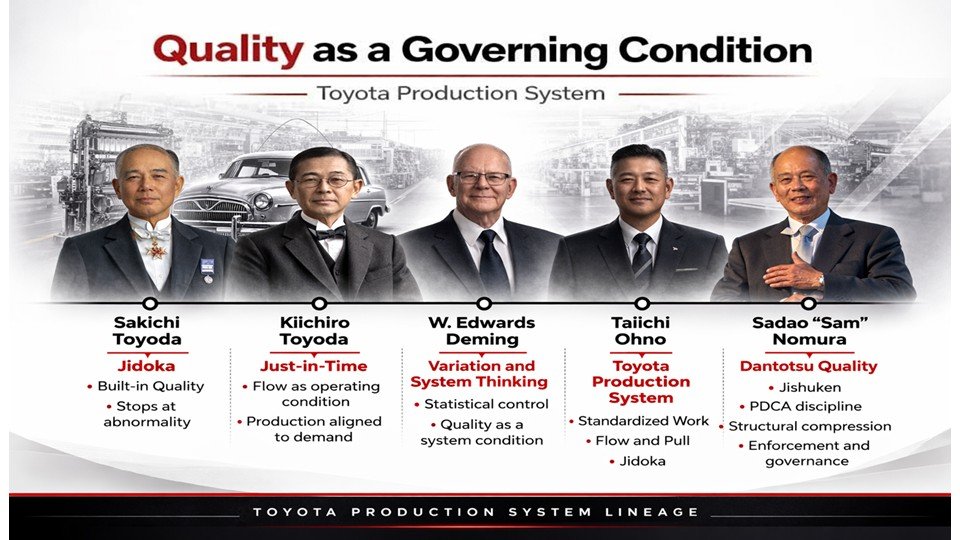
This article continues a line of inquiry developed across earlier work on LeanTPS.ca examining how Quality governance was progressively separated from the Toyota Production System as it was translated into portable improvement frameworks.
Earlier articles traced how governance was displaced by tools, projects, and certification structures, and how that displacement altered the role of leadership. In those analyses, Quality shifted from a managed condition to a reported outcome. Leadership responsibility gave way to specialist functions. Continuous improvement became something to explain, justify, and promote rather than something governed daily.
Six Sigma (post-1990s) and Lean Six Sigma (post-2010s): How Quality Governance Was Replaced examined how certification systems, project structures, and belt hierarchies displaced leadership ownership of Quality, producing technically capable organizations without durable control.
https://leantps.ca/six-sigma-lean-six-sigma-quality-governance/
Kaizen (post-1980s): How Governance Was Removed from the Toyota Production System traced how Kaizen became portable by shedding Jishuken, escalation, and leader obligation, allowing improvement activity to persist while system control eroded.
https://leantps.ca/kaizen-post-1980s-how-governance-was-removed-from-the-toyota-production-system/
Jishuken: Leadership Governance Through Direct System Engagement examined how Toyota preserved Quality by obligating leaders to participate directly in system diagnosis, escalation, and learning. It showed how Jishuken functioned as a governance mechanism rather than an improvement method, and why its absence left improvement activity disconnected from leadership responsibility.
https://leantps.ca/jishuken/
This article extends that analysis by focusing on a visible downstream consequence of the same structural shift: the rise of persuasion, presentation, and communication optimization as substitutes for leadership governance. The need to influence leaders, simplify language, or automate reporting is not an isolated problem. It is a predictable result of removing Quality ownership from leadership and relocating it to methods, roles, or tools.
Taken together, these articles form a consistent argument. Toyota did not achieve continuous improvement by improving communication. Toyota achieved continuous improvement by governing Quality. Respect for People emerged from that governance, not alongside it. Where that structure was removed, persuasion replaced control. Where it is restored, persuasion becomes unnecessary.