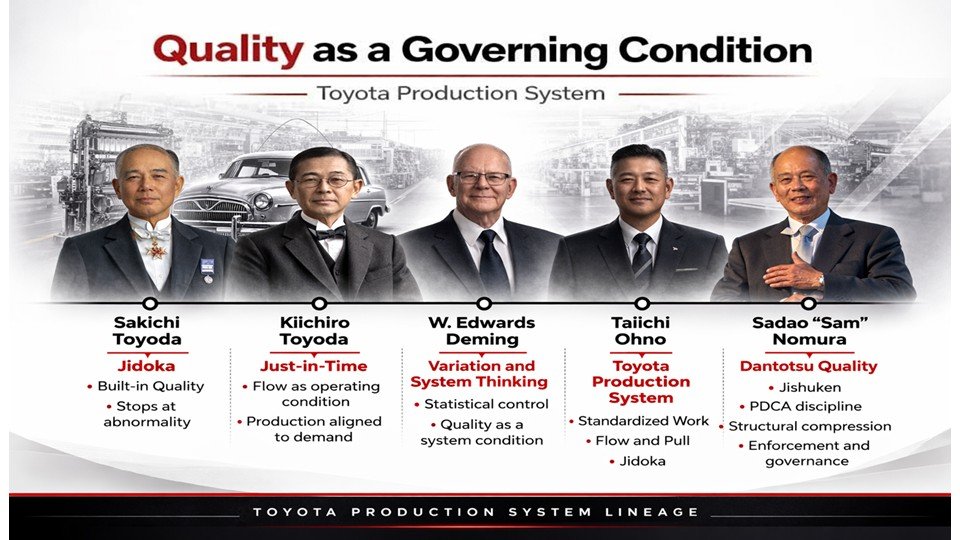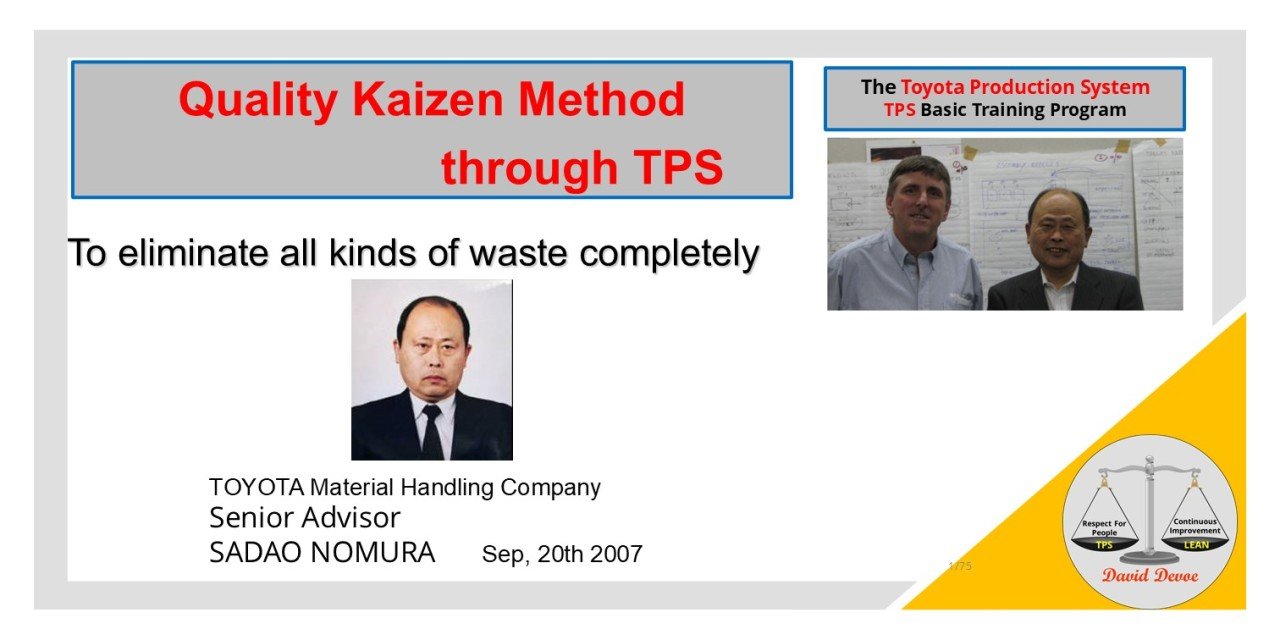
Every Toyota leader inherits two responsibilities: to improve the process and to develop the people who sustain it. This dual mission defines the Toyota Production System (TPS). It is not a collection of tools or methods, but a management system that turns work into learning and learning into leadership. Few embodied this purpose more completely than Mr. Sadao “Sam” Nomura, Senior Advisor to Toyota Industries Corporation.
For over four decades, Mr. Nomura guided Toyota teams across Japan, North America, and around the world. His mentorship reached far beyond production floors. It influenced how leaders thought, acted, and passed on what they learned. His work in Dantotsu Quality Improvement became a blueprint for how Toyota connects continuous improvement with respect for people.
The Meaning of Dantotsu
In Japanese, Dantotsu means “best of the best.” In Toyota practice, it means radical, uncompromising improvement that transforms the system itself. Dantotsu is not achieved by chasing small gains or applying isolated tools. It is achieved when leadership takes full ownership of the process, understands the cause of every defect, and designs countermeasures that prevent recurrence.
Mr. Nomura taught that Dantotsu begins with discipline. He reminded teams that quality is not inspection. It is the result of leaders making problems visible and acting immediately. “You cannot improve what you cannot see,” he said, “and you cannot see from a distance.” He expected leaders to go to the Gemba, confirm the condition, and take responsibility for restoring stability.
The Foundation of Dantotsu Quality
The Dantotsu method that Nomura developed was not separate from TPS. It was TPS practiced with complete consistency. It brought together Just in Time, Jidoka, and Standardized Work into one rhythm of daily problem solving. His book, The Toyota Way of Dantotsu Radical Quality Improvement, describes this system through sixteen chapters that outline the path from visualization to sustained control.
Each chapter links quality improvement to human development. Visualization of defects teaches people to see. Standardization of work teaches people to sustain. QC Circle activities teach people to collaborate. The structure of Dantotsu ensures that every improvement cycle produces both process stability and leadership growth.
Nomura’s goal was not just to remove defects, but to build people who could prevent them. He said, “Zero defects is not the result. It is the condition that appears when leaders and members think together every day.”
Applying Dantotsu at Toyota Material Handling
At Toyota Material Handling in North America, the Dantotsu program was a system-wide transformation effort. It began with an ambitious Hoshin target: reduce major quality issues by ninety percent over three years. Many saw this goal as impossible. Nomura saw it as necessary. He explained that radical targets force radical thinking.
His approach was methodical. Each plant mapped its defect flow, traced recurrence patterns, and applied Nomura’s eight-step procedure for defect reduction. The process was grounded in daily confirmation, visual management, and real-time countermeasures.
During his visits to BT Raymond in Brantford, Ontario, Nomura insisted that every problem have an owner and every countermeasure have a time limit. Same-day responses were expected for minor issues. Larger issues required resolution within one week or one month. Anything slower meant the system was not functioning. He reminded us that delay in action meant waste in thought.
This discipline changed how leaders led. They learned to confirm problems visually, engage operators in fact finding, and close the loop with documented countermeasures. Quality improvement became a shared responsibility rather than a departmental function.
The Power of Reflection and Learning
Nomura’s method always included reflection. After every improvement activity, he asked leaders three questions:
- What did you see?
- What did you learn?
- What will you do differently next time?
He believed that reflection was the highest form of learning because it converted experience into understanding. Without reflection, he said, improvement becomes repetition. With reflection, improvement becomes wisdom.
This thinking shaped how I approached leadership development at BT Raymond. Jishuken events became structured learning sessions. Leaders were expected to analyze process data, test hypotheses, and present findings. Each presentation had to show evidence of cause and countermeasure verified at the Gemba. Over time, this built a discipline of analytical thinking that spread across departments.
Nomura-Grams and Knowledge Preservation
Among Nomura’s most enduring contributions were his handwritten A3 memos, known as Nomura-Grams. Each was a concise record of what he observed, what was missing, and what action was required. They were not reports. They were direct learning instruments. Every note carried the weight of Genchi Genbutsu — go and see for yourself.
At BT Raymond, his Nomura-Gram #31 became part of our internal learning archive. It documented his visit, summarized his observations, and acknowledged our Lean TPS Basic Training program as a model for structured education. This single page captured Toyota’s approach to knowledge preservation. It showed how experience is converted into shared learning through simple, visual documentation.
These Nomura-Grams were later compiled into internal training materials used across Toyota Material Handling facilities. They became a living record of the Dantotsu transformation and a testament to Nomura’s belief that teaching is the highest form of respect.
The Human Side of Dantotsu
Nomura’s leadership extended beyond systems and charts. He valued the human element above all. He treated every person as capable of improvement, regardless of position. He listened carefully, asked precise questions, and encouraged open dialogue. He believed that the strength of TPS came not from perfection, but from the willingness of people to confront problems together.
He also understood that culture could not be copied. It had to be built through consistent example. His manner was humble and patient, but his standards were absolute. If he saw waste, he called it out. If he saw progress, he acknowledged it immediately. Through this balance of challenge and respect, he created a learning environment where people wanted to improve.
From Improvement to Innovation
Dantotsu Quality was not just about eliminating defects. It was about creating the conditions for innovation. Once flow was stable and problems were visible, teams began to think differently. They no longer reacted to issues. They anticipated them. This mindset shift allowed Toyota’s manufacturing sites to move from reactive quality control to proactive system design.
At Toyota L&F in Takahama, Nomura’s influence helped integrate design, production, and logistics into one synchronized flow. Quality information moved freely between departments, creating a closed learning loop that improved both process and product. This approach became the foundation for Toyota’s global forklift leadership, where stability and flexibility coexist.
Passing the Torch
Every Sensei’s work eventually transitions from teaching to legacy. Nomura’s legacy is found not in the plants he improved, but in the leaders he developed. His students carried his methods forward, embedding his teachings into training programs, audits, and Kaizen reviews across North America and beyond.
For me, his mentorship became the model for Lean TPS education. It shaped the structure of Lean TPS Basic Training and the foundation of my own teaching philosophy. Every module, from 5S to Jishuken, reflects the lessons learned from Nomura: go and see, confirm the standard, make problems visible, and respond immediately.
His approach also influenced how I define the fifth P of the Toyota Way: Performance through Jishuken. It represents the connection between learning and measurable improvement. Nomura taught that performance is not the result of pressure but of clarity. When people understand their process and own their problems, performance follows naturally.
Nomura’s Enduring Impact
Today, the phrase Dantotsu Quality continues to guide Toyota’s global improvement programs. It remains a call to leadership discipline, factual thinking, and respect for people. Its impact reaches beyond Toyota, influencing industries worldwide that study the TPS model to learn how structure, culture, and capability come together to prevent failure.
Nomura’s career stands as proof that mentorship can shape generations. His teachings were practical, his standards high, and his respect for people unwavering. He demonstrated that the real measure of success in TPS is not the elimination of defects but the development of people who can see, think, and act independently.
Conclusion: The Living System
Mr. Sadao “Sam” Nomura’s legacy is not frozen in history. It lives in every leader who applies Dantotsu thinking, in every team that learns to solve problems through facts, and in every process that improves through shared reflection. His work connected Toyota’s earliest spirit of invention to the modern discipline of system design.
Dantotsu Quality remains a living system. It teaches that radical improvement is achieved not through speed or scale, but through truth, learning, and leadership that never stops teaching. That is the essence of Nomura’s contribution to the Toyota Production System. His life’s work reminds us that improvement and respect are not separate goals. They are one and the same.