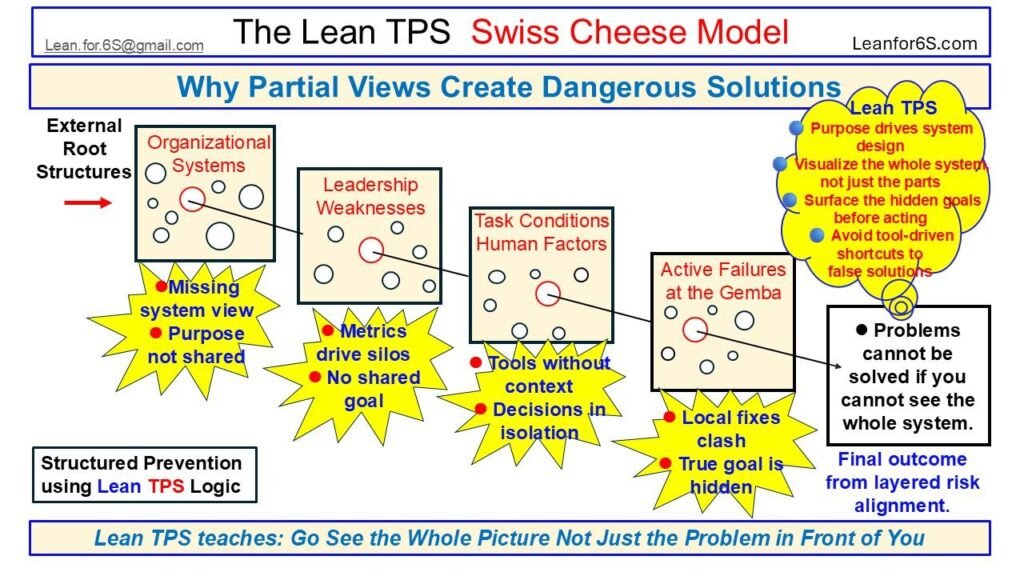
Lean TPS Swiss Cheese Model: Why Partial Views Create Dangerous Solutions

Lean TPS Swiss Cheese Model A3 visual showing how system blindness allows risks to align across leadership, process, and task layers, causing failure.
Lean TPS teaches prevention by design. The Swiss Cheese Model shows how missing system views allow risks to align. True improvement comes from shared purpose, visibility, and structure.

Most organizations believe their biggest risks come from visible problems. In Lean TPS, the real danger comes from what is not seen. It is the hidden connections between people, processes, and leadership that quietly align into failure.

The Lean TPS Swiss Cheese Model explains this clearly. Problems are rarely caused by single events. They are the result of layered risks that silently line up across time, departments, and decisions. Each layer seems small and unrelated, but when they align, they allow a complete system failure to pass through every barrier.

When the system view is missing, teams act locally. They make fixes that appear logical in isolation but collide when viewed together. Leadership focuses on metrics instead of shared purpose. Task conditions change without full context. Frontline operators adapt, creating workarounds to survive immediate pressures. Each layer performs its best, but none can see the whole picture.

The result is not individual failure. It is system failure.

This is why Toyota built Lean TPS as a prevention system, not a reaction system. The goal is not to close every hole separately but to align the structure so that the holes never line up. When alignment exists, the system becomes capable of absorbing variation without breaking. When it does not, the same problems return in different forms.

During my TPS Basic Training at Toyota L&F Takahama, this concept was reinforced through daily problem solving. When a line stopped, the question was never “who made the mistake.” The question was “what part of the system allowed this condition to exist.” That reflection connected production, maintenance, logistics, engineering, and leadership. Each function had to study how its design influenced the next.

This is the discipline of structured prevention. Standardized Work defines how the process should run. Visual Management makes abnormality visible. Jidoka ensures problems stop before they spread. PDCA turns every incident into learning. Leadership aligns purpose so that every improvement fits within a shared goal.

When this alignment exists, small gaps are offset by strong systems. When it does not, risk passes through every layer.

The Lean TPS Swiss Cheese Model is not about fear of failure. It is about respect for system design. It reminds us that improvement without structure hides problems deeper. True prevention comes from seeing the system as one connected body, where every decision either strengthens or weakens alignment.

Problems cannot be solved if you cannot see the whole system. Lean TPS teaches us to go and see, clarify the purpose, and build prevention into the work itself.
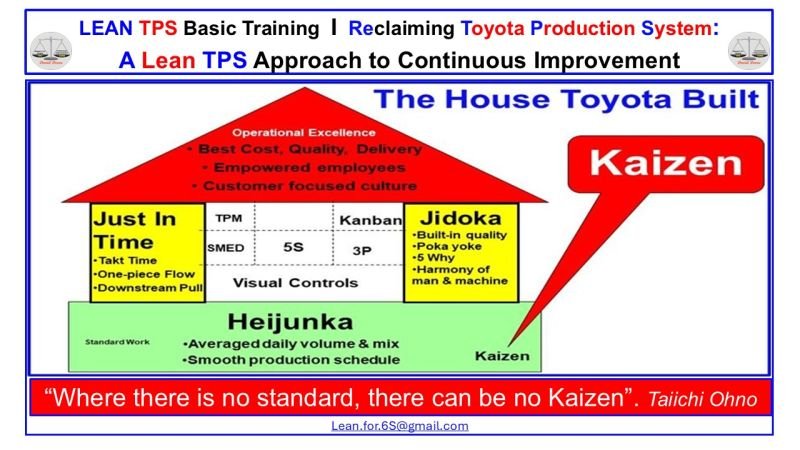
Lean TPS House diagram showing Just In Time, Jidoka, Heijunka, Standardized Work, and Kaizen positioned within the Toyota Production System architecture
This Lean TPS Basic Training visual explains how Kaizen operates within the governed architecture of the Toyota Production System. Just In Time and Jidoka function as structural pillars, Heijunka and Standardized Work provide stability, and Kaizen strengthens the system only when standards and control are in place. The image reinforces
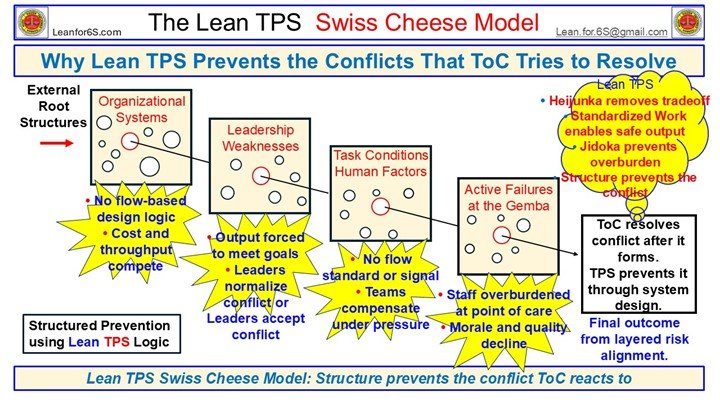
Lean TPS Swiss Cheese Model showing how governance failures propagate from organizational systems to gemba outcomes, and how TPS prevents conflicts that Theory of Constraints resolves downstream.
Theory of Constraints manages conflict after instability forms. Lean TPS prevents conflict through governance of demand, capacity, and Quality before execution begins.
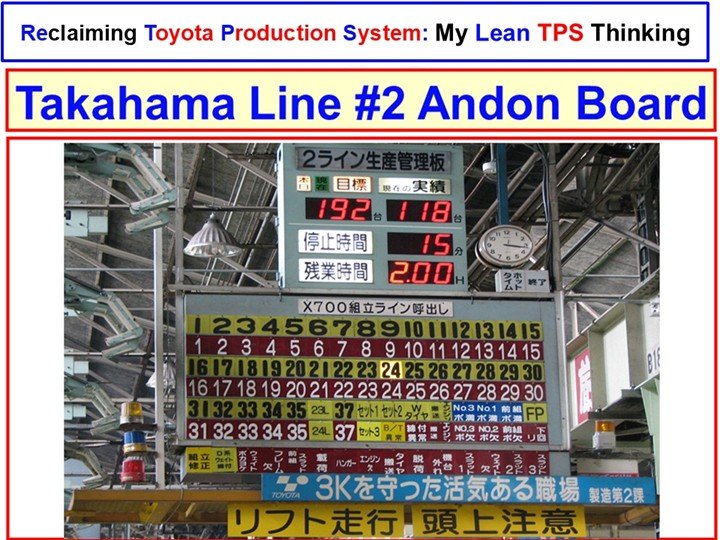
Takahama Line 2 Andon board showing real time production status and Quality control in the Toyota Production System
Dashboards and scorecards increase visibility, but they do not govern work. In Lean TPS, Andon exists to control abnormality in real time by enforcing stop authority, response timing, and leadership obligation to protect Quality.
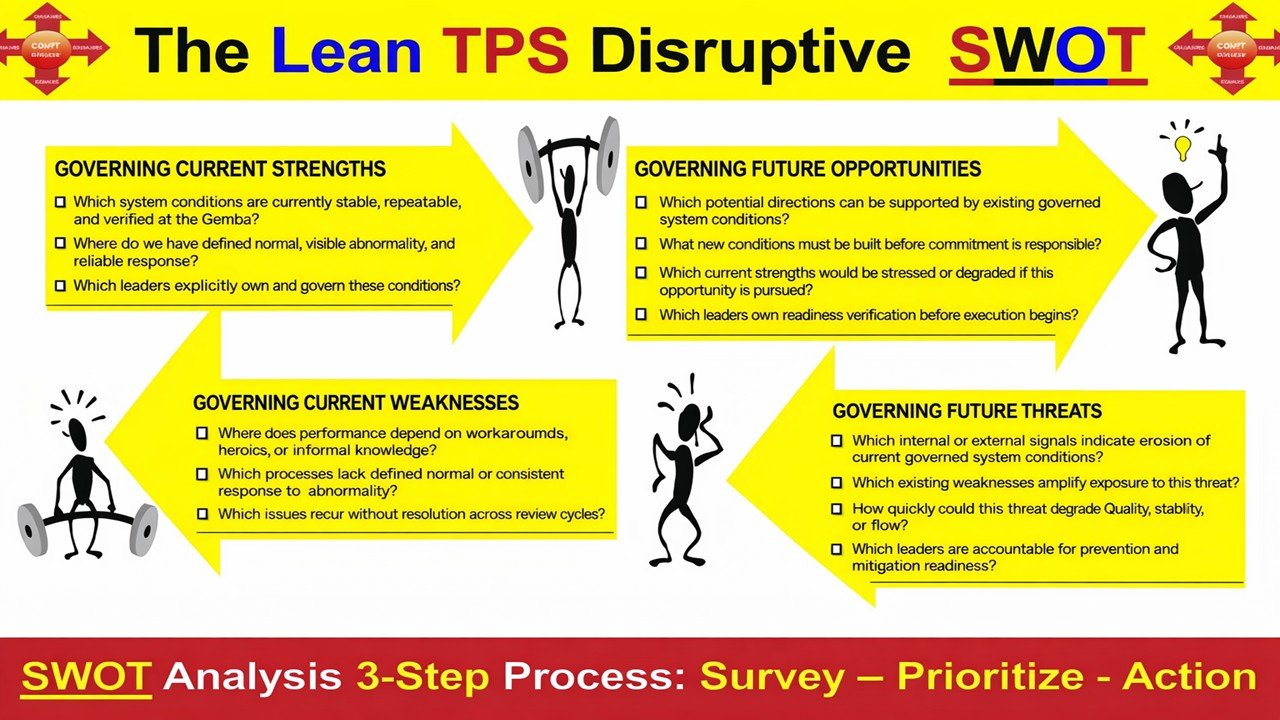
Lean TPS Disruptive SWOT transforms traditional SWOT from a static listing exercise into a governed leadership system. Through Survey, Prioritize, and Action, it aligns strategic direction with Quality, system stability, and explicit leadership obligation within a Lean TPS governance framework.
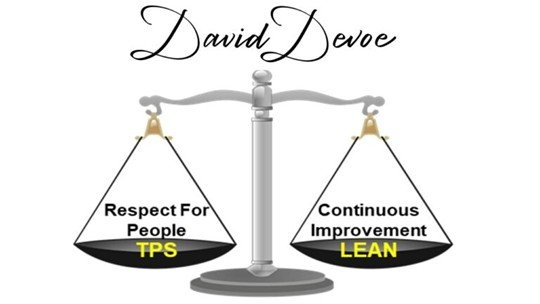
Balance scale showing Respect for People and Continuous Improvement grounded in Quality governance within Lean TPS.
In Lean TPS, Respect for People and Continuous Improvement are not independent goals. Both emerge from Quality governance, where leaders define normal work, make abnormality visible, and respond to protect system stability.
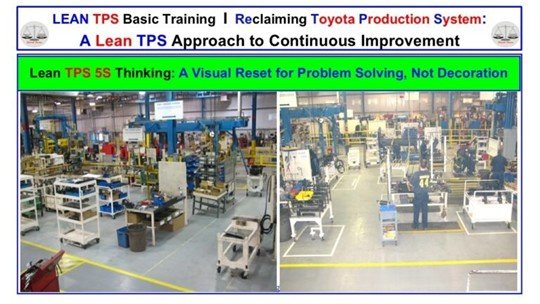
Lean TPS shop floor before and after 5S Thinking showing visual stability that enables problem detection and problem solving
5S Thinking is not about making the workplace look clean or impressive. In Lean TPS, it functions as a visual reset that restores the ability to see normal versus abnormal conditions. When the environment is stabilized, problems surface quickly, Quality risks are exposed earlier, and problem solving becomes possible at