A Governance System for Strategic Direction, Quality, and Respect for People
Introduction
Strategic direction fails in most organizations not because of poor intent, weak analysis, or insufficient ambition. Strategic direction fails because leadership systems lack governance over how direction is established, reviewed, corrected, and renewed. Strategy is often treated as a periodic activity rather than a managed system condition.
Many organizations conduct strategy reviews, planning offsites, and prioritization exercises. These activities produce awareness, alignment statements, and initiative lists. Few organizations operate a governed system that binds leadership behavior to evidence, defined conditions, and ongoing responsibility for outcomes. As a result, strategy becomes episodic. Direction becomes static. Resource allocation becomes preference driven rather than condition driven.
Lean TPS Disruptive SWOT exists to close that gap.
Within Lean TPS, strategic direction is inseparable from Quality governance and Respect for People. Quality in Lean TPS is not defined by results alone. Quality is defined by the governance of conditions under which work is performed and decisions are made. Respect for People is not expressed through communication or intent. Respect for People is expressed by designing systems that protect people from ambiguity, unmanaged risk, and shifting priorities. Strategic direction that lacks governance violates both.
Lean TPS Disruptive SWOT is not a diagnostic exercise. Lean TPS Disruptive SWOT is a leadership governance mechanism. The purpose is not to describe the organization or to collect opinions. The purpose is to govern strategic direction through disciplined leadership obligation, explicit Quality conditions, and recurring review of internal and external reality.
Traditional SWOT analysis produces lists. Lists do not govern behavior. Lists do not assign obligation. Lists do not trigger response when conditions change. Lean TPS Disruptive SWOT reframes the four SWOT quadrants as governed leadership responsibilities. Strengths, Weaknesses, Opportunities, and Threats are treated as system conditions that must be verified, owned, reviewed, and acted upon. Each quadrant becomes a mechanism for exposing risk, clarifying responsibility, and directing leadership action.
This governance approach aligns directly with Lean TPS principles. Problems must be made visible. Abnormality must be detected early. Responsibility for response must be clear and non-delegable. Learning must be structured and repeated. Strategic direction is therefore managed as a living system rather than a fixed plan.
Lean TPS Disruptive SWOT operates through a disciplined cycle that replaces static analysis with structured learning and action. Input is gathered from across the organization to surface real conditions at the Gemba. Issues are prioritized to constrain leadership discretion and force focus on what matters most. Actions are assigned with clear ownership, defined conditions of completion, and integration into existing management routines. When repeated on a defined cadence, the system reveals patterns, exposes recurring governance gaps, and builds organizational maturity.
This whitepaper defines Lean TPS Disruptive SWOT as a leadership system that aligns strategy, governance, and execution through structured obligation rather than discretionary judgment. The intent is not to introduce another framework. The intent is to establish a governed method for listening, prioritizing, and acting that raises the quality of strategic direction while reinforcing Respect for People through system design.
Why Classic SWOT Fails as a Governance Mechanism
SWOT analysis is widely used because it is simple, accessible, and familiar. Simplicity alone does not produce governance. In many organizations, SWOT persists precisely because it is easy to conduct without forcing leadership to change how decisions are made or how responsibility is owned.
Classic SWOT fails not because the questions are wrong, but because the system surrounding the questions is weak.
Traditional SWOT analysis captures opinions rather than verified conditions. Participants describe what they believe to be strengths, weaknesses, opportunities, and threats, often based on experience, perception, or recent events. Little distinction is made between evidence and assumption. In a Lean TPS context, this is a fundamental failure. Lean TPS requires decisions to be grounded in observable conditions, not aggregated viewpoints. When opinion substitutes for condition, strategic direction becomes unstable.
Classic SWOT freezes a moment in time. The exercise is typically conducted annually or during major planning cycles, producing a snapshot that quickly becomes obsolete. Markets shift. Internal capabilities change. Risks emerge gradually rather than suddenly. Without a mechanism for renewal, SWOT outputs age silently while leadership continues to reference them as if they remain valid. Static analysis cannot govern a dynamic system.
Classic SWOT lacks cadence. There is no defined expectation for when findings are revisited, revalidated, or invalidated. Items identified as important remain on charts long after conditions have changed. In Lean TPS, cadence is essential because learning depends on repetition and comparison over time. Without cadence, organizations lose the ability to detect drift, recurring failure modes, or improvement maturity.
Classic SWOT does not bind leadership to action or response. Outputs are advisory. Leadership may consider them, reinterpret them, or ignore them without consequence. No ownership is assigned. No obligation is created. No response is required when conditions deteriorate. This absence of obligation directly undermines Quality governance. When no one is required to act, problems persist and risks accumulate.
Classic SWOT produces lists rather than obligations. Lists create awareness but not responsibility. Lists do not protect people from ambiguity. Lists do not clarify who must respond when risks materialize. In Lean TPS, Respect for People is expressed through system design that removes uncertainty and makes responsibility explicit. A list that can be ignored places the burden of interpretation and compensation on individuals rather than the system.
As a result, classic SWOT becomes disconnected from system reality. Strategic direction becomes a narrative rather than a governed condition. Leadership discretion replaces disciplined response. Quality becomes reactive. Respect for People erodes as priorities shift without explanation or structure.
Lean TPS Disruptive SWOT exists to correct these structural failures. It replaces opinion with verified conditions. It replaces static snapshots with recurring review. It replaces advisory lists with leadership obligation. Most importantly, it restores governance to strategic direction by treating SWOT not as an exercise, but as a managed system aligned with Lean TPS principles.
Lean TPS Disruptive SWOT as a Governance System
Lean TPS Disruptive SWOT reframes each quadrant of SWOT as a leadership obligation rather than a discussion topic. Strengths, Weaknesses, Opportunities, and Threats are not treated as ideas to debate or perspectives to reconcile. Each quadrant represents a set of system conditions that leadership must verify, own, and govern over time. Evidence is required. Ownership is explicit. Response is mandatory when conditions change.
This reframing is essential. In Lean TPS, governance is not achieved through agreement or alignment alone. Governance is achieved when responsibility for conditions is clear and non-delegable. Disruptive SWOT functions as a governance system because it binds leadership behavior to observable reality and defined obligations rather than discretionary interpretation.
The framework is governed by three principles that anchor it within Lean TPS.
The first principle is that strategy is a system condition, not a statement of intent. Strategic direction is often expressed as vision statements, goals, or priorities. These expressions do not govern behavior unless the underlying system conditions are controlled. In Lean TPS, results are produced by conditions. Strategy therefore exists only to the extent that the organization has designed, stabilized, and governed the conditions required to support it. Disruptive SWOT evaluates strategy by examining whether those conditions actually exist.
The second principle is that leadership owns the conditions under which strategy succeeds or fails. Ownership in Lean TPS is not symbolic. Ownership means responsibility for defining normal, detecting abnormality, and responding when conditions deviate. Disruptive SWOT assigns this obligation explicitly. When a strength is claimed, leadership owns the conditions that make it reliable. When a weakness is identified, leadership owns correction. When an opportunity is pursued, leadership owns readiness. When a threat is identified, leadership owns mitigation. Strategy without ownership is not strategy. It is aspiration.
The third principle is that strategic direction must be reviewed, corrected, and renewed through disciplined cadence. Systems drift when they are not governed. Lean TPS relies on repetition to create learning, comparison, and stability. Disruptive SWOT applies the same logic to strategic direction. Findings are not assumed to remain valid. Conditions are rechecked. Patterns are examined. Recurring issues are treated as governance failures rather than execution noise. Cadence transforms SWOT from analysis into control.
Together, these principles establish Lean TPS Disruptive SWOT as a closed loop system. Input is gathered to surface real conditions. Prioritization constrains leadership discretion and forces focus. Action creates obligation and response. Review closes the loop and informs the next cycle. Unlike open-ended discussions that generate insight without accountability, Disruptive SWOT operates as a governed mechanism that continuously aligns strategic direction with Quality, Respect for People, and leadership responsibility.
In this way, Lean TPS Disruptive SWOT does not sit alongside the management system. It becomes part of the management system. Strategic direction is no longer something leaders announce. Strategic direction becomes something leaders govern.
Governing Structure of Lean TPS Disruptive SWOT
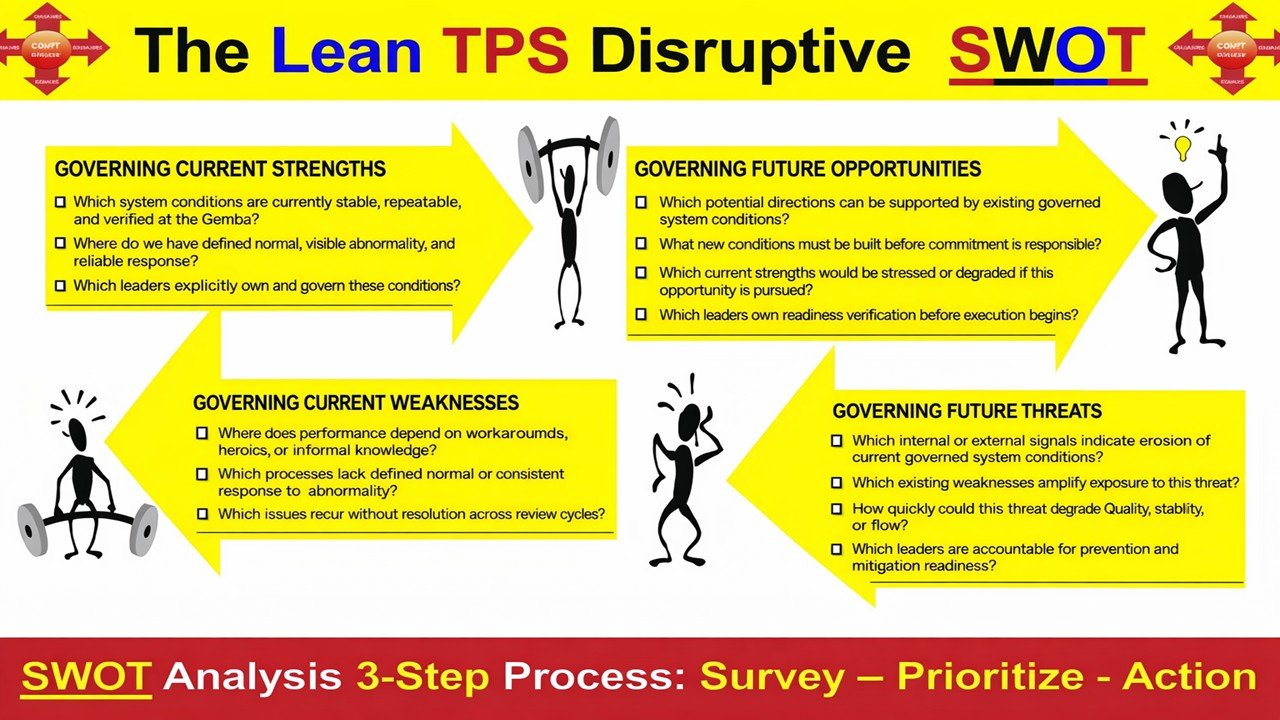
Lean TPS Disruptive SWOT operates through a structured, repeatable cycle designed to govern strategic direction rather than inform discussion. The cycle consists of three phases: Survey, Prioritize, and Action. Each phase serves a distinct governance function. Each phase produces binding outputs. Each phase constrains leadership discretion by design.
This structure reflects a core Lean TPS principle. Systems improve and remain stable only when learning is structured and repeated. Strategic direction is no exception. Without a governed structure, strategy becomes vulnerable to opinion, hierarchy, and short-term pressure. Disruptive SWOT establishes a disciplined mechanism that converts input into obligation and obligation into sustained action.
Survey establishes reality. The purpose of the Survey phase is to surface actual conditions across the organization, not to collect abstract views or preferences. Input is gathered from multiple levels to reveal how work is experienced, where stability exists, and where risk accumulates. In Lean TPS, reality is defined at the Gemba. Survey inputs therefore serve as signals of system health, Quality governance, and leadership effectiveness. Survey data is treated as evidence, not feedback to be filtered.
Prioritize establishes focus. The Prioritize phase exists to force choice. Organizations routinely fail not because they lack insight, but because they attempt to address everything simultaneously. Disruptive SWOT requires ranking and visible prioritization to surface what matters most now. This step constrains leadership discretion by preventing selective attention or silent deferral. Items that rise through prioritization become explicit commitments. Items that do not remain visible and unresolved. Focus is no longer rhetorical. Focus is governed.
Action establishes obligation. The Action phase converts prioritized issues into leadership responsibility. Each action is owned. Each action has defined conditions of completion. Each action is integrated into existing management routines rather than treated as a side initiative. In Lean TPS, action without ownership is noise. Action without review is waste. Disruptive SWOT ensures that response to identified conditions is mandatory, visible, and reviewed.
The three phases operate as a closed loop. Outputs from Action inform the next Survey. Repeated issues signal governance weakness. Sustained improvement signals system learning. This repetition is intentional. The cycle repeats on a defined cadence to prevent strategic drift and to expose whether leadership behavior is changing or merely rotating initiatives.
Through this governing structure, Lean TPS Disruptive SWOT transforms SWOT from a static framework into a living system. Strategic direction is no longer set and forgotten. Strategic direction is continuously verified against reality, constrained through prioritization, and reinforced through leadership obligation.
Phase One. Governing Current Strengths
Purpose of Strength Identification
In Lean TPS Disruptive SWOT, strengths are not achievements, reputational claims, or historical success stories. Strengths are verified system conditions that leadership commits to protect, sustain, and govern. A strength exists only to the extent that the organization can demonstrate ongoing control of the conditions that produce it.
This distinction is critical. Many organizations label outcomes as strengths without understanding or governing the mechanisms that created them. Past performance, market position, or isolated successes are often treated as proof of capability. In Lean TPS, outcomes are insufficient. Only controlled conditions qualify as strengths.
A governed strength must be observable, repeatable, and owned. Leadership must be able to define what normal looks like, detect deviation from normal, and respond when conditions degrade. Without these elements, a claimed strength is fragile and unreliable.
Examples of governed strength conditions include stable and capable processes, clearly defined Standardized Work, predictable Quality outcomes, and consistent leadership presence at the Gemba. These are not attributes. These are system behaviors. Each requires deliberate design and ongoing management. Each reflects leadership responsibility rather than individual effort.
Strength identification without verification produces false confidence. False confidence distorts strategic direction by encouraging leaders to build plans on assumptions rather than reality. When strengths are overstated or poorly understood, organizations take on risk they cannot absorb. Lean TPS Disruptive SWOT prevents this failure by requiring evidence before a condition is classified as a strength.
Governing strengths also reinforces Respect for People. When leadership verifies and maintains system conditions, people are not forced to compensate for instability through heroics or workarounds. Clear standards, predictable processes, and visible leadership response reduce ambiguity and protect people from unmanaged risk. Strengths governed through Lean TPS discipline create environments where people can succeed without improvisation.
Within Disruptive SWOT, the purpose of identifying strengths is not celebration. The purpose is protection. Strengths define the foundation on which strategic direction rests. Leadership must therefore treat strengths as obligations to be defended and verified, not as assets to be assumed. When strengths are governed, strategic direction becomes more resilient, and Quality becomes a stable prerequisite rather than a fragile outcome.
Leadership Obligation in Strength Governance
Leadership obligation in the Strength phase of Lean TPS Disruptive SWOT is explicit and non-delegable. Strengths do not exist independently of leadership behavior. Strengths exist only where leaders actively govern the conditions that produce them.
The first obligation is to define what normal looks like for each claimed strength. Normal must be specific, observable, and grounded in how work is actually performed. Vague statements such as “we have strong processes” or “we deliver high quality” do not define normal. Normal in Lean TPS is expressed through Standardized Work, expected process conditions, and clearly defined Quality criteria. Without a defined normal, no strength can be governed.
The second obligation is to verify that normal is achieved consistently. Verification is not episodic and not delegated to audits alone. Leaders must confirm through direct observation and data that the defined conditions are present day to day. Consistency matters more than peak performance. A condition that appears only when pressure is low or attention is high is not a strength. It is a temporary state.
The third obligation is to establish early detection when normal degrades. Lean TPS treats deviation as information. Leaders must ensure that signals exist to surface abnormality immediately, before outcomes deteriorate. Detection mechanisms may include visual controls, process checks, trend monitoring, or direct observation at the Gemba. Early detection protects Quality and prevents people from absorbing system failure through extra effort.
The fourth obligation is to respond immediately when degradation occurs. Detection without response has no value. When a governed strength begins to erode, leadership response is required. Response does not mean assigning blame or launching a project. Response means restoring conditions, correcting causes, and reinforcing standards. Delay signals tolerance. Tolerance converts strengths into liabilities.
A claimed strength that cannot be governed is not a strength. It introduces strategic risk by encouraging decisions based on assumption rather than control. A claimed strength without leadership obligation is a liability because it shifts the burden of compensation onto individuals and teams. Lean TPS Disruptive SWOT prevents this by making leadership ownership visible and unavoidable.
When strengths are governed in this way, strategic direction rests on stable foundations. Quality remains protected. Respect for People is reinforced through clarity and response. Leadership credibility increases because commitments are grounded in conditions that leaders actively manage rather than outcomes they hope will continue.
Governing Questions for Strengths
Lean TPS Disruptive SWOT uses governing questions to separate assumed strengths from controlled strengths. These questions are not reflective prompts. They are tests. A strength that cannot pass these tests cannot be relied upon as part of strategic direction.
The first governing question asks which organizational conditions consistently produce the claimed strength. This shifts attention away from outcomes and toward causes. Leaders must be able to point to specific system conditions such as defined processes, stable flow, clear standards, training mechanisms, and support structures. If a strength cannot be traced to controlled conditions, it is not reproducible and cannot be governed.
The second governing question asks which leaders own those conditions. Ownership must be explicit. In Lean TPS, ownership means responsibility for defining normal, maintaining conditions, and restoring stability when deviation occurs. Shared ownership or implied responsibility weakens governance. A strength without a clearly accountable leader is exposed to erosion under pressure.
The third governing question asks how quickly leadership detects degradation. Detection speed matters more than detection accuracy alone. Slow recognition allows small deviations to compound into Quality failures and operational risk. Leaders must ensure that signals exist to surface degradation early and that those signals are visible, understood, and acted upon. A strength that degrades silently is already compromised.
The fourth governing question asks what response occurs when conditions deviate. Detection without response is indistinguishable from tolerance. Leaders must be able to describe what action is taken, who takes it, and how quickly conditions are restored. Effective response reinforces system discipline and protects people from compensating for instability through extra effort or improvisation.
Strengths that fail these tests are removed from the strategic foundation. This removal is not punitive. It is protective. Lean TPS Disruptive SWOT prevents organizations from building strategy on conditions they do not control. By applying these governing questions, leadership ensures that strategic direction is anchored in reality, Quality remains governed, and Respect for People is upheld through stable and predictable systems.
Phase Two. Governing Current Weaknesses
Purpose of Weakness Identification
In Lean TPS Disruptive SWOT, weaknesses are governance gaps. Weaknesses are not admissions of failure, capability shortfalls, or individual shortcomings. Weaknesses are conditions within the system that lack clear ownership, stable processes, defined standards, or effective response mechanisms. They exist where leadership obligation is incomplete or absent.
This distinction is essential. Many organizations avoid honest discussion of weaknesses because weaknesses are perceived as blame, exposure, or reputational risk. Lean TPS rejects this framing. Weakness identification is a protective act. It reveals where the system places undue burden on people to compensate for instability, ambiguity, or unmanaged risk.
A weakness exists whenever outcomes depend on heroics, informal workarounds, or individual experience rather than governed conditions. Weaknesses are present when problems recur without resolution, when abnormality is detected late, or when escalation paths are unclear. These conditions indicate that leadership ownership has not been fully established.
Weakness identification protects the organization from hidden risk. Ungoverned weaknesses do not remain static. They compound over time, especially under pressure, growth, or change. What appears manageable during stable periods becomes fragile during disruption. Lean TPS Disruptive SWOT exposes these conditions before they result in Quality failures, safety incidents, customer dissatisfaction, or cultural erosion.
Governing weaknesses also reinforces Respect for People. When weaknesses are acknowledged and addressed at the system level, people are no longer expected to absorb risk through extra effort, improvisation, or silence. Clear identification of weaknesses signals that leadership accepts responsibility for system design and correction. This creates psychological safety rooted in structure rather than reassurance.
Within Disruptive SWOT, the purpose of identifying weaknesses is not to catalog deficiencies. The purpose is to make governance gaps visible and actionable. Weaknesses define where leadership attention, system redesign, and corrective action are required to restore stability. By treating weaknesses as governance issues rather than failures, Lean TPS Disruptive SWOT strengthens strategic direction, protects Quality, and sustains organizational integrity.
Leadership Obligation in Weakness Governance
Leadership obligation in the Weakness phase of Lean TPS Disruptive SWOT is foundational to effective governance. Weaknesses persist not because they are difficult to solve, but because leadership systems often fail to expose, own, and correct them in a disciplined way. Disruptive SWOT establishes clear expectations for leadership behavior when weaknesses are identified.
The first obligation is to expose weaknesses without blame. In Lean TPS, problems are properties of systems, not people. Leaders are responsible for creating conditions where weaknesses can be surfaced openly without fear of punishment or reputational damage. Blame suppresses signal. Suppressed signal allows risk to accumulate unseen. Exposing weaknesses without blame is therefore a prerequisite for accurate diagnosis and effective response.
The second obligation is to assign ownership for each weakness. Ownership must be explicit and individual. Collective responsibility diffuses accountability and delays correction. Ownership in Lean TPS means responsibility for understanding the condition, designing corrective action, and restoring stability. When a weakness lacks a named owner, it remains unmanaged regardless of how well it is understood.
The third obligation is to define corrective actions grounded in system design. Weaknesses cannot be corrected through reminders, exhortation, or training alone. Corrective action must address the underlying system conditions that allow the weakness to persist. This may include changes to process design, standardization, workload balance, information flow, or escalation mechanisms. Actions that do not change system conditions do not resolve weaknesses.
The fourth obligation is to monitor progress through visible measures. Leaders must be able to see whether corrective actions are producing the intended effect. Visibility enables learning and reinforces accountability. Measures should reflect condition improvement rather than activity completion. Progress that is invisible cannot be governed.
Weaknesses that remain unowned are strategic threats. An unowned weakness represents unmanaged risk embedded in the system. Over time, such risks compromise Quality, erode trust, and undermine strategic direction. Lean TPS Disruptive SWOT makes unowned weaknesses visible and non-negotiable by requiring leadership ownership, defined action, and ongoing review.
Through this disciplined approach, weaknesses are transformed from sources of avoidance into drivers of system improvement. Leadership credibility increases as problems are addressed structurally rather than deferred. Quality governance strengthens. Respect for People is reinforced through clarity, fairness, and commitment to fixing the system rather than blaming individuals.
Governing Questions for Weaknesses
Lean TPS Disruptive SWOT uses governing questions to expose weaknesses that undermine strategic direction and Quality governance. These questions are not diagnostic prompts intended to generate discussion. They are accountability tests that determine whether leadership systems are functioning as designed.
The first governing question asks which processes lack stable conditions. Instability appears where work cannot be performed predictably, where standards are unclear, or where variation is unmanaged. Leaders must be able to identify where processes depend on adjustment, judgment, or improvisation rather than controlled conditions. Persistent instability signals that system design has not been adequately governed.
The second governing question asks which decisions rely on heroics rather than systems. When outcomes depend on individual effort, experience, or intervention, the system has failed to absorb normal variation. Heroics may produce short-term success, but they mask underlying weaknesses and transfer risk to people. Lean TPS treats reliance on heroics as evidence of missing governance rather than exceptional performance.
The third governing question asks which issues repeat without resolution. Recurrence is a powerful indicator of governance failure. Problems that resurface across weeks, months, or review cycles indicate that corrective actions addressed symptoms rather than causes. Leaders must examine recurring issues as signals that ownership, escalation, or system design is insufficient.
The fourth governing question asks which leaders are accountable for correction. Accountability must be clear and visible. When multiple leaders assume someone else will act, correction stalls. In Lean TPS, accountability means responsibility for restoring stable conditions and preventing recurrence. A weakness without an accountable leader remains unmanaged regardless of how often it is discussed.
Weaknesses that persist across cycles indicate governance failure rather than execution failure. Lean TPS Disruptive SWOT uses repetition and comparison over time to make this distinction visible. When the same weaknesses appear cycle after cycle, leadership must examine how decisions are made, how ownership is assigned, and how response is governed. This shift from execution blame to governance accountability strengthens strategic direction, protects Quality, and reinforces Respect for People through system-level correction.
Phase Three. Governing Future Opportunities
Purpose of Opportunity Identification
In Lean TPS Disruptive SWOT, opportunities represent potential future value, not promises of growth. Opportunities are treated as capability stress tests rather than aspirations. The purpose of opportunity identification is not to generate enthusiasm or to populate a pipeline of initiatives. The purpose is to evaluate whether the organization can responsibly pursue future value without compromising Quality, stability, or Respect for People.
An opportunity exists only if the organization can develop and govern the conditions required to pursue it. This requirement is critical. Many organizations pursue opportunities based on market attractiveness, financial projections, or competitive pressure while assuming that internal capability will adapt later. Lean TPS rejects this assumption. Capability must precede commitment. Conditions must exist or be deliberately built before an opportunity can be pursued.
Treating opportunities as capability stress tests forces leadership to examine the system honestly. Leaders must assess whether current processes, skills, capacity, information flow, and governance mechanisms can absorb additional demand or complexity. Opportunities that exceed system readiness introduce risk. They destabilize existing operations, degrade Quality, and shift the burden of compensation onto people.
Opportunity identification therefore protects both strategic direction and operational integrity. By evaluating opportunities through the lens of system conditions, Lean TPS Disruptive SWOT prevents overextension. Growth pursued without governance erodes trust and creates hidden costs. Growth pursued with governed readiness strengthens the organization and preserves stability.
This approach also reinforces Respect for People. When opportunities are filtered through capability readiness, people are not forced to compensate for gaps through overtime, improvisation, or constant priority shifts. Clear assessment of readiness reduces ambiguity and sets realistic expectations. Leaders demonstrate respect by refusing to commit the organization to paths it cannot support.
Within Disruptive SWOT, the purpose of identifying opportunities is disciplined selection. Opportunities that align with existing strengths or with clearly buildable capabilities move forward. Opportunities that require uncontrolled risk are deferred or rejected. Strategic direction remains aligned with Quality governance and leadership responsibility rather than market pressure or optimism.
Leadership Obligation in Opportunity Governance
Leadership obligation in the Opportunity phase of Lean TPS Disruptive SWOT is centered on restraint and responsibility. Opportunities are attractive precisely because they promise future benefit. Without governance, that attraction drives premature commitment and destabilizes the system. Disruptive SWOT establishes clear leadership obligations to prevent that failure.
The first obligation is to evaluate opportunities against current system capability. Leaders must assess whether existing processes, skills, capacity, information flow, and management routines can support the opportunity. Evaluation is grounded in evidence, not confidence. Capability gaps must be explicitly identified rather than assumed to be solvable later. An opportunity that depends on unverified capability is a risk, not a plan.
The second obligation is to assess impact on Quality, stability, and flow. In Lean TPS, Quality is the prerequisite for all improvement and growth. Leaders must examine whether pursuing an opportunity will introduce variation, overload, or instability into current operations. Opportunities that compromise Quality or disrupt flow undermine long-term performance even if short-term gains appear attractive. Governance requires that these impacts be understood before decisions are made.
The third obligation is to define prerequisite conditions before commitment. Opportunities do not begin with execution. They begin with preparation. Leaders must specify what conditions must exist for the opportunity to be pursued responsibly. These conditions may include process capability, training, standardization, supplier readiness, or support infrastructure. Until these prerequisites are met, commitment is deferred. This discipline protects the system from uncontrolled expansion.
The fourth obligation is to reject opportunities that exceed system readiness. Rejection is a leadership responsibility, not a failure of ambition. Saying no preserves strategic integrity. Lean TPS Disruptive SWOT treats rejection as a sign of governance strength rather than missed potential. Leaders demonstrate credibility by refusing to expose the organization to risks it cannot absorb.
Opportunity pursuit without governance introduces strategic risk. It creates instability, degrades Quality, and erodes Respect for People by forcing individuals to compensate for system gaps. Lean TPS Disruptive SWOT prevents premature commitment by requiring leadership to govern opportunity selection through capability assessment, condition readiness, and disciplined restraint.
Governing Questions for Opportunities
Lean TPS Disruptive SWOT uses governing questions to ensure that opportunities are evaluated through system readiness rather than optimism or pressure. These questions function as decision gates. An opportunity that cannot pass these gates is deferred or rejected to protect strategic direction and Quality governance.
The first governing question asks what system capabilities are required. Leaders must identify the specific capabilities necessary to pursue the opportunity responsibly. These capabilities may include process stability, technical competence, capacity, supplier performance, information accuracy, or management routines. Vague references to flexibility or adaptability are insufficient. Capability must be defined in operational terms that can be verified and governed.
The second governing question asks which conditions must be built first. Most opportunities require preparation before execution. Leaders must determine what system conditions must exist to support the opportunity without destabilizing current operations. This includes identifying gaps between current state and required state. Building conditions before commitment prevents overloading the system and protects people from compensating for missing capability.
The third governing question asks what risks are introduced to existing strengths. Opportunities often draw resources, attention, and capacity away from areas that currently perform well. Leaders must examine whether pursuing an opportunity will weaken governed strengths by introducing variation, delay, or overload. In Lean TPS, protecting existing strengths is a leadership obligation. Opportunities that erode foundational capabilities undermine long-term performance.
The fourth governing question asks which leaders own readiness development. Ownership must be explicit. Readiness does not emerge spontaneously. Leaders must be accountable for building the required conditions, verifying progress, and determining when readiness has been achieved. Without ownership, readiness remains aspirational and commitment becomes premature.
Opportunities that compromise Quality or stability are deferred until conditions exist. Deferral is not avoidance. Deferral is disciplined governance. Lean TPS Disruptive SWOT ensures that strategic direction remains aligned with system capability, protects Respect for People through realistic commitment, and preserves Quality as the prerequisite for sustainable growth.
Phase Four. Governing Future Threats
Purpose of Threat Identification
In Lean TPS Disruptive SWOT, threats represent external or internal conditions that could degrade strategic direction, system stability, or Quality governance. Threats are not framed as future crises or speculative risks. Threats are treated as early warning signals that indicate where existing strengths may erode, where weaknesses may be amplified, or where current governance may be insufficient.
This distinction matters. Many organizations recognize threats only after impact occurs. At that point, response is reactive, costly, and disruptive. Lean TPS rejects crisis-driven management. Threat identification is therefore proactive and preventive. The objective is to detect emerging conditions early enough to respond deliberately rather than urgently.
Threats may originate outside the organization or within it. External threats include market shifts, regulatory change, supply instability, technology disruption, or labor constraints. Internal threats include skill erosion, leadership turnover, process fragility, cultural drift, and accumulated technical debt. Lean TPS Disruptive SWOT makes no distinction in importance between external and internal sources. Both are governed through the same discipline.
Treating threats as early warning signals aligns directly with Quality governance. Quality failures rarely occur without prior indication. Signals appear first as small deviations, delayed responses, recurring issues, or workarounds. Threat identification within Disruptive SWOT seeks these signals before they compound into failure. Early visibility allows leadership to design countermeasures that protect stability rather than scramble to recover it.
Threat identification also reinforces Respect for People. When threats are recognized early and addressed structurally, people are not forced into constant firefighting or emergency response. Clear anticipation and preparation reduce anxiety, overload, and ambiguity. Leaders demonstrate respect by protecting the organization from preventable disruption through disciplined foresight.
Within Disruptive SWOT, the purpose of identifying threats is not to predict the future with certainty. The purpose is to maintain readiness. By continuously scanning for conditions that could undermine strategic direction, Lean TPS Disruptive SWOT strengthens governance, preserves Quality, and ensures that leadership remains responsible for preventing failure rather than explaining it after the fact.
Leadership Obligation in Threat Governance
Leadership obligation in the Threat phase of Lean TPS Disruptive SWOT centers on anticipation and prevention. Threats do not become failures because they are unpredictable. Threats become failures because leadership systems do not monitor, interpret, and respond to signals in a disciplined way. Disruptive SWOT establishes explicit expectations for leadership behavior to eliminate that gap.
The first obligation is to monitor external and internal signals continuously. Threat governance is not an annual exercise. Leaders must maintain awareness of changes in markets, regulation, supply chains, technology, workforce capability, and internal system performance. Monitoring must be structured and intentional rather than informal or ad hoc. Signals that are visible but ignored provide no protection.
The second obligation is to link threats to specific system vulnerabilities. A threat has meaning only in relation to the system it can affect. Leaders must identify which processes, capabilities, or governance mechanisms are exposed and how existing weaknesses or fragile strengths could amplify impact. This linkage transforms abstract risk into actionable insight and prevents generalized concern from replacing disciplined analysis.
The third obligation is to develop countermeasures before impact occurs. Countermeasures are not contingency plans written after decisions are made. Countermeasures are deliberate system changes designed to reduce exposure or increase resilience. These may include strengthening process stability, building capability, adjusting standards, or redesigning escalation mechanisms. Early countermeasures preserve Quality and reduce the need for emergency response.
The fourth obligation is to review threat relevance on every cycle. Conditions change. Some threats diminish. Others intensify. Leaders must reassess threat relevance during each Disruptive SWOT cycle to ensure attention remains focused on current risk rather than outdated assumptions. Threats that persist across cycles without mitigation signal governance weakness rather than environmental inevitability.
Threats ignored become failures labeled as surprises. Lean TPS Disruptive SWOT eliminates surprise through discipline. By requiring continuous monitoring, explicit linkage to vulnerabilities, early countermeasures, and recurring review, leadership converts uncertainty into managed risk. Strategic direction remains protected, Quality is preserved, and Respect for People is reinforced by preventing avoidable disruption rather than reacting to it.
Governing Questions for Threats
Lean TPS Disruptive SWOT uses governing questions to ensure that threats are translated into managed risk rather than abstract concern. These questions force leadership to examine how threats interact with the existing system and whether governance mechanisms are sufficient to prevent degradation of strategic direction.
The first governing question asks which weaknesses amplify the threat. Threats rarely act alone. Their impact depends on existing governance gaps, unstable processes, unclear ownership, or delayed response mechanisms. Leaders must identify where current weaknesses increase exposure and accelerate failure. This examination shifts attention from external forces to internal responsibility for resilience.
The second governing question asks which strengths mitigate the threat. Governed strengths provide protection only if they are reliable and maintained. Leaders must determine whether existing strengths can absorb or dampen the threat without degrading Quality or stability. This assessment reinforces the obligation to protect strengths as active system conditions rather than assumed advantages.
The third governing question asks how quickly impact could occur. Time matters. Some threats unfold gradually, allowing deliberate preparation. Others escalate rapidly, leaving little margin for response. Leaders must understand the likely speed of impact to determine appropriate countermeasures and escalation paths. Slow recognition increases damage and forces reactive management.
The fourth governing question asks which leaders own mitigation readiness. Mitigation does not occur by consensus. Ownership must be explicit. Leaders must be accountable for maintaining readiness, verifying that countermeasures remain effective, and adjusting response as conditions change. Without ownership, readiness degrades unnoticed.
Threat governance preserves strategic stability under uncertainty. By applying these governing questions consistently, Lean TPS Disruptive SWOT ensures that uncertainty does not translate into surprise. Leadership responsibility remains focused on prevention, Quality is protected through early response, and Respect for People is reinforced by reducing crisis-driven work and unmanaged disruption.
The Role of Cadence in Strategic Governance
Cadence is the element that transforms SWOT from analysis into governance. Without cadence, SWOT remains a descriptive exercise that captures insight but does not control behavior. With cadence, SWOT becomes a managed system that binds leadership to ongoing responsibility for strategic direction.
Lean TPS Disruptive SWOT operates on defined review intervals to prevent strategic drift and to maintain alignment between intent and reality. Cadence establishes expectation. Cadence creates comparison over time. Cadence forces learning. In Lean TPS, learning does not occur through reflection alone. Learning occurs through repeated observation of conditions, response, and outcome.
Annual cycles establish strategic direction. The annual Disruptive SWOT cycle provides a structured opportunity to reassess strengths, weaknesses, opportunities, and threats in light of current conditions. This cycle defines the strategic baseline for the organization. It determines which conditions must be protected, which governance gaps must be closed, which opportunities are viable, and which threats require attention. Annual cadence anchors long-term direction without assuming stability.
Quarterly cycles verify conditions and detect drift. Strategy fails most often in the gap between annual intent and daily reality. Quarterly Disruptive SWOT reviews serve as verification points. Leaders examine whether previously identified conditions still exist, whether corrective actions are progressing, and whether new signals are emerging. Drift becomes visible early rather than after results degrade. Quarterly cadence reinforces leadership obligation to govern, not merely announce, strategic direction.
Triggered cycles occur when significant conditions change. Not all risk or opportunity follows a calendar. Major changes in demand, regulation, leadership, technology, or system performance may require immediate reassessment. Lean TPS Disruptive SWOT allows for triggered cycles to reexamine strategic assumptions when conditions shift materially. This flexibility prevents organizations from remaining committed to outdated direction while evidence accumulates.
Cadence prevents static strategy. Static strategy assumes that direction, once set, remains valid until formally revised. Lean TPS rejects this assumption. Systems evolve continuously. Governance must evolve with them. Cadence ensures that strategy remains a living system condition rather than a fixed plan.
Cadence also reinforces Respect for People. When leadership revisits strategic direction regularly and transparently, people are not forced to adapt to silent shifts or unexplained priority changes. Clear review intervals reduce uncertainty and align expectations. Leaders demonstrate respect by confronting reality consistently rather than deferring difficult decisions.
Without cadence, strategy becomes obsolete while organizations remain unaware. Lean TPS Disruptive SWOT uses disciplined cadence to maintain strategic relevance, protect Quality, and hold leadership accountable for governing direction over time rather than reacting to failure after the fact.
Integration With Lean TPS Governance Systems
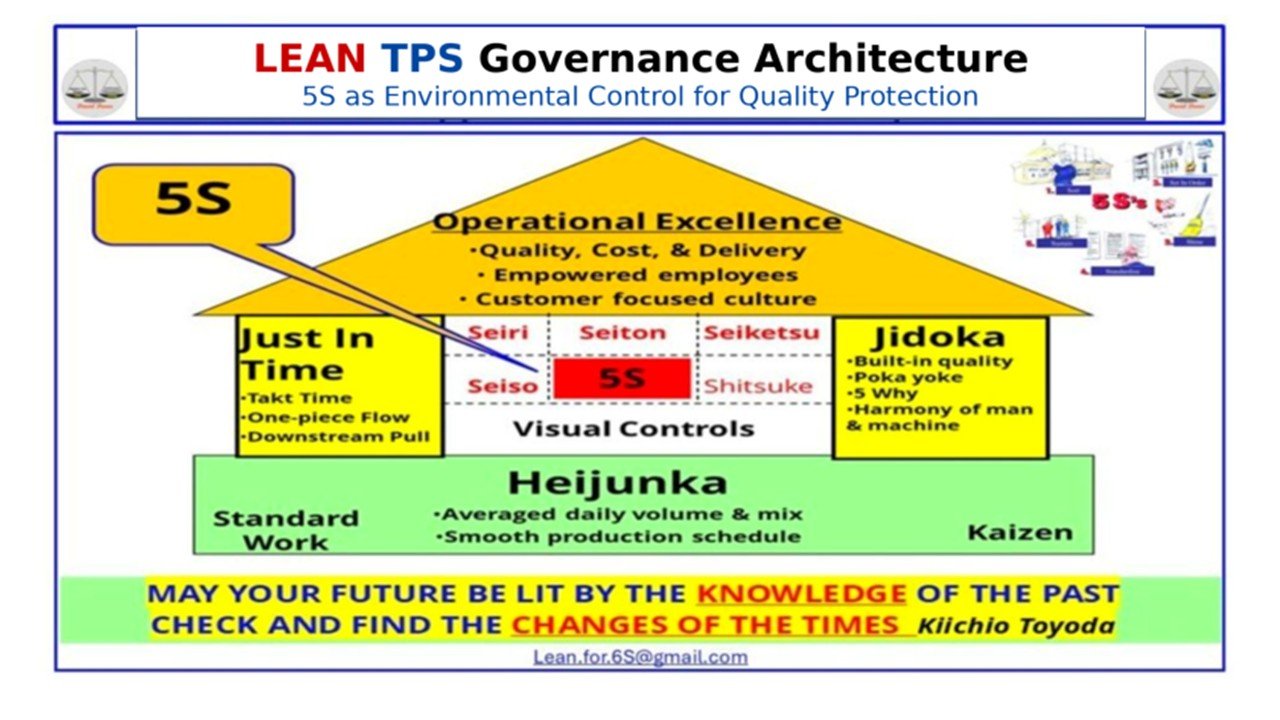
Lean TPS Disruptive SWOT does not replace existing Lean TPS governance systems. It integrates with them. The purpose of Disruptive SWOT is not to add another layer of methodology, but to govern strategic direction using the same discipline that Lean TPS applies to daily work, Quality, and improvement.
Lean TPS operates as an interconnected system. Strategic direction, daily management, problem solving, and Quality control cannot be separated without weakening governance. Disruptive SWOT occupies the strategic layer of this system and connects directly to established Lean TPS mechanisms.
Hoshin Kanri aligns long term direction with daily management. Disruptive SWOT informs Hoshin by defining which strengths must be protected, which weaknesses require correction, which opportunities are viable, and which threats demand attention. Hoshin then translates those priorities into aligned objectives, measures, and deployment across the organization. Disruptive SWOT governs what matters. Hoshin governs how direction is deployed.
PDCA ensures corrective learning through structured experimentation. Findings from Disruptive SWOT do not result in assumptions or one time decisions. They generate hypotheses about system conditions that must be tested, corrected, and verified. PDCA provides the learning mechanism that converts SWOT findings into durable improvement rather than temporary action. Repeated cycles of Disruptive SWOT and PDCA expose whether learning is occurring or whether the same conditions persist.
Gemba leadership ensures decisions reflect reality rather than abstraction. Disruptive SWOT depends on accurate understanding of conditions. Gemba presence provides that understanding. Leaders verify strengths, observe weaknesses, assess readiness for opportunities, and detect early threat signals by engaging directly with the work. Without Gemba leadership, Disruptive SWOT risks becoming conceptual rather than governed.
Jidoka protects Quality by exposing abnormality immediately. Disruptive SWOT relies on the same principle at a strategic level. Abnormal conditions related to capability, stability, or risk must be surfaced early and clearly. Jidoka reinforces the expectation that problems are visible and require response. This expectation extends from the shop floor to strategic direction. Quality governance does not stop at operations. It governs decisions.
Disruptive SWOT governs strategic direction. Lean TPS systems govern execution. Together, they form a closed loop governance system in which direction is defined by reality, executed through disciplined processes, monitored through visible conditions, and corrected through leadership response. Strategic intent and operational behavior remain aligned because both are governed by the same principles.
This integration ensures that strategic direction is not an abstract exercise removed from daily work. Strategic direction becomes a managed system condition. Quality remains the prerequisite. Respect for People is reinforced through clarity, stability, and visible leadership responsibility across every level of the organization.
From Insight to Action. Binding Leadership Behavior
Lean TPS Disruptive SWOT requires deliberate translation from insight to action. Insight alone does not change systems. Insight without obligation leaves leadership discretion unconstrained and allows known risks to persist. Disruptive SWOT closes this gap by converting prioritized findings into governed leadership behavior.
Prioritized findings are translated into explicit leadership obligations. Each finding represents a condition that must be protected, corrected, developed, or mitigated. Leadership obligation is not expressed as intent or endorsement. Leadership obligation is expressed through ownership of system conditions and responsibility for restoring or sustaining them.
Ownership is assigned for every prioritized item. Ownership is individual, visible, and non-delegable. In Lean TPS, ownership means responsibility for defining normal, monitoring condition, and responding when deviation occurs. Shared accountability diffuses responsibility and delays action. Disruptive SWOT requires clarity so that no finding remains unmanaged.
Measures are defined to make progress visible. Measures focus on condition improvement rather than activity completion. Leaders must be able to see whether actions are changing system behavior, improving stability, or reducing risk. Visibility enables learning and reinforces accountability. What cannot be seen cannot be governed.
Review cadence is established to ensure that obligations are not forgotten or deferred. Actions are reviewed within existing management routines rather than isolated as special initiatives. Regular review prevents silent drift and exposes whether leadership response is effective. Cadence transforms action from a promise into a managed commitment.
Escalation paths are clarified so that unresolved issues do not stagnate. When conditions fail to improve, escalation is required. Escalation is not a sign of failure. Escalation is a governance mechanism that ensures problems receive appropriate attention and resources. Clear escalation paths prevent normalization of deviation.
Action plans are not optional responses. Action plans are mandatory responses to governed findings. When Disruptive SWOT identifies a condition that threatens Quality, stability, or strategic direction, leadership response is required. Inaction is itself a decision and represents a governance failure.
Leadership discretion ends where governed obligation begins. This boundary is essential. Lean TPS Disruptive SWOT does not remove judgment from leadership. It constrains judgment with responsibility. Leaders remain free to decide how to respond, but they are not free to ignore, defer indefinitely, or reinterpret governed findings without consequence.
By binding leadership behavior in this way, Lean TPS Disruptive SWOT ensures that strategic direction is not aspirational. Strategic direction becomes operational. Quality remains protected. Respect for People is reinforced through clarity, consistency, and visible leadership responsibility.
Why Lean TPS Disruptive SWOT Raises Strategic Direction
Lean TPS Disruptive SWOT raises strategic direction by changing how decisions are made. The improvement does not come from better analysis or more sophisticated tools. The improvement comes from governing decisions through system conditions, evidence, and leadership obligation rather than preference, optimism, or narrative.
Strategy becomes condition based. Strategic direction is no longer defined by statements of intent, market positioning, or aspirational targets. Direction is defined by the conditions the organization can demonstrably control and sustain. Leaders commit only to directions supported by stable processes, defined standards, and governed capabilities. When conditions change, direction is reviewed and corrected rather than defended.
Allocation becomes evidence based. Resources are not assigned based on urgency, influence, or momentum. Resources are assigned based on verified strengths, exposed weaknesses, validated opportunities, and managed threats. Disruptive SWOT constrains allocation decisions by requiring leaders to justify investment against system readiness and risk. This discipline prevents overextension and protects foundational capabilities.
Leadership becomes accountable. Accountability is no longer diffuse or retrospective. Leaders are accountable for defining normal, detecting abnormality, and responding when conditions deviate. Disruptive SWOT makes this accountability visible by assigning ownership, establishing review cadence, and requiring response. Strategic direction improves because leadership behavior changes in response to governed obligation rather than external pressure.
Quality becomes the prerequisite. In Lean TPS, Quality is not one objective among many. Quality is the condition that enables all others. Disruptive SWOT enforces this principle by evaluating strengths, weaknesses, opportunities, and threats through their impact on Quality, stability, and flow. Directions that compromise Quality are deferred or rejected regardless of potential upside. This preserves long-term performance and organizational integrity.
Organizations using Lean TPS Disruptive SWOT no longer rely on belief, confidence, or narrative to guide strategic direction. Decisions are not justified by past success or future promise. Decisions are grounded in governed reality. Strategic direction remains aligned with what the system can support, what leadership can own, and what people can execute without absorbing unmanaged risk.
By raising the discipline of decision making, Lean TPS Disruptive SWOT elevates strategic direction from aspiration to governance. Strategy becomes a managed system condition. Quality remains protected. Respect for People is reinforced through clarity and consistency. Leadership credibility increases because direction is anchored in reality rather than rhetoric.
Conclusion
Lean TPS Disruptive SWOT is not a planning tool. Lean TPS Disruptive SWOT is a leadership governance system. Its purpose is not to generate insight, alignment, or consensus. Its purpose is to govern strategic direction through Quality, system stability, and explicit leadership obligation.
The framework aligns strategic direction with the conditions that actually produce results. It replaces episodic strategy activities with disciplined renewal grounded in evidence and cadence. Strengths are protected through verification and ownership. Weaknesses are exposed as governance gaps rather than hidden liabilities. Opportunities are evaluated through system readiness rather than aspiration. Threats are anticipated through early signal detection rather than crisis response.
This shift is fundamental. Strategic direction cannot be governed through intent statements, workshops, or periodic reviews detached from system reality. Direction that is not governed will drift. Drift forces people to compensate for instability, ambiguity, and unmanaged risk. Over time, Quality erodes, credibility declines, and leadership behavior becomes reactive.
Lean TPS Disruptive SWOT prevents this failure by embedding strategic direction within the same governance discipline that Lean TPS applies to daily work. Conditions are defined. Abnormality is detected. Ownership is clear. Response is required. Cadence ensures learning and renewal. Leadership discretion is constrained by obligation rather than replaced by rules.
Strategic direction cannot be delegated to consultants, frameworks, or annual planning cycles. Strategic direction is a management responsibility that must be governed continuously. Lean TPS Disruptive SWOT provides the structure required to govern it.
When applied with discipline, Lean TPS Disruptive SWOT raises the quality of decision making, strengthens system stability, and reinforces Respect for People through clarity and consistency. Strategy becomes a living system condition rather than a static plan. Leadership credibility increases because direction is anchored in reality. Quality remains the prerequisite for sustainable performance.
This is the role of Lean TPS Disruptive SWOT. It does not simplify strategy. It governs it.
Position Within the Lean TPS Governance System
Lean TPS Disruptive SWOT is not a standalone method. It is one component within a broader Lean TPS governance system that defines how Quality, leadership obligation, and system stability are managed together.
This whitepaper extends and connects with prior work on LeanTPS.ca that examines how governance operates across different layers of the system. Related articles include examinations of Quality governance as a management obligation, the role of daily management and Standardized Work in sustaining stability, and how governance was progressively removed from Lean (post-1988) translations of the Toyota Production System.
Readers interested in how strategic direction connects to daily execution, Quality protection, and leadership accountability may find it useful to review those articles alongside this paper. Together, they describe a coherent governance model in which strategic direction, improvement, and execution are not treated as separate disciplines, but as integrated responsibilities governed through Lean TPS principles.
Disruptive SWOT occupies the strategic layer of that system. Daily management, problem solving, and improvement routines govern execution. Quality remains the prerequisite. Leadership obligation remains non-delegable. This continuity is intentional. Strategic direction is governed in the same way work is governed, through defined conditions, visible abnormality, and disciplined response.
Continuity With Lean TPS Governance Work
This whitepaper extends a line of inquiry developed across earlier work on LeanTPS.ca examining how governance was progressively separated from system behavior as the Toyota Production System was translated into portable improvement frameworks.
Related articles explore that separation from different structural angles:
Six Sigma (post-1990s) and Lean Six Sigma (post-2010s): How Quality Governance Was Replaced examined how certification systems, project structures, and belt hierarchies displaced leadership ownership of Quality, producing technically capable organizations without durable control.
https://leantps.ca/six-sigma-lean-six-sigma-quality-governance/
Kaizen (post-1980s): How Governance Was Removed from the Toyota Production System traced how Kaizen became portable by shedding Jishuken, escalation, and leadership obligation, allowing improvement activity to persist while system governance eroded.
https://leantps.ca/kaizen-post-1980s-how-governance-was-removed-from-the-toyota-production-system/
Jishuken: Leadership Governance Through Direct System Engagement examined how Toyota preserved Quality by obligating leaders to participate directly in system diagnosis, escalation, and learning, and why the absence of Jishuken left improvement activity disconnected from leadership responsibility.
https://leantps.ca/jishuken/
Lean TPS Disruptive SWOT addresses a downstream consequence of the same structural shift. When strategic direction is not governed, organizations substitute persuasion, prioritization rhetoric, and episodic planning for leadership obligation. Disruptive SWOT restores governance at the strategic layer by binding direction to verified conditions, ownership, cadence, and response within a Lean TPS system.