Executive Overview
Kaizen in the Toyota Production System, as originally structured within its control architecture, has been widely mispositioned in modern Lean (post-1988) discourse. It is frequently described as a culture of continuous improvement, a philosophy of incremental change, or the primary engine of performance. These descriptions are accessible and appealing. They are structurally incomplete. They detach improvement from the architectural conditions that make it stabilizing rather than destabilizing.
This misplacement obscures Kaizen’s actual role inside the Toyota Production System.
Kaizen does not govern TPS. It operates within a governed system.
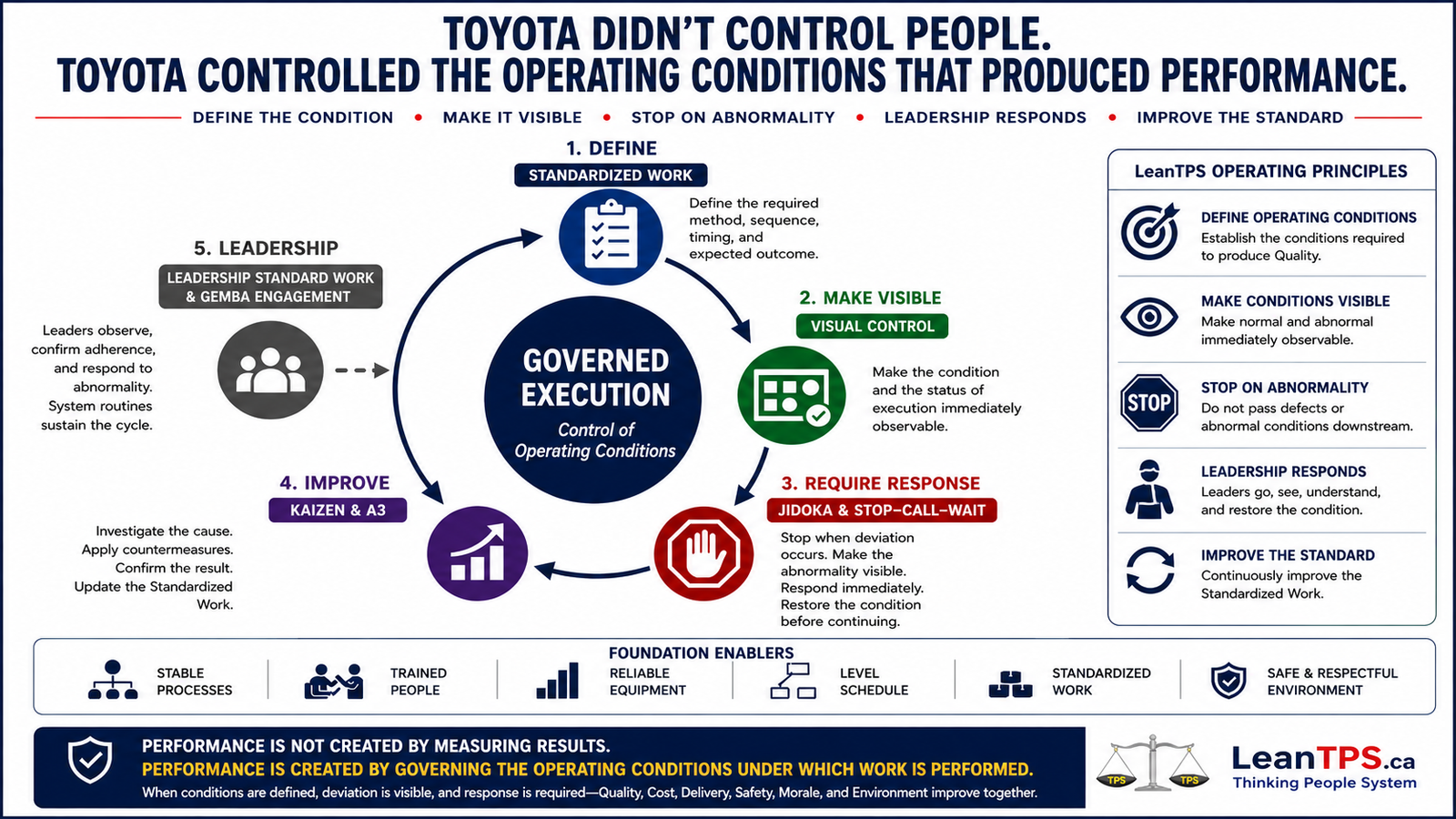
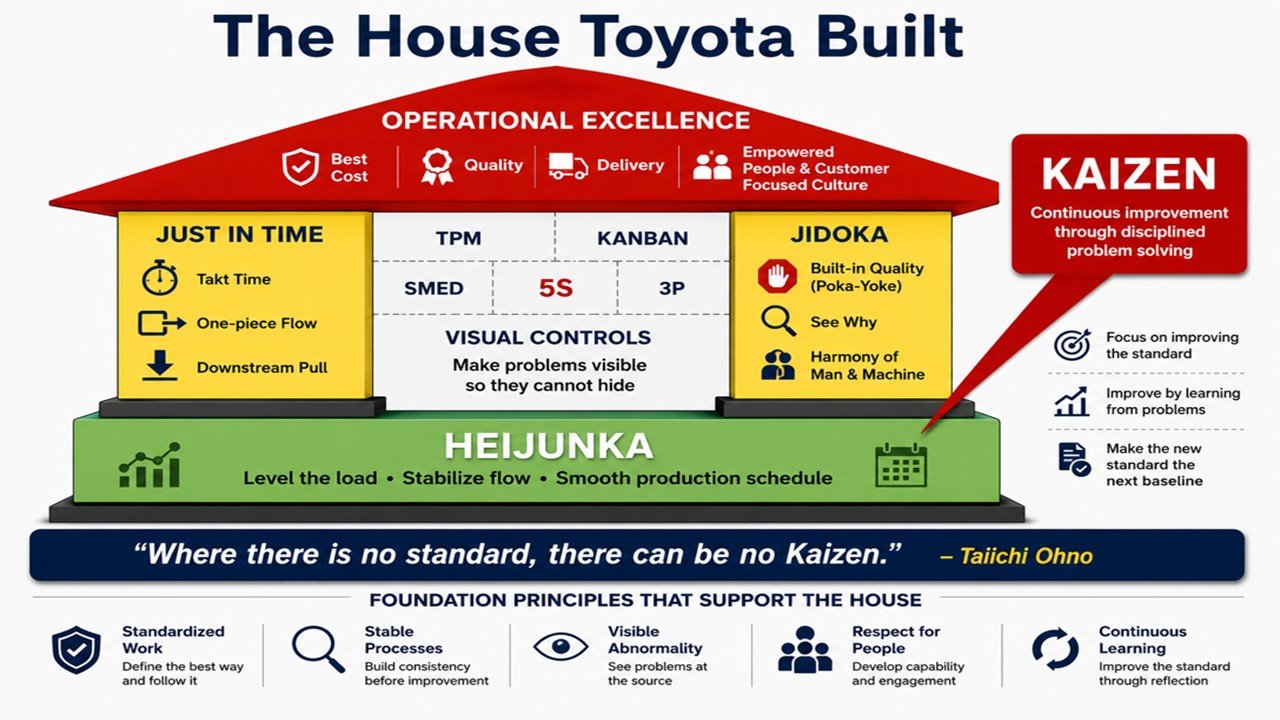
TPS is not a philosophy of improvement. It is a structured control architecture. Just In Time, Jidoka, Heijunka, and Standardized Work define operating conditions. They regulate flow, expose abnormality, stabilize workload, and preserve method. Together they form an integrated structure designed to protect Quality by making deviation visible and correction obligatory.
Kaizen functions as disciplined learning when those conditions expose instability. It is activated by structural tension. It refines method within defined boundaries. It does not create stability. It depends on stability.
When Kaizen is elevated above architecture, improvement activity replaces governance. Workshops substitute for structural redesign. Event counts substitute for system capability. Visible effort substitutes for controlled conditions. Instability is masked rather than corrected. Improvement becomes compensatory rather than stabilizing.
The distinction is architectural, not philosophical.
This Chapter 4 Preview Whitepaper clarifies the correct placement of Kaizen inside TPS. It examines the predictable failure patterns that emerge when improvement governs instead of architecture. It defines the governance obligations required to protect Quality before improvement begins. It restores Kaizen to its intended role as a bounded learning mechanism within a controlled production system.
Kaizen in the Toyota Production System: Architectural Foundation
The Toyota Production System is not a collection of tools. It is an integrated control architecture designed to regulate work, expose instability, and protect Quality under operating conditions.
Each structural element performs a governing function. These functions are coordinated control mechanisms that shape system behavior.
Just In Time establishes flow discipline. It removes excess buffers and compresses time between processes so imbalance cannot hide. By synchronizing production to demand and reducing inventory cushions, it creates intentional tension. That tension exposes unevenness, delay, and overproduction. In a buffered system, problems are absorbed. In a Just In Time system, they are revealed.
Jidoka establishes stop authority. Abnormality must surface at the point of occurrence. When deviation appears, the process is slowed or stopped to prevent defect propagation. Jidoka protects Quality by converting detection into enforced response. Without stop authority, defects travel downstream and accumulate cost.
Heijunka stabilizes volume and mix. It reduces unevenness and prevents overburden on people and equipment. Leveling creates predictable operating rhythm. Predictability allows standards to function reliably and ensures that abnormality is not confused with schedule volatility.
Standardized Work defines the current best method. It establishes the baseline against which abnormality is detected and learning is preserved. It is not documentation for compliance. It is the reference that makes deviation visible. Without defined method, there is no comparison. Without comparison, there is no control.
These mechanisms are interdependent.
Flow without stop authority accelerates defects.
Stop authority without flow produces stagnation.
Stability without standard creates ambiguity.
Standard without enforcement becomes documentation rather than control.
Together they form a closed-loop control structure:
• Standards define normal.
• Flow exposes imbalance.
• Stop authority forces visibility.
• Leadership enforces correction.
Only within these controlled conditions can disciplined learning occur. Improvement stabilizes the system only after instability is made visible and response is required.
Kaizen operates within this architecture. It refines method after abnormality is exposed and contained. It strengthens structure through disciplined adjustment. It does not replace the governing mechanisms that make learning possible.
Architecture governs. Kaizen responds.
Kaizen as Conditional Response
Improvement in the Toyota Production System is not continuous activity. It is conditional response.
A standard defines normal. Jidoka exposes deviation. Just In Time amplifies imbalance by reducing buffers and revealing constraint. When abnormality appears, structured investigation and correction are required.
That structured learning response is Kaizen.
The sequence is fixed.
Standard precedes exposure.
Exposure precedes investigation.
Investigation precedes correction.
Correction precedes revision of the standard.
Remove any element and improvement destabilizes.
Without Standardized Work, there is no baseline. Without baseline, variation cannot be distinguished from abnormality. Without abnormality, there is no defined problem to study. Improvement becomes discretionary experimentation.
Discretion increases variation. Variation obscures causality. When causality is obscured, learning degrades. Activity increases. System knowledge does not.
Consider two contrasting conditions.
In a controlled system, cycle time, sequence, and in-process stock are defined. A recurring delay appears at a specific task. Jidoka makes it visible. Flow tension reveals downstream impact. Investigation identifies root cause. Method is revised. The revised standard is confirmed under operating conditions. Learning is embedded.
That is conditional Kaizen.
In an uncontrolled system, the same delay occurs but no standard defines expected timing. No stop authority enforces investigation. Improvement begins as brainstorming. Adjustments occur without baseline. Performance shifts temporarily. Variation increases elsewhere. No standard is revised. No confirmation occurs.
That is non-conditional change.
Both scenarios involve effort. Only one produces stabilizing knowledge.
The governing principle is explicit: where there is no standard, there is no Kaizen.
Kaizen does not create standards. It refines them. It does not create stability. It operates because stability exists. Stability is produced by architectural discipline, not improvement energy.
When improvement occurs without defined standards, change multiplies faster than understanding. The system moves, but it does not learn. Apparent progress conceals structural fragility.
Kaizen is disciplined response to exposed gap within defined conditions. It is bounded by architecture and activated by deviation. It protects Quality by refining method only after instability is made visible and contained.
Improvement without condition is motion.
Improvement within condition is learning.
Kaizen Is Not Culture
In Western management discourse, Kaizen is frequently framed as culture. Culture suggests shared mindset, voluntary participation, inspirational momentum, and collective enthusiasm for change. It implies that improvement is sustained through belief and engagement.
That framing is appealing because it feels human-centered and positive. It places responsibility on attitude rather than structure.
The Toyota Production System does not rely on voluntary improvement.
In TPS, improvement is mandatory when abnormality is exposed. The trigger is structural, not emotional. System condition authorizes action. When deviation from standard appears, response is not optional. It is required to protect Quality and restore stability.
Culture may support discipline, but it does not substitute for it.
When Kaizen is framed as culture:
• Participation becomes optional.
• Improvement becomes motivational.
• Results become presentation-driven.
• Leadership responsibility diffuses into collective sentiment.
This shifts the focus from system correction to activity management. Improvement becomes something the organization encourages rather than something the system demands.
Toyota did not position Kaizen as enthusiasm. It positioned Kaizen as disciplined response to protect Quality.
In TPS, improvement is not initiated because people feel inspired. It is initiated because the system reveals deviation from standard and deviation threatens stability. Improvement is a corrective obligation, not an expression of morale.
The distinction is architectural.
Culture influences behavior over time. Architecture governs behavior in real time.
Architecture defines what is normal. It makes abnormality visible. It requires response. Culture may reinforce compliance, but architecture enforces it.
When Kaizen is reduced to cultural language, governance weakens. Leaders begin asking how to “build a culture of improvement” instead of asking whether standards are defined, whether stop authority is enforced, and whether flow exposes imbalance. Stability becomes dependent on engagement rather than structure.
When governance weakens, stability erodes. When stability erodes, Quality becomes vulnerable.
Kaizen is not a belief system. It is a response mechanism embedded inside a control architecture. It operates because architecture creates obligation. Remove that obligation, and improvement becomes discretionary activity rather than structural correction.
Architectural Misplacement and Failure Patterns
When Kaizen is elevated above architecture, predictable distortions emerge. Improvement begins to substitute for governance rather than operate within it. Instead of refining controlled conditions, it compensates for their absence.
These distortions appear across industries and organizational scales. Terminology varies. Structural failure does not.
Compensatory Improvement
Improvement events begin addressing symptoms created by unstable flow, unclear standards, or weak stop authority. Teams focus on recurring defects, delays, or inefficiencies without correcting the architectural conditions that generate them.
A recurring Quality issue triggers a Kaizen workshop. Countermeasures reduce defect frequency temporarily. Stop authority at the point of occurrence remains weak. Flow remains unstable. Standards are inconsistently followed. The underlying cause persists.
Visible problems improve. Structural instability remains.
Leadership perceives progress because activity occurred. The system remains fragile because control conditions were not restored.
Compensatory Kaizen creates the appearance of control without restoring it.
Activity Inflation
As improvement becomes central, leadership measures the number of events, implemented ideas, and reported savings. Activity becomes the proxy for progress.
Event volume increases. Structural clarity decreases.
When improvement is measured by frequency rather than stabilization of method, governance erodes. Teams become proficient at conducting workshops. They become less disciplined at confirming standards under operating conditions.
Reports multiply. Stability does not.
Metrics show movement. Architecture deteriorates.
Local Optimization
Without disciplined Standardized Work and enforced stop authority, improvements optimize isolated tasks while degrading system performance.
Cycle time is reduced at one workstation. Downstream variation increases. Buffers reappear. Flow becomes uneven. Quality escapes increase under pressure.
Local gain. Global instability.
Each change is rational in isolation. Collectively, they fragment the system.
Architecture aligns local change with system rhythm. Without it, optimization destabilizes the whole.
Improvement Fatigue
As instability persists, improvement efforts multiply. Gains become temporary. Energy rises while systemic coherence declines.
Workshops increase. Idea requests expand. Training intensifies. Recurring problems return. Standards drift. Stop authority weakens.
The organization appears active but remains unstable.
Fatigue emerges because people are asked to solve symptoms while structural conditions remain unchanged.
The issue is architectural displacement.
Kaizen cannot substitute for Just In Time.
It cannot replace Jidoka.
It cannot create Heijunka stability.
It cannot generate discipline where Standardized Work is undefined.
When governance weakens, Kaizen becomes cosmetic correction layered on structural weakness. Energy increases. Resilience does not. Quality becomes reactive rather than protected by design.
Learning Embedded in Standardized Work
In the Toyota Production System, the output of Kaizen is revised Standardized Work that holds under operating conditions.
The output is not a workshop summary.
It is not a cost reduction report.
It is not a completed event.
It is not a presentation deck.
It is a modified method verified in execution and sustained through leadership confirmation.
Kaizen produces value only when learning becomes structural memory. Standardized Work is that memory. It preserves the current best method so improvement does not depend on individual recall or informal practice.
If a process improves but the standard does not change, the system has not learned. Improvement remains individual rather than structural. The organization becomes dependent on experience instead of disciplined method.
If the standard changes but does not hold under operating pressure, the system has not stabilized. Under stress, prior habits return. Improvement collapses.
Sustained learning requires confirmation discipline.
Kaizen is complete only when:
• The revised method is clearly defined.
• The method is tested under real operating conditions.
• Deviation from the new standard is immediately visible.
• Leadership confirms adherence through direct observation.
Confirmation is not inspection. It is verification that the method holds when demand fluctuates, workload increases, and distractions arise. A method that functions only during a workshop is not stabilized. A method that holds under pressure becomes system capability.
This is the distinction between governed improvement and motivational improvement.
Governed improvement alters system behavior because it modifies and enforces the standard. Motivational improvement increases activity without structural permanence.
One produces discipline.
The other produces motion.
Only disciplined learning produces durable Quality.
When learning is embedded in Standardized Work, Kaizen strengthens architecture. The revised method becomes the new baseline. Future abnormality is measured against a higher standard. Capability accumulates.
When learning remains detached from method, improvement remains temporary. Gains depend on memory or enthusiasm. Variation returns. Quality degrades.
Standardized Work is not documentation. It is how the system remembers.
Without memory, there is no accumulation.
Without accumulation, there is no capability.
Without capability, there is no protection of Quality.
Lean (post-1988) Drift
Lean (post-1988) extracted visible practices from the Toyota Production System and distributed them as portable methods. Kaizen events became central. Toolkits expanded. Certification frameworks proliferated. Improvement was packaged for deployment across industries, functions, and cultures.
The visible mechanics traveled. The governing architecture did not.
Portability required simplification. Simplification reduced structural constraints. Tools became easier to deploy because they were detached from the tightly integrated control environment in which they originally operated. Events could be scheduled. Workshops facilitated. Metrics tracked. Results reported.
What did not travel were the conditions that made those tools stabilizing inside TPS.
Inside Toyota’s architecture, Kaizen operates within enforced stop authority, disciplined Standardized Work, leveled production, and flow tension. Outside that architecture, Kaizen was often implemented as an independent driver of change.
The shift was subtle but consequential.
When tools are abstracted from architecture, they retain vocabulary but lose governing boundaries. Improvement becomes something organizations conduct rather than something the system demands.
Without enforced stop authority, instability is masked rather than exposed.
Without disciplined Standardized Work, variation multiplies rather than converges.
Without leadership obligation tied to abnormality response, learning becomes optional.
Improvement becomes episodic rather than systemic.
Activity increases while structural clarity decreases. Performance improves temporarily, then regresses under pressure. Energy rises. Stability does not. Reported savings accumulate. System resilience does not.
The fatigue that follows is structural. It reflects architectural misplacement rather than failure of effort.
Lean (post-1988) successfully exported vocabulary and visible techniques. It struggled to export the integrated governance architecture that made those techniques self-correcting inside TPS.
When Kaizen is treated as the engine of transformation rather than a governed response within architecture, governance erodes and Quality becomes vulnerable.
The drift is not philosophical. It is architectural.
Governance Obligations
Kaizen cannot stabilize a system that leadership has not structurally defined.
Improvement does not create order. It refines order that already exists. When architecture is weak, Kaizen amplifies instability rather than correcting it.
Before Kaizen begins, leaders must confirm that foundational control conditions are in place. These are governance responsibilities.
A leader must confirm that:
• A clear Standardized Work baseline exists, is current, and is followed under operating conditions.
• Abnormality is visible at the point of occurrence and cannot be absorbed.
• Stop authority is real and enforced without hesitation when deviation appears.
• Flow design is intentional and stable enough to expose imbalance.
• Learning will be embedded and sustained through disciplined confirmation.
These conditions define readiness for improvement.
Without them, improvement amplifies instability.
Weak standards multiply variation because each change modifies an unclear baseline.
Absent stop authority hides defects rather than exposing them.
Unconfirmed standards collapse under pressure.
Governance cannot be delegated to workshops.
Leadership cannot outsource structural stability to facilitators, events, or campaigns. Governance precedes improvement. Architecture precedes adjustment. Control precedes refinement.
In a disciplined system:
Leaders define conditions.
The system exposes abnormality.
Stop authority forces response.
Kaizen refines method.
Standardized Work preserves learning.
This sequence protects Quality by ensuring improvement strengthens the system rather than destabilizes it.
Governance protects Kaizen from becoming compensatory.
Kaizen protects Quality only when governance protects Kaizen.
The obligation is architectural.
Remove governance and improvement becomes activity.
Remove architectural discipline and learning becomes temporary.
Remove confirmation and Quality becomes reactive.
Sustainable improvement begins with structural responsibility, not enthusiasm.
Restoring Architectural Integrity
Reclaiming the Toyota Production System requires restoring Kaizen to its proper architectural role.
Kaizen is not the engine of TPS. It is the disciplined learning mechanism activated by abnormality. It operates within defined standards, protected by stop logic and constrained by flow design. It strengthens system stability by refining method under controlled conditions.
When properly positioned, the system functions as an integrated control loop:
• Standards define normal.
• Flow exposes imbalance.
• Jidoka forces visibility.
• Leadership enforces correction.
• Kaizen refines method.
• Standardized Work preserves learning.
Each element reinforces the others. Architecture governs behavior in real time. Learning accumulates over time. Quality is protected by design rather than inspected at the end.
This closed-loop structure converts instability into learning and learning into capability.
When mispositioned, the loop fractures:
• Activity replaces governance.
• Events replace architecture.
• Metrics replace stability.
• Improvement compensates for structural weakness.
The system becomes reactive. Problems are addressed episodically. Learning degrades. Quality becomes vulnerable.
The distinction is architectural.
Without Standardized Work, there is no Kaizen.
Without exposure of abnormality, there is no learning.
Without enforced stop authority, there is no protection of Quality.
Without governance, there is no system integrity.
Kaizen strengthens the Toyota Production System when deviation appears. It does not substitute for its governing mechanisms.
Improvement without governance accelerates drift by increasing activity without increasing control.
Restoring Kaizen to its proper placement restores architectural coherence. Disciplined learning becomes bounded response rather than independent driver. Improvement strengthens resilience instead of masking fragility.
The discipline of Kaizen is not energy. It is control.
Control protects Quality.
Chapter 4 Context
This whitepaper serves as a structured preview of Chapter 4 in Lean TPS: The Thinking People System – A System to Prevent Failure.
Chapter 4 expands the correction introduced here. It examines the historical drift of Kaizen as popularized globally in the 1980s, analyzes its reinterpretation within Lean (post-1988), and restores its bounded role within the integrated control architecture of the Toyota Production System.
The chapter does not present tools or event methods. It defines structural placement.
It clarifies why Kaizen must remain subordinate to Just In Time, Jidoka, Heijunka, and Standardized Work. It establishes why governance must precede improvement, why stop authority must be real, and why learning must be embedded in method to protect Quality.
This whitepaper introduces the architectural correction. Chapter 4 develops it in full doctrinal depth, extending the analysis into system design, leadership obligation, and long-term capability accumulation.
Authorship
The architectural interpretation, governance framework, and structural analysis presented in this document are original to the Lean TPS methodology and reflect direct study and disciplined application of the Toyota Production System.
© 2026 David Devoe. All rights reserved.
This document is derived from Chapter 4 of Lean TPS: The Thinking People System – A System to Prevent Failure.