TOC as Compensatory Control vs TPS as Preventive Quality Governance
Why Theory of Constraints and Lean TPS Are So Often Misunderstood Together
Theory of Constraints is frequently positioned as an alternative to the Toyota Production System. In some cases, Theory of Constraints is presented as a corrective to Lean (post-1988). In other cases, Theory of Constraints is described as a more realistic operating system for complex or unstable production environments where Lean is said to struggle. These comparisons persist across manufacturing, operations management, and consulting literature, yet they are structurally incorrect.
The source of the error is the assumption that Theory of Constraints and the Toyota Production System address the same level of system behavior. Theory of Constraints and Lean TPS do not govern the same problems. They make different assumptions about leadership responsibility, operate at different points in the system, and control fundamentally different conditions. Treating both as interchangeable production systems collapses governance, Quality, and execution into a single category, preventing accurate analysis of system behavior.
Theory of Constraints is not a Quality Management System. Theory of Constraints does not define Quality conditions, normal versus abnormal work, or acceptable process states. Theory of Constraints does not specify stop conditions, escalation rules, or leadership obligation at the point of occurrence. The scope of Theory of Constraints is narrower. Theory of Constraints provides a logic for managing flow and priority after instability is already present in the system.
Lean TPS governs an earlier problem space. Lean TPS governs the conditions under which work is released, sequenced, executed, and corrected. Lean TPS is not designed to optimize priorities under constraint. Lean TPS is designed to prevent the structural conditions that create conflicting priorities. The Toyota Production System treats instability as a design failure rather than an execution challenge.
Evaluation errors arise when Theory of Constraints is compared to Lean TPS using downstream performance criteria. Scheduling effectiveness, throughput improvement, and responsiveness under variability are frequently used as evaluation measures. These criteria assess how well a system compensates for instability, not whether the system prevented instability from forming. A system can perform effectively under chaos without addressing the governance decisions that produced that chaos.
Instructional and consulting frameworks reinforce this evaluation error. Lean (post-1988) is commonly taught as a collection of tools. The Toyota Production System is often abstracted into principles detached from operating conditions. Theory of Constraints is presented as a pragmatic execution framework. When governance is removed from the discussion, methods compete for relevance at the point of execution rather than being evaluated on system design responsibility.
Quality degradation is the first consequence of this collapse. When Quality is treated as an outcome rather than a governed condition, improvement systems are judged primarily on speed, throughput, and delivery performance. Under those criteria, Theory of Constraints performs well. Theory of Constraints restores order in overloaded environments, clarifies priorities when conflicts exist, and improves due date performance when demand is ungoverned.
The Toyota Production System was not developed to restore order after instability appears. The Toyota Production System was developed to prevent instability from entering the system. The distinction is foundational rather than philosophical.
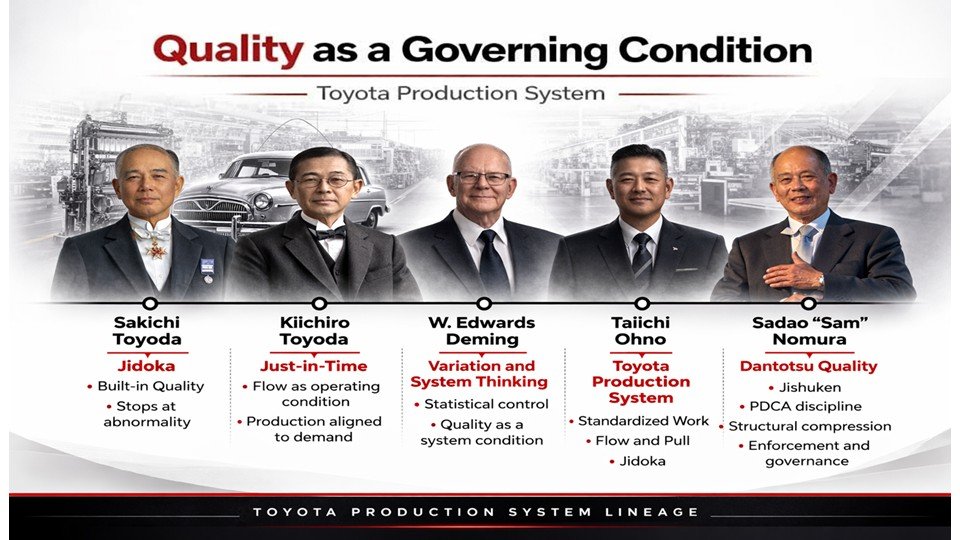
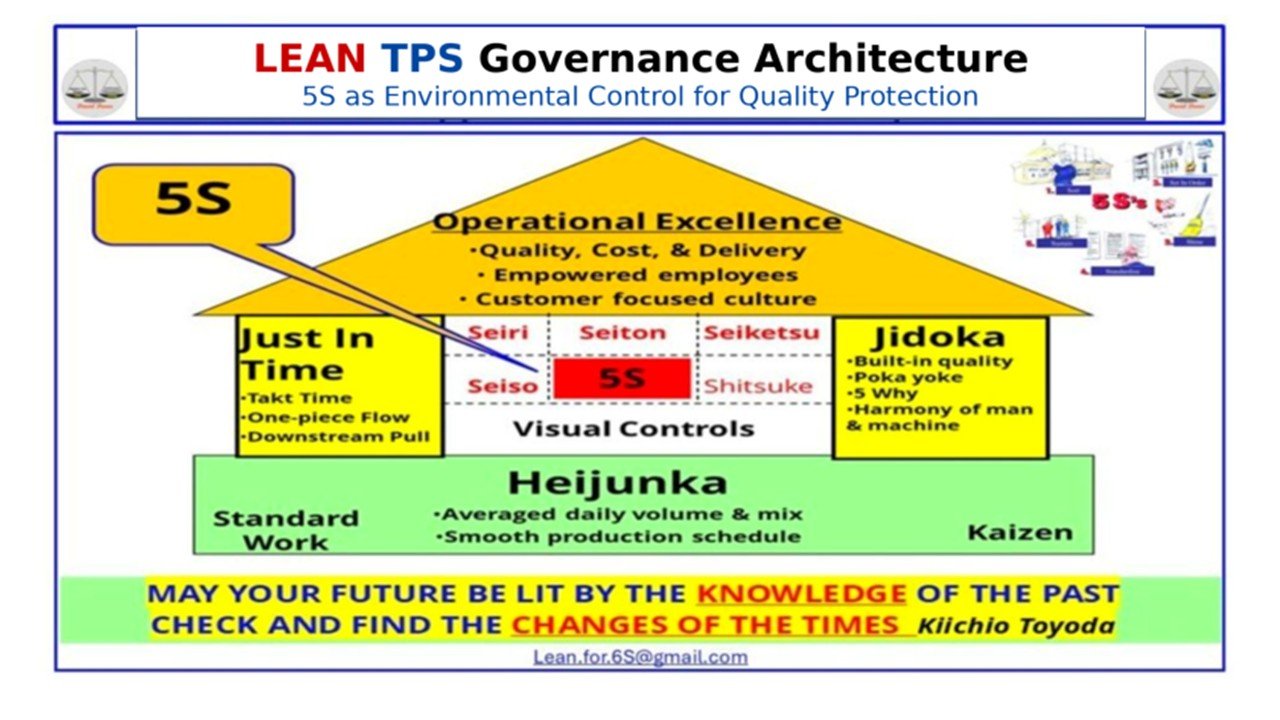
The Toyota Production System is a management system before it is a production system. Demand is governed before release to production. Capacity is defined through Standardized Work. Abnormality is surfaced through Jidoka. Leadership responsibility is explicit when conditions deviate from standard. Quality is protected at the point of occurrence rather than inspected or negotiated downstream.
Systems designed in this manner do not accumulate unresolved conflicts. Priority arbitration does not become a daily management requirement because work release is constrained by executable capacity. Management attention is not used as a control mechanism because structure governs behavior.
Theory of Constraints is often introduced in environments where Lean implementations have failed. Production systems in those environments exhibit chronic lateness, excessive work in process, and normalized expediting. Theory of Constraints delivers relief by imposing prioritization discipline where governance is absent. The effectiveness of that relief is frequently misinterpreted as evidence that the Toyota Production System is incomplete or impractical.
A more accurate interpretation is structural. Theory of Constraints becomes necessary in systems where Lean TPS is not governing. Theory of Constraints compensates for upstream governance failure rather than replacing preventive system design.
This article clarifies the role of Theory of Constraints within that boundary. Theory of Constraints functions as a compensatory control system that manages conflict after governance failure has occurred. Lean TPS functions as a preventive governance system that removes the structural causes of conflict before execution begins.
The sections that follow examine the scope of Theory of Constraints, the upstream conditions that create the environments it addresses, and the governance mechanisms within Lean TPS that prevent those conditions from forming.
Why Theory of Constraints Exists at All
Theory of Constraints did not originate as a proactive system design philosophy. Theory of Constraints emerged as a response to production environments where instability had already become a normalized operating condition. The Theory of Constraints literature consistently assumes variability, overload, and conflicting priorities as starting conditions rather than as design failures to be corrected upstream.
Several upstream system conditions must already exist before Theory of Constraints becomes relevant. Demand variation is treated as an external force rather than as a leadership responsibility. Product mix, volume, and timing are not governed for execution capability but negotiated after commitments are made. Production release decisions are disconnected from actual system capacity. These conditions are not accidental. They reflect the absence of governance at the enterprise and leadership level.
Local efficiency logic compounds these conditions. Resources are measured and rewarded for utilization rather than for flow contribution. Work is pushed into the system to keep people and equipment busy regardless of downstream readiness. Queues lengthen, work in process accumulates, and lead times become unpredictable. Flow fragmentation occurs long before any scheduling or prioritization logic is applied.
Management behavior adapts to this fragmentation. Expediting replaces system control. Priority lists multiply. Meetings are consumed by arbitration over which order deserves attention. Management attention becomes the primary control mechanism compensating for the absence of structural limits on work release. These behaviors are rational responses to an unmanaged system, not individual failures.
Under these conditions, conflict between cost, throughput, and delivery is unavoidable. Increasing utilization worsens congestion. Reducing work in process threatens due dates. Protecting one objective degrades another. The system generates mutually exclusive demands that cannot be resolved through intent or effort alone.
Theory of Constraints enters at this point in the system lifecycle. Theory of Constraints does not attempt to redesign demand, capacity governance, or leadership behavior. Theory of Constraints introduces rules to manage conflict once conflict already exists. Drum Buffer Rope establishes a pacing mechanism around the constraint. Buffer management substitutes explicit priority signals for constant negotiation. These mechanisms impose order on chaos without removing its structural causes.
The effectiveness of Theory of Constraints in such environments is real and repeatable. Due date performance improves. Work in process stabilizes. Throughput increases without additional capacity. These outcomes demonstrate the strength of TOC as a compensatory control system. These outcomes do not demonstrate preventive system design.
Theory of Constraints does not address why demand was released without capacity governance. Theory of Constraints does not address why instability was normalized. Theory of Constraints does not assign leadership obligation for preventing conflict formation. The scope of Theory of Constraints begins after governance has already failed.
Understanding the origin of Theory of Constraints clarifies its proper role. Theory of Constraints is most valuable where instability is entrenched and cannot be removed quickly. Theory of Constraints becomes unnecessary where system design prevents instability from forming. This distinction is structural rather than ideological.
Lean TPS as a Preventive Governance System
Lean TPS is built on a fundamentally different starting assumption than Theory of Constraints. Lean TPS does not treat instability as an external condition to be managed. Lean TPS treats instability as evidence of system design failure. The Toyota Production System was developed to prevent instability from entering daily operations through explicit governance of demand, capacity, and execution conditions.
Demand governance is the first preventive control within Lean TPS. Heijunka governs product mix, volume, and timing before work is released to the shop floor. Heijunka is not a scheduling technique. Heijunka is a leadership mechanism that constrains demand patterns to match executable system capability. By governing demand upstream, Lean TPS prevents artificial peaks, starvation, and overload from being introduced into production.
Capacity governance follows demand governance. Standardized Work defines the normal condition for execution by explicitly specifying work sequence, cycle time, and standard in-process inventory. Standardized Work establishes executable capacity rather than theoretical capacity. Production release is constrained by what the system can actually perform repeatedly and safely, not by forecast demand or utilization targets. This prevents the accumulation of excess work in process and eliminates the need for downstream priority arbitration.
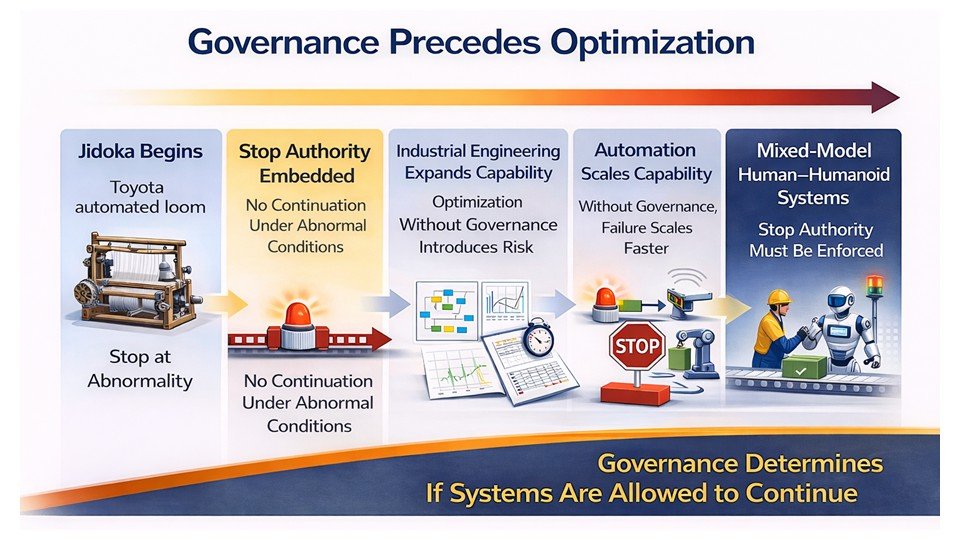
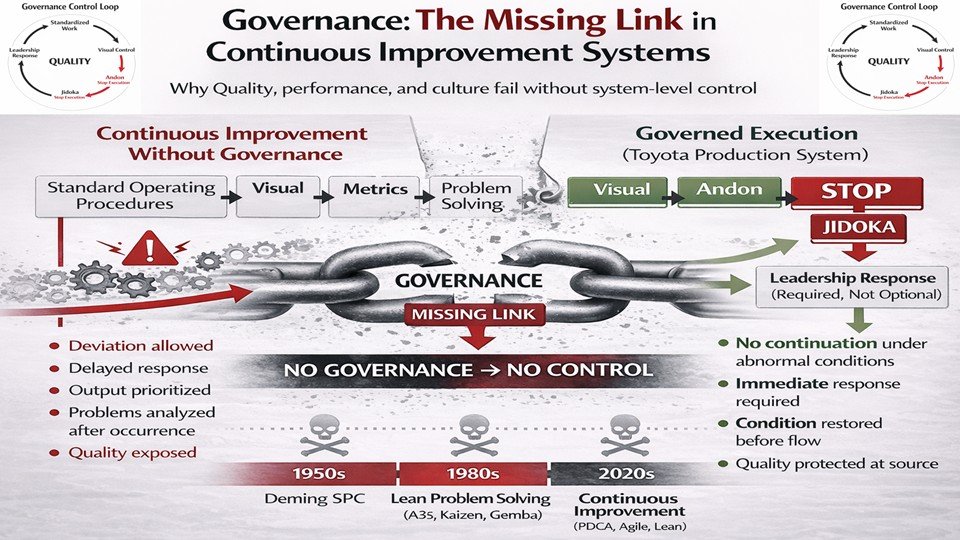
Quality governance is enforced through Jidoka. Jidoka establishes explicit stop logic when abnormal conditions occur. Abnormality is surfaced immediately rather than absorbed, worked around, or deferred. The purpose of stopping is not correction alone. The purpose of stopping is to prevent defect propagation, schedule distortion, and hidden rework from contaminating downstream operations. Jidoka converts Quality from a result to be measured into a condition to be governed.
Leadership obligation is inseparable from these controls. Lean TPS assigns responsibility for restoring normal conditions to leadership at the point of deviation. Leaders are not expected to negotiate priorities after failure occurs. Leaders are obligated to respond when standards cannot be met. This obligation is structural rather than discretionary. Leadership behavior is governed by system signals, not by urgency or persuasion.
These governance mechanisms remove the structural causes of conflict rather than optimizing performance after conflict forms. Lean TPS does not manage tradeoffs between cost, throughput, and delivery. Lean TPS designs systems so those tradeoffs do not arise during execution. Cost, throughput, and delivery performance emerge as consequences of stable, governed conditions.
Production systems governed in this manner do not require continuous prioritization logic. Work does not compete for attention because release is constrained by capacity. Orders do not require arbitration because flow is designed. Management attention is not consumed by expediting because structure governs behavior. Variability is addressed at its source rather than compensated for downstream.
Lean TPS therefore eliminates the conditions that make compensatory systems necessary. Where preventive governance is present, conflict resolution logic becomes redundant. Where preventive governance is absent, compensatory control systems become indispensable. This boundary defines the role of Lean TPS as a management system rather than an execution technique.
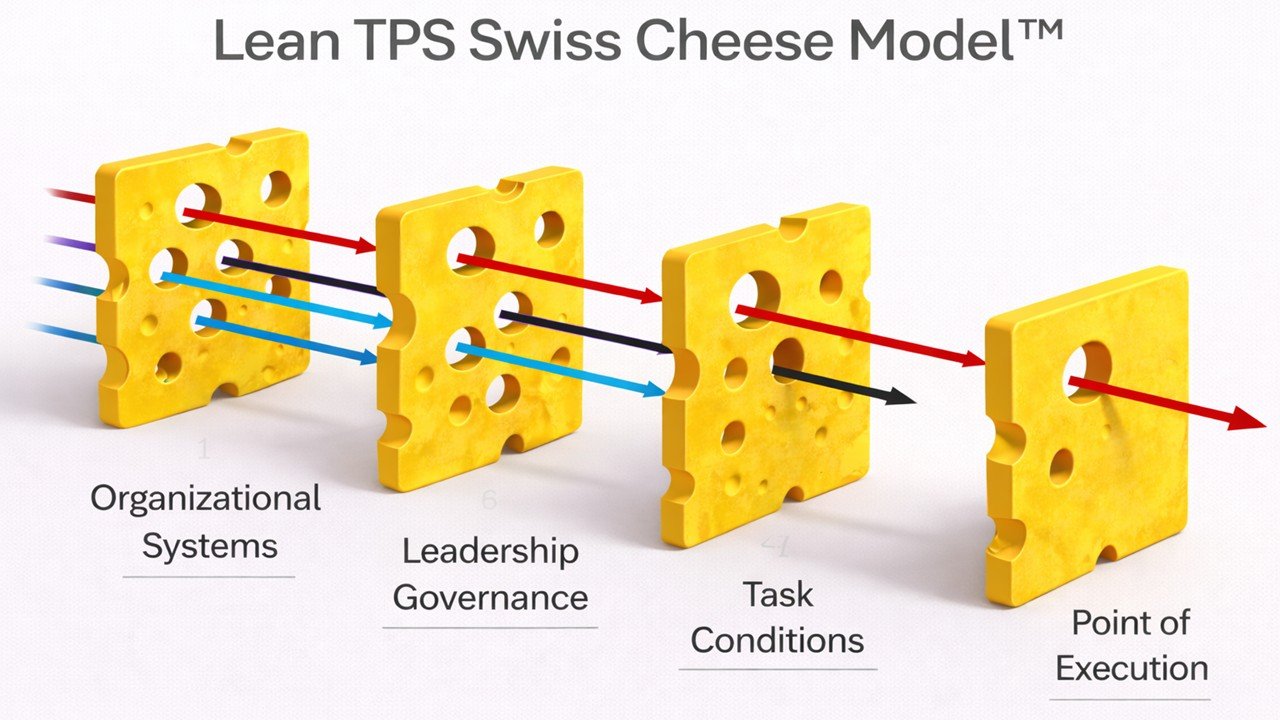
The Lean TPS Swiss Cheese Model
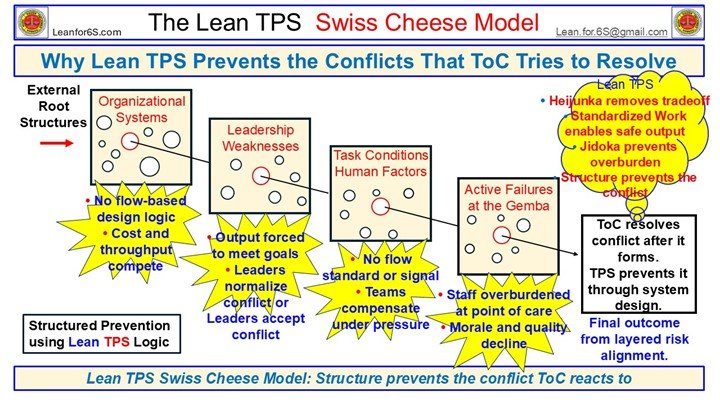
The Lean TPS Swiss Cheese Model is a governance model that explains how system failures propagate when leadership responsibility is fragmented. The model does not describe accidents or isolated errors. The model describes how organizational decisions create predictable pathways for instability to pass through multiple layers of the system until failure appears at the gemba.
The outer layer of the Lean TPS Swiss Cheese Model is organizational system design. At this layer, demand, capacity, and flow are not governed as executable conditions. Product mix, volume, and timing are committed without regard to Standardized Work capability. Capacity is treated as elastic. Demand variation is treated as unavoidable. These decisions create structural exposure before work ever reaches production.
The next layer is leadership behavior. When organizational systems fail to govern demand and capacity, leadership behavior adapts to compensate. Tradeoffs between cost, throughput, and delivery are accepted as normal. Conflict is reframed as an operational reality rather than a design failure. Leadership attention shifts from prevention to arbitration. This normalization widens the holes created by system design decisions.
The third layer is task and process conditions. When leadership accepts conflict as inevitable, task conditions are designed for flexibility rather than control. Flow signals weaken. Standardized Work loses authority. Stop logic becomes discretionary. Operators are expected to compensate through effort, workarounds, and informal coordination. Abnormality is absorbed instead of surfaced. Variability accumulates inside the work itself.
The final layer is the gemba outcome. Overburden increases. Quality deteriorates. Morale declines. Late orders, rework, and expediting become routine. These outcomes are often labeled as execution problems or people issues. Within the Lean TPS Swiss Cheese Model, these outcomes are recognized as the final manifestation of upstream governance failure.
When failures align across these layers, conflict becomes unavoidable. Orders compete for capacity. Priorities collide. Management attention is consumed by deciding what to run now, what to delay, and what to sacrifice. At this point in the system, intervention is required to prevent collapse.
Theory of Constraints operates at this final layer. Theory of Constraints introduces mechanisms to manage overload after upstream governance has failed. Drum Buffer Rope establishes pacing around the constraint. Buffer management assigns priorities to competing work. These mechanisms restore order at the point where conflict is already active. Theory of Constraints does not close upstream holes. Theory of Constraints manages the consequences of their alignment.
Lean TPS operates in the opposite direction. Lean TPS closes holes at each upstream layer before alignment can occur. Demand is governed through Heijunka. Capacity is defined through Standardized Work. Task conditions include explicit flow signals and stop logic through Jidoka. Leadership obligation is triggered by deviation from standard rather than by missed results. Failures are contained locally before they propagate.
The preventive nature of Lean TPS is structural rather than procedural. Lean TPS does not rely on management attention to regulate behavior. Lean TPS embeds control into system design. This difference explains why Lean TPS prevents conflict rather than resolving it after formation.
The Lean TPS Swiss Cheese Model clarifies why Theory of Constraints cannot function as a preventive system. Theory of Constraints mechanisms operate downstream by design. Theory of Constraints assumes the presence of variability, overload, and conflict. Lean TPS removes the structural conditions that generate those assumptions. The distinction is a matter of governance scope, not execution quality.
How Theory of Constraints Maps to the Final Layer of the Lean TPS Swiss Cheese Model
Theory of Constraints operates at the final layer of the Lean TPS Swiss Cheese Model, where upstream governance failures have already aligned and manifested as execution-level conflict. The operating conditions addressed by Theory of Constraints do not emerge spontaneously at the gemba. These conditions are produced by earlier decisions related to demand commitment, capacity governance, and leadership behavior.
At the final layer of the model, production systems exhibit overload, queue accumulation, and competing priorities. Work arrives faster than it can be executed. Orders are committed without regard to executable capacity. Lead times expand beyond control. Under these conditions, the primary management problem becomes deciding which work deserves attention now and which work must wait.
Theory of Constraints is designed to function precisely in this state. Drum Buffer Rope assumes the presence of committed orders, released work, and constrained resources. Buffer management assumes competition between orders for limited capacity. Priority signals exist only when work has already been allowed to conflict. Theory of Constraints does not eliminate these conditions. Theory of Constraints introduces discipline once these conditions exist.
The Swiss Cheese Model clarifies why Theory of Constraints cannot operate earlier in the system. At the outer layers, demand governance failures permit excessive variation in mix, volume, and timing. Theory of Constraints provides no mechanism to govern demand design. Theory of Constraints accepts demand as input rather than as a leadership obligation to be constrained before release.
At the leadership behavior layer, conflict is normalized through acceptance of tradeoffs. Delivery, cost, and throughput are treated as competing objectives rather than as outcomes of system design. Theory of Constraints does not challenge this normalization. Theory of Constraints assumes conflict is real and unavoidable. The mechanisms of Theory of Constraints are built to manage that conflict, not to prevent its creation.
At the task condition layer, Standardized Work loses authority and stop logic becomes discretionary. Operators compensate through workarounds and informal prioritization. Theory of Constraints does not define normal work, abnormal conditions, or stop rules. Theory of Constraints intervenes only after variability has been absorbed into execution and must be managed explicitly.
The necessity of management attention within Theory of Constraints further anchors it to the final layer. Buffer status must be monitored. Priority decisions must be enforced. Deviations must be escalated manually. These activities substitute human arbitration for missing structural controls. The more severe the upstream governance failure, the more indispensable these mechanisms become.
This mapping explains why Theory of Constraints performs well in damaged systems. Theory of Constraints introduces order where no structural limits exist. Theory of Constraints reduces chaos without requiring immediate redesign of upstream systems. Theory of Constraints allows organizations to survive instability without addressing its root causes.
The same mapping explains why Theory of Constraints cannot close upstream holes. No mechanism within Theory of Constraints governs Heijunka. No mechanism within Theory of Constraints defines executable capacity through Standardized Work. No mechanism within Theory of Constraints enforces Jidoka as a non-negotiable stop condition. These functions lie outside the scope of compensatory control.
The Lean TPS Swiss Cheese Model therefore positions Theory of Constraints correctly. Theory of Constraints is neither inferior nor incomplete. Theory of Constraints is bounded. Theory of Constraints exists because upstream governance failures are common, persistent, and difficult to reverse quickly.
Lean TPS operates by closing those upstream holes deliberately. Where Lean TPS governs demand, capacity, and abnormality, the final-layer conditions that activate Theory of Constraints do not form. Where Lean TPS is absent or diluted, Theory of Constraints becomes necessary to prevent operational collapse.
This distinction preserves the technical integrity of Theory of Constraints while clarifying its role within a broader governance framework. Theory of Constraints manages conflict after governance failure. Lean TPS prevents conflict through system design before execution begins.
Why Moving Theory of Constraints Upstream Breaks Its Logic
Theory of Constraints is frequently extended beyond its intended scope in an attempt to use it as a full system design framework. This extension typically occurs when organizations attempt to apply Drum Buffer Rope logic earlier in the enterprise, including demand commitment, planning, and capacity design. These attempts fail because the assumptions required for Theory of Constraints to function are violated when it is pushed upstream.
Theory of Constraints assumes that demand has already been committed. Orders exist. Due dates exist. Work has been released or is about to be released into the system. The constraint is discovered within execution, not designed intentionally. Buffer logic depends on protecting committed throughput rather than shaping demand behavior. When Theory of Constraints is applied upstream, these assumptions collapse.
Demand governance cannot be performed through buffers. Buffers react to variability after it enters the system. Buffers do not shape product mix, volume, or timing. When buffers are used as substitutes for demand design, buffer sizes inflate, work in process grows, and instability is institutionalized rather than reduced. The presence of buffers becomes justification for accepting poor demand discipline.
Capacity governance also breaks under upstream application of Theory of Constraints. Theory of Constraints treats capacity as a given constraint to be managed rather than as a condition to be defined. Executable capacity is not established through work sequence, cycle time, or standard in-process inventory. Capacity remains theoretical. Work release decisions drift toward utilization targets and forecast absorption rather than controlled execution. Buffer logic cannot compensate for undefined capacity.
Priority logic becomes permanent when Theory of Constraints is pushed upstream. Priority signals exist to resolve conflict. When conflict is introduced deliberately through unguided release, priority systems become the operating system. Management attention is consumed continuously. Every order becomes urgent. Priority inflation replaces system control. This condition is often misinterpreted as complexity rather than as governance failure.
Quality governance is entirely absent from upstream applications of Theory of Constraints. Theory of Constraints does not define normal work. Theory of Constraints does not specify abnormality. Theory of Constraints does not establish stop conditions. When Theory of Constraints is used as a primary system, Quality becomes subordinate to throughput protection. Defects, rework, and workarounds are absorbed into buffers rather than surfaced as signals for correction.
Leadership behavior adapts accordingly. Leaders become arbiters rather than governors. Decisions focus on which order to protect rather than on why conflict exists. Responsibility shifts from system design to daily intervention. Performance depends on vigilance, experience, and escalation rather than on structure. The system becomes fragile under pressure because stability is never designed.
Lean TPS does not fail in this manner because Lean TPS does not rely on downstream compensation. Lean TPS governs demand before commitment through Heijunka. Lean TPS defines executable capacity through Standardized Work. Lean TPS enforces stop logic through Jidoka. Lean TPS assigns leadership obligation when standards cannot be met. These mechanisms operate before buffers, priorities, or arbitration become necessary.
The failure of upstream Theory of Constraints applications is not evidence of incorrect execution. The failure is evidence of scope violation. Theory of Constraints is not designed to govern enterprise decisions. Theory of Constraints is designed to manage execution conflict after enterprise decisions have already created instability.
This boundary explains why attempts to replace Lean TPS with Theory of Constraints produce brittle systems. Compensatory control cannot substitute for preventive governance. Buffers cannot replace demand design. Priority signals cannot replace Standardized Work. Arbitration cannot replace leadership obligation.
Theory of Constraints retains its value when applied within its proper boundary. Lean TPS retains its value by eliminating the need for compensatory control. Confusing these roles weakens both systems. Respecting their boundaries clarifies governance responsibility and restores Quality as a system condition rather than an operational outcome.
Why Theory of Constraints Cannot Replace Lean TPS
Theory of Constraints is built on the assumption that instability is a permanent feature of the operating environment. Variability in demand, uneven loading, and conflicting priorities are treated as normal conditions that must be managed rather than eliminated. The control logic of Theory of Constraints relies on buffers, priority signals, and ongoing management attention to protect throughput in the presence of that instability.
The primary regulatory mechanism in Theory of Constraints is compensatory control. Drum Buffer Rope constrains release and sequencing after commitments have already been made. Buffer management substitutes explicit priority rules for continuous negotiation. Management attention is required to monitor buffer status, intervene when priorities collide, and arbitrate tradeoffs between competing orders. Stability is not designed into the system. Stability is approximated through control.
Lean TPS is based on a different assumption. Lean TPS treats instability as evidence of system design failure rather than as an unavoidable operating condition. Demand patterns, capacity limits, and execution rules are governed before work is released. The control logic of Lean TPS is embedded in structure rather than in ongoing intervention.
Standardized Work defines normal conditions and executable capacity. Heijunka constrains demand variation before it reaches production. Jidoka establishes explicit stop logic when conditions deviate from standard. Leadership obligation is triggered by abnormality rather than by missed outcomes. These elements do not compensate for instability. These elements remove the conditions that create instability.
The difference between Theory of Constraints and Lean TPS is not a difference in tools. The difference is a difference in governance scope. Theory of Constraints governs execution behavior after upstream decisions have already created overload and conflict. Lean TPS governs upstream decisions so overload and conflict do not form during execution.
Systems that depend on continuous conflict resolution reveal the absence of preventive governance. Priority arbitration, expediting, and buffer management become necessary only when work has already been released beyond system capability. In such systems, performance depends on vigilance, experience, and sustained management attention.
Systems designed to prevent conflict do not require arbitration. Work release is constrained by capacity. Abnormality is surfaced immediately. Leadership responsibility is explicit. Management attention is directed toward restoring normal conditions rather than choosing between bad options. Performance depends on structure rather than heroics.
Theory of Constraints cannot replace Lean TPS because Theory of Constraints does not govern the conditions that Lean TPS is designed to control. Theory of Constraints assumes instability and manages it. Lean TPS prevents instability through system design. These systems operate at different layers and cannot substitute for one another.
Governance Continuity and Conclusion
This article is part of a broader examination of why improvement efforts frequently generate visible activity without producing durable system behavior. Across improvement frameworks, industries, and operating contexts, tools are deployed, training is delivered, and projects are completed. Results appear temporarily, then decay. The common limiting factor is not technical capability, analytical skill, or organizational intent. The limiting factor is the absence of governance.
Earlier articles in this series examined how governance was progressively removed from improvement systems as methods became portable. Certification replaced management responsibility. Projects replaced system ownership. Activity replaced escalation and obligation. Each transition preserved technique while weakening control. The result was improvement that depended on persistence and persuasion rather than on structure.
Theory of Constraints fits the same pattern when viewed through a governance lens. Theory of Constraints is effective in environments where governance has already been lost. Theory of Constraints restores order by imposing compensatory control on systems overloaded by ungoverned demand, fragmented flow, and normalized conflict. The effectiveness of Theory of Constraints in such environments is evidence of disciplined execution logic. It is not evidence of preventive system design.
Lean TPS operates at a different level. Lean TPS prevents governance loss by embedding control into system design. Demand is governed before release. Capacity is defined through Standardized Work. Abnormality is surfaced immediately through Jidoka. Leadership obligation is explicit when standards cannot be met. These mechanisms do not depend on vigilance, negotiation, or arbitration. These mechanisms operate continuously as part of daily management practice.
Quality durability depends on this distinction. Quality does not endure because problems are resolved efficiently after they occur. Quality endures because systems are designed to prevent instability, ambiguity, and overload from forming. When Quality is governed structurally, improvement compounds. When Quality is managed through conflict resolution, improvement resets.
Systems that rely on conflict management are compensating for upstream design failures. Priority arbitration, expediting, and buffer control are necessary only when work has already been released beyond executable capacity. These mechanisms stabilize damaged systems. These mechanisms do not replace governance.
Lean TPS demonstrates a different possibility. Lean TPS shows that conflict between cost, throughput, and delivery is not inherent to production. Conflict emerges when leadership does not govern system conditions. When governance is present, tradeoffs do not dominate daily execution. Performance emerges from structure rather than from intervention.
The role of Theory of Constraints is therefore clear. Theory of Constraints is a powerful compensatory system for managing instability. Lean TPS is a preventive governance system for eliminating the structural causes of instability. Confusing these roles obscures the real source of improvement failure.
Quality endures only when it is governed deliberately, owned by leadership, and embedded in daily management practice. Systems designed to prevent conflict do not require arbitration. Systems designed to manage conflict reveal where governance has already failed.
Continuity With Lean TPS Governance Work
This article extends a line of inquiry developed across earlier work on LeanTPS.ca examining how governance was progressively separated from system behavior as the Toyota Production System was translated into portable improvement frameworks.
Earlier articles examine this separation at different structural levels, each reaching the same conclusion through a different governance pathway.
Six Sigma (post-1990s) and Lean Six Sigma (post-2010s): How Quality Governance Was Replaced
Examines how certification systems, project structures, and belt hierarchies displaced leadership ownership of Quality, producing technically capable organizations without durable control.
https://leantps.ca/six-sigma-lean-six-sigma-quality-governance/
Kaizen (post-1980s): How Governance Was Removed from the Toyota Production System
Traces how Kaizen became portable by shedding Jishuken, escalation, and leadership obligation, allowing improvement activity to persist while system governance eroded.
https://leantps.ca/kaizen-post-1980s-how-governance-was-removed-from-the-toyota-production-system/
Jishuken: Leadership Governance Through Direct System Engagement
Examines how Toyota preserved Quality by obligating leaders to participate directly in system diagnosis, escalation, and learning, and why the absence of Jishuken left improvement activity disconnected from leadership responsibility.
https://leantps.ca/jishuken/
Together, these articles describe a single failure mode expressed at different levels of the enterprise. When governance is removed, activity increases while control weakens. Lean TPS restores Quality by governing conditions before work begins rather than explaining loss after it occurs.