Six Sigma (Since the 1990s): Method Without Governance
Why Governance Matters More Than Methods
Since the 1990s, Six Sigma has been positioned as a comprehensive approach to Quality improvement. It has been taught, certified, deployed, refined, rebranded, and ultimately merged with Lean in repeated attempts to extend its relevance and applicability across industries. Large investments have been made in training programs, certification pathways, and project infrastructures intended to institutionalize improvement capability. Yet despite this sustained effort, organizations continue to report the same outcomes: short-term gains tied to discrete projects, stalled organizational learning, and systems that struggle to sustain improvement once attention shifts or key individuals move on.
These outcomes are not isolated failures or the result of poor execution. They appear consistently across sectors, maturity levels, and leadership teams. Improvement activity remains high, but stability does not follow. Quality metrics improve temporarily, then plateau or regress. Lessons learned in one project fail to translate into system-wide capability. Over time, improvement becomes episodic rather than cumulative.
This newsletter does not examine Six Sigma as a statistical method, nor does it question the intent or effort of those who developed, taught, or applied it. The focus here is governance. Specifically, who owns Quality, how learning is structured, and where accountability resides once improvement is formalized through projects, specialist roles, and certification systems. The distinction matters, because methods can be sound while governance quietly erodes.
Six Sigma’s post-1990s evolution reveals a consistent structural pattern. As the method expanded beyond its original corporate context, responsibility for Quality gradually shifted away from management systems and into credentialed expertise. Improvement work was increasingly contained within projects. Authority was increasingly assigned through belts. Learning was increasingly validated through certification rather than embedded in daily management practice. Leaders did not formally relinquish ownership of Quality, but the system no longer required them to exercise it directly.
As this shift took hold, Quality improvement became something executed by designated roles rather than something governed by the organization as a whole. Projects became the primary unit of learning. Success was measured by completion, savings, and certification milestones. System design, escalation discipline, and daily management accountability weakened, even as visible improvement activity increased. Over time, organizations learned how to run Six Sigma projects effectively without learning how to govern Quality sustainably.
The later alignment of Six Sigma with Lean did not reverse this trend. Instead, it combined two frameworks under a structure that still relied on belts, projects, and external validation. Lean language introduced concepts such as flow, waste, and value, but the underlying governance model remained unchanged. Quality continued to be managed through methods and initiatives rather than owned through system design and leadership responsibility. The merger increased scope and participation, but it did not restore governance.
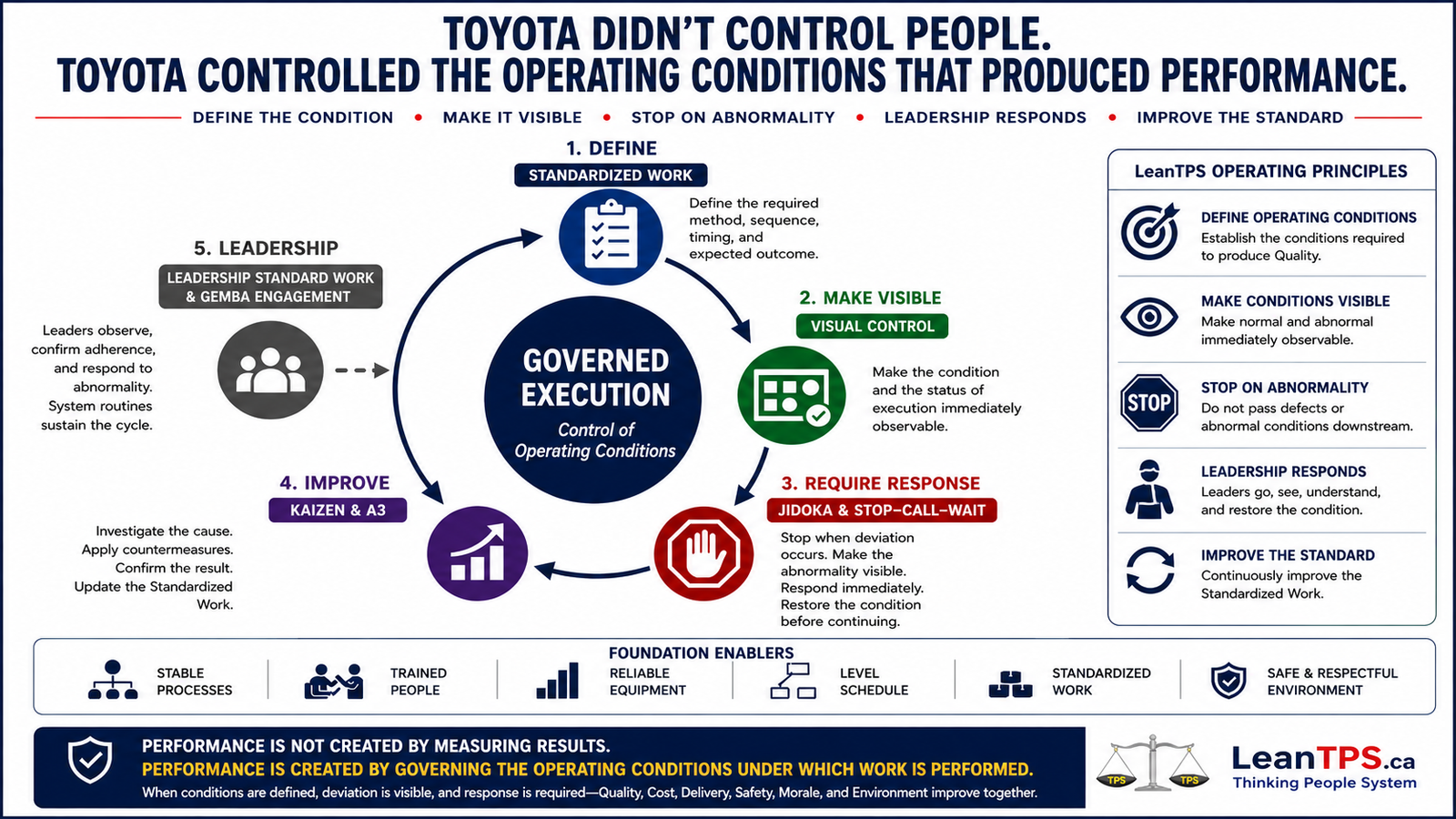
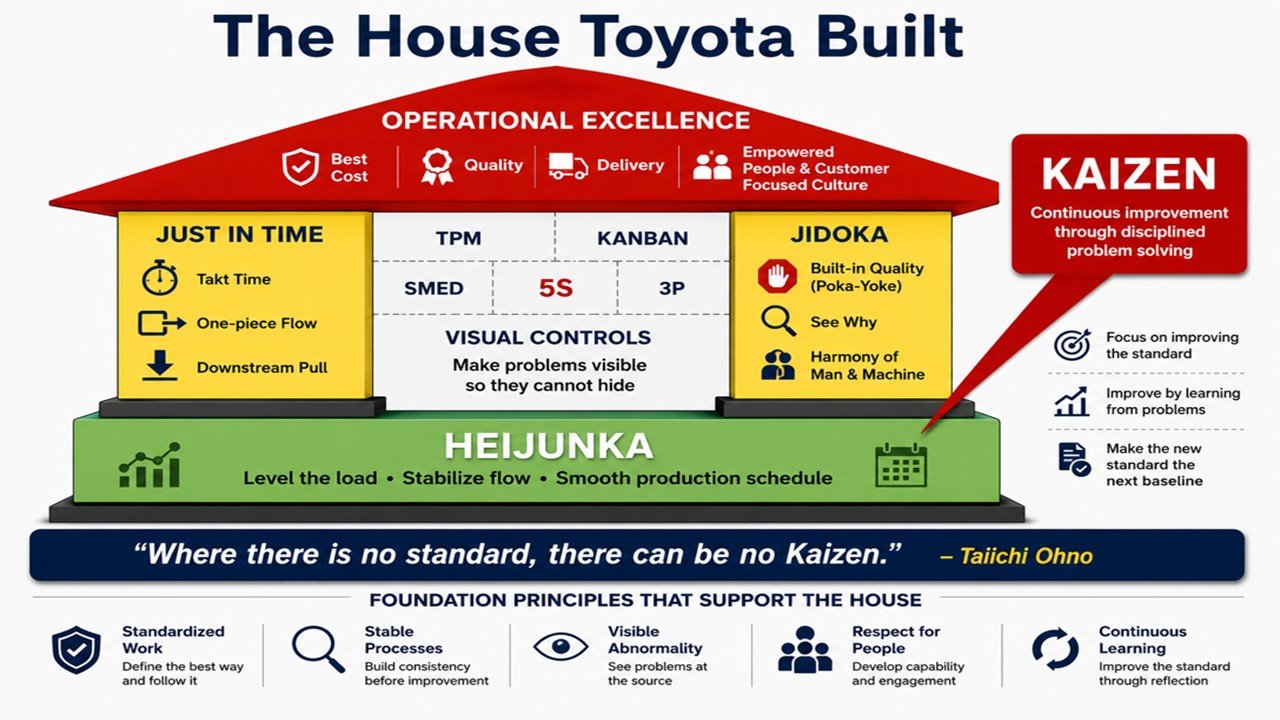
Toyota’s experience stands in contrast. The Toyota Production System has endured not because it evolved faster or adopted new labels, but because its governance never moved. Quality remained a management responsibility. Learning stayed embedded in daily work. Improvement was governed through structure, escalation, and leader obligation rather than delegated to projects or credentials. Capability accumulated because it was built into the system itself.
Understanding why Six Sigma required continual reinvention, while the Toyota Production System did not, begins with governance. That is the lens used throughout this newsletter.
What Six Sigma Originally Was
Six Sigma did not originate as a portable improvement solution or a branded methodology intended for wide replication. It emerged inside large manufacturing organizations as a tightly governed, management-directed approach to reducing variation in processes that directly affected Quality, cost, delivery, and business risk. Its early success was not driven by the statistical tools alone. It depended on the organizational conditions that controlled how and where those tools were applied.
At Motorola, and later at General Electric, Six Sigma existed inside a strong management system. Senior leaders selected projects based on business-critical needs, not local preference or training convenience. Each project had an executive sponsor with authority over resources, priorities, and decisions. Improvement work was explicitly connected to strategic objectives, financial impact, and Quality performance. Results were expected to be measurable, sustained over time, and material to the business. Six Sigma did not operate as a parallel improvement system. It functioned under management authority and within existing governance structures.
Black Belt qualification reflected this governance model. Early expectations were intentionally demanding. Candidates were required to lead complex, cross-functional projects with clearly validated results, often measured in millions of dollars of impact. Savings claims were scrutinized and confirmed through finance and leadership review. Training required significant time away from daily work and substantial financial investment. Access was limited. These barriers were deliberate controls, not inefficiencies. They ensured that Six Sigma capability remained scarce, accountable, and directly connected to leadership oversight and business responsibility.
Six Sigma was also explicitly project-based. That structure was purposeful. Projects provided focus, discipline, and a mechanism to apply advanced statistical methods where variation posed the greatest Quality and business risk. The project format allowed leadership to concentrate expertise on specific problems rather than dispersing it indiscriminately. The risk was not the use of projects themselves. The risk would later emerge when projects were treated as substitutes for system-level management. In the original context, that substitution did not occur. Management remained responsible for end-to-end Quality outcomes and did not delegate that responsibility to project teams.
During this period, Six Sigma was visible within professional communities such as ASQ through practitioner-led presentations and detailed case discussions. The emphasis was on results achieved under clearly defined organizational conditions. Certification was not treated as an outcome. It was treated as evidence that an individual had operated successfully within a governed system and delivered verified results. The credibility of Six Sigma came from demonstrated performance under leadership control, not from the spread of credentials.
This original form of Six Sigma worked precisely because it was constrained. It was difficult to deploy, expensive to maintain, and inseparable from management responsibility for Quality. Those constraints protected its effectiveness. When they were later removed to enable scale and transferability, the conditions that made Six Sigma effective were weakened, even though the tools remained the same.
Six Sigma’s Expansion After the 1990s
Six Sigma emerged inside large organizations as a method for addressing variation and defect reduction within clearly defined processes. In its original use, it operated inside existing management structures and depended on executive sponsorship to select work, remove barriers, and validate results. That operating context was not incidental. It was the condition that allowed Six Sigma to influence Quality outcomes without displacing leadership responsibility.
During the 1990s, Six Sigma began to change character. As organizations outside its original industrial base adopted the method, it was increasingly packaged for transfer. What had been an internally governed approach became a portable framework that could be taught, certified, and replicated across organizations with very different management systems. The method was no longer anchored to a specific governance environment. It became an improvement product.
This shift altered the relationship between improvement activity and management responsibility. Rather than reinforcing leadership ownership of Quality, Six Sigma increasingly positioned improvement as a specialist function. Belts, projects, and financial validation became the primary sources of authority. Improvement legitimacy came from credentials and project charters rather than from line leadership accountability for process stability and Quality performance. Learning moved away from daily work and was concentrated in defined improvement events led by trained practitioners.
As adoption accelerated, the method proved adaptable across industries and functions. At the same time, governance weakened. Results were assessed at the project level rather than at the system level. Financial savings were used as proxies for Quality improvement, even when underlying process conditions remained unchanged. Once initial gains were captured, organizations often returned to the same management behaviors that had created instability, variation, and Quality risk in the first place.
The expansion of Six Sigma after the 1990s did not fail because organizations misunderstood the tools. The tools continued to function as designed. The failure occurred because Six Sigma was asked to govern Quality in the absence of a governing system. Without management structures that owned process design, daily control, and long-term stability, projects could not sustain Quality outcomes. That structural gap would later drive attempts to reinvent Six Sigma, align it with other frameworks, or position it alongside broader management systems rather than as a governing mechanism on its own.
Why Transferability Changed Everything
The conditions that made Six Sigma effective in its original context were the same conditions that limited its spread. Strong executive sponsorship, disciplined project selection, and significant investment in training, data validation, and leadership oversight were required. These requirements protected Quality outcomes, but they also made the method difficult to deploy beyond large organizations with mature management systems. As interest grew, those constraints were increasingly viewed as barriers rather than controls.
To scale, Six Sigma had to become transferable. Training content was standardized so it could be delivered consistently across organizations. Certification pathways were formalized to allow capability to be assessed without direct dependence on a specific management system. Project requirements were normalized so that individuals could demonstrate proficiency in similar ways regardless of industry or organizational context. What had once been tightly governed inside management authority became something that could be taught, examined, and replicated externally.
This shift changed governance in a fundamental way. Authority moved away from line management responsibility and toward credentialed roles. Black Belts were no longer rare extensions of leadership intent embedded within management systems. They became designated improvement specialists operating within defined project boundaries. Responsibility for Quality improvement began to migrate from the management system to the individual role, weakening leadership accountability for process design, stability, and daily control.
Transferability also changed how success was measured. Financial validation remained a central requirement, but it was increasingly tied to individual projects rather than to sustained system performance. Project completion became a proxy for improvement, while continuity of process control and long-term Quality stability received less attention. Knowledge and certification could now be acquired independently of organizational context, allowing improvement capability to exist without corresponding changes to daily management practice.
As certification expanded, the original constraints disappeared. Training costs dropped, access widened, and project thresholds were reduced. These changes made Six Sigma easier to adopt and faster to deploy. At the same time, they weakened the mechanisms that had once enforced accountability and leadership oversight. The method continued to exist and spread, but the governance conditions that had made it effective did not.
This transition was not the result of misuse or misunderstanding. It represented an intentional trade. Transferability was gained at the expense of management ownership of Quality. That trade enabled large-scale adoption while simultaneously establishing the conditions for long-term instability in Quality governance and system performance.
Certification and the Shift in Governance
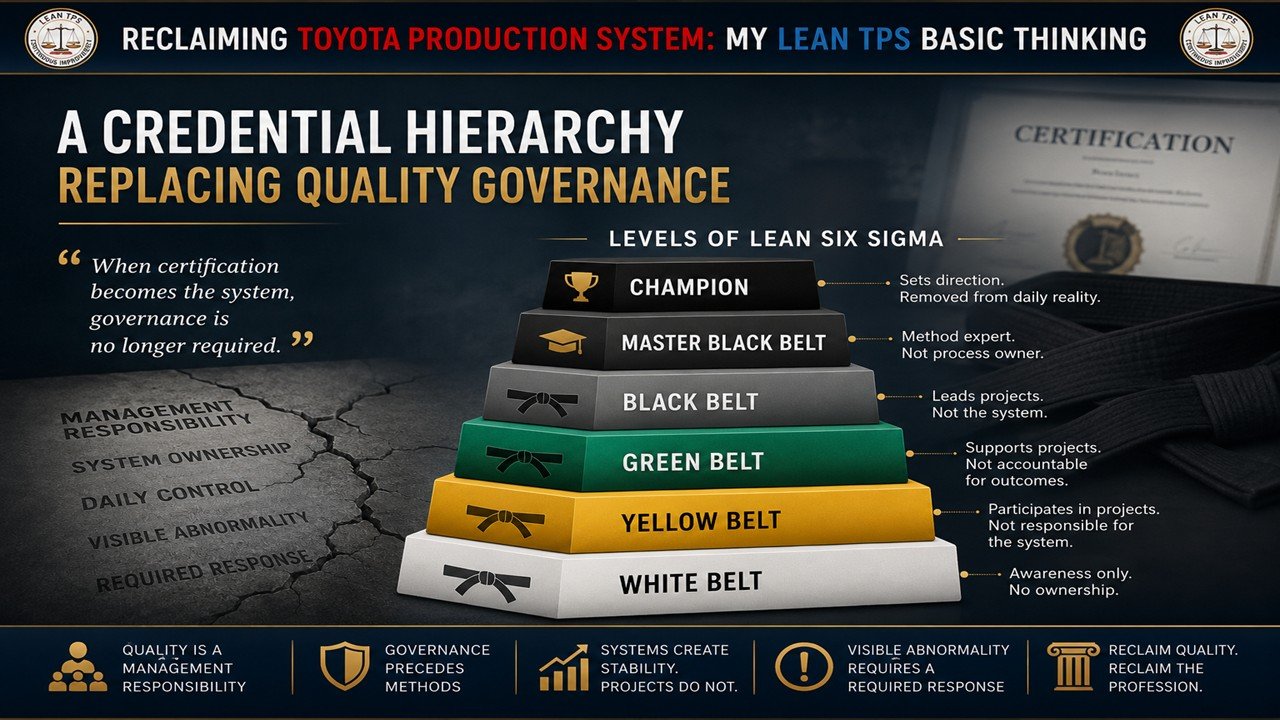
As Six Sigma expanded beyond its original organizational context, certification became the primary mechanism for scale. What could no longer be governed through management systems was governed through credentials. Belt levels defined authority, progression, and legitimacy. Improvement capability was reframed as something individuals possessed rather than something leadership embedded and sustained through the organization.
This shift did not occur in isolation. As transferability increased, Quality knowledge was formalized into standardized bodies of knowledge supported by exam preparation materials. By the late 2000s and early 2010s, Lean and Six Sigma were unified through curriculum alignment rather than through management system design. Lean tools were integrated into Six Sigma frameworks because they could be taught and tested together. Certification pathways followed that logic. Universities, professional societies, and training providers aligned around what could be examined, credentialed, and scaled, not around how Quality should be governed day to day.
This period marked the institutionalization of Lean Six Sigma. Quality was no longer governed primarily through management responsibility for system design, daily control, and long-term stability. It was governed through exams, belt hierarchies, and credential frameworks. Lean Six Sigma became a portable Quality surrogate, optimized for dissemination and repeatability rather than for ownership, continuity, and leadership accountability.
The impact on governance was immediate. Leaders were no longer required to develop deep understanding of process design or to own Quality through daily management practice. Responsibility was delegated to certified roles operating within project boundaries. Improvement activity became episodic and event-driven rather than structural and continuous. Quality performance depended on the presence of certified individuals rather than on the capability of the management system.
Certification also changed how learning occurred. Knowledge was abstracted from operational context and standardized for transfer. Success was measured through course completion, examination results, and validated project savings. Measures of system stability, capability growth, and long-term Quality performance were secondary or absent. Organizations learned how to execute Six Sigma projects without learning how to govern Quality through their systems.
This model proved efficient for dissemination but weak for continuity. When certified individuals moved on, capability moved with them. When projects ended, learning ended. Governance did not reside in the organization or in leadership practice. It resided in credentials.
This shift explains why Six Sigma required continual reinforcement, rebranding, and expansion. The method could be taught repeatedly, but Quality governance was never reestablished at the system level.
Lean Alignment as a Survival Strategy
As the limitations of certification-driven improvement became visible, Six Sigma was not displaced. It was extended. Lean language was introduced to address flow, waste, and speed, creating what became known as Lean Six Sigma. This alignment was presented as integration. Structurally, it functioned as reinforcement of an existing model rather than as a change in governance.
The addition of Lean concepts did not alter authority or accountability. Belt hierarchies remained intact. Improvement activity continued to be organized around projects. Legitimacy still flowed through certification rather than through management systems. Lean tools were absorbed into the same credential framework that had already shifted ownership of Quality away from leaders and daily management practice.
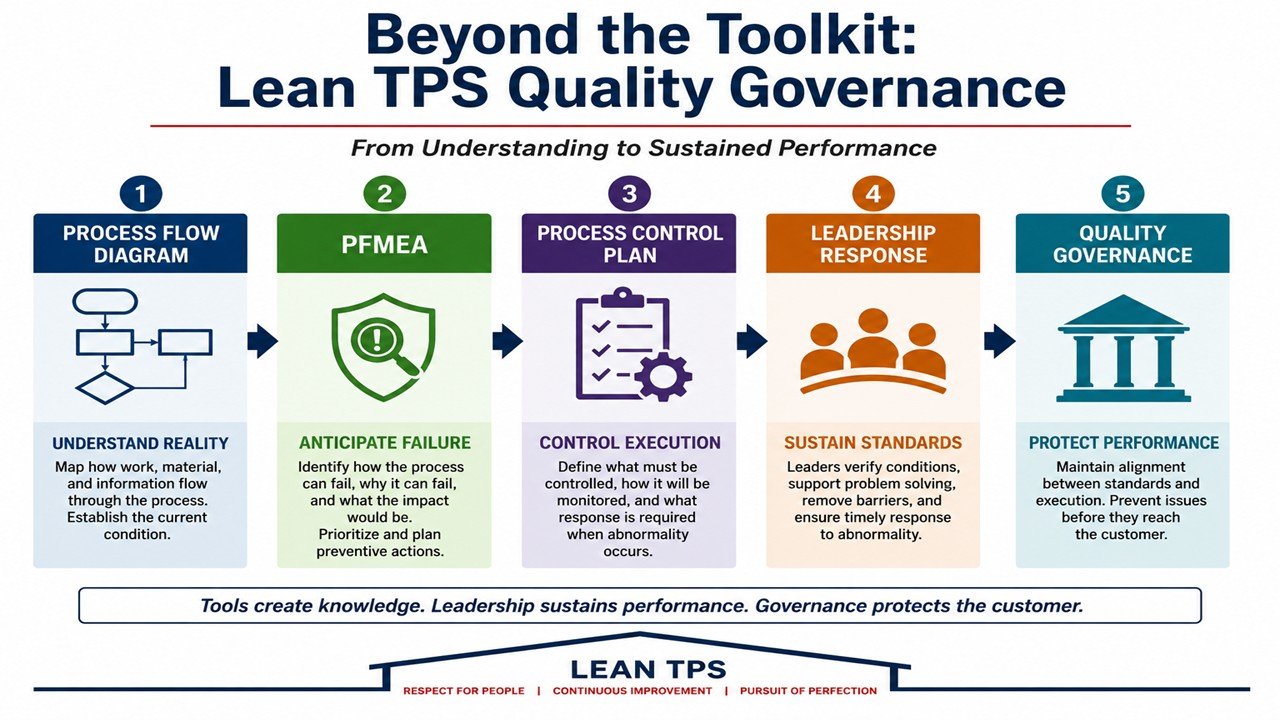
This distinction matters. Lean, when separated from its original system context, does not provide governance on its own. Without a management system that defines responsibility for process design, daily control, and learning, Lean tools become methods applied to problems rather than mechanisms that restore accountability. Waste reduction initiatives can be launched and completed, but learning remains episodic and localized. Quality outcomes remain vulnerable to turnover and changing priorities.
The result was a hybrid that appeared more comprehensive while remaining structurally unchanged. Organizations could claim progress in both defect reduction and waste elimination. At the same time, the underlying management model continued to fragment responsibility. Quality continued to be delivered by specialists and projects rather than governed through the system.
Lean Six Sigma did not fail because Lean and Six Sigma are incompatible. It failed because neither was allowed to govern. Both were applied within a framework that treated improvement as an overlay on existing management practice rather than as the operating system responsible for Quality, stability, and continuity.
Why TPS Did Not Need Reinvention
The Toyota Production System followed a different path because it was never positioned as a method to be adopted or transferred. It was designed as a management system to be lived. Quality was not assigned to roles, projects, or certifications. It remained the explicit responsibility of leaders through daily management, standardization, and structured learning built into the work itself.
TPS governance does not rely on credentials to establish authority. Authority is established through responsibility for process design, ownership of Standardized Work, and the ability of leaders to see, respond to, and correct abnormality at the gemba. Improvement is not episodic or event driven. It is continuous because it is inseparable from how work is planned, executed, and managed every day. Quality control and Quality improvement are not separated activities. They are part of the same management responsibility.
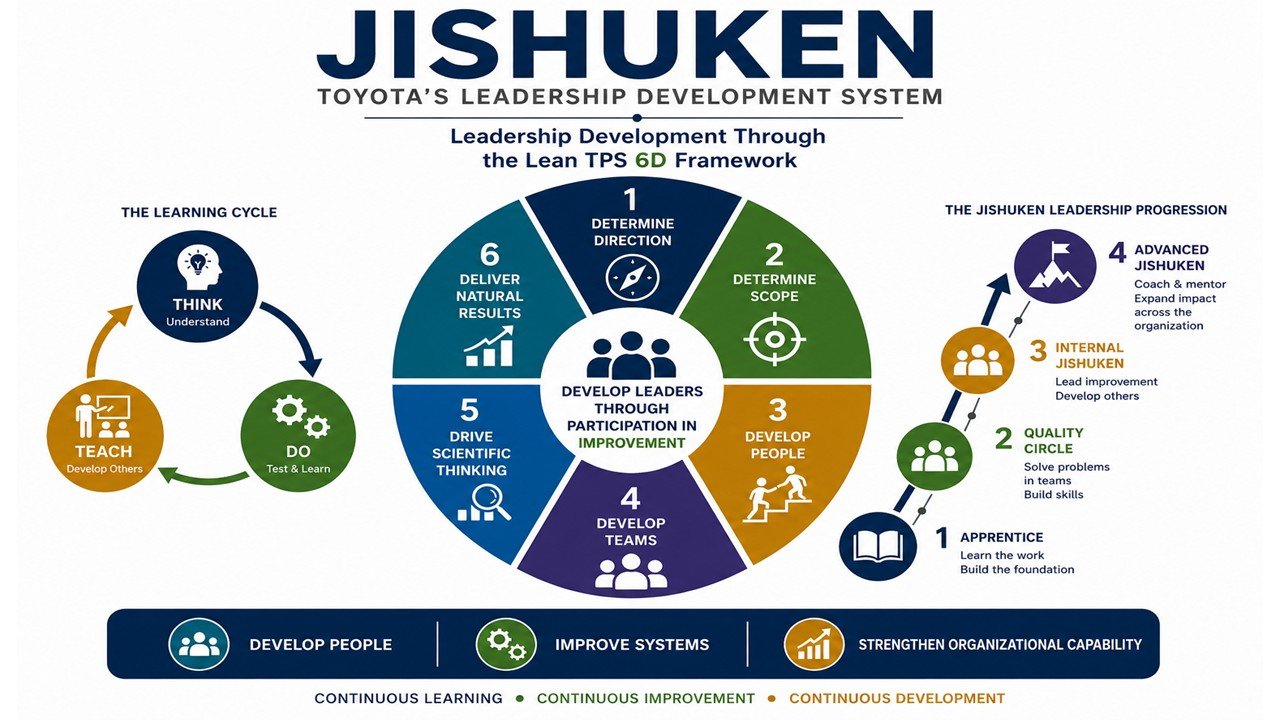
This distinction explains why TPS has not required rebranding, expansion, or alignment to survive. When governance is intact, additional frameworks are unnecessary. Learning does not reside in individuals or certifications. It is built into the system through shared standards, deliberate leader development, and disciplined problem solving. Capability remains when people move on because the system carries the knowledge forward.
Where Six Sigma and Lean Six Sigma depend on reinforcement through certification cycles and program refreshes, TPS depends on consistency of management practice. Where other approaches seek relevance through expansion, TPS maintains relevance through stability. The framework does not change because leadership responsibility for Quality does not change. Process design, daily control, and learning remain management obligations.
TPS continues not because it is culturally Japanese or uniquely resistant to Western contexts. It continues because it does not trade governance for speed of deployment. Short-term financial pressure may challenge its application, but the system itself does not drift. It remains grounded in Quality as a management responsibility, not as a project outcome or a credentialed activity.
Governance Determines What Endures
Six Sigma’s trajectory since the 1990s follows a consistent pattern. Methods scale rapidly when they are portable, certifiable, and financially legible. They struggle when asked to govern systems. The repeated reinvention of Six Sigma, and its eventual alignment with Lean, reflects ongoing attempts to compensate for missing governance rather than to restore management responsibility for Quality.
ASQ’s evolution reflects the same structural shift. An organization originally established to steward Quality control, systems thinking, and management responsibility gradually moved toward credential administration. Certification became a proxy for capability. Knowledge was increasingly abstracted from daily practice and system operation. Quality was professionalized through roles and credentials, but it was no longer governed through management ownership of processes and outcomes.
The results of this shift are predictable. Improvement activity increases, often dramatically. Training volumes grow. Project counts rise. At the same time, system stability does not improve in a sustained way. Organizations accumulate trained individuals while remaining dependent on episodic projects. Learning occurs, but it does not compound. Results appear, but they erode once attention moves elsewhere or certified individuals leave.
The Toyota Production System persists because it never made that trade. Governance remained anchored in management responsibility for process design, daily control, and learning. Improvement was never separated from how work is managed. Quality was not delegated to methods, specialists, or credentials. It was built into the operating system itself.
This distinction explains why many improvement programs require constant renewal, rebranding, or expansion to remain relevant, while TPS does not. Systems fail when governance is replaced by methods. Systems endure when governance is preserved.
That is the difference that matters.
What This Means for Leaders
Organizations do not lack methods. They lack governance.
When Quality is treated as a program, a portfolio of projects, or a certification pathway, responsibility fragments and learning decays. Improvement activity becomes visible, but it is unstable. Results depend on individuals rather than on structure. Continuity disappears when those individuals move on. The organization appears active, yet Quality is no longer governed through the management system.
Investment in belts and certifications is often justified as evidence of commitment to improvement. In practice, it reflects a short-term management trade. Credentials offer speed, measurability, and delegation. They allow leaders to fund improvement without changing how Quality is governed day to day. Improvement becomes something specialists deliver rather than something leaders are accountable for through their management practice.
This trade produces predictable consequences. Responsibility for Quality shifts away from leadership and into defined roles. Learning is concentrated in projects instead of embedded in daily work. Systemic problems are addressed episodically rather than through structural change. Over time, leaders become consumers of results instead of stewards of Quality. Governance weakens even as improvement activity increases.
The Toyota Production System offers no shortcut and no credential. It offers something more demanding. Sustained management responsibility for Quality, exercised daily through structure, Standardized Work, and learning at the gemba. Quality cannot be delegated without being degraded. It must be governed through presence, discipline, and consistency, regardless of short-term financial pressure.
This is why TPS continues where other approaches cycle, merge, and rebrand. Governance was never surrendered. Quality remained a management obligation rather than a method to deploy.
The lesson for leaders is not to adopt another framework. It is to stop replacing governance with methods and to reclaim Quality as a responsibility that cannot be outsourced, certified, or delegated without consequence.
What This Means for Leaders
Organizations do not lack methods. They lack governance.
When Quality is treated as a program, a portfolio of projects, or a certification pathway, responsibility fragments and learning decays. Improvement activity becomes visible, but it is unstable. Results depend on individuals rather than on structure. Continuity disappears when those individuals move on. The organization appears active, yet Quality is no longer governed through the management system.
Investment in belts and certifications is often justified as evidence of commitment to improvement. In practice, it reflects a short-term management trade. Credentials offer speed, measurability, and delegation. They allow leaders to fund improvement without changing how Quality is governed day to day. Improvement becomes something specialists deliver rather than something leaders are accountable for through their management practice.
This trade produces predictable consequences. Responsibility for Quality shifts away from leadership and into defined roles. Learning is concentrated in projects instead of embedded in daily work. Systemic problems are addressed episodically rather than through structural change. Over time, leaders become consumers of results instead of stewards of Quality. Governance weakens even as improvement activity increases.
The Toyota Production System offers no shortcut and no credential. It offers something more demanding. Sustained management responsibility for Quality, exercised daily through structure, Standardized Work, and learning at the gemba. Quality cannot be delegated without being degraded. It must be governed through presence, discipline, and consistency, regardless of short-term financial pressure.
This is why TPS continues where other approaches cycle, merge, and rebrand. Governance was never surrendered. Quality remained a management obligation rather than a method to deploy.
The lesson for leaders is not to adopt another framework. It is to stop replacing governance with methods and to reclaim Quality as a responsibility that cannot be outsourced, certified, or delegated without consequence.
Continuity With the Previous Newsletters
This newsletter continues the line of inquiry established in earlier editions of Lean TPS: The Thinking People. Each has examined why improvement efforts so often generate activity without durability. In every case, the limiting factor has not been a lack of tools, commitment, or intelligence. It has been the absence of governance.
Previous newsletters explored how improvement frameworks drift when they are detached from management responsibility, and how organizational structure determines whether learning compounds or resets. The examination of Six Sigma and its alignment with Lean reaches the same conclusion from a different direction. Methods can spread, tools can multiply, and training can expand, yet without governance, Quality outcomes remain unstable.
When improvement is governed through certification, projects, or external validation, it becomes vulnerable to market cycles, leadership turnover, and shifting priorities. Capability concentrates in roles rather than in the system. Learning occurs, but it does not accumulate. When improvement is governed through daily management practice, learning reinforces itself. Responsibility remains clear. TPS continues to function not because it resists change, but because it governs change through structure rather than through method.
Newsletter 12 does not argue against Six Sigma or Lean as techniques. It clarifies why techniques cannot substitute for governance, and why systems that preserve management responsibility do not require reinvention. Tools can support Quality, but they cannot own it.
This distinction returns the discussion to the central theme of this series. Quality endures only when it is owned, practiced, and governed by leadership every day.
Continuity With the Earlier Articles in This Series
This article extends a line of inquiry developed across earlier work on LeanTPS.ca, each examining a different pathway through which governance was separated from system behavior.
Kaizen (post-1980s): How Governance Was Removed from the Toyota Production System traced how Kaizen became portable by shedding Jishuken, escalation, and leadership obligation, turning improvement activity into a substitute for system governance.
https://leantps.ca/kaizen-post-1980s-how-governance-was-removed-from-the-toyota-production-system/
Why the Toyota Production System Is Being Rewritten to Fit Lean (post-1988) examined how TPS was abstracted into frameworks and interpretations once its operating conditions were removed, making outcomes dependent on intent rather than structure.
https://leantps.ca/toyota-production-system-vs-lean-post-1988/
Why Compare Industrial Engineering and the Toyota Production System: Governance Preceded Optimization examined why technical disciplines with strong analytical foundations repeatedly fail to sustain Quality without governance. It showed how Industrial Engineering and TPS share common roots in system analysis, yet diverge structurally once authority, stop logic, and leadership obligation are considered. The comparison clarified why optimization explains systems, but only governance controls behavior under pressure.
https://leantps.ca/why-compare-industrial-engineering-and-the-toyota-production-system-governance-preceded-optimization/