A System-Level Examination of How Governance Is Replaced by Frameworks
This newsletter is written in response to a visible and accelerating shift in how the Toyota Production System (TPS) is being described, taught, and positioned in professional discourse. Across recent commentary, institutional material, and credentialed guidance, TPS is increasingly treated as precursor material, philosophical influence, or historical input to a broader Lean(post-1988) framework. In that reframing, Lean becomes the governing construct, while the Toyota Production System is reduced to source material rather than engaged as a production and management system that must be operated and verified.
This represents a structural reordering of authority. When Lean(post-1988) is positioned above TPS, the reference standard changes. The Toyota Production System is no longer the system against which claims must be tested. That shift alters what is examined, what is enforced, and ultimately what protects Quality, leadership accountability, and system stability.
This article is not a critique of Lean(post-1988) as a collection of methods, nor an argument against the evolution of improvement practices. The issue addressed here is narrower and more consequential. It is the reinterpretation of the Toyota Production System itself to fit inside a conceptual framework that was created after it and outside the conditions that originally governed its operation.
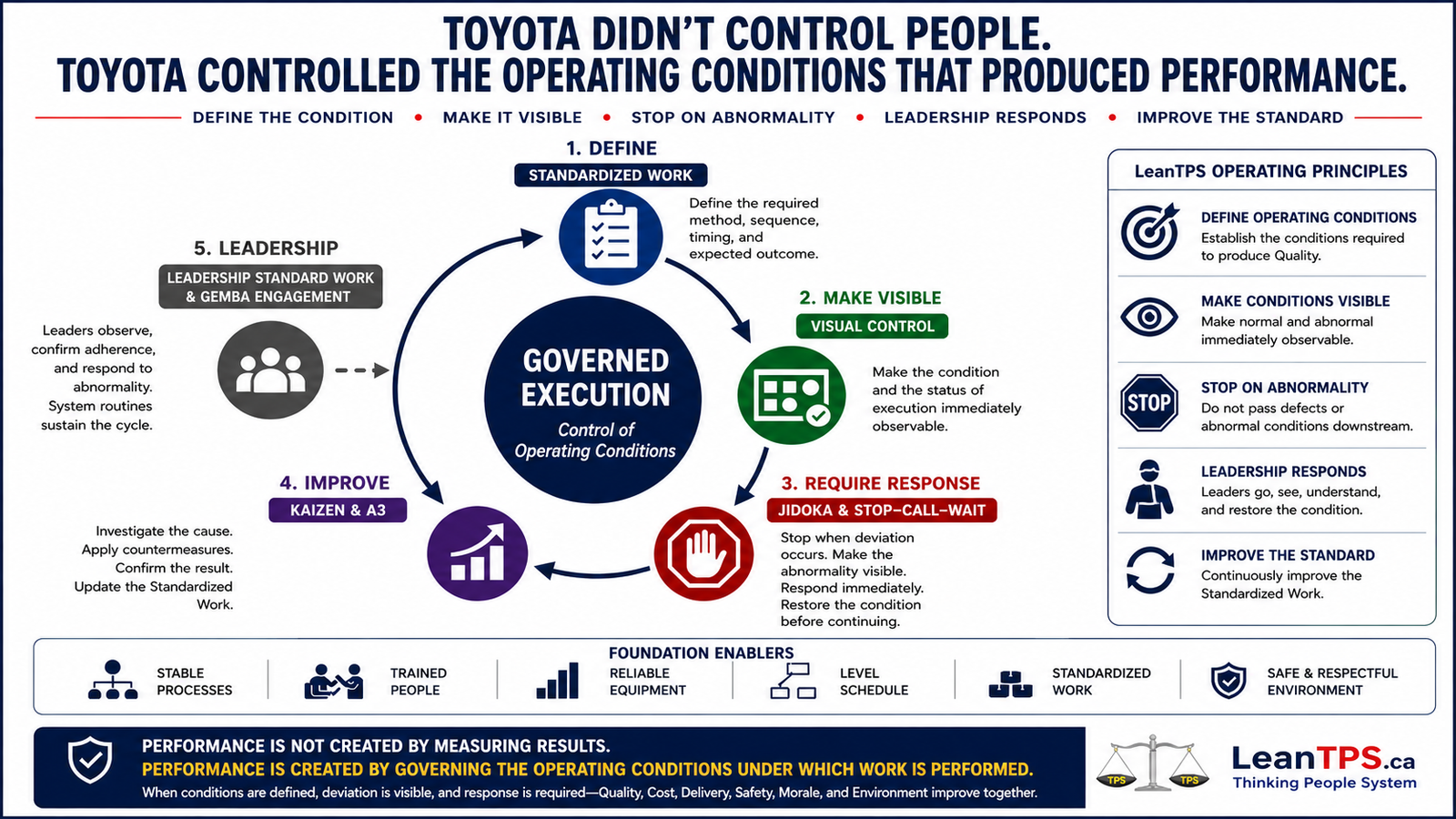
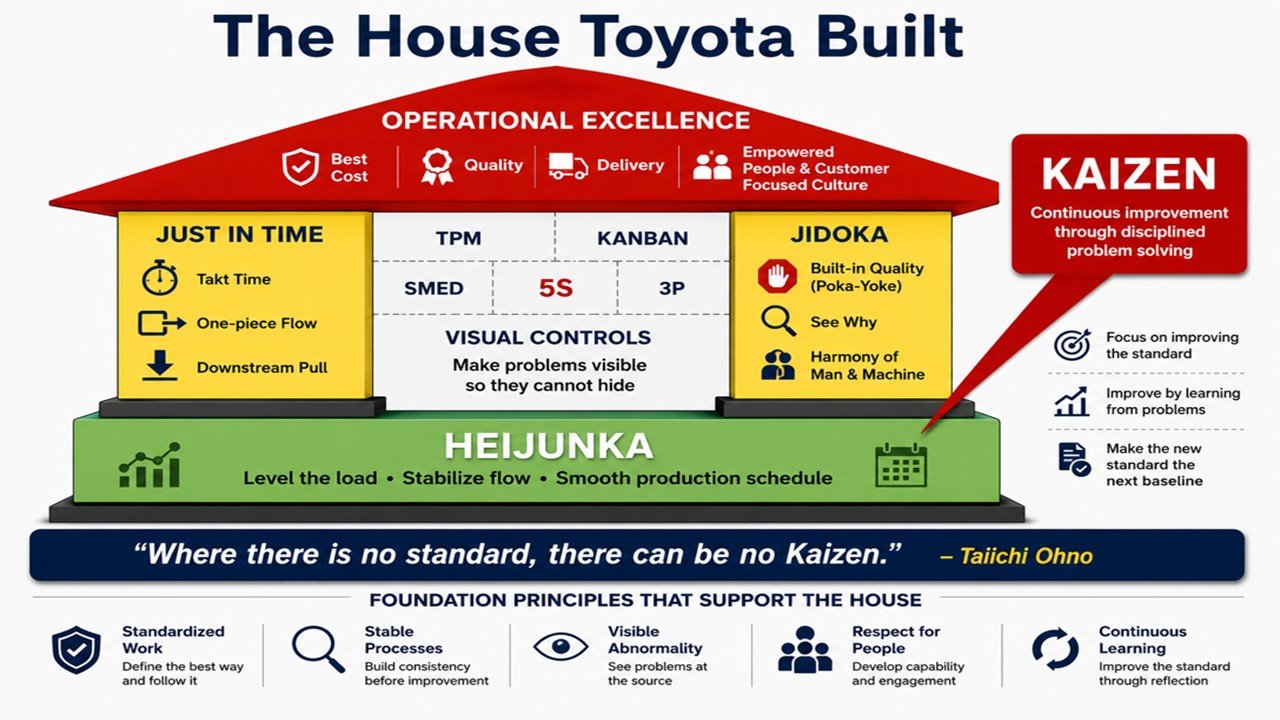
The Toyota Production System was not designed as philosophy, values, or interpretive theory. It was designed as an operating system. Its purpose is to govern how work is performed, how problems are surfaced, how Quality is protected, and how leaders are obligated to respond when conditions break down. Those outcomes are achieved through enforced system conditions, not through belief, intent, or interpretation. Employment stability, stop logic, Standardized Work, leader response, and Quality-first decision making are not ideas inside TPS. They are requirements.
When TPS is rewritten to fit within a higher-level framework, its governing role is removed. Attention shifts away from whether system conditions are present and enforced and toward whether language, models, or interpretations align with the framework. At that point, TPS no longer governs outcomes. It informs discussion.
Once the Toyota Production System is treated as conceptual input rather than as the reference operating system, there is no longer a requirement to verify whether Quality is protected by design, whether Standardized Work is enforced, or whether leadership obligation is structurally unavoidable. Claims can persist without operational proof.
This newsletter examines how that rewrite occurs, why it has become increasingly common in Lean(post-1988) discourse, and why its consequences are now unavoidable. The catalyst is not a single post or individual, but a consistent pattern of professional engagement in which TPS is discussed through eras, ideology, frameworks, and future narratives while the operating system itself drops out of view. That pattern signals a boundary violation with direct operational consequences.
When TPS Is Treated as Source Material Instead of the System
How framework-first thinking reverses the reference point
“As Toyota’s success was later studied, named, and disseminated beyond Toyota, ‘Lean’ became a more explicit and portable framework.”
“Rather than representing a new ‘Lean era,’ perhaps these efforts reflect a renewed engagement with the sort of difficult foundational problems that Lean originally sought to address…”
These statements appear measured and reasonable on the surface. They acknowledge Toyota as origin and avoid overt claims of replacement. Taken together, however, they introduce a consequential inversion. The Toyota Production System is positioned as something that was observed, labeled, and translated, while Lean(post-1988) is positioned as the framework that carries meaning forward.
In this framing, continuity no longer runs through the Toyota Production System as an operating system. It runs through Lean as a conceptual container. The foundational problems are described as problems Lean sought to address, not as problems governed by TPS system conditions. Toyota becomes the source of insight, while Lean becomes the structure that organizes, extends, and renews that insight.
This reversal matters because it changes the reference standard. Once TPS is treated primarily as historical input, its role shifts from governing system to contextual influence. The question is no longer whether the Toyota Production System’s conditions are present and enforced, but whether contemporary practice aligns with an evolving framework. Verification gives way to interpretation.
Portability sits at the center of this shift. Frameworks are designed to travel. They abstract away constraints that do not move easily across organizations, cultures, and governance models. The Toyota Production System was not designed for portability. It was designed for survival through enforced conditions. When portability becomes the priority, those conditions are softened, implied, or omitted.
At that point, TPS is no longer the system against which claims must be tested. It becomes a reference story that supports ongoing development elsewhere. The system is still cited, but it no longer governs. This is the first step in rewriting. Not by rejecting TPS, but by repositioning it beneath a framework that does not require its operating discipline to be present.
This section establishes the pattern. The following sections show how that same inversion progresses from reframing, to reclassification, to institutionalization.
When the Toyota Production System Is Reclassified as Ideology
Why removing system status makes governance optional
Once the Toyota Production System is no longer treated as the governing operating system, it must be redefined in a way that explains why its conditions no longer need to be enforced. This does not happen accidentally. The most effective mechanism is reclassification.
“What’s wrong with TPS… that too is an ideology.”
This statement performs a decisive shift. The Toyota Production System is no longer engaged as a production and management system with enforceable conditions. It is reframed as belief, interpretation, or worldview. In that category, the system no longer carries operational authority. Ideologies are debated. Systems are operated and verified.
This reclassification has immediate consequences. Once TPS is treated as ideology, questions about Standardized Work, stop logic, Quality protection, and leadership obligation are no longer required lines of inquiry. Discussion shifts toward interpretation, historical framing, philosophical alignment, or personal perspective. The operating system itself drops out of scope while its language often remains in use.
This creates a structural contradiction. TPS continues to be referenced as the source of legitimacy while being stripped of its governing role. The name carries authority, but the system no longer constrains behavior. That separation allows TPS to be cited rhetorically without requiring anyone to operate it.
Reclassification also resolves the inversion introduced earlier. If TPS is merely one ideological position among many, it no longer needs to function as the reference standard. It can coexist alongside newer or broader frameworks without governing them. From that point forward, TPS can be cited, critiqued, or bypassed without any requirement for operational comparison or system-level verification.
The consequence of this shift is made explicit in the next step.
“As it should because the focus is on the future and TPS may or may not be part of that.”
Once TPS has been reduced to ideology, it becomes optional. Its relevance is no longer determined by whether its system conditions produce stable Quality and disciplined execution. Instead, relevance is framed as a matter of future preference, strategic narrative, or conceptual alignment. The system’s presence becomes discretionary rather than required.
This is the structural break. A governed system does not become optional if the outcomes it protects still matter. Quality either requires enforced conditions or it does not. Stop logic either governs behavior or it does not. Leadership obligation is either structurally unavoidable or it is left to intent. Optionality is not neutral. It is the direct result of removing system status.
Together, these two statements complete the reclassification sequence. First, the Toyota Production System is abstracted into ideology. Then, having lost its status as a governing operating system, it is treated as non-essential. At that point, TPS can be subordinated, replaced, or set aside without appearing to be removed. The name remains. Governance does not.
This is what makes later institutional moves possible. Once TPS is no longer treated as a system that must operate, it can be absorbed into frameworks, credentials, and curricula while continuing to be referenced for legitimacy. The following section examines how that absorption is formalized.
When the Rewrite Becomes Institutional
How governance is replaced by credentials, curricula, and abstraction
Once the Toyota Production System is no longer treated as a governing operating system, it becomes possible to teach it, credential it, and package it as conceptual knowledge. At this point, reinterpretation hardens into structure. The rewrite no longer depends on individual commentary or discourse. It becomes embedded in institutions that define legitimacy, authority, and professional advancement.
At this stage, the Toyota Production System no longer needs to be operated to be claimed. It can be taught, certified, and referenced without enforcing its conditions. Academic programs, professional bodies, and certification frameworks position TPS as theory, influence, or historical foundation rather than as a production and management system that governs behavior. Knowledge replaces enforcement. Understanding replaces obligation.
This institutional framing changes what counts as proof. Legitimacy no longer comes from demonstrating system behavior under load, protecting Quality through enforced conditions, or showing how leadership response is structurally unavoidable. Instead, legitimacy is conferred by credentials, degrees, and bodies of knowledge. Authority shifts away from operation and toward recognition. The system becomes something to master intellectually rather than something that constrains daily work.
Certification structures formalize this inversion. When TPS is absorbed into generalized improvement credentials, it is reduced to a component within a broader framework. Its governance requirements are flattened into transferable concepts and tools. Standardized Work becomes a technique. Stop logic becomes a principle. Leadership obligation becomes a value statement. The operating system dissolves into curriculum, detached from the conditions that made it function.
Universities reinforce the same pattern. TPS is taught as historical case study, philosophical influence, or developmental stage in management thought. Students learn how Toyota influenced Lean, Six Sigma, Agile, and other frameworks, but not how the Toyota Production System itself enforces behavior through design. The system is explained, compared, and discussed. It is not required to operate. Outcomes are debated, not verified.
At this point, Lean(post-1988) is positioned as the integrating discipline. It becomes the framework that organizes, updates, and extends what TPS is said to have contributed. The Toyota Production System is acknowledged rhetorically, but it is no longer permitted to serve as the reference standard. It is placed inside the structure rather than allowed to govern it.
This is not a neutral evolution. Once TPS is institutionalized in this way, it can no longer function as the system against which claims must be tested. Credentials do not enforce stop logic. Curricula do not compel leadership response. Frameworks do not guarantee Quality. Without governance, system behavior becomes optional, and failure modes reappear under the cover of formal legitimacy.
This explains why the rewrite persists even when practitioners identify the loss of system fidelity. The issue is no longer misunderstanding or misuse. It is structural. When institutions encode TPS as abstract knowledge rather than as an operating system, governance is replaced. Authority shifts away from operation and into certification. Reversal becomes difficult because the system is no longer allowed to judge its own use.
The next section reasserts the boundary that must exist if the Toyota Production System is to remain visible and usable as a system rather than as influence, ideology, or foundation material.
Reasserting the Boundary: The Toyota Production System Is Not a Framework
Why TPS must remain the governing reference, not an input
At this point in the sequence, the pattern is no longer ambiguous. The Toyota Production System is first repositioned as source material beneath a framework. It is then reclassified as ideology, making its conditions optional. Finally, it is absorbed into institutions that teach, credential, and abstract it as knowledge. Each step removes governance without ever explicitly rejecting TPS. The system is not dismantled directly. It is displaced by reinterpretation.
This is why the boundary must be stated plainly. The Toyota Production System is not a philosophy, not an ideology, not a methodology, and not an input to Lean(post-1988). It is a governed production and management system. Its legitimacy does not come from lineage, academic framing, or professional endorsement. It comes from operation. Either its conditions are enforced and Quality is protected by design, or the system is not in use.
When TPS is folded into credentialing structures, this boundary is erased. Professional bodies such as the American Society for Quality formalize this erasure by presenting “Lean Six Sigma” certifications that subsume the Toyota Production System into a generalized body of improvement knowledge. In that structure, TPS no longer governs. It becomes curriculum. Standardized Work becomes a tool. Stop logic becomes a concept. Leadership obligation becomes a value statement. None of these enforce behavior. None of them guarantee Quality. The operating system is reduced to content.
Academic institutions reinforce the same inversion. Universities teach TPS as historical context, management theory, or case study while positioning Lean(post-1988) as the contemporary framework that integrates, updates, and advances it. TPS is no longer permitted to function as the reference system against which claims must be tested. It becomes explanatory background rather than governing structure. Students learn how Toyota influenced improvement thinking, but not how the Toyota Production System governs work through enforced conditions.
This distinction matters because systems do not coexist neutrally with frameworks. Frameworks adapt. Systems constrain. When the Toyota Production System is treated as optional, inspirational, or foundational rather than governing, its constraints are removed. Once removed, Quality protection, stop logic, and leadership accountability revert to intent and interpretation. Failure is no longer an anomaly. It is the predictable outcome of design.
This is also why Lean(post-1988), in its current institutional form, cannot succeed. By aligning itself with credentialing economies, degree hierarchies, and Six Sigma constructs that depend on champions rather than system enforcement, Lean has been redesigned into something structurally incapable of transfer. Results collapse when leadership changes because nothing in the system compels continuity. That outcome is not accidental. It is locked in.
Reasserting the Toyota Production System does not require rejecting Lean(post-1988). Lean(post-1988) can continue to evolve as a collection of methods, practices, and interpretations. The boundary is simpler and more demanding. When the Toyota Production System is cited, it must be engaged as a system that governs behavior and outcomes. If those conditions are not present, then TPS is not in use and should not be referenced.
This newsletter draws that boundary explicitly. The issue is not ideology, preference, or historical interpretation. It is system fidelity. The Toyota Production System either operates as designed or it does not. Treating it as influence, ideology, or framework input is substitution, not evolution.
What This Means for Practice
Why system fidelity matters now
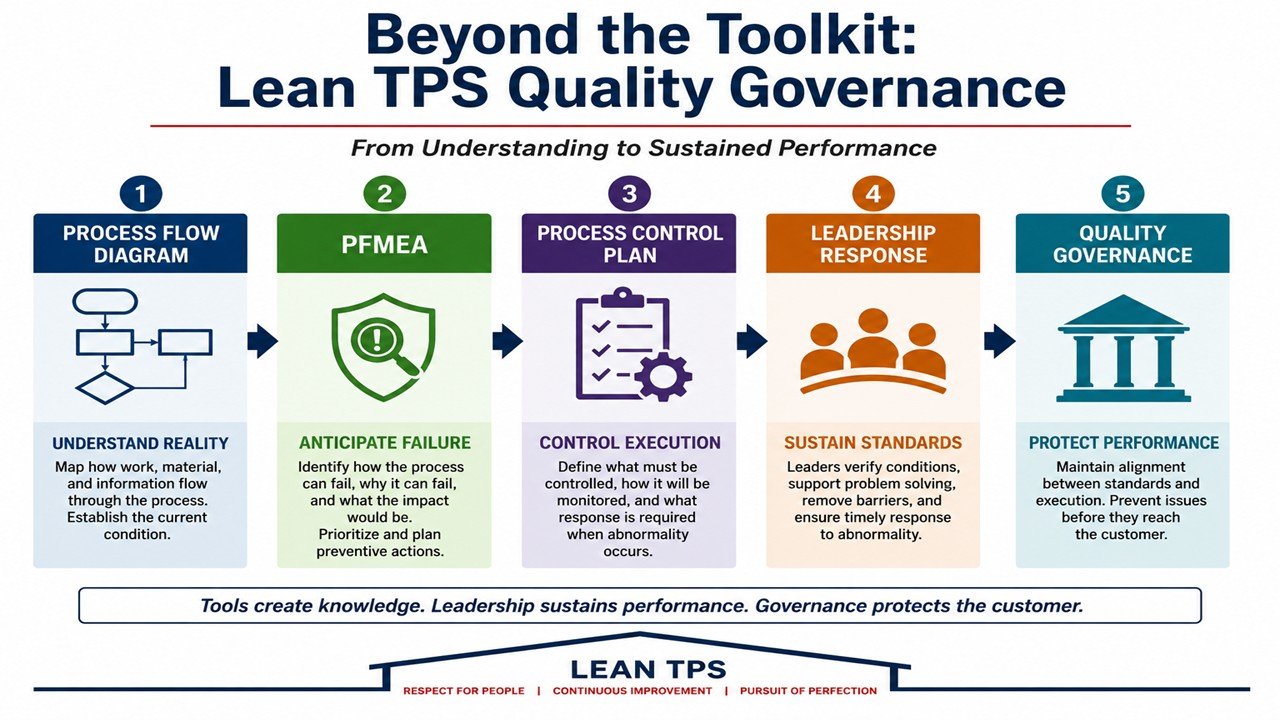
The sequence described in this newsletter is not theoretical. It produces direct, observable consequences in how organizations design work, protect Quality, and hold leaders accountable. When the Toyota Production System is treated as influence, ideology, or framework input, the conditions that make Quality unavoidable are no longer enforced. What replaces them is intent, interpretation, and credentialed confidence rather than system design.
Frameworks can describe improvement activity. They cannot govern behavior. When stop logic is optional, abnormalities persist. When Standardized Work is treated as a technique rather than a requirement, variation returns. When leadership obligation is expressed as a value rather than enforced by system design, response depends on individual judgment. These are not philosophical outcomes. They are operational failure modes.
This is why the distinction between the Toyota Production System and Lean(post-1988) must remain visible. Lean(post-1988) can support improvement activity, tool deployment, and localized learning. It cannot replace a governed operating system. When TPS is absorbed into broader frameworks, the reference standard shifts from enforcement to alignment. Once that shift occurs, failure is no longer an exception. It becomes predictable.
The purpose of this article is not to settle debate or challenge individual interpretations. It is to restore clarity. If the Toyota Production System is cited, it must be engaged on its own terms as a system that governs behavior and outcomes. If its conditions are not present and enforced, then TPS is not in use and should not be referenced as such.
This distinction is not academic. It is the difference between systems that prevent failure by design and frameworks that explain failure after the fact.
Closing Boundary
What cannot be redefined without consequence
The Toyota Production System does not require reinterpretation, modernization, or elevation into a broader framework. It requires operation. Its relevance is not determined by credentials, institutional endorsement, or future-oriented narratives. It is determined by whether its system conditions are enforced and whether those conditions protect Quality, expose abnormalities, and compel leadership response in daily work.
When the Toyota Production System is treated as influence, ideology, or historical input, governance is replaced by interpretation. The name may remain, but the system no longer governs behavior or outcomes. Failure does not arrive suddenly. It accumulates quietly behind stable language, professional legitimacy, and well-structured frameworks that no longer constrain work.
This newsletter is not an argument against Lean(post-1988). It is a refusal to allow the Toyota Production System to be reclassified into something it was never designed to be. Lean(post-1988) may continue to evolve as a collection of methods and practices. That evolution does not grant it authority over the Toyota Production System, nor does it allow TPS to be treated as optional input.
The boundary is simple and non-negotiable. If the Toyota Production System is being cited, it must be engaged as a governed production and management system. If those conditions are absent, then TPS is not in use and should not be referenced. Without that boundary, Quality becomes conditional, leadership accountability becomes discretionary, and systems designed to prevent failure are replaced by frameworks that rationalize it afterward.
Continuity With the Earlier Articles in This Series
This article extends a line of inquiry developed across earlier work on LeanTPS.ca, each examining a different pathway through which governance was separated from system behavior.
Six Sigma (post-1990s) and Lean Six Sigma (post-2010s): How Quality Governance Was Replaced examined how certification, projects, and belt hierarchies displaced management ownership of Quality, producing technically capable organizations without durable control.
https://leantps.ca/six-sigma-lean-six-sigma-quality-governance/
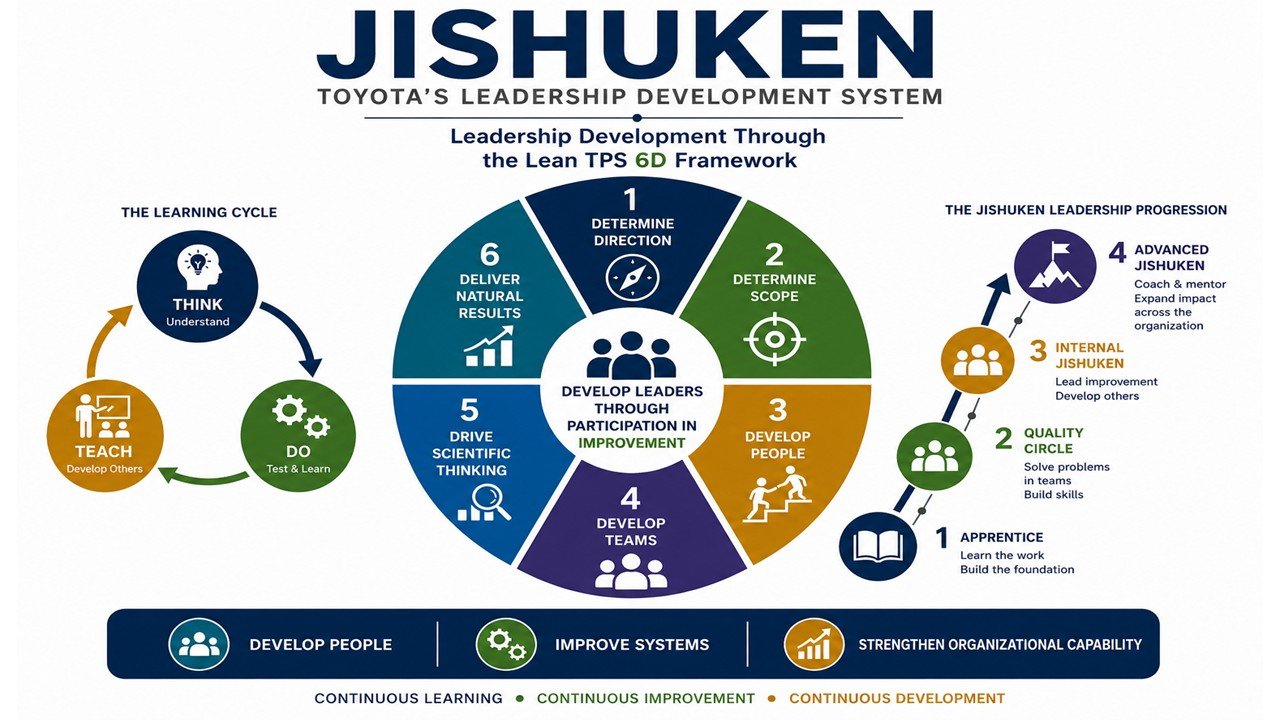
Kaizen (post-1980s): How Governance Was Removed from the Toyota Production System traced how Kaizen became portable by shedding Jishuken, escalation, and leadership obligation, turning improvement activity into a substitute for system governance.
https://leantps.ca/kaizen-post-1980s-how-governance-was-removed-from-the-toyota-production-system/
Why Compare Industrial Engineering and the Toyota Production System: Governance Preceded Optimization examined why technical disciplines with strong analytical foundations repeatedly fail to sustain Quality without governance. It showed how Industrial Engineering and TPS share common roots in system analysis, yet diverge structurally once authority, stop logic, and leadership obligation are considered. The comparison clarified why optimization explains systems, but only governance controls behavior under pressure.
https://leantps.ca/why-compare-industrial-engineering-and-the-toyota-production-system-governance-preceded-optimization/