Lean TPS Publications

Lean TPS Publications brings together my writing on Toyota Production System leadership, 5S Thinking, Kaizen, Jishuken, Standardized Work, and disciplined continuous improvement. Each article is grounded in real Gemba experience from Toyota training, Jishuken activity, and Lean TPS leadership work in North America. The purpose of this collection is to provide clear, structured knowledge that helps organizations build capability, prevent failure, and strengthen daily operations through Lean TPS principles.

Articles

The Articles collection features longer studies and analytical writing on Lean TPS practice. Each piece explores structured methods, leadership development, and improvement through 5S Thinking, Kaizen, Jishuken, and Standardized Work. These articles document real experience and applied learning, showing how structure builds capability and prevents failure.

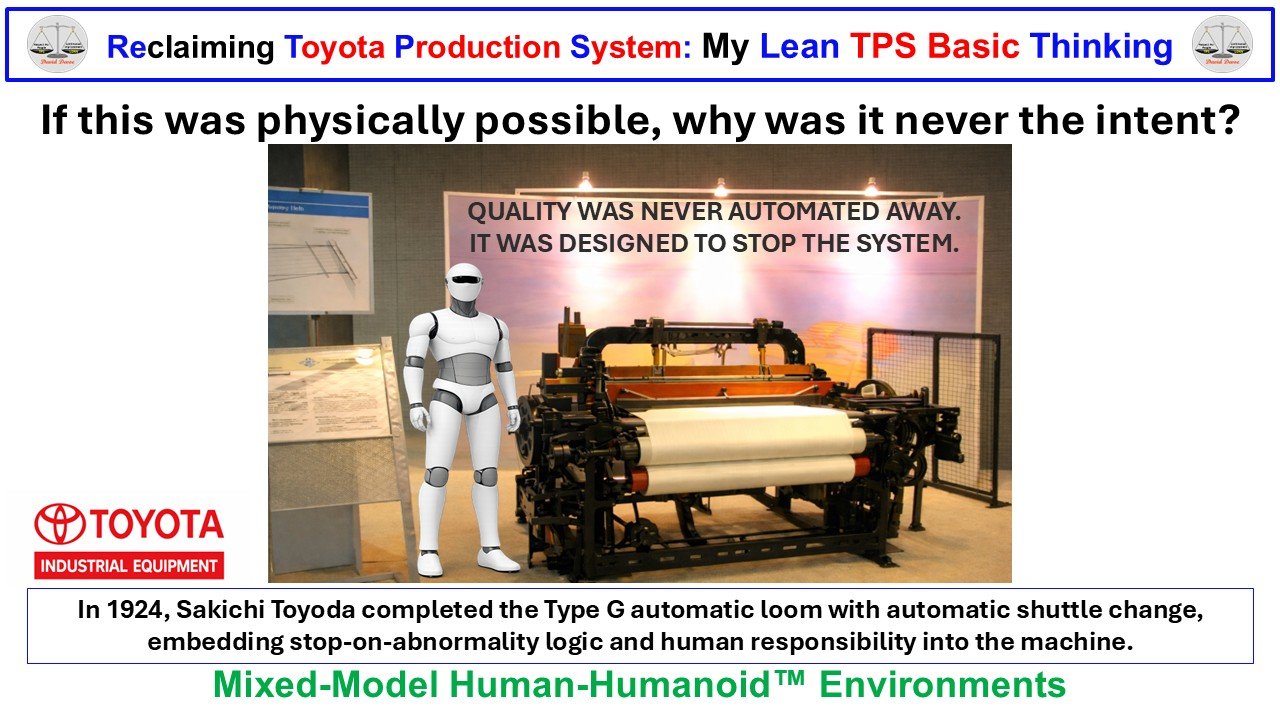
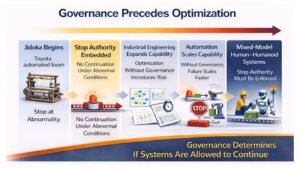
Humanoid positioned beside Sakichi Toyoda’s automatic loom illustrating Jidoka as a system design principle rather than automation
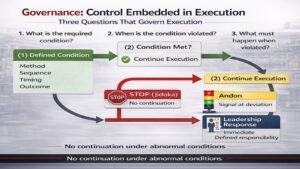
Sakichi Toyoda’s automatic loom shows that Jidoka was never about removing responsibility from people. This article examines how Quality is governed by design intent and why modern Mixed-Model Human-Humanoid execution exposes systems that rely on human compensation rather than structure.
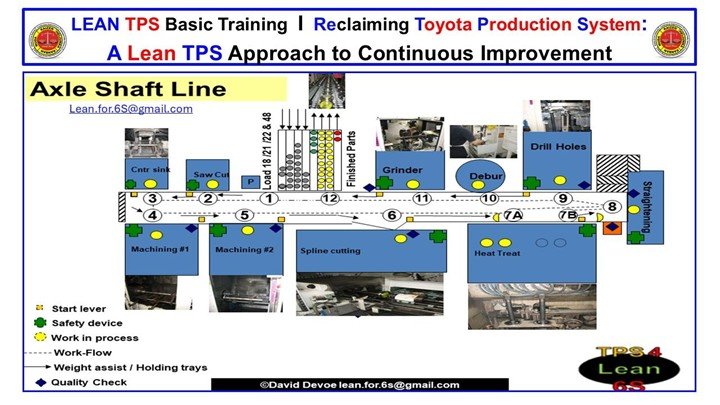
Axle shaft machining and finishing cell showing defined standard in-process stock, work sequence, and capacity flow across machining, spline cutting, heat treatment, straightening, drilling, deburring, and grinding operations.
In-process stock is not inventory. It is a designed condition that makes capacity executable. Using a real axle shaft machining and finishing cell, this article explains how Standardized Work governs capacity, flow, and Quality through takt time, defined work sequence, and calculated standard in-process stock. The same capacity logic that
Lean TPS visual showing the two pillars of the Toyota Production System: Just in Time and Jidoka.
Artificial intelligence and humanoid robotics do not introduce a new production paradigm. This article explains why the Toyota Production System already governs mixed human and machine execution through Standardized Work, Jidoka, and system-level responsibility for Quality.
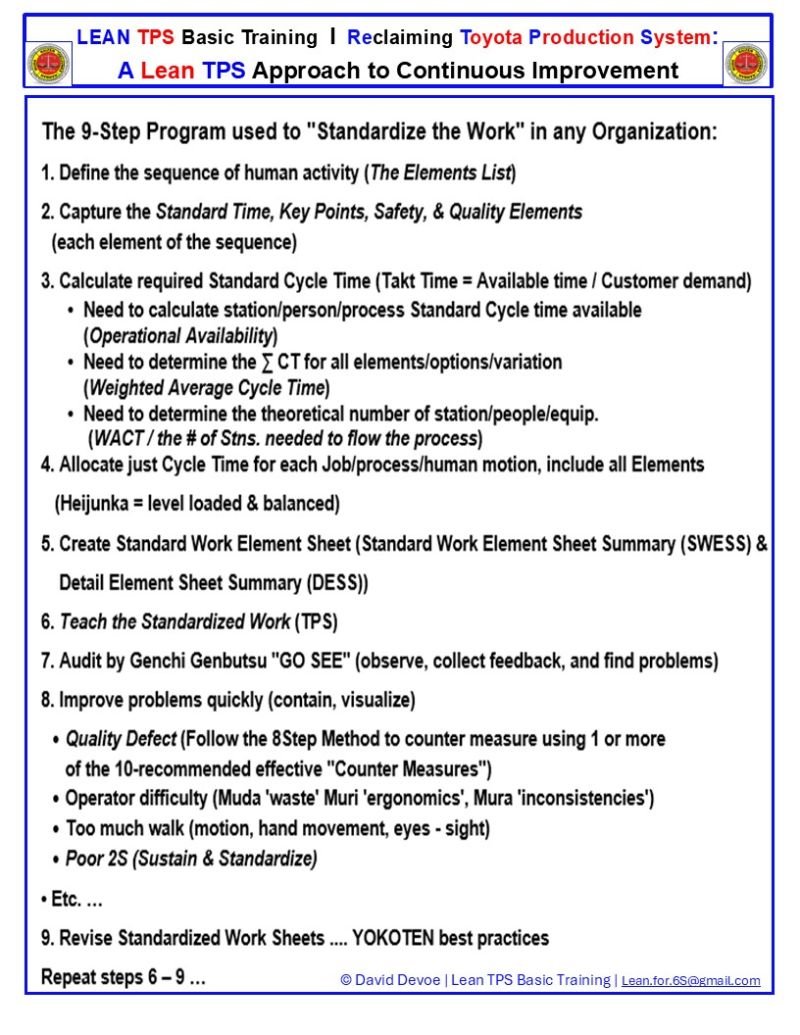
Lean TPS 9-Step Method visual showing how Toyota standardizes work through observation, measurement, teaching, auditing, and improvement to build stability and continuous flow.
The Lean TPS 9-Step Method visual summarizes how Standardized Work is created, taught, audited, and improved. It connects leadership, training, and flow into one structured method for continuous improvement.
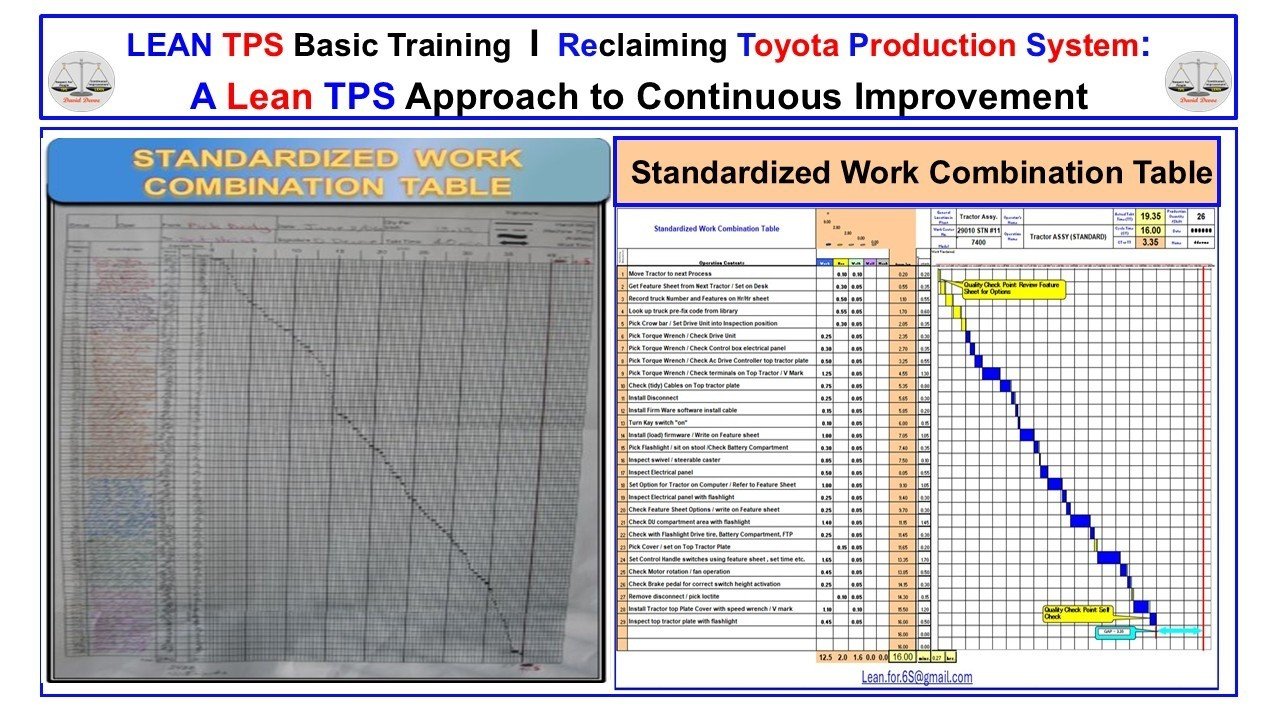
Standardized Work Combination Table showing operator time, sequence, and flow balance in Lean TPS.
The Standardized Work Combination Table (SWCT) is the visual foundation of Lean TPS. It reveals how people, machines, and time interact in sequence, exposing waste and creating flow. Used correctly, it stabilizes processes, supports Kaizen, and connects leadership to real work.
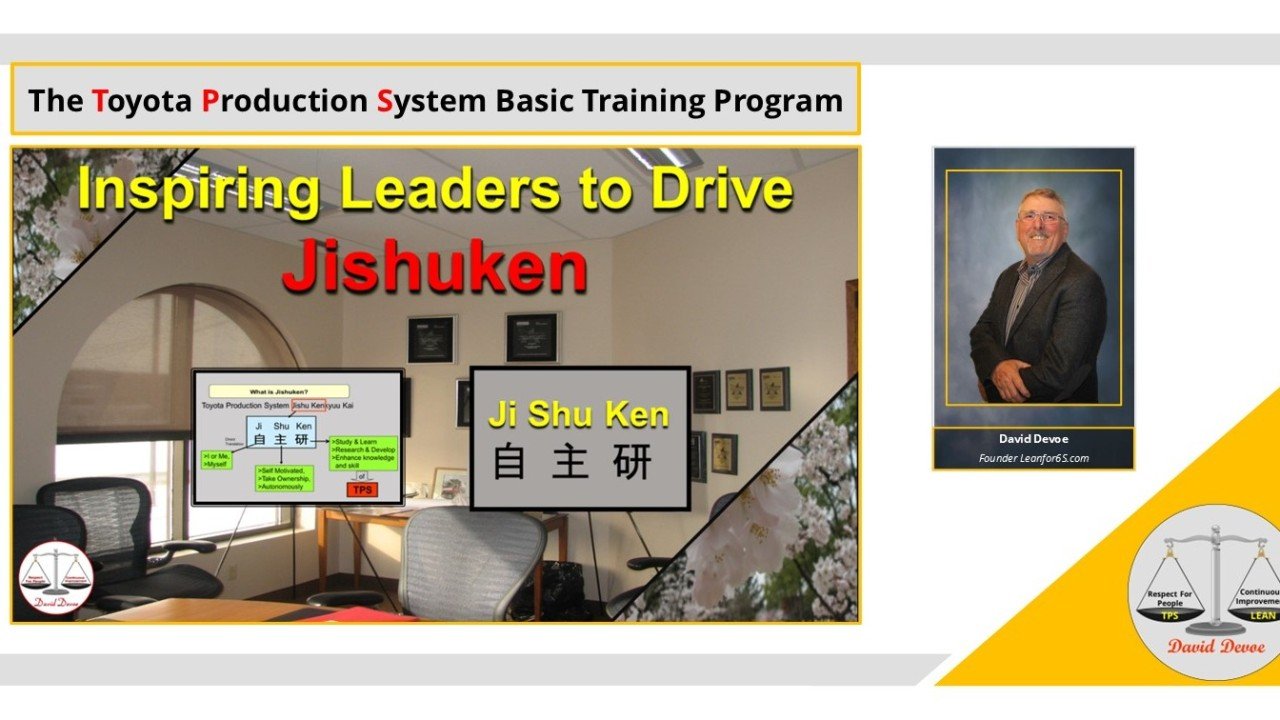
Visual diagram of Lean TPS learning levels showing how participation, simulation, teaching, and action-based learning build capability through Jishuken.
Lean TPS learning begins with structure and ends with capability. This article shows how Jishuken transforms training from awareness to action through self-motivated study and leadership participation.
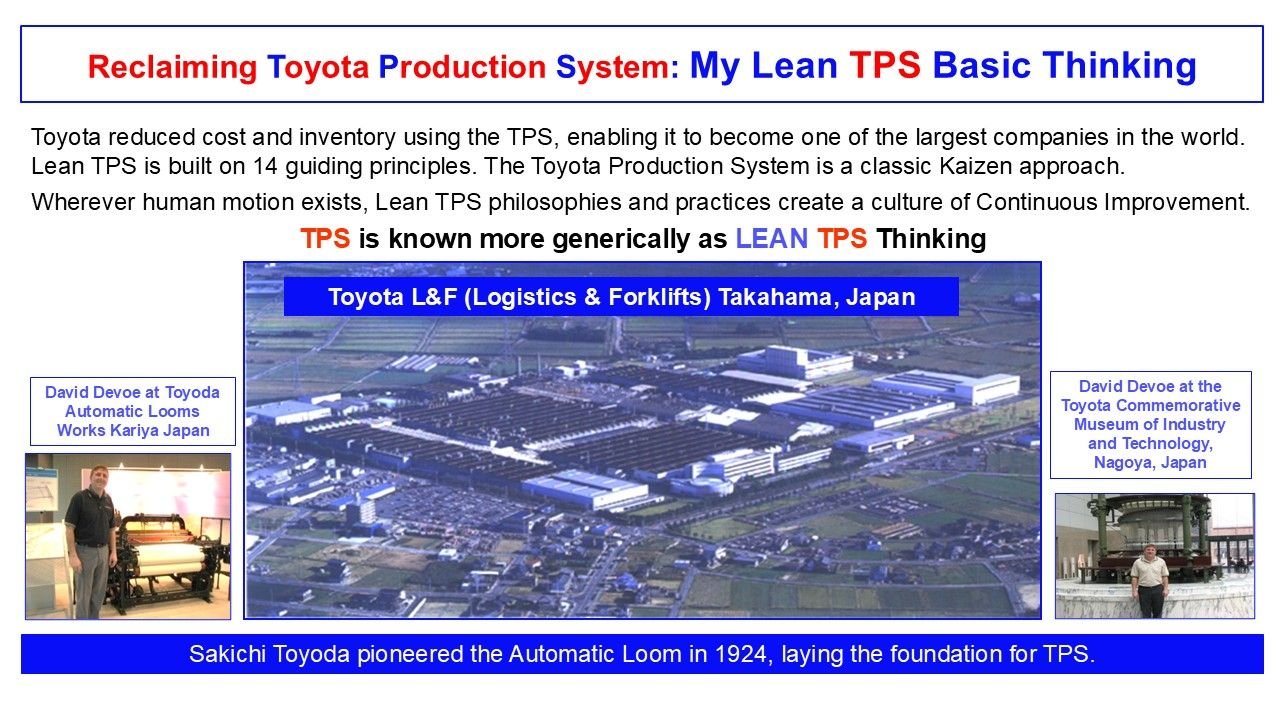
David Devoe at Toyota L&F Takahama, Japan, and Toyoda Automatic Loom Works, illustrating the origins and living practice of Lean TPS Basic Thinking.
At Toyota L&F in Takahama, Japan, Lean TPS Basic Thinking was not taught in classrooms but practiced daily at the Gemba. This article explains how Standardized Work, Jishuken, and leadership accountability create the foundation for continuous improvement.
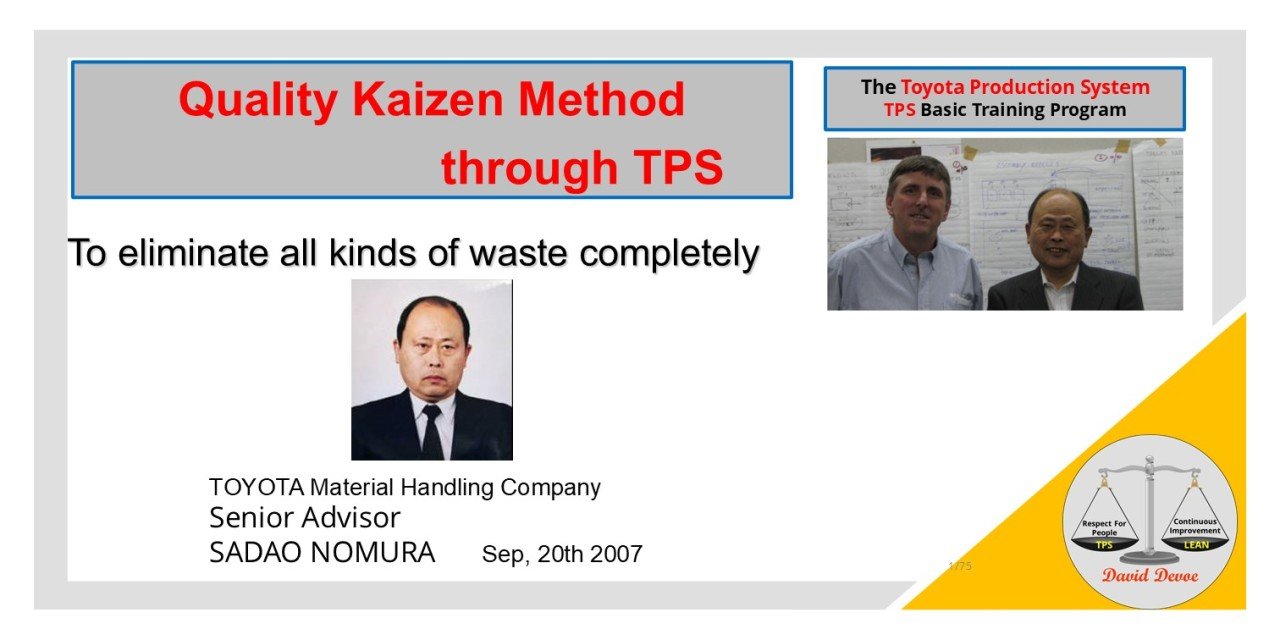
David Devoe and Mr. Sadao “Sam” Nomura at a Toyota Material Handling Jishuken event, representing the transfer of Dantotsu Quality leadership and Toyota Production System wisdom across generations.
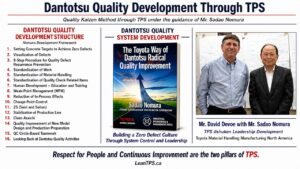
Mr. Sadao “Sam” Nomura’s Dantotsu Quality philosophy defined how Toyota leaders connect process improvement with people development. His teachings remain a living example of how mentorship sustains the Toyota Production System across generations.
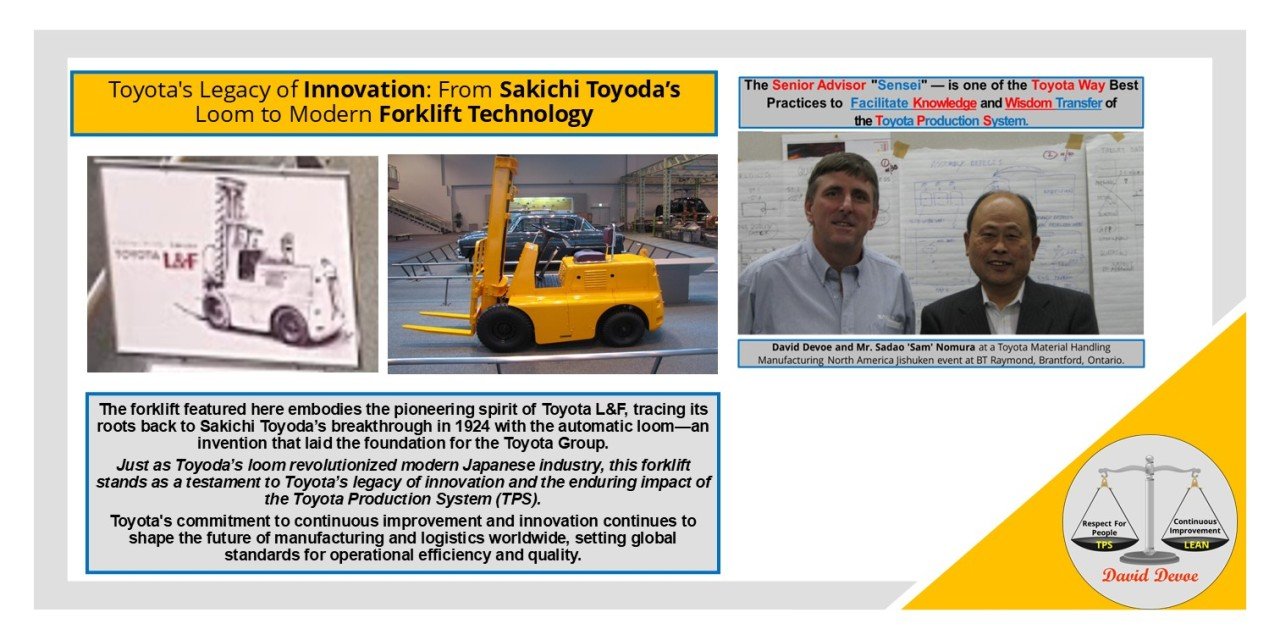
David Devoe with Mr. Sadao “Sam” Nomura at a Jishuken event at BT Raymond, alongside Toyota’s legacy forklift image linking Sakichi Toyoda’s original loom innovation to modern TPS leadership.
Toyota’s legacy of innovation began with Sakichi Toyoda’s loom and continues through Mr. Sadao Nomura’s Dantotsu leadership. This article traces how innovation, mentorship, and radical problem solving define the continuity of the Toyota Production System.
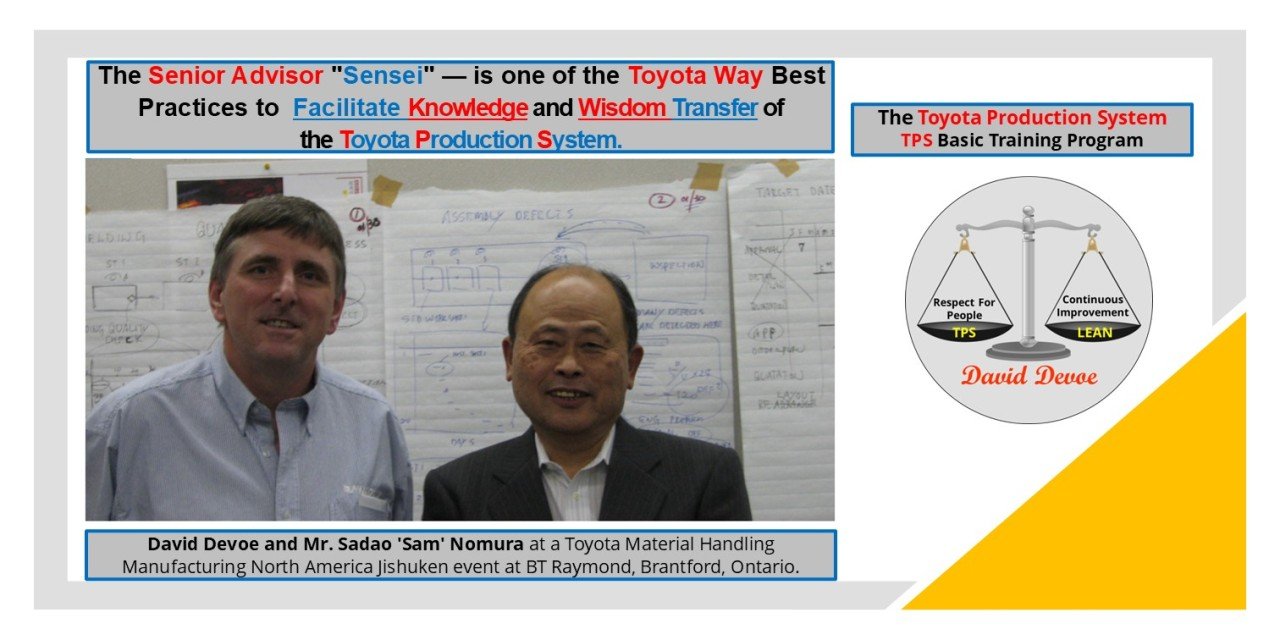
Mr. Sadao “Sam” Nomura with David Devoe during a Jishuken event at BT Raymond, Brantford, symbolizing Toyota’s tradition of mentorship and knowledge transfer in the Toyota Production System.
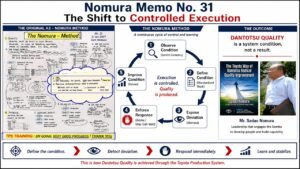
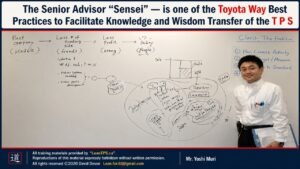
Mr. Sadao “Sam” Nomura personified the role of Sensei in the Toyota Production System. Through Nomura-Grams and direct mentorship, he taught that true TPS depends on knowledge transfer, structured learning, and respect for people.
David Devoe with Toyota leaders and training teams during Lean TPS Basic Training, representing lessons from Toyota Production System history and modern application.

A 20-Category Assessment Framework for Building a Thinking People System Introduction to the Lean TPS Assessment The Lean TPS Assessment is designed as a practical tool to help organizations measure their progress in applying Lean and Toyota Production System philosophies, practices, and methods. It is not a simple scorecard. It

Standardized Work in Lean TPS provides the foundation for consistency, quality, and continuous improvement. It defines the best known method, enabling leaders to see deviation, support problem solving, and sustain Kaizen. Through clear structure, it builds the discipline that transforms individual effort into team-based operational excellence.

Posts

In-depth writing on Lean TPS practice. These posts capture observations, examples, and applied thinking from daily work, exploring Standardized Work, Kaizen, Jishuken, and 5S Thinking through practical lessons and leadership reflection.

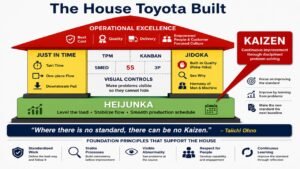
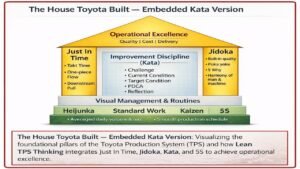
Lean TPS House diagram showing Just In Time, Jidoka, Heijunka, Standardized Work, and Kaizen positioned within the Toyota Production System architecture

Reclaiming Kaizen: Governance, Architecture, and the Discipline of Learning in the Toyota Production System

This Lean TPS Basic Training visual explains how Kaizen operates within the governed architecture of the Toyota Production System. Just In Time and Jidoka function as structural pillars, Heijunka and Standardized Work provide stability, and Kaizen strengthens the system only when standards and control are in place. The image reinforces Taiichi Ohno’s principle that without standards, there can be no Kaizen.

Read More »
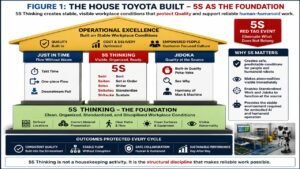
Lean TPS shop floor before and after 5S Thinking showing visual stability that enables problem detection and problem solving

5S Thinking as a Visual Reset for Problem Solving

5S Thinking is not about making the workplace look clean or impressive. In Lean TPS, it functions as a visual reset that restores the ability to see normal versus abnormal conditions. When the environment is stabilized, problems surface quickly, Quality risks are exposed earlier, and problem solving becomes possible at the system level rather than through reaction and workarounds.

Read More »
Lean TPS Kaizen and Jishuken governance model showing how Kaizen operates within the Toyota Production System under leadership escalation and system control

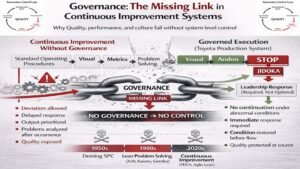
Kaizen(post-1980s): How Governance Was Removed from the Toyota Production System

Kaizen became widely adopted after the 1980s as a portable improvement method, but what did not travel with it was the governance structure that originally constrained its use inside the Toyota Production System. This article explains how that separation occurred, why Kaizen was never designed to govern outcomes, and how removing Jishuken and leadership escalation turned improvement activity into a substitute for system control.

Read More »
Lean TPS diagram showing Kaizen leading to stable results, rising creativity, and Respect for Humanity through Quality improvement

Lean TPS Enables Respect for People Through Quality Improvement

Respect for People in Lean TPS is not a cultural value to promote, but a system outcome created through Quality-first design and disciplined improvement. Kaizen improves Quality by removing the conditions that force people to compensate for weak systems. When work becomes stable and predictable, learning and creativity emerge, and Respect for People becomes operational rather than aspirational.

Read More »
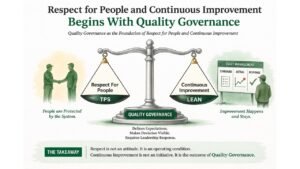
Balance graphic illustrating the misalignment between Respect for People in the Toyota Production System and Continuous Improvement in Lean(post-1988).

Why the Toyota Production System Is Being Rewritten to Fit Lean(post-1988)

The Toyota Production System is increasingly described through the language of Lean(post-1988) frameworks rather than engaged as a governed production and management system. This article examines how TPS was repositioned, abstracted, and institutionalized, and why removing its system conditions replaces governance with interpretation and makes failure predictable.

Read More »
Visual diagram showing leadership as the keystone connecting people, process, and technology within Lean TPS Thinking.

Leadership in Lean TPS: Harmonizing People, Process, and Technology

Lean TPS leadership is the balance between people, process, and technology. By aligning these three elements, leaders create systems that sustain improvement and respect human capability. Technology supports people, processes remain disciplined, and learning becomes continuous, reflecting the Toyota approach to operational excellence and leadership development.

Read More »
Funnel diagram showing Lean TPS learning stages from reading to participation, illustrating how action learning builds capability through structure and Jishuken.

How We Learn in Lean TPS

Many organizations think training means PowerPoints, lectures, and policies. The way people actually learn is very different. Reading gives little retention. Hearing adds a small amount. Pictures and videos help, but not enough. Real learning happens when people act, simulate, teach, and take ownership at the workplace. This is why

Read More »

Lean TPS Support and Capability Development

Lean TPS support is available for plant teams, regional operations, and leadership development. Support focuses on structured improvement, capability building, and systems-based problem solving grounded in Toyota Production System methods.

Services include:

Continuous Improvement Facilitation
Structured guidance to stabilize flow, expose abnormalities, and strengthen daily management through Standardized Work.

Jishuken Leadership Development
Hands-on improvement cycles that build leadership capability through participation, observation, and accountability at the Gemba.

Lean TPS 5S Thinking and Workplace Organization
Establishing structure, visual control, and discipline to protect flow and create the conditions for Kaizen.

Standardized Work Design and Audit Support
Defining the best known method, connecting people to process, and sustaining improvement through leader observation and verification.

Jidoka and Abnormality Management
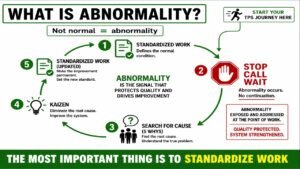
Making problems visible through Stop Call Wait, quality response routines, and structured root cause analysis.

Kaizen Facilitation
Practical improvement activity focused on waste elimination, variation reduction, and sustained flow.