Lean TPS Quality Governance Begins Before Production
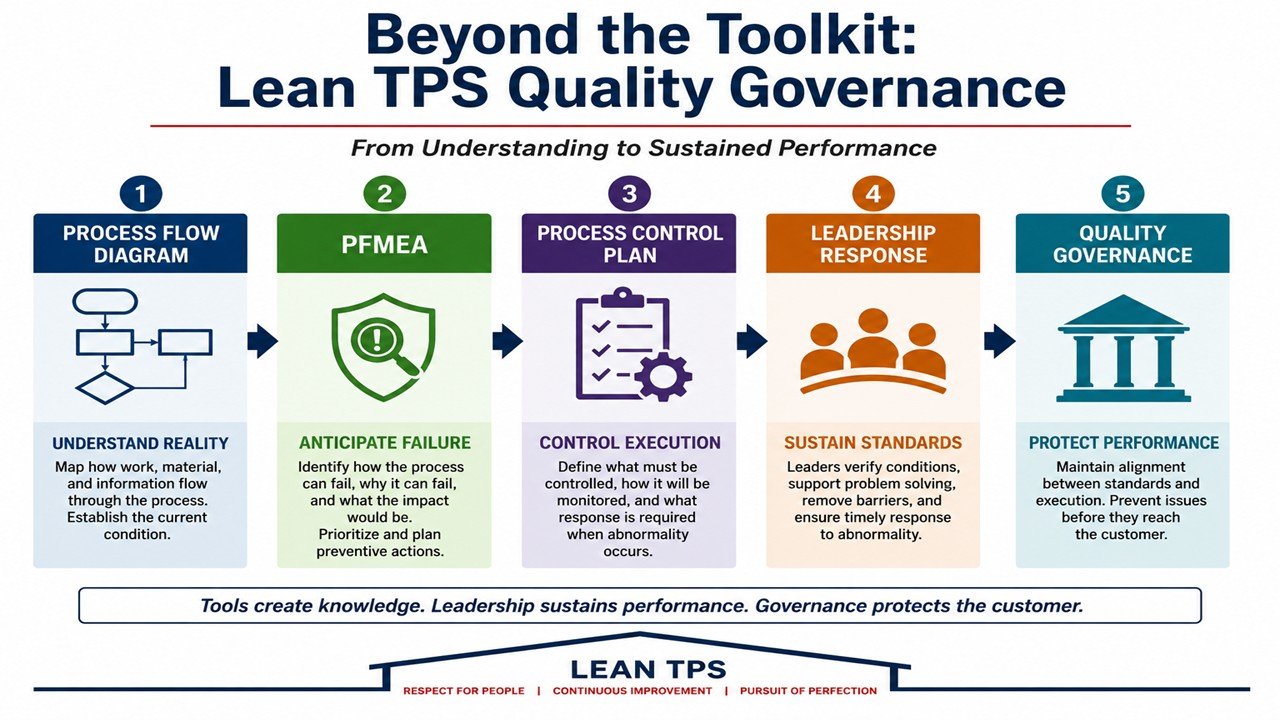
Lean TPS Quality Governance provides the framework for understanding process conditions, preventing failure, governing execution, and sustaining Quality through leadership response. Process Flow Diagrams, PFMEA, and Process Control Plans support this governance system by connecting process understanding, risk prevention, and operational control.
Many organizations treat Process Flow Diagrams, Process Failure Mode and Effects Analysis (PFMEA), and Process Control Plans as documentation requirements. Teams complete them during product launches, customer audits, certification activities, and process changes. Once approved, the documents are maintained, periodically updated, and referenced when problems occur.
Despite widespread use, many organizations continue to experience recurring defects, unstable processes, missed deliveries, excessive firefighting, and inconsistent execution. The existence of quality tools does not guarantee the existence of process control.
The underlying challenge is often misunderstood.
Process Flow Diagrams, PFMEAs, and Process Control Plans were never intended to function as independent quality documents. Within the Toyota Production System, these tools support a broader management system designed to understand process conditions, identify risk, establish operating standards, and govern execution. Their purpose extends far beyond documentation. Their purpose is to create the conditions necessary for Quality, stability, and continuous improvement.
This distinction is important because Lean TPS was never built around a collection of tools. Organizations can implement Process Flow Diagrams, PFMEAs, Process Control Plans, visual management boards, audits, and improvement projects while continuing to struggle with recurring problems if the conditions required for stable execution are not actively governed.
Quality is not created because documents exist.
Quality emerges when process conditions are understood, risks are anticipated, standards are maintained, and abnormal conditions receive timely response.
The Toyota Production System was developed around the principle that Quality cannot be inspected into a process after production begins. Defects can be detected after the fact, but detection occurs only after material, labor, time, and customer risk have already been consumed. Sustainable Quality requires a different approach. Process understanding must precede improvement. Potential failure must be understood before prevention becomes possible. Operating conditions, controls, and response mechanisms must exist before stable execution can be achieved.
Process Flow Diagrams, PFMEAs, and Process Control Plans work together to support this objective. The Process Flow Diagram establishes an understanding of how work, material, and information move through the process. PFMEA builds upon that understanding by identifying how the process can fail and where risk exists. The Process Control Plan converts that knowledge into operational control by defining the conditions, responses, escalation requirements, and leadership responsibilities necessary to sustain performance over time.
Together, these tools establish the knowledge and controls required to govern process execution before abnormality reaches the customer. Each tool builds upon the information generated by the previous one, creating a progression from process understanding to risk prevention and ultimately to execution governance.
Understanding that relationship helps explain why these tools remain relevant decades after their development. Their value does not reside in the documents themselves. Their value resides in the management system that uses them to shape behavior, expose abnormality, support leadership response, and sustain control over time.
The discussion that follows examines how Process Flow Diagrams, PFMEAs, and Process Control Plans function together within Lean TPS and why their greatest contribution is not documentation, but governance.
1. Quality Cannot Be Inspected Into a Process
Many organizations continue to approach Quality primarily as a detection activity. Products are manufactured, services are delivered, inspections are performed, and defects are identified after the work has been completed. Once a problem is discovered, resources are consumed investigating causes, sorting material, performing rework, managing customer concerns, and implementing corrective actions intended to prevent recurrence.
Inspection remains an important component of any quality system, but inspection alone cannot create Quality. Inspection evaluates the results of a process after execution has already occurred. By the time a defect is detected, material has been consumed, labor has been expended, schedules have been affected, costs have increased, and customer risk has already entered the system. Detection may reduce the consequences of failure, but it cannot prevent the failure from occurring.
The Toyota Production System was developed around a fundamentally different understanding of Quality. Rather than relying primarily on inspection to protect the customer, Lean TPS focuses on creating processes capable of producing Quality consistently at the source. Quality is treated as a process condition that must be designed, maintained, and governed throughout execution rather than verified after production is complete.
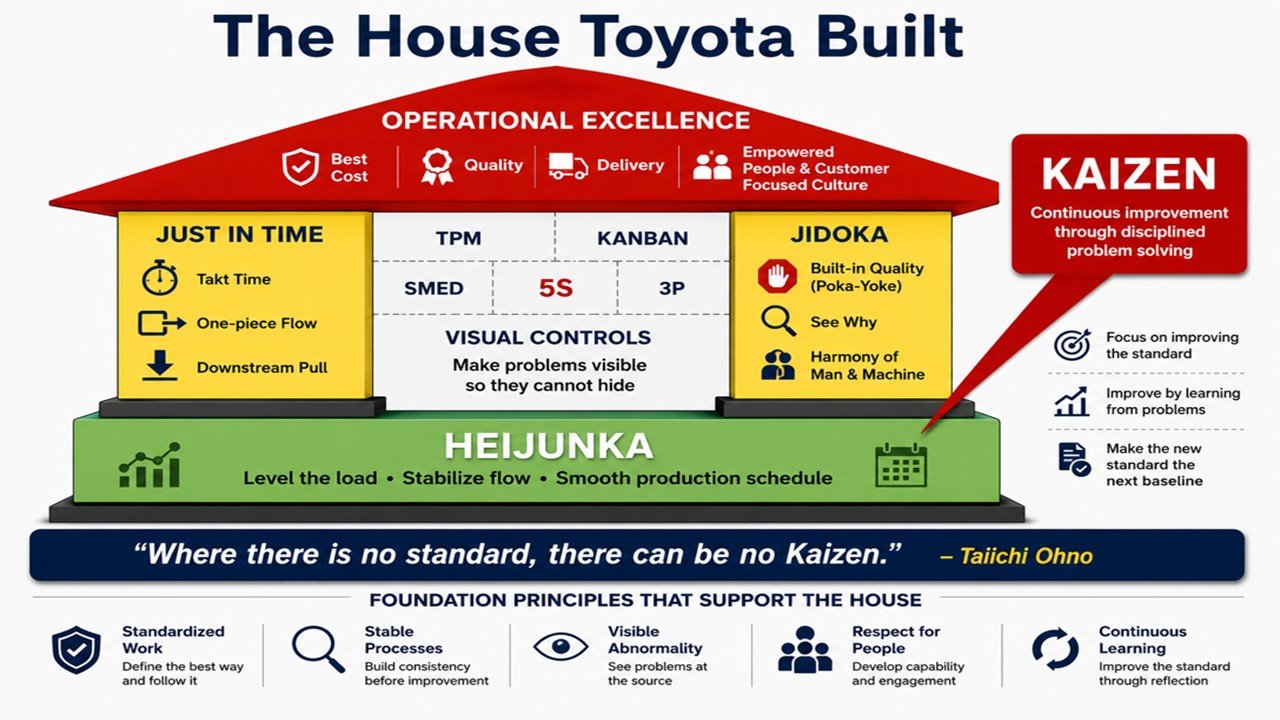
This way of thinking forms the foundation of Jidoka.
Jidoka is often translated as autonomation or automation with a human touch, but the principle extends far beyond automation. Jidoka establishes the expectation that abnormal conditions must be recognized immediately and that execution should not continue when the conditions required to achieve Quality no longer exist. The objective is not simply to detect defects. The objective is to identify and correct the conditions that allow defects to be created.
A defect therefore represents something more than a nonconforming result. A defect is evidence that a process condition has already deviated from the expected standard. Attention shifts away from the defect itself and toward the factors that produced it. Equipment capability, material quality, process parameters, work methods, operating standards, environmental conditions, and leadership response all influence whether Quality can be achieved consistently. Sustainable improvement depends upon understanding and controlling these conditions rather than merely identifying the defects they produce.
The same logic supports the concept of Built-in Quality. Quality cannot be added to a process after execution has been completed. Quality must be created through process design and protected throughout execution. Risks must be understood before production begins. Process conditions must be clearly defined. Standards must be established before variation occurs. Controls and response mechanisms must exist before abnormality appears. When these conditions are present, Quality becomes the natural outcome of the process rather than the result of extensive inspection activity.
This perspective reflects a broader distinction between detection and prevention. Detection focuses on identifying failures after they occur. Prevention focuses on understanding the conditions that make failure possible and strengthening the process before performance is affected. Detection evaluates outcomes. Prevention improves the system that creates those outcomes.
The same distinction can be seen between inspection and governance. Inspection evaluates completed work against established requirements. Governance establishes the operating conditions, responsibilities, controls, escalation paths, and response mechanisms necessary to achieve those requirements consistently. Inspection determines whether expectations were met. Governance creates the conditions that make those expectations achievable.
Process Flow Diagrams, Process Failure Mode and Effects Analysis (PFMEA), and Process Control Plans support this governance approach by helping organizations understand process conditions before production begins, identify potential sources of failure before defects occur, and establish controls capable of maintaining stability during execution. Together, these tools shift organizational attention away from finding defects and toward preventing them.
Quality therefore begins long before the first product is produced or the first service is delivered. Quality begins when processes are understood, risks are anticipated, operating conditions are defined, and controls are established. Sustainable performance emerges when those conditions are actively maintained through daily management and leadership response.
Within Lean TPS, Quality is not something that can be inspected into a process. Quality must be designed into the process from the beginning and governed throughout execution.
2. The Process Flow Diagram Defines Reality
Every improvement effort begins with a deceptively simple question: How does the process actually operate?
Many organizations assume the answer is already known. Procedures have been written, work instructions have been approved, training has been completed, and managers can often describe the process from memory. Daily execution, however, rarely follows documentation perfectly. Informal workarounds emerge, communication pathways evolve, priorities shift, and local adjustments are introduced to keep work moving. Over time, the documented process and the actual process can become significantly different.
Meaningful improvement becomes difficult when decisions are based on assumptions rather than direct observation.
The Toyota Production System addresses this challenge through Genchi Genbutsu, often translated as “go and see.” Leaders and teams are expected to develop their understanding of a process through firsthand observation at the gemba, the place where value is created. Reports, metrics, presentations, and meeting discussions provide useful information, but none of them replace direct observation of how work is actually performed. Improvement begins by understanding reality rather than discussing assumptions.
The Process Flow Diagram provides a structured method for capturing that reality. By visually representing how work, material, and information move through a process, the diagram creates a common understanding of the current condition before improvement activities begin. Operations, inspections, transportation steps, decision points, delays, handoffs, and information exchanges become visible within a single framework, allowing the process to be viewed as an integrated system rather than a collection of individual activities.
This perspective is essential because process performance is rarely determined by a single operation. Results emerge from the interaction of people, methods, materials, equipment, information, and management decisions throughout the entire value stream. Organizations frequently discuss automation opportunities, productivity improvements, cost reduction initiatives, and future-state designs before fully understanding how the current process functions. Teams attempt to solve problems without clearly identifying where the problems originate or how process interactions contribute to performance. Under these conditions, improvement becomes speculation rather than learning.
The Process Flow Diagram establishes the factual baseline required for effective problem solving.
Material flow often reveals the first significant opportunities for improvement. As products, components, services, or information packages move through the process, delays, transportation, inventory accumulation, rework loops, redundant handling, and unnecessary complexity become visible. Activities that appear efficient when viewed independently can create waste when viewed as part of the larger system. Understanding these interactions frequently exposes improvement opportunities that remain hidden when departments evaluate only their own area of responsibility.
Information flow is equally important. Customer orders, production schedules, engineering changes, purchasing signals, approvals, work instructions, and communication pathways influence process performance just as significantly as physical activities. Many operational problems originate within information flow long before they become visible on the shop floor. A Process Flow Diagram helps expose these relationships by illustrating how information triggers, controls, and influences process execution throughout the system.
Direct observation at the gemba strengthens the value of the diagram because it reveals the difference between intended execution and actual execution. Teams often discover additional inspections, informal communication channels, recovery activities, and compensating actions that have developed over time to address recurring weaknesses. Temporary solutions frequently evolve into permanent operating practices. These discoveries provide valuable insight because they reveal how the process performs under real operating conditions rather than how it was originally designed to perform.
The Process Flow Diagram also provides the foundation for Standardized Work. Sequence, timing, handoffs, operating conditions, and process interactions must be understood before meaningful standards can be established. Standards that are not grounded in direct observation often reflect assumptions about the process rather than the process itself. Sustainable improvement requires standards based upon verified knowledge of how work is actually performed.
Waste identification becomes significantly more effective when the entire process is visible. Waiting, transportation, overprocessing, excess motion, inventory accumulation, rework, and unnecessary complexity frequently remain hidden when activities are viewed in isolation. The Process Flow Diagram allows teams to understand how waste propagates through the system and how local decisions influence overall performance.
The value of the Process Flow Diagram therefore extends far beyond documentation. It establishes a shared understanding of the current condition, creates visibility across organizational boundaries, supports Standardized Work, and provides the foundation upon which risk analysis, process controls, and continuous improvement are built.
Every subsequent activity discussed in this article depends upon the accuracy of that understanding. Risks cannot be effectively analyzed if the process is not understood. Controls cannot be effectively designed if process interactions remain unclear. Governance cannot be sustained if the organization lacks a shared understanding of how work, material, and information actually flow.
The Process Flow Diagram defines that reality and provides the starting point for everything that follows.
3. PFMEA Defines Potential Failure
Understanding how a process operates is an essential first step, but process understanding alone does not guarantee Quality. Every process, regardless of how well it is designed, contains potential sources of risk. Equipment can fail, materials can vary, methods can drift from standard, information can become incomplete or inaccurate, and environmental conditions can change. Left unmanaged, these conditions create defects, delays, rework, customer dissatisfaction, and operational instability.
Once the current condition has been established through direct observation and process mapping, attention must shift from understanding the process to understanding its vulnerabilities. Organizations must determine not only how the process operates, but also where failure may occur, how severe the consequences could be, and what actions can be taken to reduce risk before performance is affected.
Process Failure Mode and Effects Analysis (PFMEA) was developed to support this objective. Rather than waiting for problems to emerge and then investigating their causes, PFMEA provides a structured method for identifying potential failures before they affect the customer or disrupt execution. Teams systematically examine each process step, evaluate how that step could fail, assess the consequences of failure, identify contributing causes, and establish actions intended to reduce risk before abnormal conditions develop into defects.
This preventive orientation reflects one of the fundamental principles of Lean TPS. Many organizations devote significant resources to analyzing failures after they occur. Root causes are investigated, corrective actions are implemented, and lessons learned are documented. Valuable knowledge is often created through these activities, but the learning occurs only after resources have been consumed, schedules have been disrupted, and performance has already been affected.
PFMEA shifts that learning earlier in the process. Instead of asking why a failure occurred yesterday, teams examine where failure may occur tomorrow. Potential risks are evaluated before they become defects. Vulnerabilities are understood before they become customer concerns. Preventive actions are developed before operational stability is threatened. The objective is not merely to react more effectively when problems occur but to reduce the likelihood that those problems occur in the first place.
This approach reflects the principle of Hansei. Although Hansei is often translated as reflection, the concept extends beyond reviewing past performance. Hansei encourages organizations to challenge assumptions, acknowledge weaknesses, and actively search for opportunities to strengthen the system before significant problems occur. A process that appears successful today may still contain vulnerabilities capable of creating risk tomorrow.
PFMEA provides a structured method for applying this mindset. Rather than assuming a process is stable because current results appear acceptable, teams deliberately examine where variation may occur, how process conditions may deteriorate, and what consequences may result if those conditions are left unmanaged. The objective is not to predict every possible problem. The objective is to develop a deeper understanding of risk so that prevention becomes part of process design rather than a reaction to process failure.
The relationship between PFMEA and Jidoka is equally important. Jidoka depends upon the ability to recognize abnormal conditions and respond before defects continue downstream. Effective response is only possible when potential sources of abnormality are understood in advance. Failure modes identified through PFMEA frequently become the basis for error-proofing devices, detection systems, alarms, inspection methods, stop conditions, containment activities, and escalation requirements. PFMEA therefore contributes not only to understanding how failure may occur but also to defining how abnormality will be recognized and managed when process conditions begin to deviate from standard.
This relationship extends directly into abnormality management and governance. Normal operating conditions must be understood before abnormal conditions can be identified. Risks must be understood before appropriate controls can be established. PFMEA helps organizations anticipate where variation may occur, understand how that variation may affect performance, and determine which controls are necessary to reduce exposure. Preventive actions can then be incorporated into the process before instability develops rather than after performance has already deteriorated.
The result is a more resilient operating system. Risks become visible before they become defects. Vulnerabilities become understood before they become crises. Preventive actions become intentional rather than reactive. Quality improves because failure is anticipated, studied, and addressed before it reaches the customer.
The Process Flow Diagram establishes an understanding of reality by revealing how work, material, and information flow through the process. PFMEA builds upon that understanding by examining where the process is vulnerable and how failure may occur. Together, they create the knowledge required to move from process understanding toward operational control and governance.
At its core, PFMEA asks a simple but important question:
How can failure be prevented before it occurs?
4. The Control Plan Defines Governance
A Process Flow Diagram establishes an understanding of how work, material, and information move through a process. Process Failure Mode and Effects Analysis (PFMEA) builds upon that understanding by identifying potential failure modes and evaluating the risks associated with those failures. Together, these tools provide a detailed understanding of process reality and process vulnerability.
Understanding alone, however, does not ensure stable execution.
Organizations must also define how operating conditions will be maintained, how abnormality will be recognized, and how response will occur when process conditions deviate from standard. Without these mechanisms, process knowledge remains theoretical, risk analysis remains incomplete, and process stability becomes dependent upon individual judgment rather than a managed system.
The Process Control Plan provides this governance framework.
Among the three quality planning tools, the Process Control Plan is often the most misunderstood. Many organizations view it primarily as a compliance document used to satisfy customer requirements, industry standards, or certification expectations. Process characteristics are listed, measurement methods are defined, sampling frequencies are established, and inspection requirements are documented. Once approved, the document is filed, maintained, and periodically updated.
Within Lean TPS, the Process Control Plan serves a far more significant purpose.
The Process Control Plan establishes the operating conditions required to achieve the desired result and defines how those conditions will be maintained during daily execution. Rather than functioning as an inspection document, it functions as a governance mechanism designed to sustain process stability over time.
Every process depends upon conditions that must remain within defined limits. Equipment settings, process parameters, material specifications, work sequence, cycle times, environmental conditions, measurement methods, and critical quality characteristics all influence performance. Stable results cannot be achieved if these conditions are poorly understood, inconsistently applied, or allowed to drift from their intended state.
The Process Control Plan identifies which conditions require control and defines how those conditions will be monitored during execution. These control points create visibility by allowing operators, supervisors, engineers, and leaders to determine whether the process remains within its expected operating condition.
Visibility is essential because abnormality cannot be managed if abnormality cannot be seen. Detection alone, however, does not create control. Control exists only when abnormal conditions trigger a defined response. For this reason, effective Process Control Plans include reaction plans that specify what actions are required, who becomes responsible, how containment will occur, and how normal operating conditions will be restored. Response expectations must be established before abnormality occurs. Waiting until a problem appears to determine what should happen introduces delay, inconsistency, and uncertainty precisely when clarity is most needed.
Escalation provides the next layer of governance. Some abnormalities can be addressed immediately by the individual performing the work. Other conditions require technical expertise, maintenance support, engineering involvement, supplier engagement, or leadership intervention. Escalation defines how responsibility moves through the organization as risk increases and ensures that abnormal conditions receive the level of attention necessary to protect Quality, delivery, safety, and operational stability.
Organizations that lack clearly defined escalation often experience a predictable pattern. Similar problems receive different responses from different individuals. Ownership becomes unclear. Temporary fixes replace permanent solutions. Recurring abnormalities consume increasing amounts of organizational attention because responsibility for restoring process stability remains undefined.
Leadership involvement is what prevents this deterioration from occurring.
Many organizations associate leadership involvement with reviewing results after performance has already declined. Lean TPS operates from a different assumption. Leadership responsibility begins when process conditions deviate from standard. Leaders are expected to understand the process, verify actual conditions, support problem solving, remove barriers to execution, and ensure that stability is restored before abnormality becomes systemic.
This expectation connects the Process Control Plan directly to daily management. Daily management is not simply the review of performance metrics. Daily management is the continuous confirmation that process conditions remain within standard and that abnormal conditions receive timely and appropriate response when deviations occur.
The significance of the Process Control Plan therefore extends far beyond quality documentation. It converts process understanding and risk analysis into operational behavior by defining what must be controlled, how abnormality will be recognized, how response will occur, how escalation will function, and how leadership maintains oversight of process performance.
The Process Flow Diagram establishes an understanding of reality.
PFMEA establishes an understanding of risk.
The Process Control Plan establishes how the organization will govern execution.
Sustainable Quality depends upon all three, but governance begins with the Process Control Plan because it defines how the organization responds when the conditions required for Quality no longer exist.
5. Why Toyota Uses All Three Together
Process Flow Diagrams, Process Failure Mode and Effects Analysis (PFMEA), and Process Control Plans are frequently taught, implemented, and managed as separate quality tools. Different departments often assume responsibility for each activity, documentation is completed at different stages of the product or process lifecycle, and the resulting outputs are maintained as independent deliverables. Although this approach may satisfy customer requirements, industry standards, and compliance obligations, it often weakens the relationship between the tools and limits their effectiveness as a system for managing Quality.
The Toyota Production System takes a different approach.
Rather than viewing these tools as independent activities, Lean TPS treats them as interconnected elements of a single quality planning and governance framework. Each tool builds upon the knowledge generated by the previous one, creating a progression that moves from understanding reality to anticipating risk and ultimately to governing execution. The value of the framework lies not in the individual documents but in the learning that occurs as information flows from one stage to the next.
The Process Flow Diagram establishes the foundation by creating a shared understanding of the current condition. Through direct observation at the gemba, organizations gain visibility into how work, material, and information move through the process. Interactions, handoffs, delays, inspections, decision points, and communication pathways become visible as parts of an interconnected system rather than isolated activities. Improvement efforts grounded in this understanding are based upon facts rather than assumptions.
PFMEA builds upon that foundation by shifting attention from process understanding to process vulnerability. Once the current condition is understood, the organization can begin examining where failure may occur, how severe the consequences may be, what conditions contribute to risk, and what actions can reduce the likelihood of failure reaching the customer. The purpose is not simply to document potential problems. The purpose is to understand risk before risk becomes reality.
The Process Control Plan completes the progression by translating process knowledge and risk analysis into operational governance. Conditions requiring control are identified, monitoring methods are established, reaction plans are defined, escalation requirements are clarified, and responsibilities become explicit. Knowledge gained through process observation and risk analysis is converted into a practical system for maintaining stability during daily execution.
Viewed together, the relationship between the three tools becomes clear. The Process Flow Diagram establishes an understanding of how the process operates. PFMEA builds upon that understanding by identifying how the process can fail. The Process Control Plan defines how the organization will maintain control when operating conditions begin to deviate from standard. Each stage depends upon the accuracy and completeness of the stage before it.
This progression reflects a broader principle embedded throughout Lean TPS. Understanding precedes improvement. Prevention precedes detection. Governance precedes results. Organizations must first understand reality before they can improve it, understand risk before they can prevent failure, and establish control before they can sustain performance. Attempting to bypass any step weakens the effectiveness of the entire system.
The consequences of separating these activities are often significant. Risk analysis loses effectiveness when the process itself is not fully understood. Process Control Plans become administrative paperwork when they are disconnected from actual process risks. Process mapping provides limited value when the information it generates is never used to reduce risk or strengthen execution. Sustainable Quality emerges only when process understanding, risk analysis, and operational control function together as an integrated system.
This integration explains why the competitive advantage of the Toyota Production System never resided in the tools themselves. Process maps, PFMEAs, and Control Plans can be copied. Software can be purchased. Templates can be standardized. Documentation can be generated. Competitive advantage emerges from the management system that connects those tools to learning, decision-making, daily management, and leadership behavior.
The enduring value of Process Flow Diagrams, PFMEAs, and Process Control Plans therefore lies not in the documents they produce but in the organizational capability they develop. When integrated into daily management, the three tools transform Quality from a reactive activity focused on finding defects into a proactive system focused on understanding processes, preventing failure, and governing execution before problems reach the customer.
6. The Missing Fourth Element: Leadership Response
Process Flow Diagrams, Process Failure Mode and Effects Analysis (PFMEA), and Process Control Plans provide a comprehensive framework for understanding processes, identifying risk, and establishing the controls necessary to achieve stable execution. Yet many organizations continue to struggle with recurring quality problems, process instability, inconsistent execution, and continual firefighting despite having all three tools in place.
The explanation is not found in the tools themselves.
Processes change. Conditions change. Customer requirements evolve. Equipment ages. Personnel change. Temporary workarounds emerge. Standards gradually drift away from the conditions they were originally designed to protect. Although the documentation often remains unchanged, actual execution slowly diverges from the assumptions upon which that documentation was built.
The critical question is not whether the organization possesses the appropriate tools, but whether anyone is responsible for ensuring those tools remain connected to daily execution.
This reality exposes a common weakness in many quality systems. The process has been mapped. Risks have been analyzed. Controls have been established. Documentation has been approved. The assumption is often that the system will now sustain itself.
Experience consistently demonstrates otherwise.
Many organizations attempt to address this deterioration by increasing administrative oversight. Additional audits are introduced, inspections become more frequent, reports become more detailed, and meetings consume increasing amounts of organizational attention. Despite these efforts, process control often continues to weaken because administrative activity cannot substitute for operational governance.
The Toyota Production System addresses this challenge through leadership response.
Responsibility for maintaining process stability does not rest solely with quality departments, engineers, auditors, or frontline personnel. Leadership remains directly connected to the process. Leaders are expected to understand operating conditions, verify execution at the gemba, recognize abnormality, remove barriers, support problem solving, and ensure that corrective actions restore the process to its intended condition.
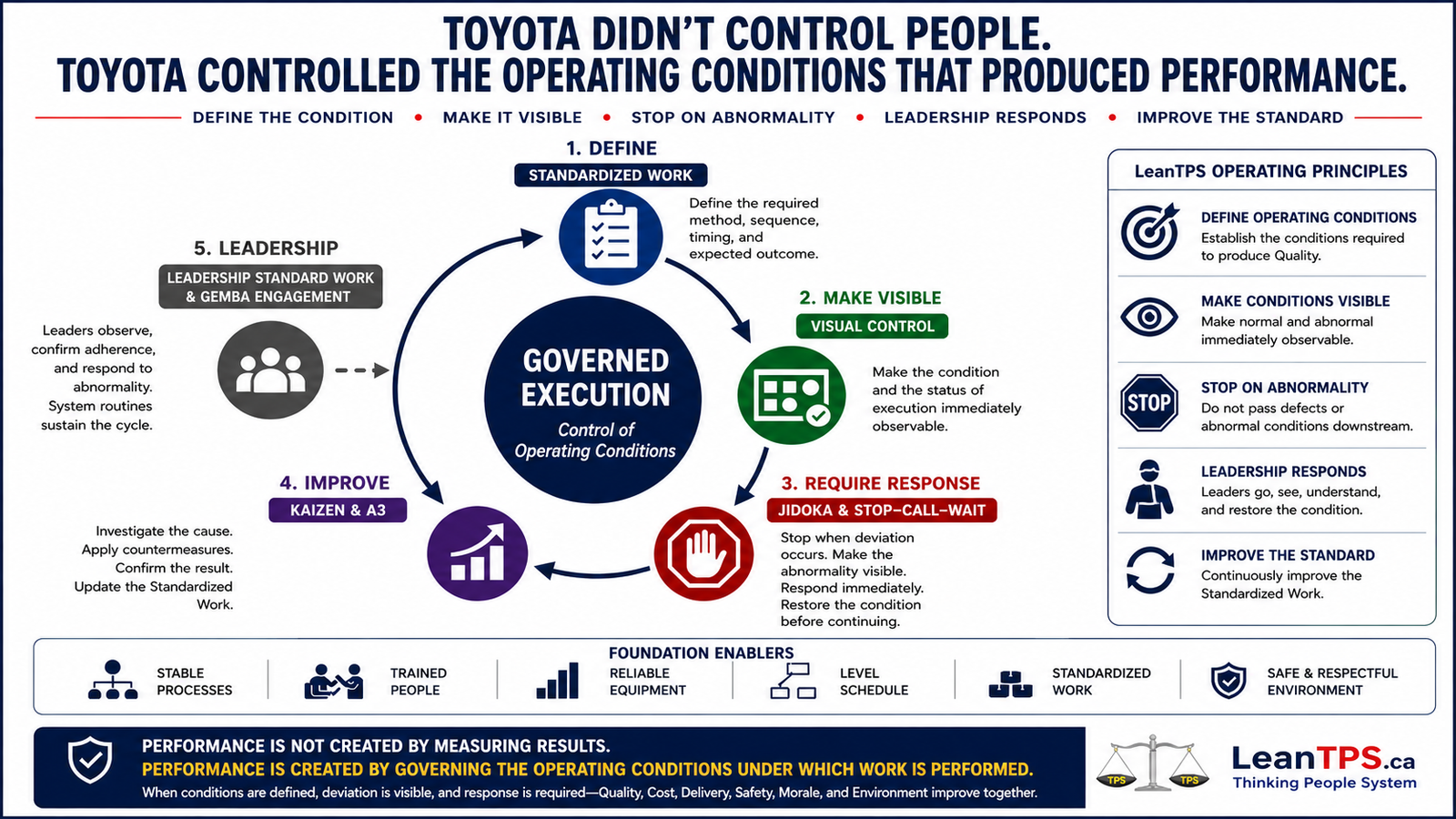
This expectation is consistent with the broader architecture of Lean TPS. Jidoka requires abnormal conditions to become visible. Standardized Work defines the expected condition. Visual management makes deviation recognizable. Daily management creates the routine for confirmation. Leadership response ensures that abnormality receives timely and appropriate action.
Without leadership response, the effectiveness of every other element gradually erodes. Risks identified through PFMEA become less relevant as process conditions change. Process Control Plans become administrative documents when controls are no longer actively verified. Standards lose effectiveness when accountability for maintaining them becomes unclear. Recurring problems consume increasing amounts of organizational attention because abnormality is observed but not governed.
The purpose of leadership response is therefore not supervision in the traditional sense. Effective leaders do not create control by constantly monitoring people. Effective leaders create control by confirming process conditions, ensuring standards remain valid, supporting problem resolution, and responding appropriately when deviations occur.
Governance becomes visible when abnormal conditions trigger action, escalation follows a defined process, and leaders routinely verify actual conditions before instability becomes systemic. Accountability remains connected to process performance because responsibility for maintaining operating conditions remains explicit.
These responsibilities cannot be delegated to documentation, procedures, or software systems. The most accurate Process Flow Diagram cannot respond to a process failure. The most comprehensive PFMEA cannot resolve a deviation. The most detailed Process Control Plan cannot enforce accountability when operating conditions deteriorate.
Responsibility for maintaining process stability ultimately rests with leadership rather than documentation, procedures, or software systems.
Long-term performance depends upon maintaining alignment between the documented process and the actual process, between defined standards and daily execution, and between abnormality and response. Sustainable Quality requires more than process understanding, risk analysis, and defined controls. Sustainable Quality requires leadership capable of ensuring that those elements remain connected to reality as conditions change.
The Process Flow Diagram establishes an understanding of reality.
PFMEA establishes an understanding of risk.
The Process Control Plan establishes the framework for governance.
Leadership response sustains them all.
7. Application in Mixed-Model Human-Humanoid Environments
The increasing adoption of Artificial Intelligence, advanced robotics, autonomous systems, and humanoid technologies does not reduce the importance of process understanding, risk management, or governance. These technologies increase the consequences of poorly understood processes, poorly managed risks, and poorly defined response mechanisms. As operational complexity grows, the principles underlying Process Flow Diagrams, Process Failure Mode and Effects Analysis (PFMEA), Process Control Plans, and leadership response become even more important.
Much of the discussion surrounding emerging technologies focuses on capability. Organizations evaluate whether technology can perform work more efficiently, improve productivity, reduce labor requirements, increase consistency, or support decision-making. Although these questions are important, they address only part of the challenge. Technology executes within the operating system that already exists. Artificial Intelligence, robotics, autonomous systems, and humanoid technologies introduce new capabilities, but they do not eliminate variation, risk, abnormality, or the need for leadership accountability.
As automation increases, failures can propagate more quickly, affect larger portions of the process, and become more difficult to detect. A process weakness that once affected a single workstation can rapidly influence an entire production line, distribution network, or service operation. The consequences of weak governance therefore increase as technological complexity increases.
Every automated system depends upon clearly defined operating conditions. Equipment parameters, process sequences, cycle times, material requirements, information flows, decision criteria, and expected outputs must be understood before automation can perform reliably. A poorly understood process does not become stable because technology is introduced. Technology often accelerates the execution of existing conditions, whether those conditions support stability or instability.
This reality reinforces the importance of Process Flow Diagrams. Understanding how work, material, information, people, and technology interact remains a prerequisite for effective system design and operational control. Organizations cannot govern relationships they do not understand, and automation does not eliminate the need to understand the current condition.
The same principle applies to risk management. Sensors fail. Software produces unexpected outputs. Algorithms generate recommendations based on incomplete information. Robots lose calibration. Autonomous systems encounter situations outside their programmed assumptions. Humanoid technologies introduce new interactions between people and machines that create additional opportunities for abnormality. As systems become more interconnected, understanding how failure may occur becomes increasingly important.
PFMEA provides the framework for developing that understanding. Organizations must evaluate how technology can fail, how those failures influence process performance, how abnormal conditions will be recognized, and what actions are required to reduce risk before deployment occurs. Prevention remains more effective than correction regardless of whether work is performed by people, machines, or intelligent systems.
Process Control Plans become equally important because advanced technologies require clearly defined operating boundaries. Conditions requiring control must be identified, monitoring methods must be established, response expectations must be defined, and escalation paths must be understood. Stable execution cannot be achieved when normal conditions, abnormal conditions, and response requirements have not been clearly established.
The principles of Jidoka remain unchanged within these environments. Abnormal conditions must be recognized. Appropriate action must occur when those conditions appear. Escalation must occur when local response is insufficient. Stability must be restored before execution continues. The methods used to detect abnormality may evolve, but the requirement to respond to abnormality does not.
Leadership responsibility also remains unchanged. Leaders must understand how technology interacts with the process, how risk evolves as automation increases, and how abnormal conditions are surfaced within increasingly complex operating environments. Governance requires maintaining visibility of process conditions and ensuring that abnormality receives timely response rather than becoming hidden behind software, dashboards, algorithms, or automated decision-making systems.
Organizations that successfully integrate Artificial Intelligence, robotics, automation, and humanoid technologies will not succeed simply because they possess more advanced technology. Long-term success will depend upon their ability to understand process conditions, anticipate risk, establish effective controls, and respond appropriately when abnormality occurs.
The progression developed throughout this article remains unchanged. Process Flow Diagrams establish understanding, PFMEA establishes prevention, Process Control Plans establish governance, and leadership response sustains the system.
Technology increases the need for governance.
Technology does not replace governance.
Final Thought
Many organizations implement Process Flow Diagrams, Process Failure Mode and Effects Analysis (PFMEA), and Process Control Plans because customer requirements, industry standards, and quality management systems require them. The documents are completed, approved, maintained, and periodically updated as part of normal operating procedures.
Within the Toyota Production System, Process Flow Diagrams, PFMEAs, and Process Control Plans were developed to support a larger objective: understanding process conditions, preventing failure, and maintaining control of execution. Each tool contributes to that objective, but none of them can achieve it independently. Process understanding without risk analysis leaves vulnerabilities hidden. Risk analysis without effective controls leaves prevention incomplete. Controls without leadership response eventually become disconnected from daily execution.
Viewed together, these tools reflect a fundamental principle embedded throughout Lean TPS. Organizations must first understand reality before they can improve it. Risks must be understood before they can be prevented. Operating conditions must be governed before stable performance can be sustained. Long-term success depends not upon the existence of standards, controls, or procedures, but upon the organization’s ability to maintain alignment between intended conditions and actual conditions as circumstances change.
Leadership completes the system by ensuring that process understanding, risk prevention, and operational control remain connected to daily execution.
Process understanding establishes visibility. Risk analysis establishes prevention. Governance establishes control. Leadership response ensures that abnormal conditions receive timely action before instability becomes systemic. Sustainable performance emerges when these elements operate together as part of daily management rather than as isolated quality activities.
The enduring lesson is not that Toyota possessed better forms, better documentation, or better quality tools. Organizations around the world use Process Flow Diagrams, PFMEAs, and Process Control Plans. The competitive advantage was created by the management system that connected those tools to leadership accountability, operational discipline, problem solving, and continuous learning.
This distinction becomes increasingly important as organizations integrate Artificial Intelligence, robotics, automation, and humanoid technologies into their operations. Technology can execute work, monitor conditions, collect information, and support decision-making. Technology cannot assume responsibility for governance. Technology operates within the system that leadership creates and sustains.
The future of operational excellence will not be determined by the sophistication of technology alone. Sustainable success will belong to organizations that understand their processes, anticipate risk, govern execution, and respond effectively when abnormality occurs.
Quality is sustained through governance.