Lean TPS Change Leadership: The Laws of Change and Toyota Thinking
Why Change Matters
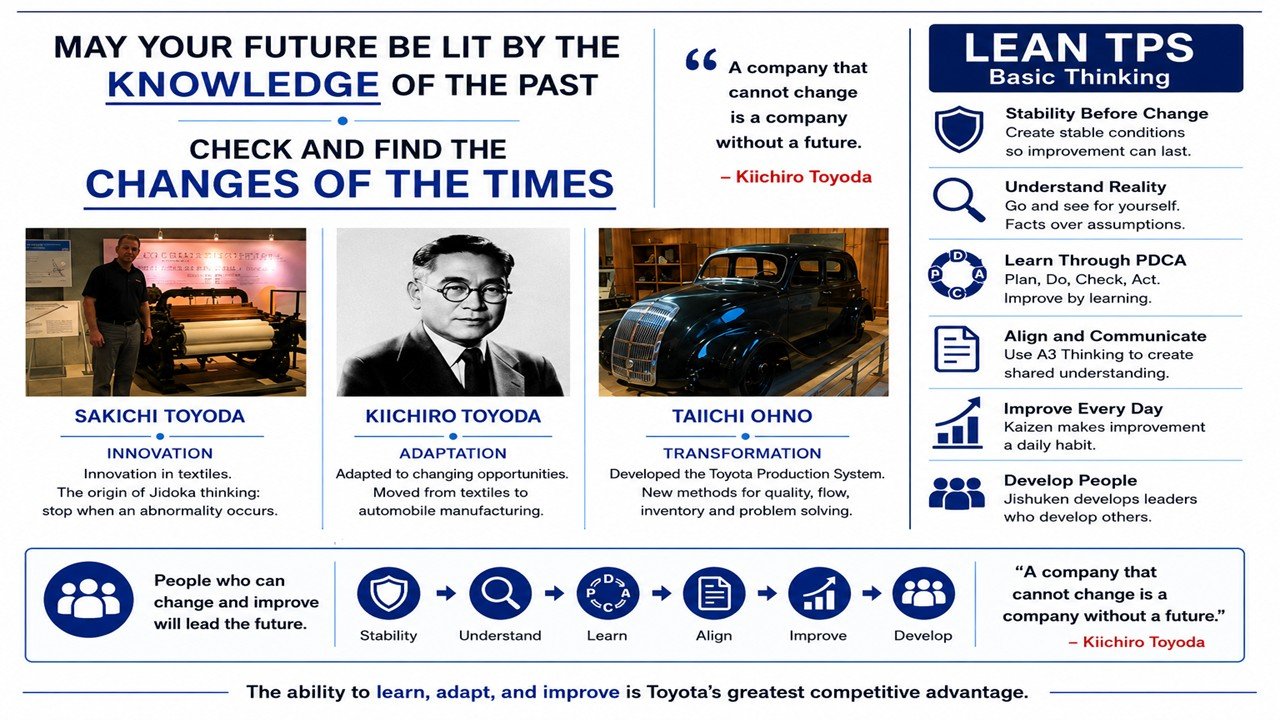
More than eighty years ago, Kiichiro Toyoda described a leadership challenge that remains relevant today:
A company that cannot change is a company without a future.
— Kiichiro Toyoda
Change is one of the most discussed topics in leadership and management. Organizations invest significant resources in transformation initiatives, restructuring efforts, technology implementation, operational improvement programs, and cultural development activities. Yet despite these investments, many change efforts fail to achieve their intended results. New systems are introduced but old behaviors remain. New standards are established but execution gradually returns to previous practices. Improvement efforts begin with enthusiasm but lose momentum over time.
The problem is often not the change itself.
The problem is the absence of a management system capable of supporting continuous adaptation.
Within the Toyota Production System, change is not treated as a special event requiring extraordinary attention. Change is recognized as a normal condition of business. Markets evolve. Technologies advance. Guest expectations shift. Competitors introduce new capabilities. Economic conditions fluctuate. Organizations that fail to adapt to changing conditions eventually lose the ability to compete regardless of their size, resources, or previous success.
Toyota understood this reality long before the concepts of change management, organizational agility, and digital transformation became common management language. The company’s history reflects a continuous pattern of adaptation in response to changing conditions. Sakichi Toyoda transformed textile manufacturing through the development of automatic looms. Kiichiro Toyoda recognized emerging opportunities within the automotive industry and redirected the organization toward automobile production. Following the Second World War, Toyota leaders faced severe resource constraints and increasing competitive pressure. Rather than attempting to imitate larger manufacturers, they developed new approaches to production, problem solving, and leadership that eventually became known as the Toyota Production System.
Toyota’s transition from textile manufacturing to automobile production, followed by the development of the Toyota Production System, was not a series of isolated events. Each transition reflected the organization’s ability to learn, adapt, and improve in response to changing conditions.
They were the result of leaders who understood that long-term survival depends upon the ability to learn, adapt, and improve continuously.
The significance of Kiichiro Toyoda’s observation extends far beyond a simple call to embrace change. Within Toyota, the challenge was never whether change would occur. The challenge was developing the organizational capability required to respond effectively when conditions changed. Markets, technologies, competitors, and Guest expectations continually evolve. Organizations that fail to adapt eventually lose the ability to compete regardless of previous success. Toyota therefore focused on creating management systems capable of learning, adapting, and improving continuously rather than reacting only when conditions became critical.
Many organizations approach change through projects, implementation plans, communication campaigns, and training programs. While these activities may support specific initiatives, they do not necessarily develop the capability to adapt repeatedly over time. Toyota approached the problem differently. The Toyota Production System was designed to create an environment where learning, problem solving, and improvement become part of daily work rather than occasional activities.
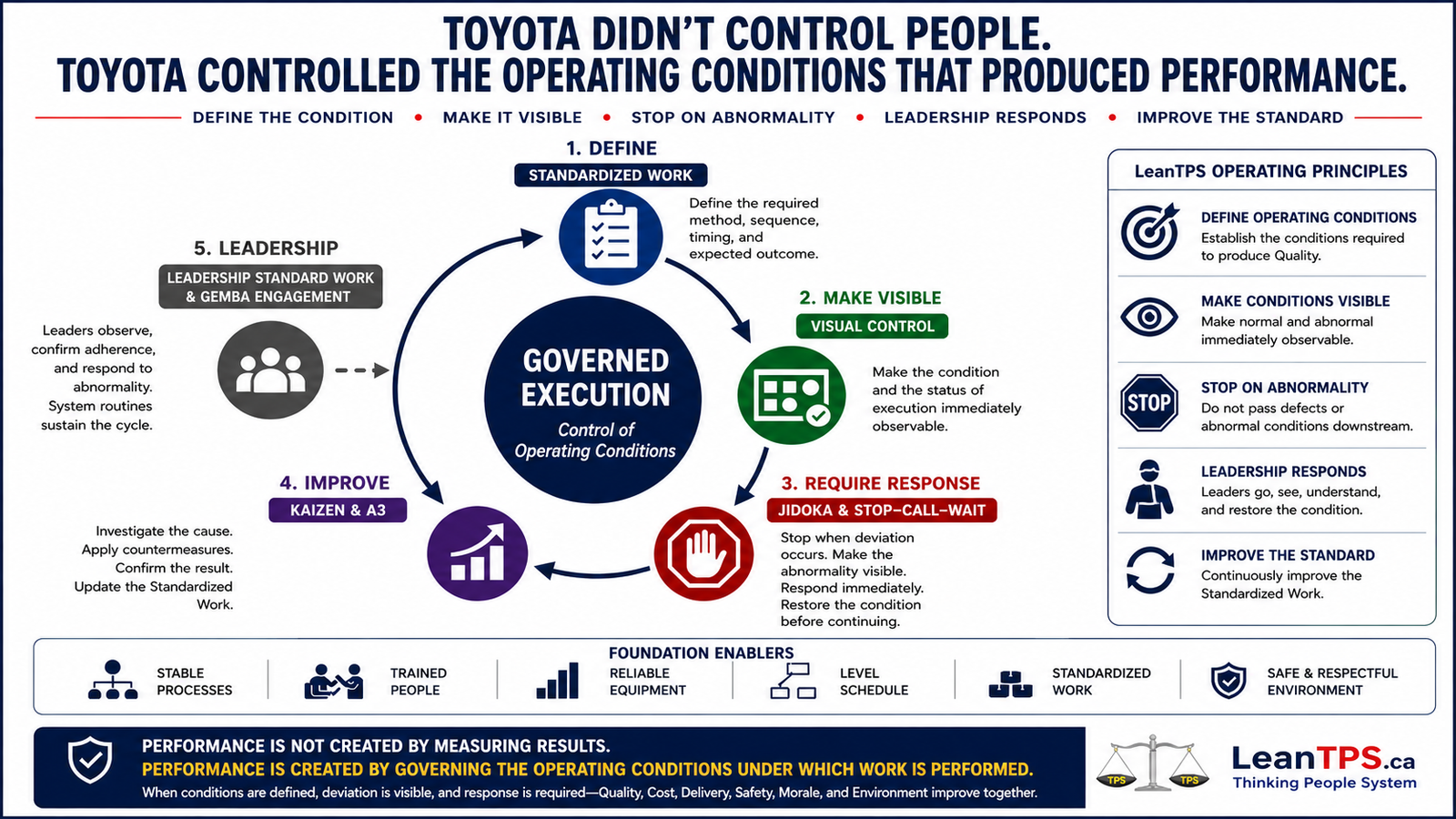
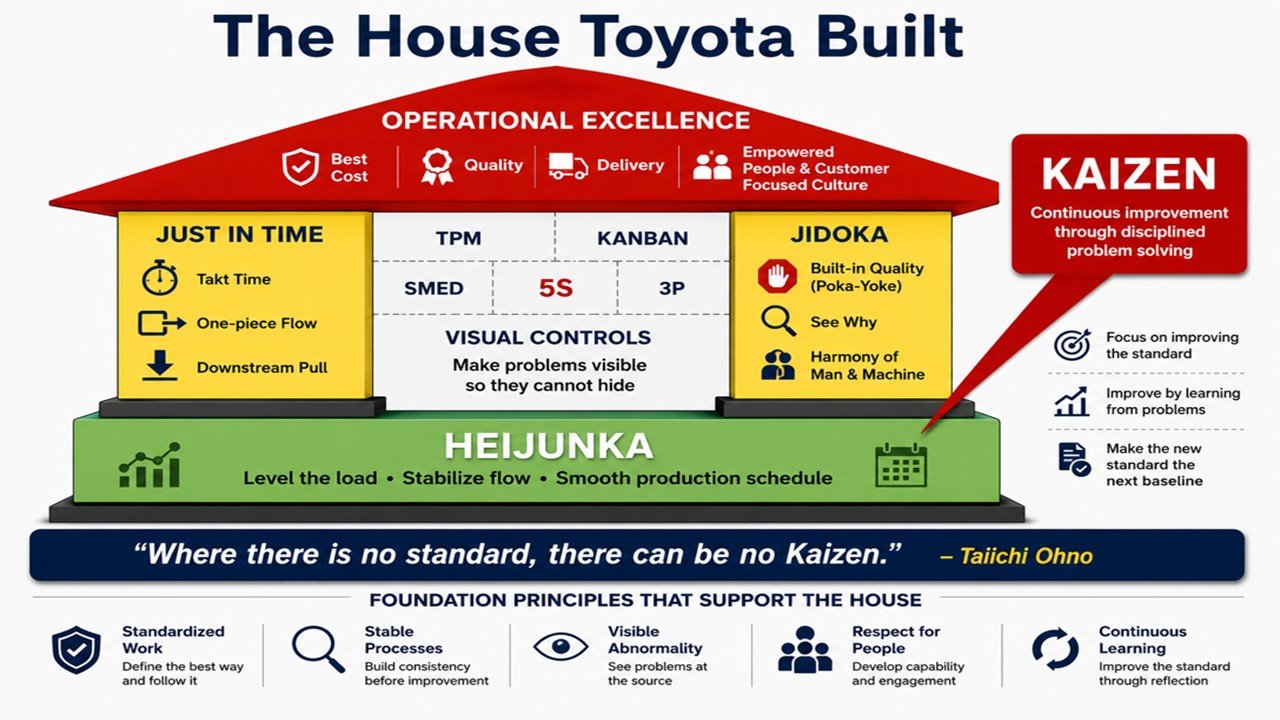
Toyota developed organizational adaptability through a collection of mutually supporting management practices that connect leadership, problem solving, learning, and operational execution. Standardized Work establishes stable operating conditions. Genchi Genbutsu ensures that decisions are based upon direct observation rather than assumption. PDCA provides a structured method for learning through experimentation. A3 Thinking develops alignment and shared understanding. Kaizen creates continuous improvement at every level of the organization. Jishuken develops leaders capable of teaching, coaching, and improving others.
Standardized Work, Genchi Genbutsu, PDCA, A3 Thinking, Kaizen, and Jishuken work together to create a capability that many organizations struggle to achieve: the ability to adapt continuously while maintaining operational stability.
Toyota never pursued change for its own sake. The distinction between change and improvement remained fundamental to Toyota thinking because change alone does not guarantee better performance. Uncontrolled change creates variation. Variation creates instability. Instability reduces quality, disrupts flow, obscures abnormalities, and prevents learning. The objective of Lean TPS is not continuous disruption or constant change. The objective is continuous adaptation supported by stable operating conditions, disciplined leadership, and systematic problem solving. Improvement occurs because the organization learns how to respond effectively to changing conditions while maintaining operational stability.
The relationship between stability, learning, and adaptation has become increasingly important as organizations face new challenges associated with Artificial Intelligence, automation, digital manufacturing, humanoid robotics, demographic shifts, and global economic uncertainty. Although the technologies may be new, the leadership challenge remains unchanged. Organizations must develop the capability to understand changing conditions, learn from those conditions, and respond effectively without sacrificing operational stability.
The Toyota Production System provides a framework for helping organizations learn, adapt, and improve without sacrificing operational stability. More importantly, it provides a method for developing leaders capable of guiding organizations through changing conditions while maintaining stability, quality, and continuous improvement.
The organizations that thrive in the future will not necessarily be the largest, the fastest growing, or the most technologically advanced. They will be the organizations that develop the capability to learn, adapt, and improve as conditions change around them.
1. Change Is the Natural Condition of Business
Many organizations approach change as a temporary disruption to normal operations. A new system is introduced, a process is redesigned, or a restructuring initiative is launched. Once implementation is complete, leaders often assume the organization can return to a stable and predictable state.
Toyota viewed the relationship between stability and change differently.
Within the Toyota Production System, change is not considered an interruption to normal operations. Change is normal operations. Every organization operates within an environment that is continuously evolving. Technologies advance. Competitors improve. Guest expectations increase. Regulations change. Supply chains fluctuate. Workforce demographics shift. Economic conditions rise and fall. Organizations that fail to respond to these changing conditions eventually lose their ability to compete regardless of their past success.
Toyota’s history demonstrates this principle repeatedly. The company itself exists because leaders responded to changing conditions rather than preserving existing practices. Sakichi Toyoda transformed textile manufacturing by addressing limitations within existing weaving technology and challenging accepted methods of operation. Kiichiro Toyoda recognized that future opportunities extended beyond textiles and into automobile manufacturing. Following the Second World War, Toyota faced significant resource limitations that prevented direct competition with larger Western manufacturers. Rather than accepting these constraints as permanent disadvantages, Toyota’s leaders developed new approaches to production, inventory management, quality control, and leadership that eventually became the foundation of the Toyota Production System.
Toyota’s transition from textile manufacturing to automobile production, followed by the development of the Toyota Production System, reflected a consistent pattern of learning, adaptation, and improvement. These transitions were not isolated events. They demonstrated an organizational capability to respond effectively to changing conditions while continuing to develop people, systems, and leadership capability. Toyota’s success was not created by preserving existing methods. It was created by developing the ability to adapt as conditions changed.
The difference between solving individual problems and developing organizational learning capability remains important today. Many organizations focus their improvement efforts on correcting immediate issues while failing to strengthen the systems and leadership practices required to address future challenges. A production issue is corrected. A quality concern is addressed. A scheduling problem is resolved. Yet when conditions change again, the organization often finds itself facing a new set of problems because the capability to learn and adapt was never developed.
Toyota approached improvement differently. The objective was not merely to solve today’s problem. The objective was to strengthen the organization’s ability to identify, understand, and respond to changing conditions repeatedly over time.
This commitment to long-term adaptability became embedded within the management system itself. Standardized Work established stable operating conditions. Visual Management exposed abnormalities. Genchi Genbutsu encouraged leaders to understand problems through direct observation. PDCA created a structured method for experimentation and learning. Kaizen encouraged continuous improvement at every level of the organization. Leadership development ensured that future generations possessed the knowledge, discipline, and problem-solving capability required to continue improving the system.
Together, these practices created something far more valuable than a collection of manufacturing techniques. They created a management system capable of adapting continuously without sacrificing operational stability, quality, or long-term performance.
Many organizations view stability and change as competing objectives. Stability is associated with consistency and control. Change is associated with disruption and uncertainty. Toyota viewed the relationship differently. Stability and change are not opposites. Stability creates the conditions necessary for effective change. Without stable operating conditions, organizations cannot distinguish between improvement and variation. Without improvement, organizations gradually lose the ability to respond to evolving conditions.
For this reason, Toyota pursued stability and improvement simultaneously. Stable execution created the foundation for learning. Learning enabled improvement. Improvement strengthened adaptability. Adaptability supported long-term competitiveness. This relationship is both sequential and continuous, creating an organization capable of responding to change without sacrificing operational control.
The relationship between stability, learning, improvement, and adaptation remains highly relevant today. Artificial Intelligence, automation, digital manufacturing, and humanoid robotics are creating opportunities and challenges that many organizations have never previously encountered. Although the technologies may be new, the underlying leadership challenge remains unchanged. Organizations must still understand changing conditions, evaluate alternatives, test assumptions, develop people, and learn from results.
The organizations that succeed will not necessarily be those with the most advanced technology. They will be the organizations that most effectively combine learning, leadership, and operational discipline to adapt as conditions continue to evolve.
Toyota recognized this reality decades ago. Change was never treated as an exception requiring special attention. Change was understood as the natural condition of business, and the responsibility of leadership was to develop an organization capable of learning, adapting, and improving continuously as those conditions changed.
2. Stability Before Change
One of the most common misconceptions about continuous improvement is the belief that change and improvement are the same thing. Toyota recognized early that they are fundamentally different concepts.
Change simply means that something is different. Improvement means that something is better.
Organizations introduce new software systems, reorganize departments, modify procedures, implement automation, and launch improvement initiatives in an effort to improve performance. Each action creates change. However, change alone does not guarantee improvement. Many organizations experience increased variation, reduced productivity, quality concerns, missed commitments, and operational instability following major change efforts because the conditions necessary for learning were never established before implementation began.
Toyota recognized the difference between change and improvement early in the development of the Toyota Production System. Before improvement can occur, a stable operating condition must exist. Although this requirement appears straightforward, it is frequently overlooked. Many organizations attempt to improve processes that have never achieved stability. Performance fluctuates from shift to shift. Methods vary between operators. Equipment reliability is inconsistent. Workloads are uneven. Standards are either undefined or not consistently followed. Despite these conditions, leaders pursue productivity initiatives, technology implementations, quality programs, and cost reduction efforts in the hope that improvement will follow.
The result is often additional variation rather than measurable improvement because the underlying instability remains unchanged.
When instability already exists, introducing further change makes it increasingly difficult to understand the relationship between cause and effect. If performance improves, leaders cannot determine whether the improvement resulted from the change itself, from differences in execution, from changing operating conditions, or from other uncontrolled factors. If performance deteriorates, the organization faces the same uncertainty. Learning becomes difficult because there is no reliable reference condition against which results can be evaluated.
Toyota approached this challenge differently by establishing a stable operating condition before attempting improvement. Only after stability existed could meaningful learning occur, and only after learning occurred could sustainable improvement be achieved.
The requirement for stability before improvement became one of the foundational purposes of Standardized Work. Standardized Work was never intended to limit creativity, eliminate flexibility, or prevent improvement. Its purpose was to establish the current best-known method for performing work safely, consistently, and repeatedly under defined operating conditions. Once a stable method existed, leaders and team members could evaluate whether proposed changes actually improved performance.
Without a defined baseline condition, organizations cannot reliably determine whether performance has improved or simply changed.
If three operators perform the same task using three different methods and a fourth method is introduced, determining whether the new approach improved performance becomes difficult. The results may reflect the effectiveness of the method, differences in execution, variation in training, inconsistent materials, equipment conditions, or numerous other uncontrolled influences. Under these conditions, organizations often mistake variation for improvement or attribute improvement to causes that do not actually exist.
Toyota therefore established standards before pursuing improvement. The standard provided a reference condition from which performance could be evaluated. The reference condition enabled comparison. Comparison enabled learning. Learning enabled improvement. This sequence remains one of the most important cause-and-effect relationships within Lean TPS thinking.
The importance of stability extends beyond repeatability and measurement. Stable operating conditions also make abnormalities visible.
When operating conditions are defined and consistently executed, deviations become easier to identify. Quality concerns, safety risks, delays, equipment deterioration, process variation, and execution problems can be detected earlier because leaders understand what normal conditions should look like. Without a clearly defined normal condition, abnormal conditions become difficult to distinguish from routine variation. Problems remain hidden because there is no reliable basis for recognizing when performance has deviated from expectation.
The relationship between stable operating conditions and abnormality visibility explains why Standardized Work, Visual Management, Jidoka, and Leadership Confirmation are closely connected within the Toyota Production System. Jidoka depends upon the ability to recognize abnormal conditions. Leadership Confirmation depends upon the ability to verify execution against a known standard. Problem solving depends upon understanding when and where conditions deviate from expectation. None of these activities can function effectively if normal operating conditions have not been clearly established.
Toyota also understood that establishing a standard does not guarantee that the standard will be sustained.
Standardized Work establishes the operating condition, but leadership is responsible for confirming, sustaining, and improving that condition over time.
Leaders are expected to observe execution directly, confirm adherence to standards, identify abnormalities, and support problem solving when deviations occur. Without ongoing leadership engagement, standards gradually deteriorate, variation increases, abnormalities become normalized, and organizational learning slows. Sustainable improvement therefore depends not only upon establishing standards but also upon maintaining the discipline required to sustain them.
PDCA relies upon the same foundation. A proposed countermeasure can only be evaluated when the current condition is understood and operating consistently. Root cause analysis depends upon stability because recurring problems become difficult to identify when processes produce inconsistent results. Continuous improvement depends upon stability because there must be a known condition from which improvement can occur.
For this reason, Toyota never viewed Standardized Work as a documentation activity. The objective was not to create procedures, manuals, or records. The objective was to establish a stable execution condition that could be observed, confirmed, improved, and sustained over time.
The relationship between stability, learning, and improvement becomes increasingly important as organizations adopt advanced technologies. Artificial Intelligence, automation, digital systems, and humanoid robotics all depend upon predictable operating conditions. Many organizations assume technology can compensate for instability. Toyota understood the opposite relationship.
Technology executes within the system that already exists.
If operating conditions are unstable, technology accelerates instability by executing variation more consistently and at greater speed. If operating conditions are stable, technology can amplify capability, improve consistency, strengthen quality, and increase performance. Advanced technology does not eliminate the requirement for stability. In many cases, it increases the requirement because highly capable systems often depend upon tighter control of operating conditions than traditional manual processes.
Toyota understood the relationship between stability, learning, and sustainable improvement long before modern discussions about digital transformation, Artificial Intelligence, and humanoid robotics emerged. The organization recognized that sustainable improvement requires both adaptation and control. Change without stability creates variation. Stability without improvement creates stagnation. Long-term success requires both.
The Toyota Production System therefore pursues stability and improvement simultaneously because neither objective can be sustained without the other. Stable operating conditions create the foundation for learning. Learning enables improvement. Improvement strengthens adaptability. Adaptability supports long-term competitiveness. Together, these relationships explain why Toyota pursued stability and improvement as complementary objectives rather than treating them as competing priorities.
For Toyota, stability was never the opposite of change.
Stability was the condition that made meaningful change possible.
3. The Human Side of Change
Many leadership models focus on processes, technology, organizational structures, and management systems when discussing change. While these elements are important, Toyota recognized that sustainable improvement ultimately depends upon people.
Processes do not improve themselves. Machines do not improve themselves. Technology does not improve itself.
People improve systems through observation, learning, experimentation, and problem solving.
This belief became one of the foundational assumptions of the Toyota Production System. While Toyota is often associated with production methods, quality systems, and operational excellence, the organization’s long-term success was built upon something far more difficult to develop than tools, procedures, or technology. Toyota invested in developing people capable of understanding, improving, and sustaining those systems over time.
The difference between implementing change and developing people separates Toyota from many traditional approaches to organizational change.
Many organizations approach change as an implementation challenge. New procedures are created. Training sessions are conducted. Expectations are communicated. Performance is monitored. Leaders then wait for employees to adopt the new approach. While compliance may increase temporarily, sustained improvement frequently fails to materialize because implementation alone does not create understanding. Employees may know what has changed without understanding why the change was necessary, how the new process improves performance, or what role they play in sustaining the improvement.
Toyota approached organizational change differently by emphasizing capability development. The objective was not simply to change a process. The objective was to develop people capable of improving the process.
This philosophy influenced every aspect of the Toyota Production System. Leaders were expected to do more than assign work and monitor results. They were expected to develop the thinking capability of their teams. Improvement became sustainable because the organization continuously developed individuals capable of identifying problems, investigating causes, testing countermeasures, and improving performance.
This philosophy is closely connected to Toyota’s principle of Respect for People.
The phrase is often misunderstood. Respect for People is sometimes interpreted as being supportive, accommodating, or avoiding difficult conversations. Toyota’s interpretation is significantly more demanding.
Respect means believing that people are capable of learning.
Respect means creating conditions where learning can occur.
Respect means investing time to develop capability.
Respect means holding individuals accountable to standards while providing the coaching necessary to achieve them.
Respect means developing people rather than merely directing them.
From Toyota’s perspective, failing to develop people is itself a form of disrespect because it limits their ability to contribute, learn, and improve.
Organizations that believe people cannot change eventually stop investing in development. Leaders begin solving every problem themselves. Decisions become centralized. Improvement becomes dependent upon a small group of specialists. When those specialists leave, improvement slows or stops because knowledge and problem-solving capability were never distributed throughout the organization.
Toyota invested heavily in developing problem-solving capability at every level. Team members learned to identify abnormalities. Team leaders learned to respond to abnormalities. Supervisors learned to coach. Managers learned to develop others. Senior leaders learned to create systems that supported learning and improvement. Capability development became part of daily work rather than an occasional training activity.
Toyota’s emphasis on capability development also explains why the organization places such importance on direct observation and experiential learning. Classroom instruction can create awareness, but awareness alone rarely changes behavior. Sustainable learning occurs when people apply concepts to real problems, observe actual conditions, evaluate results, and reflect upon outcomes. Understanding develops through practice rather than exposure alone.
Toyota’s belief that understanding develops through practice can be seen throughout the Toyota Production System. Standardized Work develops consistency and discipline. Genchi Genbutsu develops observational capability. PDCA develops scientific thinking. A3 Thinking develops structured problem solving. Kaizen develops continuous improvement capability. Jishuken develops leadership capability through direct engagement with operational challenges. Together, these practices create an environment where learning occurs continuously rather than occasionally.
Continuous learning, coaching, and problem solving create something many organizations struggle to achieve.
They create confidence grounded in capability.
Employees become more willing to identify problems because they possess methods for addressing them. Leaders become more willing to delegate responsibility because they have invested in developing capability. Teams become more adaptable because learning occurs continuously rather than only during formal improvement initiatives.
The importance of organizational learning and problem-solving capability continues to increase as organizations confront Artificial Intelligence, automation, digital manufacturing, humanoid robotics, workforce shortages, demographic shifts, and rapidly changing Guest expectations. No leadership team possesses all the answers required to navigate every future challenge. Organizations therefore require people at every level who can observe conditions, solve problems, adapt to change, and improve performance.
Toyota recognized decades ago that long-term competitiveness depends upon developing people capable of learning, adapting, and improving continuously.
The long-term strength of an organization is not determined solely by its products, technology, facilities, or equipment. Those assets can be purchased, copied, upgraded, or replaced.
The true strength of an organization resides in the capability of its people.
For this reason, the Toyota Production System was never intended to be merely a production system.
It was designed to be a people development system that uses improvement as the vehicle for learning, leadership development, and long-term organizational adaptation.
4. Why Most Change Efforts Fail
The failure of change initiatives is often attributed to resistance from employees. Leaders frequently conclude that people are unwilling to change, reluctant to learn, or uncomfortable with new expectations. While resistance can certainly occur, Toyota viewed the problem differently.
Most change efforts fail because organizations attempt to implement solutions before fully understanding the conditions that created the problem.
The difference between implementing solutions and understanding problems influences everything that follows. In many organizations, a problem is identified, leadership develops a solution, a project is launched, training is conducted, performance expectations are communicated, resources are assigned, and implementation begins. Only later does it become apparent that the original problem was not fully understood.
As a result, organizations often implement solutions that address symptoms rather than causes, creating significant activity without achieving meaningful improvement.
Toyota recognized this pattern and developed a fundamentally different approach. Rather than beginning with solutions, improvement begins with understanding. The objective is not to change something quickly. The objective is to understand the current condition deeply enough that effective improvement becomes possible.
The difference between implementation-focused change and learning-focused improvement separates many traditional change initiatives from Lean TPS thinking.
Conventional change efforts focus primarily on implementation. Lean TPS focuses on learning.
Implementation may create activity, but learning creates understanding. Understanding creates capability. Capability creates sustainable improvement.
Without learning, organizations frequently repeat the same cycle. New initiatives are launched every few years. New terminology is introduced. New systems replace previous systems. New performance measures are established. Employees become accustomed to waiting for the next program because experience has taught them that many initiatives eventually disappear.
Over time, organizational confidence declines. Employees become skeptical because previous improvements were not sustained. Leaders become frustrated because expected results fail to materialize. Resources are consumed without strengthening the organization’s ability to solve future problems.
For this reason, Toyota treated improvement as a process of discovery rather than a process of implementation.
The first responsibility of leadership is to understand the current condition. This requires direct observation, data collection, and a clear understanding of how work is actually performed. Assumptions are insufficient. Reports are insufficient. Meetings are insufficient. Leaders must understand reality before deciding what action should be taken.
The requirement to understand actual conditions before implementing solutions explains why Genchi Genbutsu became such an important principle within the Toyota Production System. Decisions improve when leaders understand actual conditions rather than relying exclusively on summaries, opinions, presentations, or assumptions. Effective change begins with understanding reality as it exists rather than reality as people believe it exists.
Toyota also recognized that organizational learning requires experimentation. Not every proposed countermeasure will produce the desired result. Some improvements will improve performance. Others will reveal new information. Still others will expose flaws in the original assumptions. Rather than viewing these outcomes as failures, Toyota treats them as opportunities to learn.
This belief that improvement begins with learning rather than implementation became embedded within PDCA.
A proposed change is treated as a hypothesis rather than a guaranteed solution. The organization plans, tests, evaluates, and adjusts based upon actual results. Learning occurs because the objective is understanding rather than implementation alone.
The emphasis on learning also changes the role of leadership. Many organizations expect leaders to possess answers. Toyota places greater emphasis on developing leaders who can ask the right questions. Leaders who assume they already know the solution frequently overlook important information. Leaders who approach problems with curiosity create opportunities for learning, discovery, and improvement.
Another common reason why change efforts fail is the absence of leadership engagement after implementation begins.
A new process is introduced. Training is completed. Expectations are communicated. Leadership attention then shifts to the next priority.
Without ongoing confirmation, coaching, and reinforcement, execution gradually returns to previous habits. Standards deteriorate. Variation increases. Improvements that initially appeared successful slowly disappear.
Toyota addresses this challenge through active leadership involvement at every level. Leaders are expected to confirm execution, identify abnormalities, support problem solving, and develop capability continuously. Improvement is not delegated to a project team and then monitored from a distance. Leadership remains engaged because sustainable change requires sustained attention.
The importance of ongoing leadership engagement is closely connected to Leadership Confirmation. Standards establish expectations, but leaders confirm execution. Without confirmation, organizations cannot determine whether improvements are being followed, whether abnormalities are occurring, or whether additional support is required. Improvement therefore depends not only upon implementation but also upon continuous observation, coaching, and reinforcement.
The emphasis on learning, confirmation, coaching, and sustained leadership involvement reflects one of the most important principles within Lean TPS.
Sustainable improvement is not created by projects.
Sustainable improvement is created by management systems.
Projects may introduce change, but management systems sustain it. Organizations that rely primarily on initiatives, programs, and implementation campaigns often achieve temporary gains. Organizations that develop systems for learning, observation, confirmation, problem solving, and people development create improvements that continue long after the original project has ended.
For Toyota, the objective was never simply to implement change.
The objective was to create an organization capable of improving continuously.
The capability to improve continuously begins with understanding current conditions through Genchi Genbutsu, learning through PDCA, developing people through coaching, and sustaining improvements through Leadership Confirmation. When these elements work together, improvement becomes part of the management system rather than a temporary initiative.
Without these elements, change becomes another program.
With them, change becomes a competitive advantage.
5. Genchi Genbutsu: Change Begins with Understanding
One of the most common reasons organizations struggle with improvement is that decisions are often made far from the work itself. Leaders review reports, discuss performance metrics, attend meetings, analyze dashboards, and evaluate recommendations while the actual conditions where work is performed remain only partially understood.
Toyota recognized that decision quality deteriorates when leaders become separated from the work itself and established a principle that remains fundamental to the Toyota Production System: Genchi Genbutsu.
The phrase is often translated as “Go and See.” While technically accurate, the translation does not fully capture its significance. Genchi Genbutsu is not simply an instruction to visit the workplace. It is a disciplined approach to understanding reality through direct observation.
Within Toyota, leaders are expected to understand conditions firsthand before making decisions. Problems are not evaluated exclusively through reports, presentations, summaries, dashboards, or secondhand information. Leaders go to the Gemba, observe the work, confirm operating conditions, and develop an understanding of the situation based upon what is actually occurring rather than what they assume is occurring.
The difference between information and understanding is critical because many organizational problems persist despite repeated attempts to solve them. Leaders often believe they understand a process because they understand the documented procedure. They believe they understand a problem because they have reviewed performance data. They believe they understand a situation because it has been discussed extensively during meetings.
Genchi Genbutsu challenges these assumptions.
Understanding work requires observing work. Understanding problems requires observing problems. Understanding operating conditions requires direct observation of those conditions. Information can support understanding, but information alone is not understanding.
This requirement becomes particularly important during periods of change. When organizations attempt to improve performance, leaders frequently focus their attention on potential solutions. New procedures are developed. New technologies are evaluated. New structures are proposed. Yet when the current condition has not been fully understood, proposed solutions often address symptoms rather than causes.
As a result, organizations implement change without fully understanding the problem they are attempting to solve.
Toyota therefore begins improvement differently. Before discussing countermeasures, leaders are expected to understand the current condition. What is actually happening? Where is the abnormality occurring? How frequently does it occur? Under what conditions does it occur? What evidence supports the conclusion? What facts have been directly observed?
Questions regarding abnormality location, frequency, operating conditions, and supporting evidence cannot be answered through opinion alone. They require direct observation.
Genchi Genbutsu helps organizations separate facts from assumptions, observation from interpretation, and reality from perception.
The importance of direct observation has become even greater as organizations become increasingly dependent upon digital systems and performance metrics. Modern organizations possess more information than at any point in history. Dashboards, automated reporting systems, analytics platforms, sensors, and real-time monitoring tools provide unprecedented visibility into organizational performance. While these technologies can be extremely valuable, information should support observation rather than replace it.
Data can indicate that a problem exists, but data alone rarely explains why.
A production report may indicate declining output. A quality dashboard may reveal increasing defects. A delivery metric may identify missed commitments. These indicators are important because they help identify where attention should be focused. However, reports rarely reveal the full cause of the problem. Understanding requires direct observation of the operating conditions producing the result.
Toyota leaders therefore learn to connect information with reality. Reports identify areas requiring attention. Observation reveals how work is actually being performed. Problem solving investigates the causes producing the result. Improvement changes the conditions responsible for the outcome.
This sequence—observation, understanding, problem solving, and improvement—prevents organizations from rushing prematurely toward solutions and increases the likelihood that improvement efforts address actual causes rather than symptoms.
Genchi Genbutsu also plays a critical role in leadership development. Leaders who regularly observe work develop a deeper understanding of operational reality. They learn how standards are executed, how abnormalities emerge, how teams respond to problems, and how operating conditions influence performance. Over time, decision-making improves because leadership becomes grounded in direct understanding rather than assumption.
The principle remains equally important within environments that incorporate automation, Artificial Intelligence, digital manufacturing systems, and humanoid robotics. Advanced technologies can provide unprecedented visibility into system performance, but they do not eliminate the need to understand actual operating conditions. Sensors may identify abnormalities. Data may reveal trends. Algorithms may generate recommendations. Leadership must still understand the operating conditions, decisions, interactions, and constraints that produced the result.
Technology can support observation.
Technology cannot replace understanding.
For Toyota, Genchi Genbutsu was never intended to be a management technique or leadership slogan. It was intended to be a discipline that keeps decision-making connected to reality. The discipline ensures that improvement remains connected to actual conditions, that problem solving remains connected to observed facts, and that leadership remains connected to the work being performed.
Sustainable change begins with understanding current conditions.
Within the Toyota Production System, that understanding begins at the Gemba.
6. PDCA: The Scientific Method of Organizational Change
If Genchi Genbutsu provides the discipline for understanding current conditions, PDCA provides the discipline for improving them.
Few concepts are more closely associated with continuous improvement than the Plan-Do-Check-Act cycle. Unfortunately, PDCA is often misunderstood and reduced to a project management tool, an implementation checklist, or a simple improvement cycle. While PDCA can support these activities, Toyota viewed it as something far more important.
PDCA is the learning engine of the Toyota Production System.
The purpose of PDCA is not merely to implement change. The purpose is to develop understanding.
This distinction separates Lean TPS thinking from many traditional improvement approaches. Organizations frequently approach change by identifying a problem, selecting a solution, implementing the solution, and measuring the result. Success is often defined by whether implementation occurred according to plan.
The Toyota Production System approaches improvement differently because it recognizes a fundamental reality: leaders rarely possess complete knowledge before action is taken.
Markets change. Conditions change. Technologies evolve. New problems emerge. In many situations, the correct answer is not immediately obvious. The challenge is therefore not simply implementing change. The challenge is learning which actions actually improve performance.
PDCA provides a structured method for doing exactly that.
Within Lean TPS, every proposed improvement is treated as a hypothesis. The organization begins by understanding the current condition and establishing a target condition. Based upon available knowledge, observation, and experience, a countermeasure is proposed. Until that countermeasure has been tested under actual operating conditions, however, it remains an assumption.
PDCA provides a disciplined method for testing whether that assumption is correct.
The Plan phase establishes the current condition, target condition, expected outcome, and proposed countermeasure. The Do phase introduces the countermeasure under controlled conditions. The Check phase compares actual results against expectations. The Act phase determines whether the learning should be standardized, modified, expanded, or used to guide the next experiment.
Although the sequence appears straightforward, the learning generated can be significant.
Many organizations treat implementation as the objective. Lean TPS treats implementation as the beginning of learning. A successful countermeasure improves understanding of the relationship between cause and effect. An unsuccessful countermeasure can be equally valuable because it exposes incorrect assumptions, incomplete knowledge, or previously unrecognized conditions.
In both cases, understanding improves because the relationship between actions and results becomes clearer.
This perspective fundamentally changes how leaders approach improvement. Instead of asking whether a project succeeded or failed, the critical question becomes: What was learned? Instead of defending assumptions, assumptions are tested. Instead of focusing exclusively on results, attention is directed toward understanding the conditions that produced those results.
Over time, this approach develops scientific thinking throughout the organization. Leaders learn to define problems clearly, establish measurable expectations, test ideas systematically, evaluate outcomes objectively, and adjust based upon evidence rather than opinion. Improvement becomes less dependent upon authority, intuition, and assumption and increasingly dependent upon observation, experimentation, and learning.
This is why continuous improvement is often described within Toyota as a learning process rather than simply a problem-solving process. Problems create opportunities to learn. Countermeasures create opportunities to test understanding. Results create opportunities to refine knowledge. Each PDCA cycle deepens understanding of the system being studied and strengthens the organization’s ability to improve it.
The relationship between PDCA and change leadership is particularly important. Many change efforts fail because leaders assume they already know the answer. Solutions are implemented before sufficient understanding exists. When results fail to meet expectations, additional changes are introduced, often creating even greater instability because the original assumptions were never tested.
PDCA reduces this risk through disciplined experimentation. Small tests replace large assumptions. Learning occurs before broad implementation. Countermeasures are evaluated based upon evidence rather than optimism. Organizations adapt because they learn continuously rather than relying exclusively on prediction.
This capability becomes increasingly valuable as organizations confront uncertainty associated with Artificial Intelligence, automation, digital manufacturing, and humanoid robotics. Future operating conditions cannot be understood completely in advance. New technologies create new opportunities, new challenges, and new forms of variation. Organizations that rely solely upon planning will struggle because planning alone cannot eliminate uncertainty. Organizations that develop strong learning capabilities will be better positioned to respond because they can adapt as new information becomes available.
Toyota recognized decades ago that uncertainty cannot be eliminated through planning alone. Organizations must learn their way forward through experimentation.
For this reason, PDCA was never viewed simply as an improvement cycle. It is a systematic method for learning, adapting, and improving under changing conditions. Every cycle deepens understanding. Every experiment strengthens organizational learning. Every lesson improves future decision-making and system performance.
For this reason, PDCA remains one of the most powerful elements of the Toyota Production System and one of the most effective methods ever developed for leading change when the correct answer cannot be known in advance.
7. A3 Thinking: Creating Alignment During Change
Organizations rarely fail because people are incapable of solving problems.
More often, organizations struggle because people understand the problem differently.
Leaders interpret conditions differently. Departments pursue competing priorities. Teams develop conflicting solutions. Individuals reach different conclusions regarding causes, risks, responsibilities, and opportunities. As a result, improvement efforts often lose momentum because the organization lacks a common understanding of the situation it is attempting to improve.
Toyota recognized this challenge and developed a structured method for creating alignment through problem solving.
That method became known as A3 Thinking.
Many organizations mistakenly view the A3 as a report, form, presentation, or documentation requirement. While the A3 is commonly recorded on a single sheet of paper, the document itself is not the primary purpose. The true value of A3 Thinking lies in the learning, communication, coaching, and alignment that occur while the A3 is being developed.
For Toyota, the A3 is not primarily a reporting tool.
It is a thinking process.
The purpose of the process is to create a common understanding of the current condition, target condition, root causes, proposed countermeasures, implementation activities, and follow-up actions before implementation begins. Rather than allowing individuals to develop separate interpretations of a problem, the A3 provides a structured framework through which people can investigate, discuss, and understand the situation together.
This capability becomes particularly important during periods of change.
Most change initiatives affect multiple stakeholders with different responsibilities, objectives, and perspectives. Operations, Quality, Engineering, Maintenance, Human Resources, Finance, and leadership teams may all be influenced by the same improvement effort. Without alignment, implementation becomes difficult because different groups frequently pursue different objectives while believing they are solving the same problem.
The Toyota approach is to create understanding before implementation begins.
This principle is closely connected to Nemawashi, a practice used throughout Toyota to build alignment before decisions are finalized. Nemawashi is often translated as consensus building, but the concept extends well beyond agreement. The objective is not to obtain approval for a predetermined solution. The objective is to develop a shared understanding of the problem, the current condition, the proposed direction, and the reasoning supporting the recommendation.
Developing this understanding frequently involves observation, questioning, coaching, discussion, and refinement. Assumptions are examined. Concerns are addressed. Additional information is gathered. Perspectives are challenged. Understanding gradually improves as participants work through the logic supporting the proposed direction.
By the time a formal decision is made, much of the learning has already occurred.
Many organizations reverse this sequence. A solution is selected first and alignment is pursued afterward. Resistance then emerges because individuals are asked to support a decision they did not help understand. What appears to be resistance to change is often resistance to a decision-making process that excluded understanding.
Toyota approaches the situation differently.
Understanding comes before agreement.
Agreement comes before implementation.
Implementation follows understanding.
This sequence significantly increases commitment because people participate in developing the logic supporting the decision rather than simply receiving the decision after it has already been made.
The A3 process also reinforces scientific thinking throughout the organization. Teams are expected to define problems clearly, understand current conditions, identify root causes, establish measurable objectives, and evaluate the effectiveness of proposed countermeasures. Opinions gradually give way to evidence. Assumptions are replaced by observation. Discussions become increasingly focused on understanding rather than persuasion.
In this way, A3 Thinking serves as a natural extension of PDCA. PDCA develops learning through experimentation. A3 Thinking creates organizational alignment around what is being learned. Together, they help organizations improve performance while developing a common understanding of both the problem and the path forward.
Over time, A3 Thinking becomes far more than a problem-solving method.
It becomes a leadership development process.
Leaders learn how to ask questions, challenge assumptions, facilitate learning, and guide teams toward deeper understanding. Team members learn how to analyze conditions, communicate effectively, and participate in structured improvement activities. The organization develops a common language for learning, problem solving, and continuous improvement.
These capabilities become increasingly important during periods of significant change. New technologies, changing market conditions, organizational restructuring, workforce challenges, and evolving operating requirements all create uncertainty. Organizations with strong alignment capabilities respond more effectively because people share a common understanding of both the problem and the intended direction.
For Toyota, the A3 was never intended to be a report.
The document records the learning.
The value comes from the thinking.
When organizations develop the ability to think together, learn together, and improve together, change becomes significantly easier to sustain because people are no longer implementing someone else’s solution.
They are executing a direction they helped understand, develop, and improve.
8. Jishuken: Developing Leaders Who Can Change
Many organizations view leadership development as a training activity. Employees attend workshops. Managers participate in seminars. Leaders complete certification programs. New knowledge is acquired and organizations hope that improved performance will follow.
The Toyota Production System approaches leadership development differently.
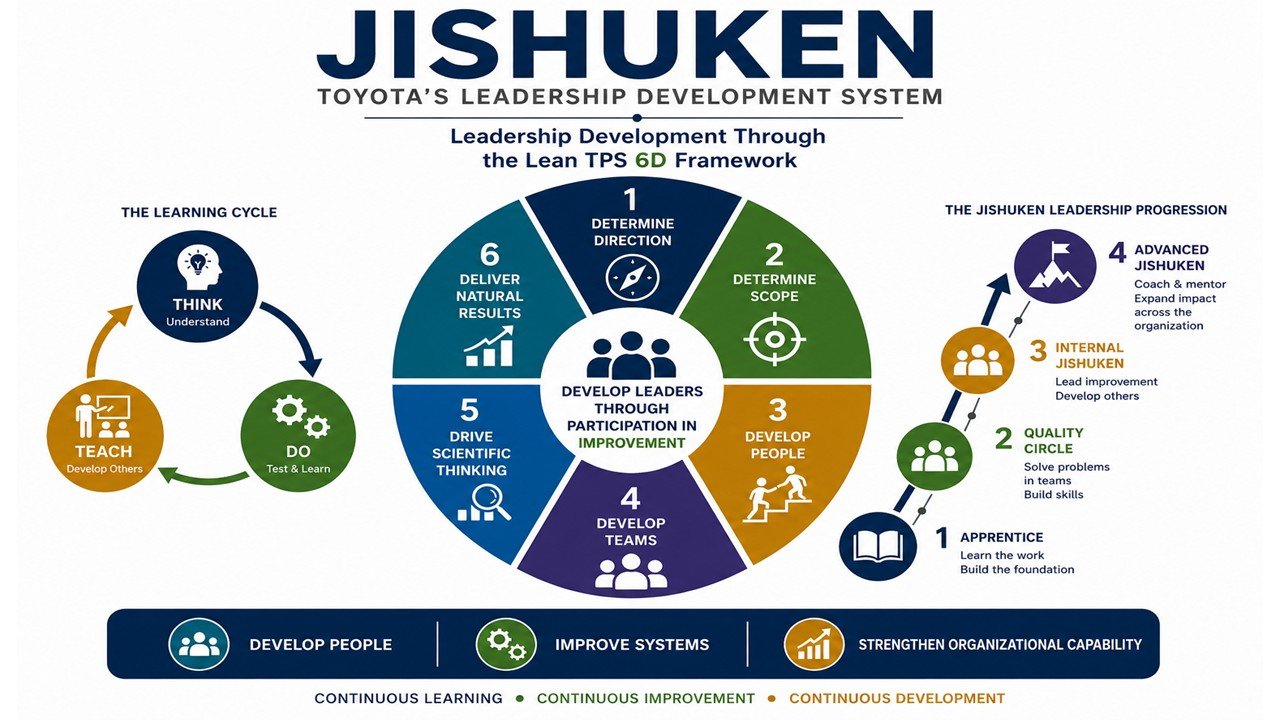
Leadership capability is not developed primarily through classroom instruction. It develops through direct engagement with real problems, practical application of improvement methods, observation, coaching, experimentation, reflection, and continuous learning. For this reason, Toyota created development processes that embed learning directly into the work itself rather than separating development from operational reality.
One of the most powerful examples of this approach is Jishuken.
The term Jishuken is commonly translated as “self-study” or “autonomous learning.” While technically accurate, these translations do not fully capture its purpose within the Toyota Production System. Jishuken is not independent study in the traditional sense. It is a structured approach to developing leadership capability through direct participation in improvement activities.
The purpose of Jishuken is not simply to solve problems.
The purpose is to develop people capable of solving problems.
This distinction reflects one of the most important principles within Lean TPS. Many organizations evaluate improvement activities primarily by the operational results achieved. Toyota values operational improvement, but equal importance is placed upon the learning that occurs during the improvement process. An activity that develops stronger leaders may create greater long-term value than an activity that produces immediate results while leaving organizational capability unchanged.
This philosophy is based upon a simple observation.
Understanding develops through practice.
Reading about Standardized Work does not create the same understanding as developing, confirming, and improving Standardized Work. Studying PDCA does not create the same understanding as conducting repeated cycles of experimentation and learning. Learning about coaching does not create the same capability as coaching individuals through actual operational challenges.
Capability develops through application.
Jishuken was designed to create those opportunities.
Participants work on actual operating conditions rather than simulated exercises. Problems are real. Constraints are real. Results are real. Learning occurs because participants must apply Lean TPS principles under actual conditions rather than discussing them theoretically. Observation, analysis, experimentation, reflection, and coaching become part of the learning process.
This approach closes the gap between knowledge and application.
Jishuken also recognizes that most organizational problems extend beyond departmental boundaries. Quality affects production. Production influences logistics. Logistics affects scheduling. Scheduling impacts inventory, workload, and delivery performance. When improvement activities occur exclusively within functional silos, understanding often remains limited because individuals see only a portion of the system.
To address this challenge, Jishuken creates cross-functional learning environments. Participants with different backgrounds, experiences, and responsibilities work together to understand conditions, identify abnormalities, investigate causes, and develop countermeasures. As a result, individuals gain a broader understanding of how organizational systems interact while developing a greater appreciation for the challenges faced by other functions.
This cross-functional perspective improves both collaboration and problem solving. Participants learn to move beyond local optimization and begin viewing performance from a system perspective. The learning extends well beyond the immediate improvement activity because individuals develop a deeper understanding of the relationships that influence organizational performance.
Jishuken also develops leadership behaviors that are difficult to teach through traditional training programs. Participants learn how to observe conditions objectively, ask effective questions, challenge assumptions, facilitate discussion, build alignment, and coach others through problem-solving activities. These capabilities emerge through repeated practice under real operating conditions rather than through classroom instruction alone.
The relationship between Jishuken and the broader Toyota Production System is equally important.
Leadership development is not separate from continuous improvement.
Leadership development occurs through continuous improvement.
Every PDCA cycle develops scientific thinking. Every A3 develops problem-solving capability. Every Kaizen activity develops learning capability. Jishuken integrates these elements into a structured development process that develops leaders through direct application rather than theory alone.
Over time, these experiences create leaders who are comfortable operating under changing conditions because they possess the skills required to understand problems, evaluate alternatives, develop people, and guide improvement efforts. They learn how to lead when answers are not immediately known. They learn how to improve systems by developing people. Most importantly, they learn how to create learning within the organization itself.
These capabilities become increasingly important as organizations confront Artificial Intelligence, automation, humanoid robotics, workforce shortages, demographic change, and growing operational complexity. Future conditions cannot be predicted with certainty. Organizations therefore require leaders who can learn, adapt, teach, and improve rather than simply apply predefined solutions.
Toyota recognized decades ago that future challenges could not be solved through procedures alone.
Organizations require leaders capable of learning their way forward.
The purpose of Jishuken was never merely to improve processes.
The purpose was to develop leaders capable of improving processes continuously.
In doing so, Toyota created one of the most effective leadership development systems ever embedded within an operating system.
The Toyota Production System was never designed as a collection of improvement tools. It was designed as a leadership system capable of learning, adapting, and developing people continuously.
Explore additional Lean TPS articles, TPS leadership resources, and practical improvement insights at LeanTPS.ca.
9. Kaizen: Change as a Daily Activity
Many organizations pursue improvement through large projects. Significant resources are assembled. Teams are assigned. Consultants are engaged. Plans are developed. Implementation schedules are created. Months may pass before meaningful changes are introduced.
While these initiatives can produce valuable results, Toyota recognized that relying exclusively on large-scale improvement efforts creates limitations. Markets do not wait for projects to finish. Problems do not appear according to implementation schedules. Guest expectations evolve continuously. New technologies emerge. Competitive pressures change. Opportunities for improvement arise every day at the point of work.
Organizations that depend primarily upon major initiatives often respond too slowly because improvement becomes separated from daily operations.
The Toyota Production System addresses this challenge through Kaizen.
Kaizen is commonly translated as continuous improvement. While accurate, the translation often understates the significance of the concept. Within Toyota, Kaizen is not simply an improvement activity. It is a management philosophy that embeds observation, learning, problem solving, and adaptation directly into daily work.
The objective is not occasional improvement.
The objective is to make improvement part of normal work.
This distinction explains why Toyota does not rely solely on periodic projects to improve performance. Larger improvement initiatives certainly occur, but the greatest source of organizational learning often comes from countless small improvements generated directly by the people performing the work.
Team members, team leaders, supervisors, managers, and senior leaders continuously identify opportunities to eliminate waste, reduce variation, improve quality, simplify execution, strengthen safety, and improve flow.
Over time, these small improvements create significant operational benefits. More importantly, they create an organization that becomes increasingly capable of adapting to change.
Each improvement begins with observation. Observation develops understanding. Understanding supports experimentation. Experimentation produces learning. Learning improves future decisions and strengthens the organization’s ability to solve the next problem. The cumulative effect extends far beyond the individual improvement itself because problem-solving capability is strengthened every day throughout the organization.
This relationship explains why Kaizen serves both as an improvement process and a people-development process.
Many organizations focus primarily on the results generated by improvement activities. Toyota values results, but equal importance is placed on developing the capability to achieve future results. Every Kaizen activity strengthens problem-solving capability, deepens operational understanding, improves teamwork, and increases confidence in the ability to improve performance.
Over time, this creates an important competitive advantage.
Conditions change continuously. Guest expectations evolve. Technologies advance. Markets fluctuate. Supply chains change. Workforce demographics shift. New challenges emerge. Organizations that improve only during major projects often struggle to respond because learning occurs intermittently. Organizations that practice Kaizen develop a habit of continuous adaptation because observation, experimentation, and improvement occur every day.
Improvement gradually becomes part of the culture rather than a special event.
This capability becomes increasingly important in environments influenced by Artificial Intelligence, automation, digital manufacturing, and humanoid robotics. New technologies will continue to create opportunities for improvement while simultaneously introducing new forms of complexity and variation. Organizations that possess strong Kaizen capability will be better positioned to adapt because they have already developed the habit of identifying problems, testing ideas, and adjusting to changing conditions.
This reflects a broader principle within the Toyota Production System.
Organizations do not become adaptable because they occasionally change.
Organizations become adaptable because they improve continuously.
Kaizen provides the mechanism through which continuous improvement becomes embedded in daily work.
For Toyota, Kaizen was never intended to be an event, a workshop, or a periodic improvement program. It was intended to become part of daily work and part of daily leadership. Every improvement strengthens understanding. Every lesson improves future decision-making. Every problem solved increases the organization’s ability to respond to the next challenge.
Over time, thousands of small improvements create something far more valuable than individual operational gains.
They create an organization capable of adapting continuously as conditions change.
That capability ultimately becomes one of the strongest forms of competitive advantage because it allows the organization to improve faster than the environment around it changes.
10. Leading Through the Changes of the Times
Every generation of leaders faces a different set of challenges. Technologies evolve. Markets change. Workforce demographics shift. Competitive pressures increase. New opportunities emerge while established business models become obsolete. Although the specific circumstances differ from one generation to the next, the fundamental responsibility of leadership remains remarkably consistent: understand changing conditions and guide the organization’s response.
Toyota’s history provides numerous examples of leaders adapting successfully to changing conditions while relying upon a remarkably consistent set of principles. Sakichi Toyoda responded to limitations within textile manufacturing through innovation and experimentation. Kiichiro Toyoda recognized that future opportunities extended beyond textiles and into automobile manufacturing. Taiichi Ohno developed new approaches to production, inventory management, quality, and flow in response to resource limitations and changing market conditions following the Second World War.
The circumstances facing each leader were different.
The leadership challenge was the same.
Each generation was required to understand current conditions, develop people, learn through experimentation, and improve continuously. The specific problems changed. The underlying method for addressing those problems remained remarkably consistent.
Organizations today face a different set of challenges, but the pattern remains familiar.
Artificial Intelligence is transforming decision-making, information management, quality analysis, and administrative processes. Digital manufacturing systems are creating unprecedented levels of connectivity and operational visibility. Advanced automation continues to change the relationship between people and machines. Humanoid robotics is beginning to introduce new possibilities for flexible manufacturing environments. At the same time, organizations must respond to demographic change, skilled labor shortages, supply chain instability, increasing regulatory requirements, and intensifying global competition.
Many organizations view these developments primarily as technology challenges.
Toyota’s history suggests they should also be viewed as leadership challenges.
Technology does not eliminate the need for leadership. In many respects, it increases the importance of leadership because increasingly complex operating environments require greater clarity regarding standards, operating conditions, abnormality management, decision-making, and problem-solving capability.
Advanced technology may improve the speed of execution.
It does not eliminate the need to establish the conditions under which effective execution can occur.
Organizations frequently assume that technological advancement alone creates competitive advantage. History suggests otherwise. New technologies eventually become available to competitors. Equipment can be purchased. Software can be licensed. Automation can be replicated. Analytical tools can be acquired.
Sustainable advantage rarely comes from technology itself.
Sustainable advantage comes from an organization’s ability to understand changing conditions, learn more effectively than competitors, and adapt its operating system accordingly.
This reality helps explain why the core practices of the Toyota Production System remain relevant despite dramatic changes in technology.
Standardized Work remains necessary because stable operating conditions are still required for learning.
Genchi Genbutsu remains necessary because leaders must continue to understand actual conditions rather than assumptions.
PDCA remains necessary because organizations must continue testing ideas and learning from results.
A3 Thinking remains necessary because alignment and shared understanding remain essential.
Kaizen remains necessary because opportunities for improvement continue to emerge every day.
Jishuken remains necessary because leadership capability must still be developed through practice rather than theory alone.
The technologies have changed significantly since the Toyota Production System was first developed.
The underlying leadership challenges have not.
This reality becomes particularly important as organizations begin integrating Artificial Intelligence and humanoid robotics into operational environments. Much of the current discussion focuses on what these technologies can do. Far less attention is given to the operating conditions required for those technologies to perform effectively.
Toyota’s experience suggests that advanced capability cannot compensate for unstable execution.
Technology executes within the system that already exists.
If operating conditions are unstable, technology often amplifies instability by executing variation more consistently and at greater speed. If operating conditions are stable, technology can strengthen consistency, improve capability, accelerate learning, and increase performance.
For this reason, the future of manufacturing is unlikely to be determined solely by advances in Artificial Intelligence, robotics, automation, or digital technologies.
The organizations that benefit most from these technologies will be those that possess the strongest capability to learn, adapt, and improve under changing conditions.
The future will also be shaped by the ability of leaders to establish stable operating conditions, develop capable people, identify abnormalities, learn through experimentation, and continuously improve performance.
These responsibilities guided Toyota’s development throughout the twentieth century and remain equally important as organizations navigate the challenges of the twenty-first.
The specific problems confronting leaders will continue to evolve. New technologies will emerge. New competitive pressures will develop. New forms of work will appear.
Yet organizations that understand how to learn, adapt, and improve systematically will be better prepared to respond because they possess something more valuable than any individual technology.
They possess the capability to continue improving as conditions change around them.
That capability has always been the true source of long-term competitiveness.
11. Change Capability as Competitive Advantage
Many organizations view competitive advantage as a product of technology, capital investment, market position, intellectual property, scale, or access to resources. While these factors can influence performance, Toyota’s history suggests that a more fundamental source of competitive advantage exists.
The ability to learn, adapt, and improve as conditions change.
Throughout its development, Toyota repeatedly demonstrated that long-term success depends less upon existing capabilities and more upon the ability to develop new capabilities when circumstances require them. This pattern can be observed across multiple generations of leadership and helps explain why Toyota’s management system continues to attract attention decades after its development.
The foundation was established by Sakichi Toyoda. His innovations in textile manufacturing were not simply technical achievements. They reflected a commitment to understanding problems, challenging assumptions, and improving performance. The development of automatic looms introduced a principle that would later become central to the Toyota Production System: abnormalities should be identified immediately, and work should not continue when acceptable conditions no longer exist. The thinking that eventually evolved into Jidoka began with this approach.
Kiichiro Toyoda extended this foundation by demonstrating the importance of adaptation. The textile industry had created the company’s initial success, yet he recognized that future opportunities required a different direction. Rather than protecting an existing business model, he redirected the organization toward automobile manufacturing. The transition required new technologies, new suppliers, new manufacturing methods, new management practices, and new leadership capabilities. It also required the willingness to abandon familiar assumptions in order to pursue future opportunities.
Following the Second World War, Toyota faced another challenge. Limited resources, low production volumes, and increasing competition made it impossible to compete directly with larger Western manufacturers using conventional approaches. Taiichi Ohno responded by developing new methods for managing production, inventory, quality, flow, and problem solving. These methods eventually became the Toyota Production System.
Viewed together, these three leaders reveal a progression that extends far beyond manufacturing.
Sakichi Toyoda demonstrated the importance of solving problems.
Kiichiro Toyoda demonstrated the importance of adapting to changing conditions.
Taiichi Ohno created a management system capable of institutionalizing both.
This progression helps explain the true source of Toyota’s long-term success.
The competitive advantage was never a particular machine, production method, technology, or management tool.
The competitive advantage was the organization’s ability to learn.
Each generation strengthened Toyota’s capacity to respond effectively to changing conditions. Problems became opportunities for learning. Constraints became opportunities for innovation. Change became an opportunity for improvement rather than a threat to stability. Over time, these practices created an organization capable of adapting repeatedly without losing its identity, values, or operational discipline.
This capability remains relevant because the challenges facing organizations continue to change. Technologies evolve. Markets shift. Products change. Competitive pressures emerge and disappear. Yet the need to understand current conditions, develop people, solve problems, and improve continuously remains constant.
Toyota’s long-term success was never built upon a single innovation.
It was built upon an organizational capability to learn, adapt, and improve repeatedly as conditions changed.
That capability became one of the most powerful competitive advantages ever embedded within a management system because it enabled Toyota to respond effectively to challenges that could not be predicted in advance.
Organizations seeking long-term success often focus on acquiring new technologies, implementing new systems, or responding to immediate challenges. Toyota’s history suggests a different priority.
Develop the capability to learn.
Organizations that develop this capability are better prepared not only for today’s challenges, but also for conditions that have not yet emerged. They possess a competitive advantage that remains valuable regardless of how technologies, markets, competitors, or business conditions evolve.
The future cannot be predicted.
The capability to learn, adapt, and improve can be developed.
That capability may be the most enduring competitive advantage an organization can possess.
The common thread connecting every chapter of Toyota’s history is not a specific tool or method. It is the development of an organizational capability to learn, adapt, and improve under changing conditions.
Final Thought
Throughout its history, Toyota faced challenges that could not have been predicted in advance. Markets changed. Technologies evolved. Competitors emerged. Economic conditions shifted. Guest expectations increased. Each generation of Toyota leaders encountered different circumstances requiring different responses, yet the underlying leadership challenge remained remarkably consistent.
How does an organization continue to succeed when the conditions that created its success are constantly changing?
Toyota’s answer was not a single tool, initiative, improvement program, or technology. It was the development of a management system designed to strengthen organizational learning over time.
Standardized Work established stable operating conditions from which improvement could occur. Genchi Genbutsu grounded decisions in direct observation and reality. PDCA created a disciplined method for learning through experimentation. A3 Thinking developed alignment and shared understanding. Kaizen embedded improvement into daily work. Jishuken developed leaders capable of teaching, coaching, and improving others.
Together, these practices created far more than operational efficiency.
They created organizational adaptability.
This distinction becomes increasingly important as organizations navigate Artificial Intelligence, automation, digital manufacturing, humanoid robotics, demographic change, workforce challenges, and growing competitive pressure. Technologies will continue to evolve. Markets will continue to change. New opportunities and new challenges will continue to emerge.
The leadership challenge remains the same.
Organizations must understand changing conditions, develop capable people, learn from experience, and improve continuously without sacrificing operational stability.
Toyota’s long-term success was never built solely upon equipment, production methods, technology, or operational tools. Those elements evolved repeatedly throughout the company’s history. What remained constant was the organization’s commitment to learning, problem solving, people development, and continuous improvement.
The importance of this capability remains as relevant today as when Kiichiro Toyoda observed:
“A company that cannot change is a company without a future.”
The statement is often interpreted as a call to embrace change.
Toyota’s history suggests a deeper meaning.
The challenge is not simply responding to change when it occurs. The challenge is developing an organization capable of learning, adapting, and improving before circumstances force change upon it.
Organizations that develop this capability will be better prepared not only for today’s challenges, but also for opportunities and uncertainties that have not yet emerged.
For leaders, the responsibility extends far beyond managing individual initiatives or implementing new technologies.
The responsibility is to develop people, systems, and leadership practices capable of learning, adapting, and improving long after any individual project, technology, or leader has passed.
Ultimately, the future belongs not to the organizations that change the fastest, but to the organizations that learn the fastest.
Because the ability to learn is what makes adaptation possible.
And adaptation is what makes long-term success sustainable.