Why Lean TPS uses Standardized Work as the foundation for visual control
Why 5S Exists in Lean TPS
Lean TPS does not use 5S to improve appearance. Lean TPS uses 5S to make problems visible so they can be addressed through structured problem solving. Visibility is not an aesthetic preference in the Toyota Production System. Visibility is a functional requirement for Quality, safety, and stability.
Every production system experiences change. Product mix changes. Volumes change. Equipment is modified. Layouts are adjusted. New people are trained. Each change introduces instability into the system, even when the change is well intended. Instability does not announce itself clearly. Instability hides inside unclear work areas, informal staging, excess material, and personal workarounds. When the environment allows ambiguity, people compensate in order to keep production moving.
Lean TPS treats compensation as a warning signal, not as success. When operators search for tools, stage extra parts “just in case,” shift material locations, or adjust their own sequence to cope with constraints, the system appears to function while learning is delayed. Problems remain hidden. Quality risks increase quietly. Improvement becomes reactive instead of deliberate.
5S exists to remove that cover.
In Lean TPS, 5S establishes a clear visual baseline so deviations from the intended condition are immediately apparent. The purpose is not to make the area neat. The purpose is to make abnormal conditions obvious without discussion, interpretation, or measurement. A visually unclear environment forces people to think and decide constantly. A visually controlled environment allows people to see problems instantly.
Problem solving requires a known current condition. Without visual clarity, no reliable current condition exists. Teams discuss symptoms instead of causes. Leaders rely on reports instead of observation. Improvement activity focuses on effort rather than structure. Lean TPS prevents this by treating 5S as a prerequisite for problem solving, not as an improvement outcome.
Visibility also protects Quality at the source. When boundaries are clear and quantities are defined, missing parts, extra parts, blocked access, and broken flow stand out immediately. Errors are exposed at the moment they occur. The system does not rely on inspection or heroics to recover later. Learning happens where the work is performed.
Lean TPS therefore applies 5S with intent. The work area is reset so only what is required remains. Locations are fixed. Quantities are limited. Boundaries are explicit. What remains represents the system’s intent, not personal preference. Once that baseline exists, instability introduced by change can be seen clearly.
5S does not improve processes by itself. 5S creates the conditions where problems cannot hide. Lean TPS depends on this visibility to enable real problem solving, accelerate learning, and protect Quality before loss occurs.
Standardized Work as the Foundation for Visual Control
5S cannot function independently in Lean TPS. Visual control only works when the intended condition of the work has already been defined. Standardized Work provides that definition. Without Standardized Work, 5S becomes subjective and fragile. With Standardized Work, 5S becomes enforceable.
Lean TPS uses Standardized Work to define how work is performed and how the system is expected to operate. Sequence, quantity, position, and timing are not preferences. They are system constraints. These constraints describe the only condition under which flow, safety, and Quality can be achieved simultaneously. Visual control exists to make adherence to those constraints visible.
Standardized Work establishes intent before any physical layout is finalized. The order of operations defines where people stand, where parts are presented, and how work progresses. Required quantities define how much material is allowed at each point. Timing defines pace and interaction with shared resources. Position defines where work happens and where it does not. Layout emerges from these requirements. Layout does not precede them.
When Standardized Work is unclear or incomplete, visual organization becomes cosmetic. Floor markings are applied without meaning. Storage locations multiply. Excess material accumulates to absorb variation. Tools migrate based on convenience. The area may appear organized, but the system lacks control. People must interpret conditions and make local decisions to keep work moving. This creates inconsistency and hides problems.
Lean TPS avoids this failure by treating Standardized Work as the governing system. Visual elements exist to support the standard, not to replace it. Locations are fixed because the work requires them to be fixed. Quantities are limited because the standard defines how much is needed. Flow paths are constrained because sequence and timing demand it. Visual control reflects intent. It does not create intent.
This relationship explains why 5S initiatives often fail when introduced in isolation. Without a defined standard, teams debate what belongs, where it belongs, and how much is acceptable. Decisions drift toward comfort and convenience. Over time, personal preference replaces system discipline. Visual order deteriorates because there is nothing objective to sustain it.
In Lean TPS, Standardized Work removes ambiguity before 5S is applied. The work is defined. The system intent is clear. Only then does 5S establish the visual conditions that enforce that intent daily. Deviations become obvious because the standard exists. Problems surface because the system has something to deviate from.
Visual control is therefore a consequence of Standardized Work, not a substitute for it. Lean TPS relies on this hierarchy to prevent drift, protect Quality, and ensure that learning occurs through observation of real conditions rather than interpretation of incomplete information.
5S Thinking as a Visual Reset After Change
Lean TPS applies 5S deliberately after change, not as a preparatory activity and not as routine maintenance. Change introduces instability even when it improves capability. New layouts, new equipment, mixed products, revised sequences, and adjusted staffing all disrupt previously stable conditions. If the environment allows ambiguity, that instability is absorbed by people rather than exposed by the system.
5S Thinking is used as a visual reset to remove that ambiguity.
After change, informal adaptations appear quickly. Parts are staged temporarily. Tools are placed where they seem convenient. Material accumulates to protect against uncertainty. Access paths widen or narrow without intent. These adjustments allow production to continue, but they also mask where the system no longer supports the work. Problems become normalized. Learning slows.
Lean TPS uses 5S to reset the work area to the intended condition defined by Standardized Work. Items that do not support the standard are removed. Locations are fixed to reflect sequence and position. Quantities are limited to what the work requires. Boundaries are made explicit so deviation is immediately visible. The environment is no longer allowed to absorb variation quietly.
This reset is not about enforcement through discipline. It is about removing interpretation. When locations are optional and quantities are flexible, people must decide constantly how to proceed. Decision-making hides system weakness. A visually controlled environment removes choice where choice is not required. The system communicates what is correct without explanation.
Timing matters. Applying 5S before standards are stable creates false order. Applying 5S after change exposes where standards are incomplete or breaking down. Lean TPS uses this exposure intentionally. When the visual reset is complete, the system either operates as intended or it does not. Failure becomes obvious at the point of use.
5S Thinking therefore functions as a diagnostic step. It reveals where flow is constrained, where access is compromised, where quantities are wrong, and where sequence cannot be maintained. These conditions surface immediately because the environment no longer compensates. The work area becomes a reflection of the system’s capability rather than the workforce’s adaptability.
Lean TPS depends on this clarity. Without a visual reset after change, instability is normalized and improvement stalls. With it, problems are seen early, addressed deliberately, and resolved structurally. 5S Thinking creates the conditions where change can be evaluated honestly and where Quality risks are exposed before loss occurs.
Reading the Image: From Ambiguity to Enforced Flow
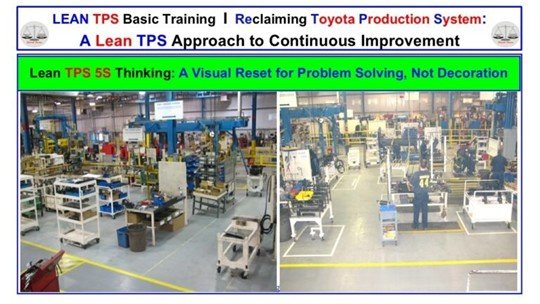
The image associated with this article shows two conditions of the same work area at different points in its evolution. The value of the image is not in the contrast itself, but in what the contrast makes visible about system intent and system discipline. The image is not evidence of cleaning. It is evidence of control.
The left condition represents an intermediate state during change. Flow exists, but it is ambiguous. Boundaries are soft. Material is present, but sequence and quantity are not immediately clear. People can adjust locally to keep work moving. The system appears functional, but its constraints are not obvious. Problems can hide because the environment absorbs variation.
The right condition represents the executed state aligned to Standardized Work and the Information and Flow layout. Boundaries are explicit. Positions are fixed. Quantities are controlled. Flow paths are defined. There is little excess space to absorb error. The environment communicates how work must proceed without explanation. Deviation becomes visible at the moment it occurs.
The most important elements in the image are the carts. These carts are not storage devices. In this system, the carts themselves are the kanban signal. They define what is pulled, in what sequence, and in what quantity. What appears on each cart, how much is present, and where the cart is positioned are all defined by Standardized Work. The carts enforce order, quantity, and timing physically at the point of use.
This is a full pull system. Capacity and work-in-process are controlled by the number of carts in circulation. When demand increases and the existing carts cannot absorb the required pace within the defined constraints, additional carts are added deliberately. When demand decreases, carts are removed. Adjustment does not require redesigning the layout or rewriting the process. The pull signal changes by changing the number of carts, while the work definition remains stable. One piece at a time flow is preserved because the layout and the carts are designed for it.
Physical constraints matter. Components are heavy. Fixtures are specific. Lifting systems are shared. Positions must be precise for work to proceed without delay or rehandling. The layout reflects these constraints directly. There is no buffer space to absorb misplacement or excess material. If flow breaks down, the cause is immediately visible because the environment cannot hide it.
The image also shows how mixed products can be supported without confusion when standards are clear. Different models require different fixtures and positions, yet flow is maintained because each condition is defined and enforced visually. People are not required to remember exceptions or compensate for ambiguity. The system carries that responsibility.
The purpose of the image is to teach how Lean TPS uses visual control to enforce intent. The right condition did not emerge from organizing effort. It emerged from disciplined definition of work and deliberate visual enforcement. Once that enforcement exists, the system either functions or fails openly. That openness is what enables learning and protects Quality at the source.
Why People Must Not Become the Buffer
Production systems fail quietly when people compensate for structural weakness. Lean TPS treats this behavior as risk, not resilience. When operators adapt their sequence, carry extra material, search for tools, or adjust timing to keep work moving, the system appears stable while its problems remain unresolved. Quality loss is delayed, not prevented.
Human adaptability is powerful. Humans can work around clutter, ambiguity, and inconsistency. Humans can anticipate problems and recover locally. That ability keeps production running, but it also masks where the system no longer supports the work. When people become the buffer, learning stops at the surface. The system does not improve because it is never allowed to fail visibly.
Lean TPS is designed to prevent this condition. Visual control exists so that deviation from the intended condition is exposed immediately rather than absorbed. When quantities are limited, missing or extra parts stand out. When positions are fixed, misplacement is obvious. When sequence is enforced, out-of-order work is visible. The environment signals failure at the point of use.
This visibility connects directly to stop logic and Quality protection. Lean TPS does not rely on inspection to catch defects later. It relies on the system to reveal abnormal conditions early, when correction is possible without escalation. When people are not required to compensate, they are free to stop, signal, and solve. The system supports them instead of demanding heroics.
Leadership responsibility is central to this design. Allowing people to buffer poor system design transfers risk downward. It creates variability in outcomes and fatigue in the workforce. Lean TPS places the burden of stability on the system itself. Leaders define the standards, enforce the visual conditions, and respond when the system exposes failure.
Preventing people from becoming the buffer is not about reducing flexibility. It is about preserving learning. When problems surface immediately, causes can be addressed structurally. When problems are hidden by effort, the same failures repeat. Visual control ensures that the system, not the individual, carries responsibility for performance.
Lean TPS protects Quality by refusing to let problems hide behind human adaptability. Visibility replaces compensation. Structure replaces effort. Learning replaces recovery.
Personal Experience: What Became Visible After the Reset
The most important learning from this change did not come from planning the layout. It came from what surfaced after the visual reset was complete. Once the environment stopped absorbing variation, the system began to speak clearly.
Problems that had existed for some time became obvious immediately. Material that had been staged informally no longer had a place to hide. Sequence breaks appeared as soon as they occurred. Access issues surfaced the moment flow was interrupted. What previously required explanation now required only observation. The system exposed its own weaknesses.
What was striking was how quickly people stopped compensating once the visual conditions were enforced. Operators no longer adjusted their sequence to work around constraints. Extra parts were no longer carried forward to protect against uncertainty. Work proceeded correctly or it stopped. That change was not driven by instruction. It was driven by the environment.
Learning accelerated because cause and effect were no longer separated by time or distance. When flow broke, the reason was visible at the point of use. When access was blocked, the boundary made it obvious. When quantities were wrong, the excess or shortage stood out immediately. Problem solving shifted from discussion to direct observation.
Discipline mattered more than effort during this phase. The temptation to reintroduce flexibility in the name of productivity was constant. Each exception weakened the signal the system was producing. Maintaining the visual standard required restraint, especially when pressure increased. Allowing the system to fail visibly was uncomfortable, but it was necessary.
The reset also clarified where Standardized Work was incomplete. Some conditions had been assumed rather than defined. The visual environment exposed those gaps quickly. Instead of blaming execution, the team returned to the standard and corrected it. The system improved because it was allowed to reveal its limits.
This experience reinforced a core Lean TPS principle. Visibility is not a reporting mechanism. Visibility is a learning mechanism. When the environment enforces intent, the system teaches continuously. People are no longer required to compensate for ambiguity. They are able to focus on solving the real problems the system presents.
Why 5S Does Not Solve Problems
5S Thinking does not solve problems in Lean TPS. It creates the conditions where problems cannot hide. This distinction matters because misunderstanding it leads to false conclusions about both success and failure.
Without Standardized Work, 5S produces order without control. Work areas may appear organized, but deviations remain subjective and enforcement depends on memory and effort. Problems surface only when they escalate into defects, delays, or safety incidents. At that point, response is reactive and learning is limited.
With Standardized Work in place, 5S establishes a visual environment that enforces intent continuously. Boundaries, locations, and quantities are no longer negotiable. Deviation is not debated. It is visible. This visibility does not correct the deviation automatically, but it ensures that the deviation is seen at the moment it occurs.
Problem solving in Lean TPS depends on this immediacy. Causes can be addressed while conditions are fresh and observable. Countermeasures are tested against real constraints rather than assumptions. Learning compounds because the system reveals its weaknesses repeatedly until they are resolved structurally.
Treating 5S as a solution shifts responsibility onto people. Treating 5S as an enabler places responsibility back on the system. Lean TPS relies on this discipline to protect Quality at the source. When problems surface early, defects are prevented rather than detected. When problems are hidden, Quality loss accumulates silently.
5S Thinking remains essential in Lean TPS, but only when used with intent. It enforces Standardized Work visually so that instability introduced by change is exposed rather than absorbed. It prevents people from becoming buffers. It accelerates learning by making failure visible.
The role of 5S is therefore clear. It does not improve processes by itself. It makes improvement unavoidable.