Why Every Lean TPS Journey Starts with 5S Thinking

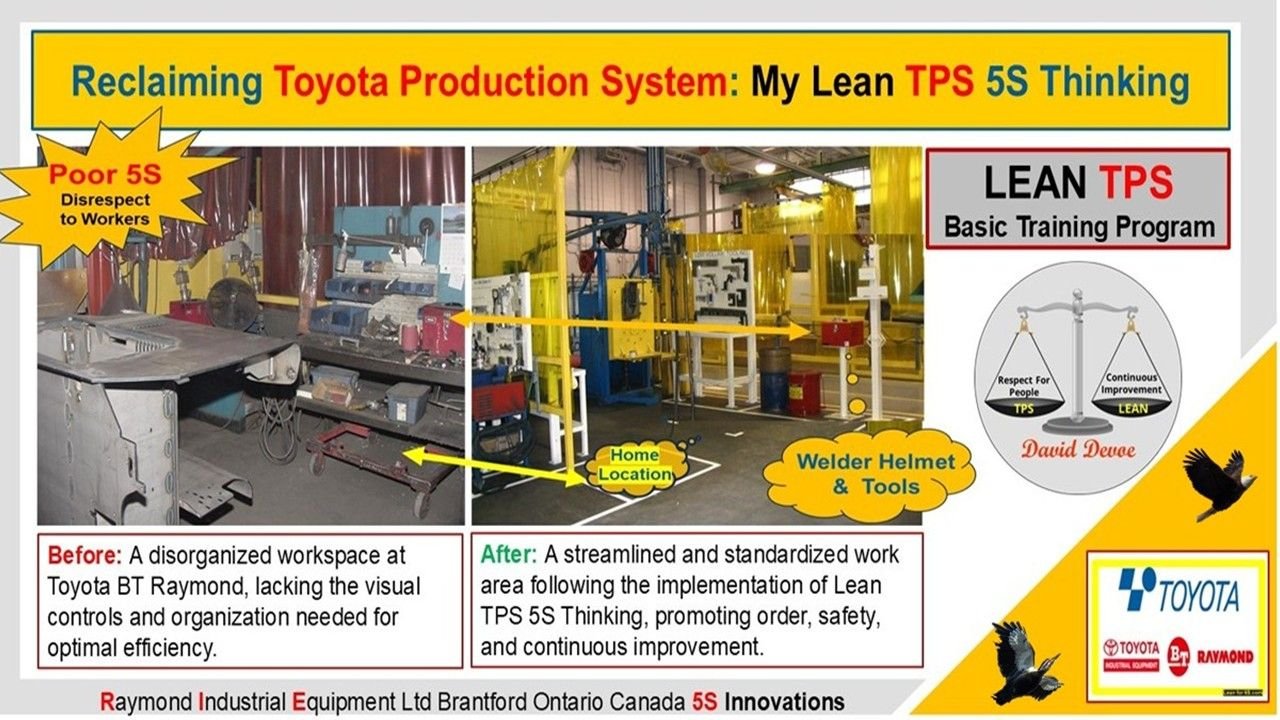
A Toyota-style weld cell demonstrating 5S and Standardized Work integration used to teach flow, time, and motion in Lean TPS training.
At Toyota, every Lean TPS journey begins with 5S Thinking. It builds the foundation for flow, quality, and leadership by creating stability, visibility, and problem awareness.

What does 5S have to do with flow, quality, and leadership?
More than most realize. It is the beginning of everything.

At Toyota, training never started with cost targets or performance metrics. It started with learning how to see. The first lesson was always 5S Thinking. Not because it was simple, but because it created the foundation for stability, visibility, and discipline.

Over the years, I have trained more than one thousand people in 5S Thinking and watched disorganized work areas transform into smooth, stable, and high-performing environments. The change was never just about cleaning or taping floors. It was about developing a structured way of thinking that made problems visible and improvement possible.

5S Thinking teaches order and awareness at the most fundamental level of Lean TPS.
It begins with:

Sort (Seiri) – Remove everything that is not needed.
Set in Order (Seiton) – Define the exact place and method for storing each item.
Shine (Seiso) – Clean and inspect to expose abnormalities early.
Standardize (Seiketsu) – Create consistent routines that sustain flow and quality.
Sustain (Shitsuke) – Build discipline through leadership and daily reinforcement.

At Toyota Raymond, 5S was always trained alongside Standardized Work Charts, Combination Tables, Working Sequence, and Takt Time. The reason was clear. You cannot improve what you cannot see. A cluttered or inconsistent workplace hides problems and prevents improvement from taking hold.

Every successful Lean TPS transformation begins with this foundation.
Not with spreadsheets.
Not with automation.
But with the discipline to see.

The 5S system is the first visible layer of the Lean TPS Swiss Cheese Model. It creates the stable base that supports Jidoka, Standardized Work, and Just-in-Time. When 5S is missing, improvement efforts fail to hold. When it is practiced correctly, it builds capability and strengthens the structure that supports quality, cost, and delivery performance.

Genchi Genbutsu means to go and see for yourself.
The same principle applies to 5S.
Seeing the real workplace reveals the conditions that make improvement possible.
That is why every Lean TPS journey starts with 5S Thinking.
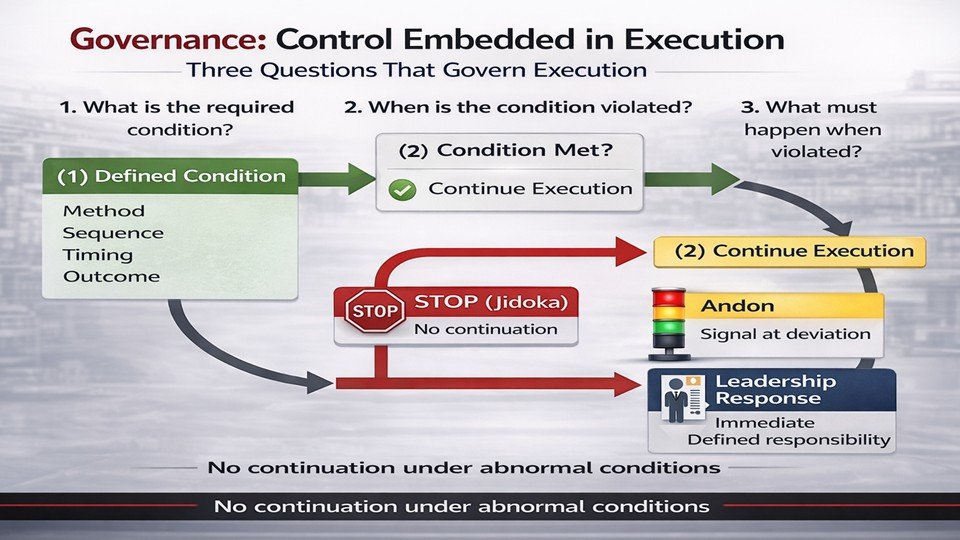
A Lean TPS system requires that execution is governed by three questions that define control. The required condition for execution must be explicitly defined through method, sequence, timing, and outcome. The point at which the condition is violated must be immediately recognizable during execution. The response required when the condition is not met must be enforced without delay. When these three elements operate together, execution is controlled and Quality is maintained as a condition of the system. Control precedes improvement because improvement depends on a stable and defined state of execution. When conditions are not defined, exposed, and enforced, improvement activity operates on an unstable system and results do not hold. Work continues under abnormal conditions, variation accumulates, and outcomes remain inconsistent. When control is established, improvement operates within defined boundaries and reinforces the condition that governs execution. Quality exists only when the required condition is maintained during each cycle of work. Quality is not achieved through measurement or inspection after execution. Quality is protected through enforcement of conditions during execution. When the condition is not met, work does not continue, and response restores the defined state before execution resumes. This enforcement prevents deviation from propagating and maintains stability at the source. A Lean TPS system requires that continuation under abnormal conditions is not permitted. When work continues despite violation of method, sequence, timing, or outcome, control does not exist and the system becomes dependent on judgment. Deviation is absorbed into normal work, and Quality is degraded. When continuation is prevented, the system enforces the boundary between normal and abnormal states and maintains control of execution. The system extends beyond individual elements and requires integration across condition definition, exposure, response, and learning. When these elements are aligned, execution is governed, leadership responds as required, and learning is embedded through repeated cycles of confirmation and correction. This integration establishes a system that maintains control and protects Quality as a condition of execution. Further development of this system requires expansion into condition design, response structure, and leadership integration at scale. The next stage addresses how conditions are constructed, how response is embedded across functions, and how governance is sustained across the organization.
Lean TPS governance image showing how conditions, deviation detection, and enforced response control execution.
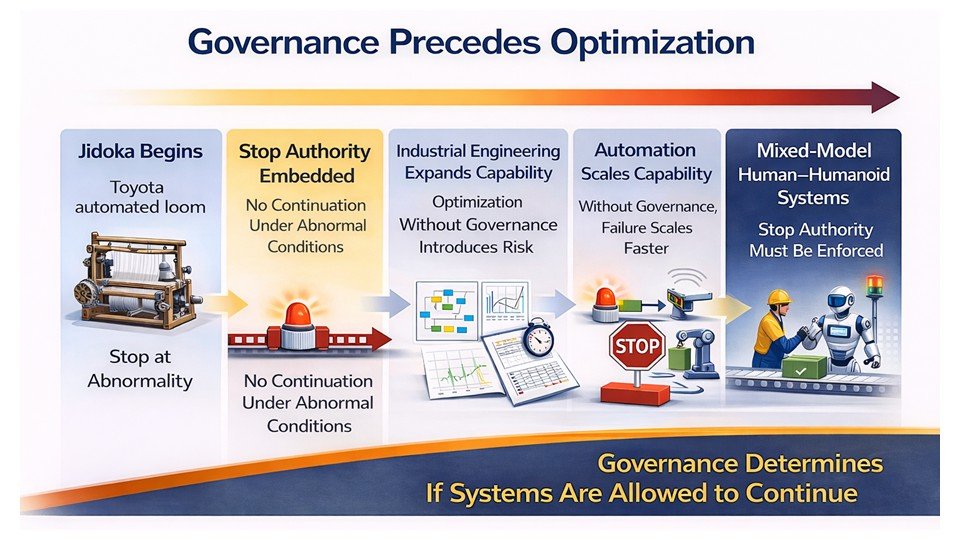
Industrial Engineering and Toyota Production System comparison showing governance, stop authority, and no continuation under abnormal conditions in Mixed-Model Human–Humanoid environments
Industrial Engineering develops system capability through analysis and optimization. The Toyota Production System governs execution in Mixed-Model Human–Humanoid environments by enforcing stop authority and preventing continuation under abnormal conditions.
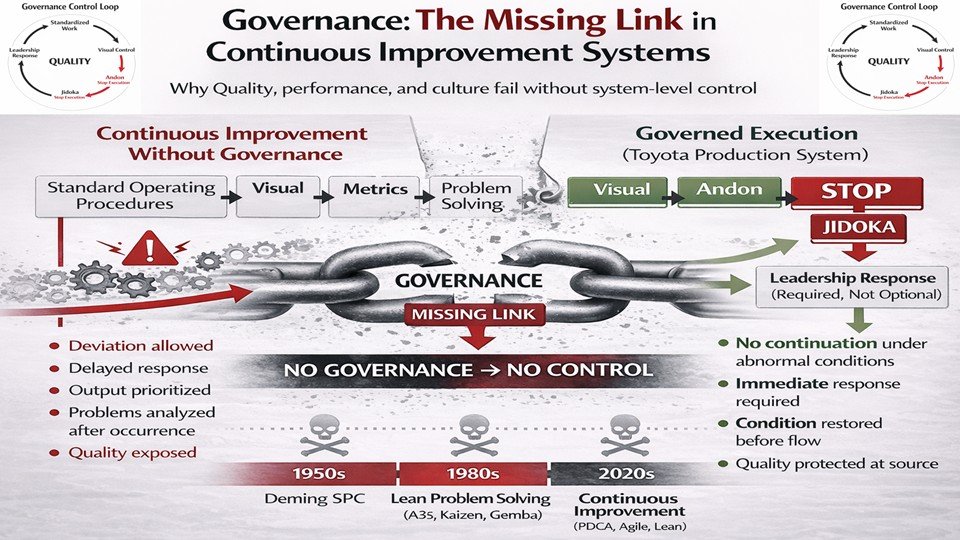
Governance as the missing link in continuous improvement systems showing standard operating procedures, visual control, Andon stop, Jidoka, and required leadership response to protect Quality
Continuous improvement systems fail when governance is absent. Standard operating procedures, visual control, Andon, and Jidoka must function together to stop execution, require leadership response, and protect Quality at the source
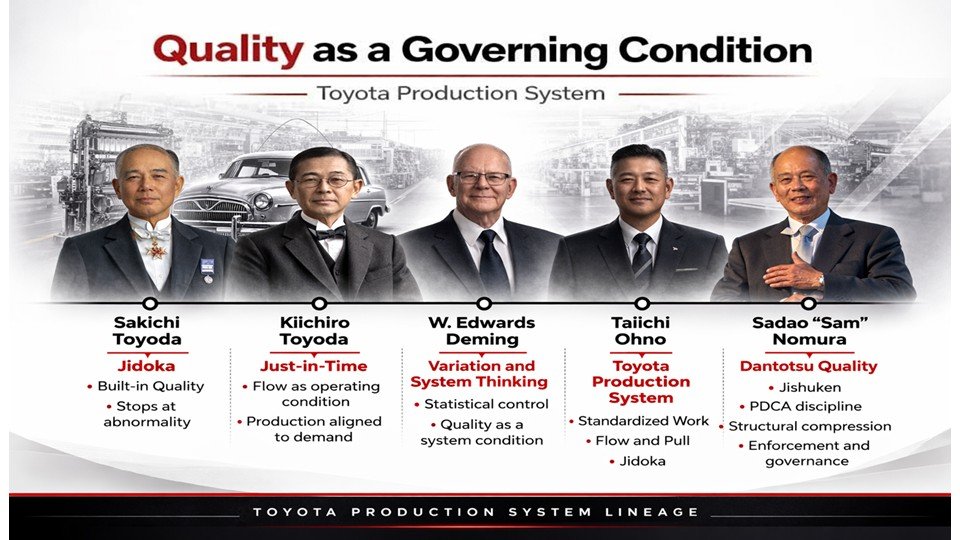
Toyota Production System Quality progression showing governing conditions, abnormality detection, and enforced response across operations
Quality in the Toyota Production System governs execution. Work continues only when conditions are met, abnormality is visible, and response is required.
Diagram illustrating Jishuken as deliberate buffer reduction within Lean TPS governance, showing how reduced manpower, inventory, and cycle time expose management behavior and test Quality protection under disciplined control.
Improvement without governance amplifies variation. Jishuken deliberately reduces buffer to expose whether leadership discipline can protect Quality under tighter operating conditions. Stability under compression confirms governance maturity.
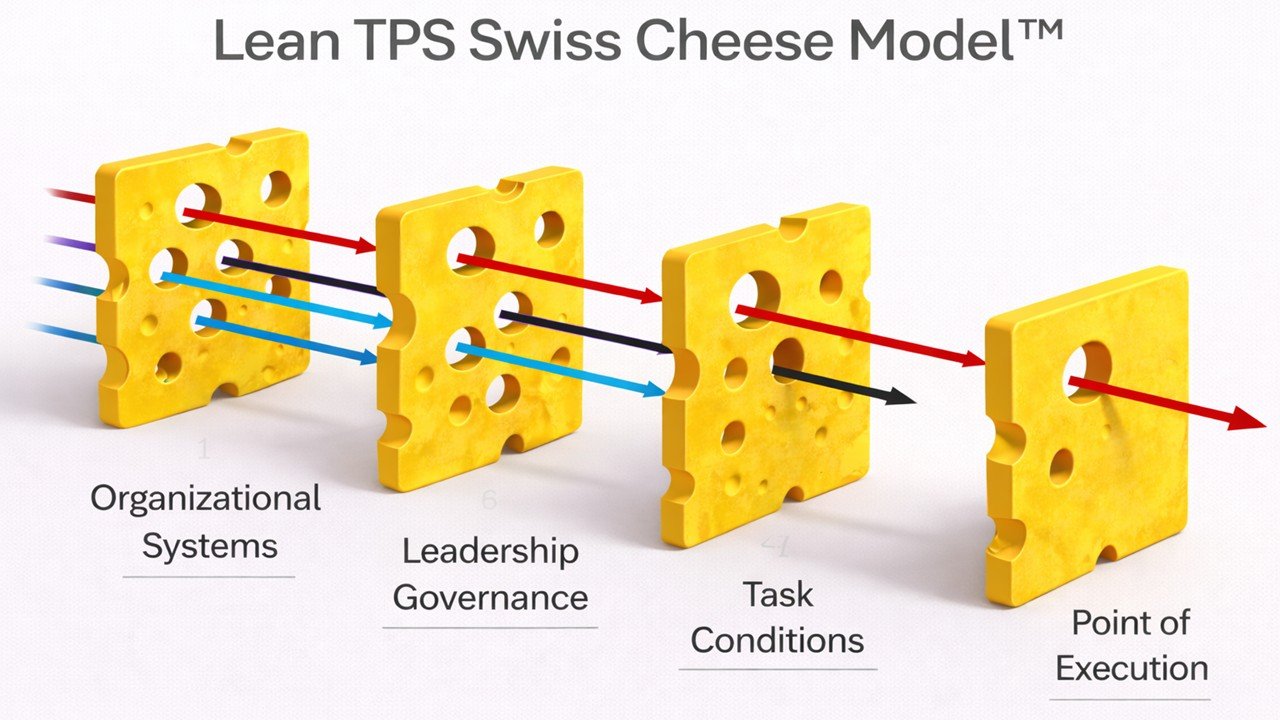
Lean TPS Swiss Cheese Model showing four aligned cheese slices representing Organizational Systems, Leadership Governance, Task Conditions, and Point of Execution, with layered penetration paths demonstrating Quality containment.
A visual representation of the Lean TPS Swiss Cheese Model™, demonstrating how layered governance architecture progressively protects Quality from Organizational Systems through to Point of Execution.