Reclaiming Toyota Production System: My Lean TPS 5S Thinking

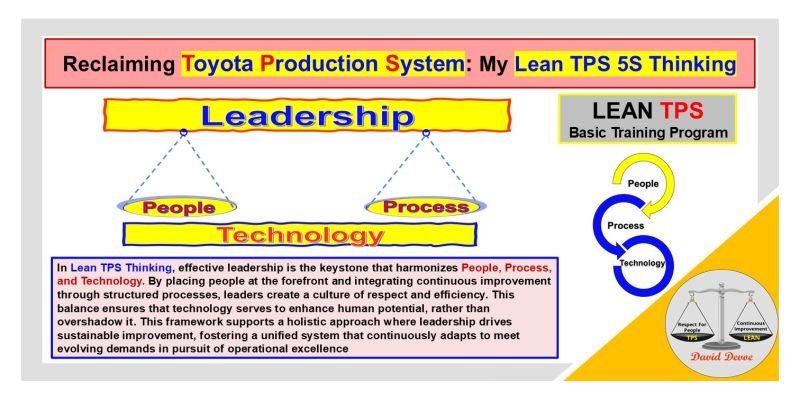
Lean TPS Basic Training visual created by David Devoe showing My Lean TPS 5S Thinking framework where leadership balances People, Process, and Technology to drive structure and safety.
Lean TPS 5S Thinking is leadership in action. It harmonizes People, Process, and Technology to create structure, visibility, and sustainable improvement.

What made the Toyota Production System different was not its tools. It was its structure. At Toyota, improvement began with a disciplined way of thinking that created visibility, built respect, and taught leadership through daily practice. That method was called 5S Thinking.

In Lean TPS, 5S is more than workplace organization. It is the foundation of all learning. It teaches leaders how to see, how to standardize, and how to sustain improvement through clarity and structure.

The Foundation of 5S Thinking
The five elements—Sort, Set in Order, Shine, Standardize, and Sustain—work together to make problems visible and processes predictable. Each “S” supports the next:

  • Sort removes what is unnecessary to focus on value.
  • Set in Order assigns a place for everything.
  • Shine maintains cleanliness and ownership.
  • Standardize ensures consistency across teams and shifts.
  • Sustain anchors discipline through leadership follow-up and visible results.

When applied together, 5S creates stability. It exposes waste and builds a culture of accountability. It also makes learning possible by ensuring that every member sees the same reality.

Leadership Balance: People, Process, and Technology
In Lean TPS 5S Thinking, leadership is the keystone that balances People, Process, and Technology. When people are supported and processes are structured, technology enhances rather than replaces human potential. When leadership fails to maintain that balance, systems drift and quality declines.

The visual from my Lean TPS Basic Training shows this relationship clearly. Leadership sits above, harmonizing People and Process, with Technology providing the base. This structure ensures that improvement is driven by people and sustained through process discipline.

Adding the Sixth S: Safety
My Lean TPS 6S Thinking expands the model by adding Safety as the sixth S. Safety is not a separate program; it is the highest expression of Respect for People. It ensures that every improvement strengthens both quality and well-being.

At Toyota BT Raymond, this addition became the turning point for sustainable improvement. Once safety was fully integrated, maintaining 5S standards required only minutes each day because ownership was shared. Safety transformed discipline into culture.

Why 5S Thinking Matters
5S Thinking builds the environment for all Lean TPS systems—Jidoka, Just-In-Time, Standardized Work, and Kaizen. It is the first step in building a stable foundation for learning and continuous improvement.

Reclaiming Toyota Production System means returning to this foundation. My Lean TPS 5S Thinking restores the structure that connects People, Process, and Technology through leadership balance and Respect for People.

5S Thinking is not housekeeping. It is the visible structure of leadership. It is how organizations learn to see.
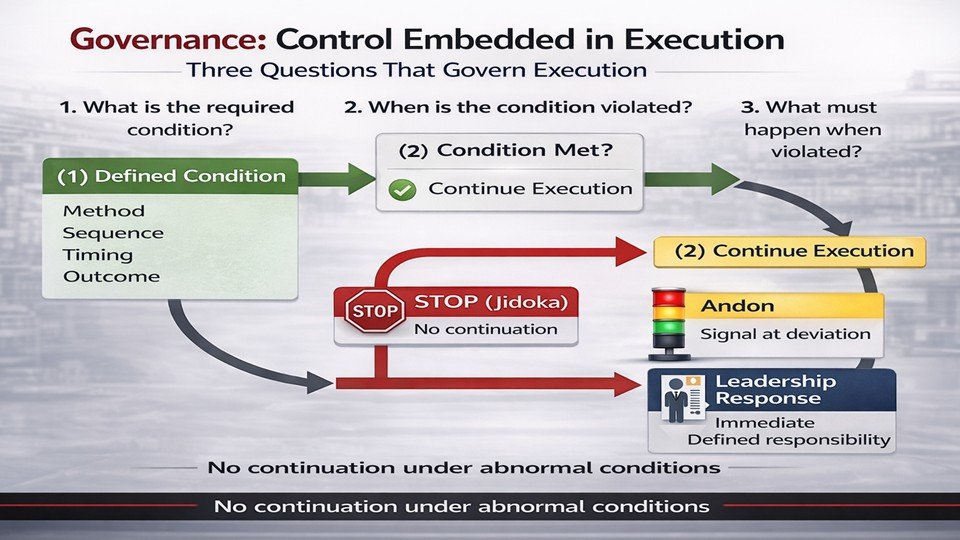
A Lean TPS system requires that execution is governed by three questions that define control. The required condition for execution must be explicitly defined through method, sequence, timing, and outcome. The point at which the condition is violated must be immediately recognizable during execution. The response required when the condition is not met must be enforced without delay. When these three elements operate together, execution is controlled and Quality is maintained as a condition of the system. Control precedes improvement because improvement depends on a stable and defined state of execution. When conditions are not defined, exposed, and enforced, improvement activity operates on an unstable system and results do not hold. Work continues under abnormal conditions, variation accumulates, and outcomes remain inconsistent. When control is established, improvement operates within defined boundaries and reinforces the condition that governs execution. Quality exists only when the required condition is maintained during each cycle of work. Quality is not achieved through measurement or inspection after execution. Quality is protected through enforcement of conditions during execution. When the condition is not met, work does not continue, and response restores the defined state before execution resumes. This enforcement prevents deviation from propagating and maintains stability at the source. A Lean TPS system requires that continuation under abnormal conditions is not permitted. When work continues despite violation of method, sequence, timing, or outcome, control does not exist and the system becomes dependent on judgment. Deviation is absorbed into normal work, and Quality is degraded. When continuation is prevented, the system enforces the boundary between normal and abnormal states and maintains control of execution. The system extends beyond individual elements and requires integration across condition definition, exposure, response, and learning. When these elements are aligned, execution is governed, leadership responds as required, and learning is embedded through repeated cycles of confirmation and correction. This integration establishes a system that maintains control and protects Quality as a condition of execution. Further development of this system requires expansion into condition design, response structure, and leadership integration at scale. The next stage addresses how conditions are constructed, how response is embedded across functions, and how governance is sustained across the organization.
Lean TPS governance image showing how conditions, deviation detection, and enforced response control execution.
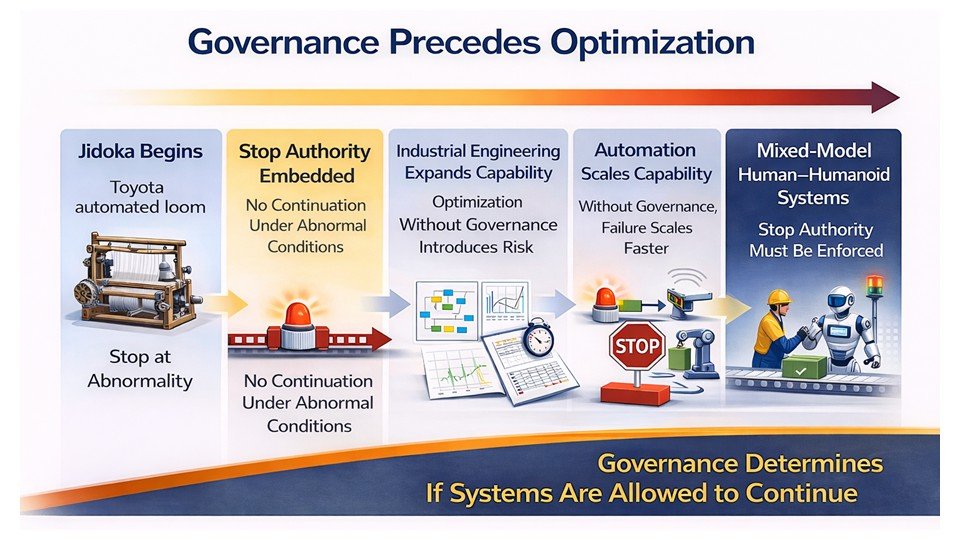
Industrial Engineering and Toyota Production System comparison showing governance, stop authority, and no continuation under abnormal conditions in Mixed-Model Human–Humanoid environments
Industrial Engineering develops system capability through analysis and optimization. The Toyota Production System governs execution in Mixed-Model Human–Humanoid environments by enforcing stop authority and preventing continuation under abnormal conditions.
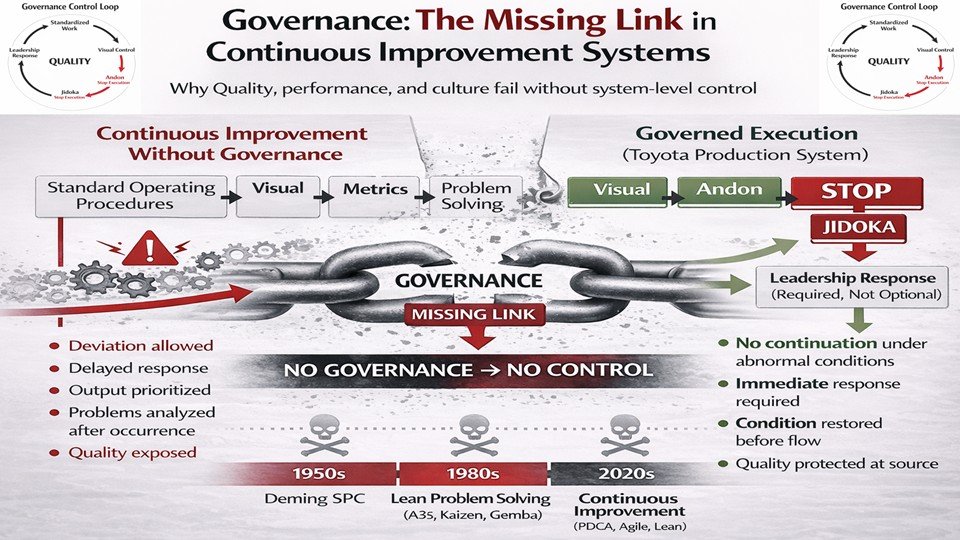
Governance as the missing link in continuous improvement systems showing standard operating procedures, visual control, Andon stop, Jidoka, and required leadership response to protect Quality
Continuous improvement systems fail when governance is absent. Standard operating procedures, visual control, Andon, and Jidoka must function together to stop execution, require leadership response, and protect Quality at the source
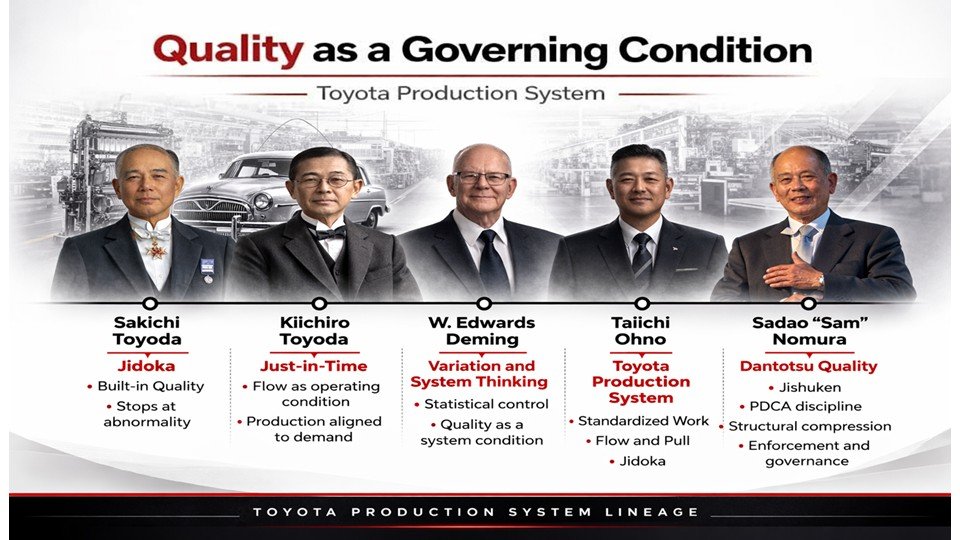
Toyota Production System Quality progression showing governing conditions, abnormality detection, and enforced response across operations
Quality in the Toyota Production System governs execution. Work continues only when conditions are met, abnormality is visible, and response is required.
Diagram illustrating Jishuken as deliberate buffer reduction within Lean TPS governance, showing how reduced manpower, inventory, and cycle time expose management behavior and test Quality protection under disciplined control.
Improvement without governance amplifies variation. Jishuken deliberately reduces buffer to expose whether leadership discipline can protect Quality under tighter operating conditions. Stability under compression confirms governance maturity.
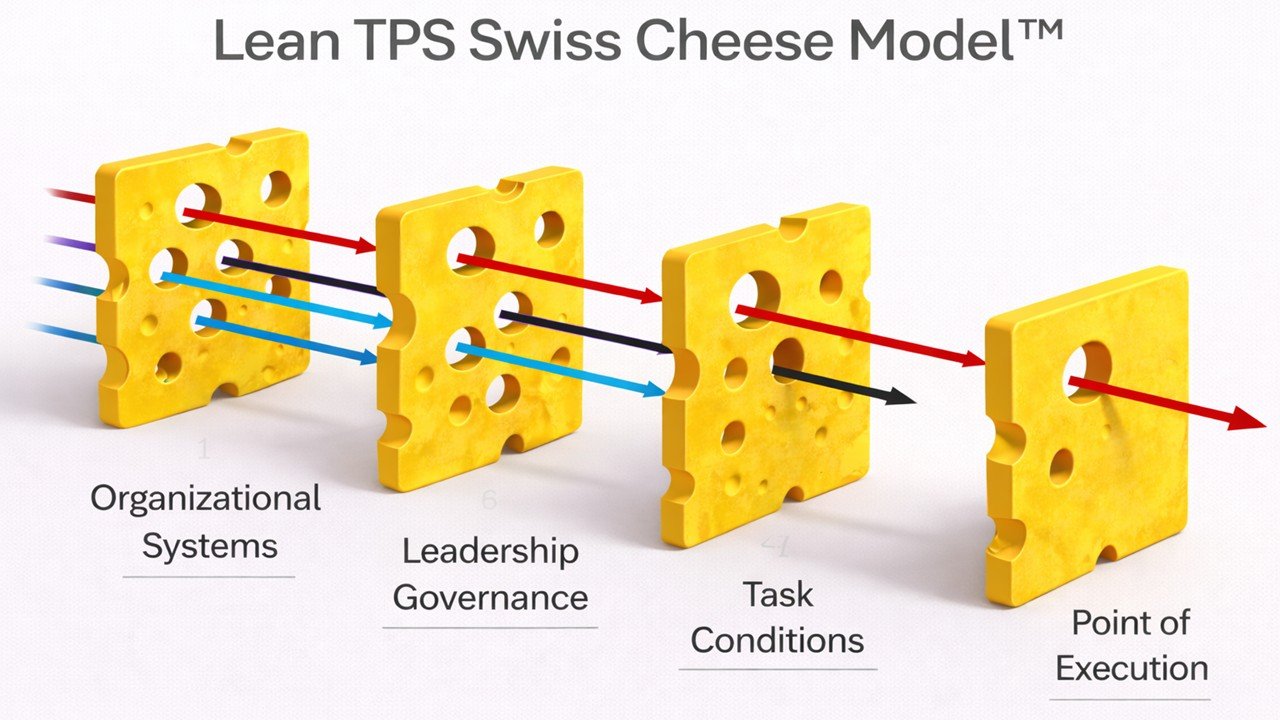
Lean TPS Swiss Cheese Model showing four aligned cheese slices representing Organizational Systems, Leadership Governance, Task Conditions, and Point of Execution, with layered penetration paths demonstrating Quality containment.
A visual representation of the Lean TPS Swiss Cheese Model™, demonstrating how layered governance architecture progressively protects Quality from Organizational Systems through to Point of Execution.