1. Environmental Stability as the First Condition of Quality
5S is not housekeeping. It is the first structural condition of Quality governance inside Lean TPS. When 5S is reduced to cleaning and organizing, its purpose is misunderstood. 5S was not created to improve appearance. It was created to stabilize the operating environment so that Quality can be protected at the point of execution.
Many organizations treat 5S as workplace organization. Floors are cleaned. Tools are labeled. Visual boards are installed. Initial activity is visible. Structural control remains unchanged. Environmental inconsistency persists in excess material, undefined locations, informal storage, and visual noise. When the environment lacks definition, deviation lacks contrast. Quality becomes dependent on vigilance rather than design.
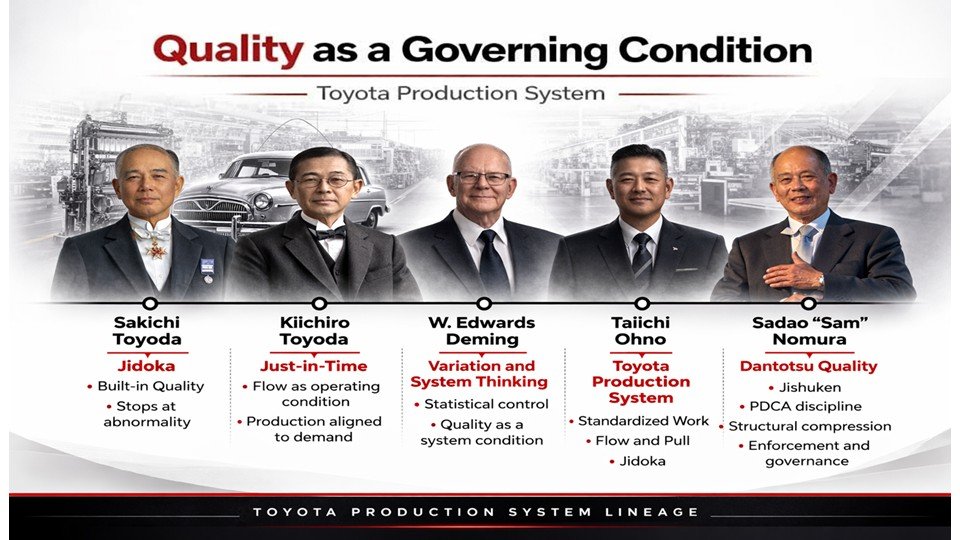
Within Toyota Production System governance, environmental stability precedes process stability. Sort removes excess that distorts visibility. Set in Order fixes location and quantity. Shine restores baseline condition. Standardize defines expected state. Sustain confirms adherence through leadership cadence. These disciplines establish a stable reference condition for work.
A stable reference condition enables control. Standardized Work depends on fixed tools, defined space, and predictable material presence. Without environmental discipline, execution adapts informally and variation expands. With environmental discipline, the workplace supports repeatability rather than undermines it.
Quality is not created by inspection after the fact. It is protected by defining and maintaining the conditions under which work occurs. 5S establishes those conditions. It forms the environmental boundary within which Standardized Work can hold, abnormality can be recognized immediately, and governance can begin at the ground level of the workplace.
2. 5S as Environmental Control, Not Aesthetics
5S was not created to make a workplace appear organized. It was created to regulate the physical conditions under which work is performed so that Quality can be protected. When 5S is reduced to visual appeal, it becomes decoration. When applied as designed, it becomes environmental regulation.
Sort, Set in Order, Shine, Standardize, and Sustain were never intended as housekeeping steps. Each removes a specific source of instability. Excess inventory conceals imbalance. Undefined locations distort motion. Contaminated equipment hides deterioration. Informal storage introduces interpretation. Inconsistent review allows standards to weaken. These conditions erode control before any visible defect appears.
Visual neatness does not equal precision. Precision exists only when purpose, location, quantity, and condition are clearly defined and consistently confirmed. 5S establishes these parameters. It replaces informal judgment with defined limits. It reduces discretionary behavior at the environmental level.
Environmental ambiguity increases cognitive demand. Operators must interpret what belongs, what is sufficient, and what is acceptable. Interpretation introduces variability. Variability increases exposure. 5S transfers those decisions from individuals to defined environmental standards. The workplace begins to guide execution rather than rely on memory or effort.
When environmental parameters are defined, deviation gains contrast. Missing items, incorrect quantities, contamination, and displacement are no longer absorbed into background conditions. They stand out against a stable baseline.
Environmental regulation precedes process regulation. Standardized Work depends on fixed tools, defined space, and predictable material presence. Jidoka depends on visible deviation. 5S establishes the physical clarity that enables both to function.
5S is not aesthetic refinement. It is structural discipline. It regulates the environment so that Quality can be governed at the source rather than inspected after impact.
3. Narrowing the Operating Condition
Every production system functions within defined physical and process limits. When those limits are broad or poorly defined, variation can accumulate without immediate detection. Workarounds develop. Operators compensate for instability. Inventory absorbs imbalance. Time buffers expand. Performance may appear acceptable while structural exposure increases beneath the surface.
5S reduces that exposure by tightening environmental limits.
Sort eliminates excess material and equipment that conceal imbalance. Set in Order fixes location and quantity so movement becomes predictable rather than adaptive. Shine restores visibility of equipment condition and surface integrity. Standardize defines the expected environmental state. Sustain confirms adherence through routine review. Together, these disciplines reduce environmental latitude.
As environmental latitude decreases, deviation becomes easier to detect at its point of origin. Displacement is visible because location is fixed. Quantity distortion is evident because limits are defined. Mechanical deterioration stands out against a clean baseline. The system becomes more responsive because the baseline is stable.
Responsiveness should not be confused with fragility. A loosely defined system appears stable because it absorbs variation. A tightly defined system appears sensitive because it exposes variation. Exposure enables earlier correction. Earlier correction limits defect propagation and protects Quality closer to the source.
Loose operating conditions delay recognition. Defined conditions accelerate recognition. 5S narrows the environmental field in which work occurs, reducing the opportunity for deviation to remain unnoticed.
Narrowing the operating condition is not an exercise in rigidity. It is a method of increasing precision. Precision sharpens detection. Sharpened detection strengthens accountability. Strengthened accountability protects Quality through timely response rather than retrospective inspection.
Through disciplined 5S, the workplace shifts from adaptive tolerance to controlled precision. Quality stability improves because deviation can no longer accumulate silently.
4. Where 5S Sits in Lean TPS Architecture
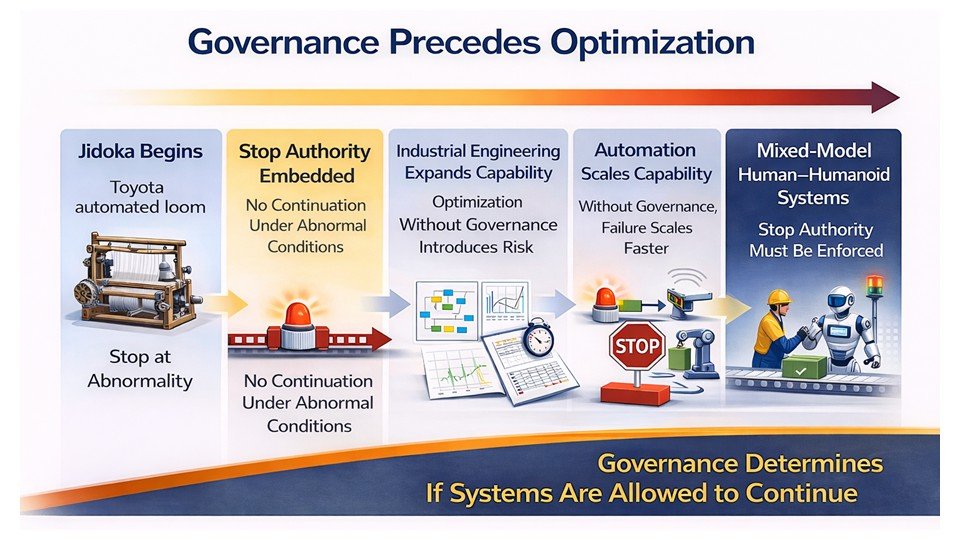
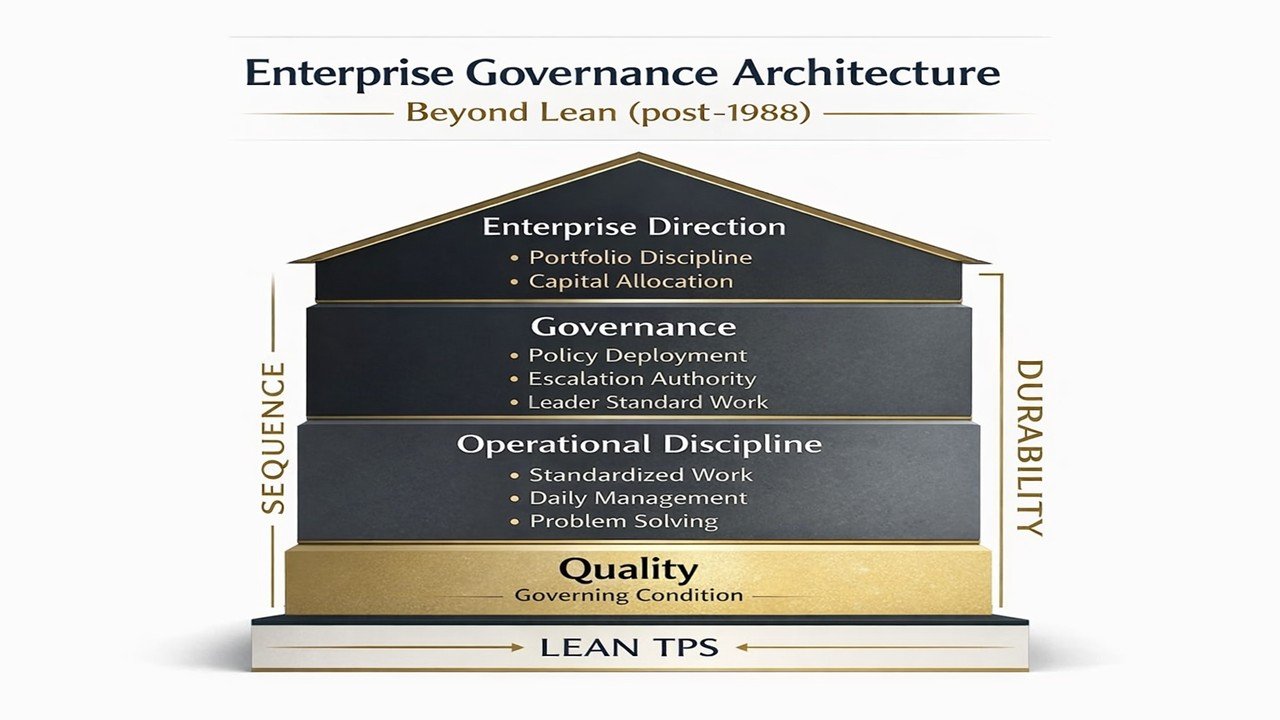
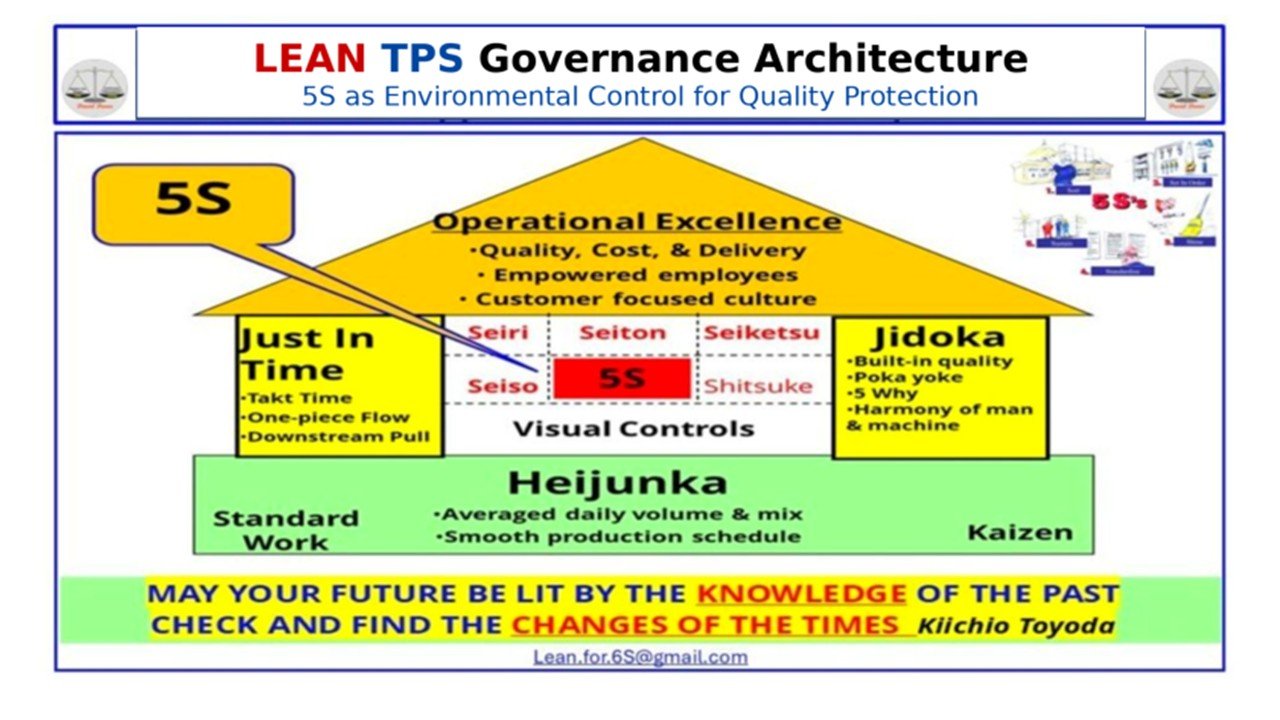
5S does not function independently inside Lean TPS. It occupies a defined structural position within the governance system. Its role is foundational. It stabilizes the physical and visual conditions so that higher control mechanisms can operate with precision.
Each element within Lean TPS serves a specific control purpose. 5S defines environmental order. Standardized Work defines execution sequence and timing. Heijunka stabilizes volume and mix. Just In Time governs material movement through defined quantity and replenishment logic. Jidoka enforces immediate response when deviation occurs. These mechanisms are not parallel initiatives. They are layered controls.
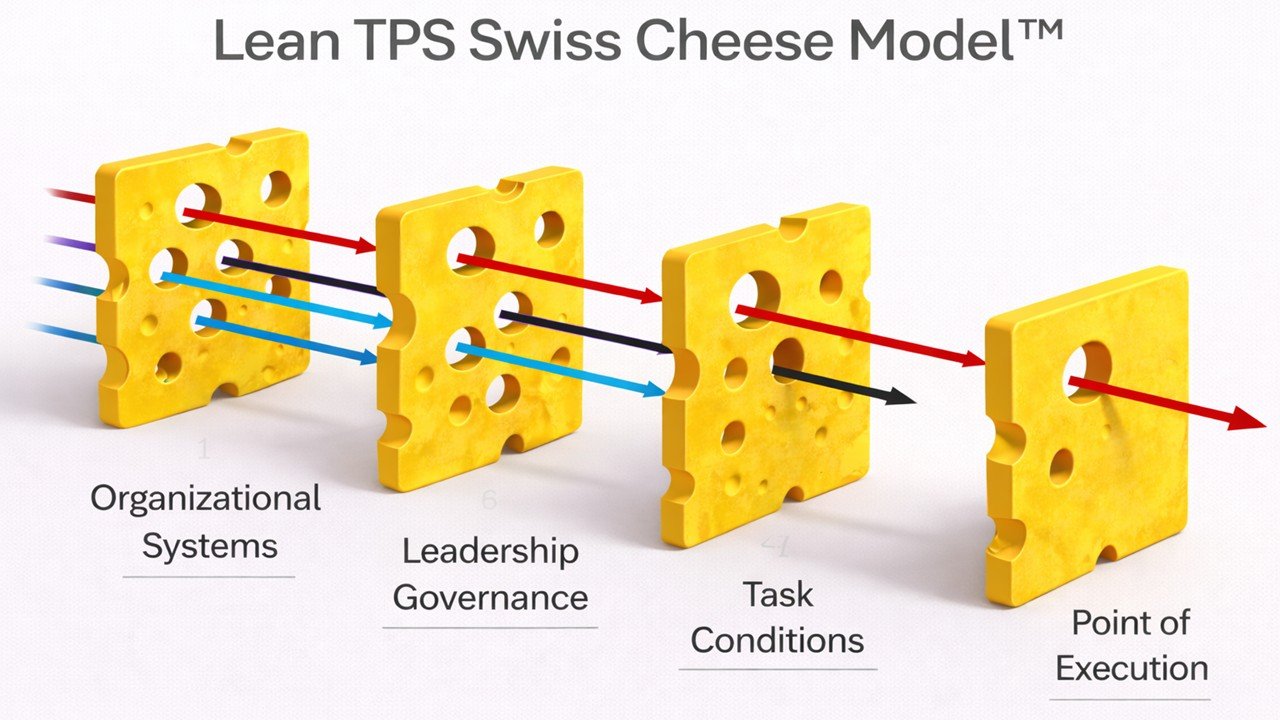
Environmental instability disrupts every layer above it. When tools shift, materials accumulate, or locations lose definition, Standardized Work loses repeatability. Sequence becomes adaptive rather than defined. Variation increases at the point of execution.
As variation increases, abnormal signals weaken. Jidoka depends on clear deviation from a defined normal. When the baseline is unstable, detection shifts downstream. Response becomes containment rather than prevention. Quality protection moves from the source of occurrence to the point of discovery.
5S therefore functions as the first control layer in the Quality chain. It prevents environmental instability from distorting process control. Defined locations and quantities directly support Just In Time pull discipline. Stable environmental conditions allow Heijunka leveling to hold without hidden buffers. Standardized Work depends on both.
5S is not preparation work. It is structural groundwork. Environmental stability enables execution stability. Execution stability enables controlled flow. Controlled flow enables immediate response to abnormality.
When 5S is weak, imprecision enters the system at ground level. When 5S is disciplined, governance begins at the workplace surface. Quality protection starts with clearly defined conditions that are visible and confirmed every day.
5. The Interdependence of 5S and Standardized Work
5S and Standardized Work are often implemented as separate initiatives. In Lean TPS governance, they are inseparable. One stabilizes the environment. The other stabilizes execution. Neither can hold without the other.
Standardized Work defines sequence, timing, and expected outcome. It specifies how work is performed under defined conditions. Those conditions are not abstract. They are physical. Tools must be in fixed locations. Materials must be present in defined quantities. Equipment must operate within stable parameters. Visual references must be clear. These environmental requirements are established through 5S.
When 5S is weak, Standardized Work becomes theoretical. Sequence may be documented, but execution varies because the environment varies. Operators compensate for misplaced tools, unclear storage, excess inventory, or obstructed space. Adaptation increases. Informal adjustments replace defined method. Variation expands.
When Standardized Work is weak, 5S becomes cosmetic. Tools may be neatly arranged, but work sequence remains inconsistent. Quantity limits are posted, but replenishment logic is undefined. Surfaces are clean, yet timing and motion differ shift to shift. Visual order exists without execution discipline. Quality exposure remains.
The interdependence is structural. 5S defines the physical and visual boundary in which Standardized Work operates. Standardized Work gives purpose to the environmental order established by 5S. Environmental clarity without defined method does not protect Quality. Defined method without environmental stability cannot sustain.
Together, 5S and Standardized Work narrow variation from two directions. 5S reduces environmental ambiguity. Standardized Work reduces process ambiguity. Reduced ambiguity increases visibility. Increased visibility strengthens abnormality detection. Early detection protects Quality before defect multiplication.
In Lean TPS governance, environmental discipline and execution discipline function as a single control system. When both are maintained, deviation becomes immediately apparent and correction becomes objective. When either weakens, drift re-enters silently.
Quality stability depends on their interdependence.
6. 5S and Jidoka Sensitivity
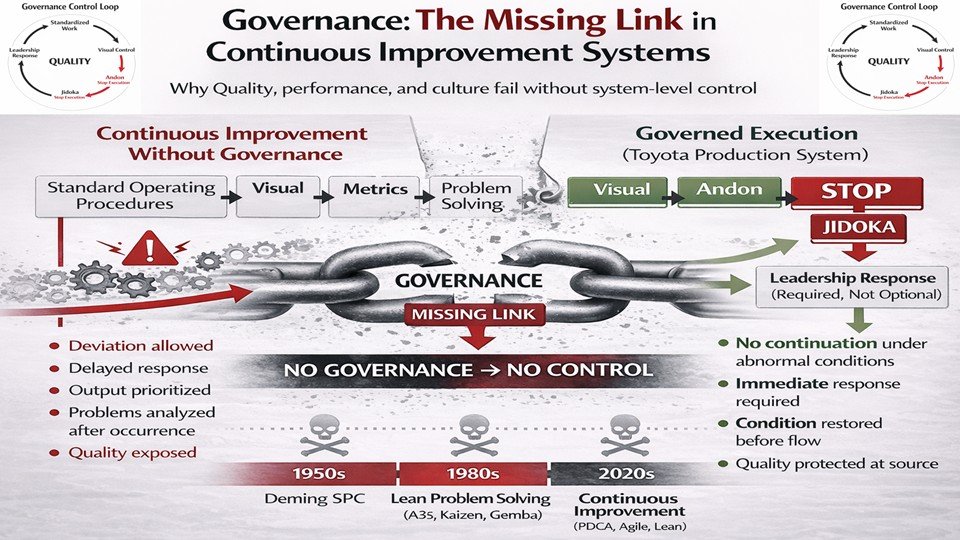
Jidoka protects Quality by requiring immediate response to abnormality. Stop authority has meaning only when deviation is recognized at the point of occurrence. Recognition depends on a clearly defined normal condition. 5S establishes that normal condition at the environmental level.
Jidoka is not merely a mechanical stop function. It is a response obligation triggered by visible deviation. If the environment is cluttered, loosely defined, or visually inconsistent, deviation lacks contrast. Displacement blends into excess. Minor deterioration disappears into background noise. Abnormal signals weaken before they reach the response mechanism.
Environmental precision strengthens Jidoka.
When locations are fixed, quantities are defined, and condition is confirmed routinely, the baseline becomes sharp. A missing item interrupts flow. An incorrect quantity distorts replenishment. Surface contamination reveals deterioration. These are not cosmetic observations. They are early indicators of instability that would otherwise propagate into defect.
Jidoka depends on contrast. Deviation must stand out clearly against a stable reference point. 5S creates that reference point. It reduces environmental variability so that abnormality is judged against a defined standard rather than personal expectation.
When environmental control is weak, stop authority is delayed. Abnormality is discovered further downstream. Containment replaces prevention. Defect exposure increases because propagation has already occurred.
When environmental control is disciplined, response occurs closer to origin. Deviation is contained before multiplication. The system reacts while impact remains small. Quality protection shifts upstream.
5S therefore strengthens Jidoka not by adding devices, but by sharpening the environmental baseline. A precise baseline produces precise signals. Precise signals enable decisive response. Decisive response protects Quality at the source.
7. Leadership Cadence and the Discipline of Sustain
Sustain is frequently misunderstood as reinforcement of earlier steps. In Lean TPS governance, Sustain is not reinforcement. It is leadership control. It ensures that environmental standards remain active operating conditions rather than temporary improvements.
Sort, Set in Order, and Shine can be executed in concentrated effort. Standardize can be written and displayed. Sustain requires ongoing confirmation. Environmental stability cannot be assumed. It must be reviewed at defined intervals with defined response expectations.
Cadence gives Sustain its authority. Review frequency is specified. Confirmation points are known. Deviations are addressed immediately. Environmental standards are treated as structural requirements, not visual preferences. Audit functions as condition assessment, not compliance scoring.
When leadership embeds this cadence into daily and weekly routines, environmental discipline becomes predictable. Standards are understood as non-negotiable. Supervisory response is consistent. Management attention signals that environmental precision is a control condition tied directly to Quality performance.
Absent cadence, environmental standards weaken gradually. Locations shift. Quantities expand. Informal storage appears. Visual contrast dulls. None of these changes occur abruptly. They accumulate until environmental control loses precision.
Sustain protects Quality by maintaining the clarity required for early instability detection. Environmental disorder often precedes process deviation. Misplaced tools interrupt sequence. Excess inventory obscures imbalance. Surface neglect conceals equipment deterioration. Leadership confirmation interrupts these signals before they propagate into defect.
Sustain therefore represents the leadership layer of 5S. It embeds environmental control into managerial behavior and operational rhythm. When cadence is consistent, 5S transitions from initiative to governance condition.
Quality stability depends on this continuity of confirmation.
8. Why 5S Must Be Treated as Architecture
5S is often described as a cultural foundation. Culture may improve as discipline improves, but culture is not the primary function of 5S. The primary function of 5S is structural. It organizes the physical environment so that Quality can be governed through defined conditions rather than encouraged through behavior.
When 5S is framed as culture, the focus shifts toward engagement and participation. Engagement does not eliminate ambiguity. Participation does not narrow variation. Morale does not stabilize execution. Control requires defined limits and consistent confirmation.
5S establishes those limits at the environmental level. It fixes location. It defines quantity. It clarifies expected condition. It embeds confirmation through routine review. These parameters transform space into a controlled operating field. Deviation becomes visible because normal has been precisely defined.
This framing also clarifies accountability. Environmental stability is not a voluntary improvement effort. It is a required operating condition. Leadership defines and confirms standards. Operators maintain them. Deviation is treated as system exposure, not housekeeping oversight.
Sustainment based on enthusiasm fades. Sustainment based on governance persists. Governance does not depend on energy. It depends on structure, cadence, and response.
Treating 5S as structural discipline also reinforces its integration with the broader Lean TPS system. Standardized Work requires stable environmental conditions. Jidoka requires clear abnormal signals. Just In Time requires defined quantities and fixed locations. Environmental precision enables each of these mechanisms to function as designed.
5S must therefore be understood as structural design, not cultural initiative. It establishes the physical conditions under which Quality can be protected consistently and governance can operate reliably at the ground level of the workplace.
9. From 5S to Jishuken: Structural Progression
5S does not end with environmental order. It creates the structural precondition for deeper system engagement. When environmental instability is removed, execution becomes clearer. When execution becomes clearer, abnormality becomes traceable. Traceable abnormality creates the foundation for meaningful Kaizen. Sustained Kaizen creates the entry condition for Jishuken.
The progression is structural, not event-driven.
5S stabilizes the environment.
Standardized Work stabilizes execution within that environment.
Jidoka enforces response when deviation occurs.
Kaizen improves defined processes under controlled conditions.
Jishuken tests the integrity of the entire system through direct leadership engagement.
Without disciplined 5S, Kaizen often addresses symptoms. Teams improve isolated areas without stabilizing the underlying environment. Gains erode because environmental ambiguity reintroduces variation. Improvement becomes local and temporary.
When 5S is strong, Kaizen operates inside defined boundaries. Problems are visible. Data reflects actual instability rather than environmental noise. Countermeasures are anchored to a stable baseline. Improvements update standards rather than overlay activity on top of drift.
Jishuken represents the next level of progression. It is not a workshop. It is leadership entering the system to examine whether environmental discipline, execution discipline, and abnormality response are aligned. Jishuken exposes whether 5S and Standardized Work are truly functioning as governance layers or merely as artifacts.
In environments where 5S has matured into sustained discipline, Jishuken becomes structural. Leaders engage with a stable baseline. Abnormalities are real, not masked. Discussions focus on system design, not housekeeping correction. Quality exposure can be traced to architectural weakness rather than environmental disorder.
The progression from 5S to Jishuken therefore reflects increasing levels of governance depth. Environmental control enables execution control. Execution control enables flow control. Flow control enables system-level examination.
5S is the entry condition for this progression. Without it, higher-level engagement becomes episodic and reactive. With it, structural learning becomes possible and Quality protection strengthens at every layer.
10. Structural Results and the Protection of Quality
When 5S is practiced as environmental governance rather than housekeeping, the results are structural. The improvement is visible in stability, detection timing, and defect exposure. These are not motivational gains. They are measurable control gains.
Defined quantity limits reduce inventory distortion. Excess material no longer conceals imbalance. Shortages appear sooner and are addressed earlier. Fixed locations reduce motion variability and flow interruption. Equipment deterioration surfaces before escalation because environmental baselines are clean and visible. Abnormal signals strengthen because normal condition is clearly defined and routinely confirmed.
Quality protection improves because detection shifts upstream. Deviation is identified closer to its origin. Interpretation declines because environmental standards are explicit. Reduced interpretation narrows variation. Narrowed variation lowers defect probability. When deviation occurs, response is timely and objective rather than reactive and compensatory.
Operational flexibility also improves. Shift consolidation, labor adjustment, and workload balancing can occur without eroding Quality because environmental discipline prevents hidden buffers and informal workarounds from absorbing instability. Performance is evaluated against defined conditions rather than excess capacity.
These outcomes persist because they are tied to structure, not enthusiasm. Environmental standards are defined. Confirmation cadence is embedded. Deviation triggers response. The workplace regulates itself through visible condition and consistent leadership review.
5S reduces environmental entropy so that Quality becomes measurable, traceable, and defendable. Protection does not depend on inspection after impact. It depends on controlling the conditions under which work is performed.
When 5S is treated as governance, the workplace becomes a controlled environment rather than a managed effort. Quality is no longer a target to pursue. It becomes a condition that is engineered, defined, and protected every day.