I. Improvement Activity and Operating Stability
Many organizations pursue Quality improvement as visible activity rather than sustained operating condition. Workshops are organized, targets announced, cost reductions reported, and visual boards multiplied. Activity intensifies, yet the underlying operating system often remains unchanged. Variation persists within process flow. Leadership response to abnormality remains inconsistent. Exposure remains embedded in daily work. Temporary gains may occur, but they often conceal fragility rather than remove it.
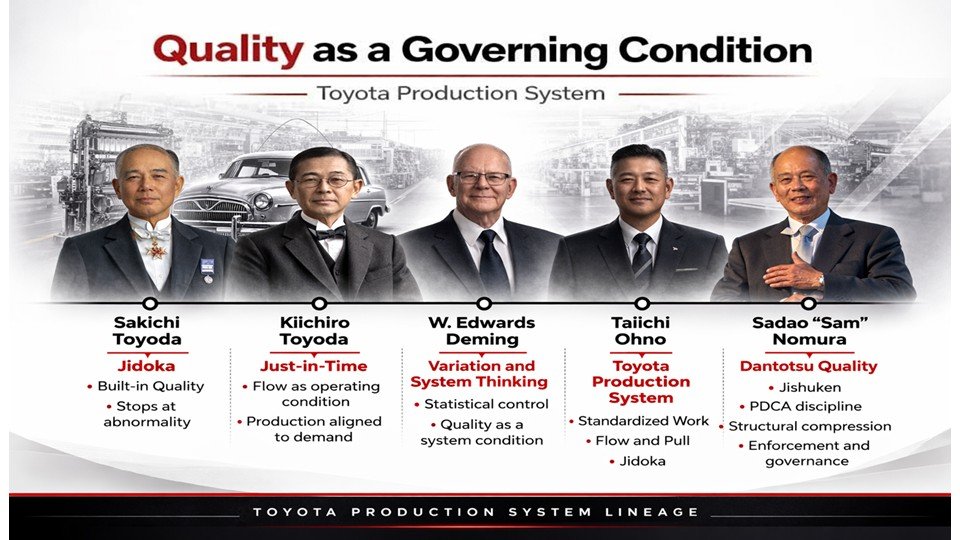
Within the Toyota Production System, Jishuken is a structured internal study in which leaders deliberately reduce buffer by tightening manpower, inventory, cycle time, or station count to examine whether Daily Management can protect Quality under increased operating pressure. Jishuken is not an event applied to weak systems. It operates inside an already governed structure. It does not introduce discipline or compensate for inadequate leadership control. By reducing excess capacity and narrowing tolerance, it prevents deviation from remaining hidden within margin. When buffers are removed, leadership control becomes visible.
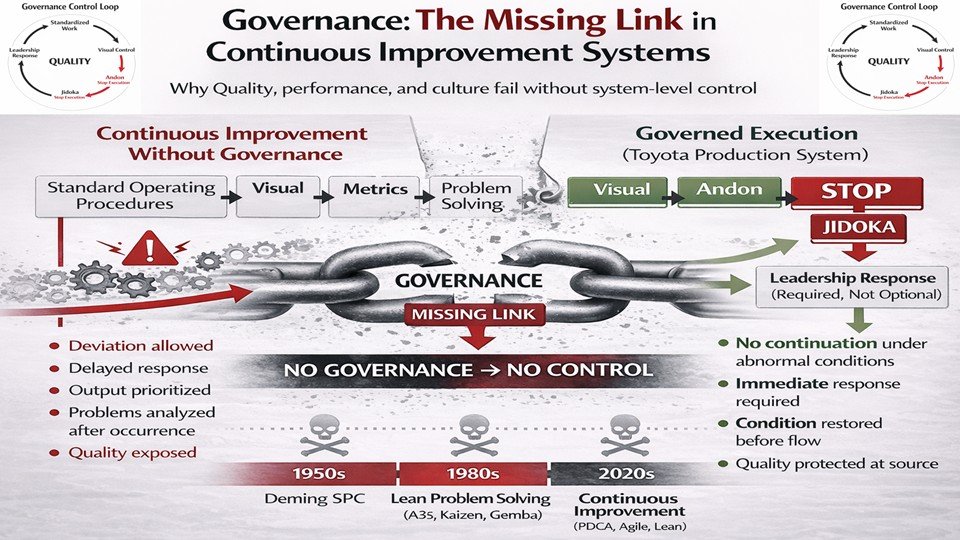
Governance in Lean TPS is the leadership control structure that protects Quality through defined standards, explicit escalation rules, and disciplined management behavior. Governance establishes constraint before change. Quality improvement follows stability; it does not create it. When stability is absent, improvement increases variation because change is introduced into a system that is not consistently controlled.
Standardized Work defines normal condition. Visual Management exposes deviation from that condition. Jidoka enforces stop logic to prevent abnormal flow. Just In Time reduces buffer and increases sensitivity to disruption. Daily Management stabilizes rhythm through structured review. Each mechanism depends on consistent leadership behavior. Leadership must require adherence to Standardized Work, respond immediately to visual abnormality, enforce stop logic when criteria are met, sustain flow discipline under Just In Time, and maintain review cadence through Daily Management. When discipline weakens, mechanisms may remain present, but adherence declines, escalation slows, and system integrity deteriorates beneath the appearance of stability.
System integrity may appear stable when buffer absorbs inconsistency, but appearance does not confirm control. Jishuken intensifies exposure by reducing the buffer that previously absorbed variation. Variability once tolerated becomes consequential. When manpower, inventory, or cycle time cushion declines, direction clarity, ownership, review cadence, corrective discipline, problem-solving rigor, and reporting accuracy are tested directly under operating conditions. Quality performance under reduced buffer reflects governance strength because deviation can no longer be masked by excess capacity.
Strong governance maintains Quality stability while cost declines and flow improves. Weak governance produces Quality instability even when visible improvement activity increases.
Governance precedes improvement. Jishuken reveals management behavior before it improves performance. Improvement without governance produces temporary gains because exposure remains unresolved. Governance without disciplined execution remains theoretical because defined structure is not consistently enforced.
II. Governance as the Foundation of Toyota Production System
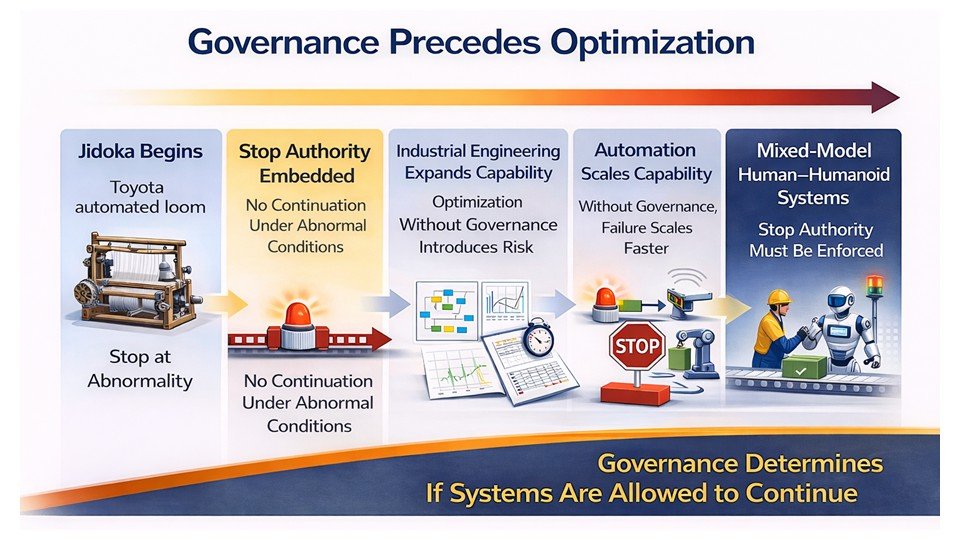
Toyota Production System was not designed as a collection of improvement techniques. It was designed as an operating governance system in which improvement mechanisms function within disciplined control. Tools, methods, and events do not create stability on their own. Governance creates stability by defining how work is executed, reviewed, corrected, and refined. Improvement becomes meaningful only when stability is structurally protected and consistently enforced.
Governance in Lean TPS is the leadership control structure, executed through disciplined management behavior, that maintains system integrity and protects Quality daily. Governance establishes constraint before change. It defines the boundaries within which work is performed and the rules by which deviation is detected and corrected. Without governance, improvement becomes isolated effort that may produce temporary gains without altering structural exposure. With governance, improvement strengthens a stable system because change occurs within controlled conditions.
Daily Management functions as the execution layer of governance. It establishes rhythm and enforces repetition so deviation cannot accumulate silently. Structured review defines when performance is evaluated, how abnormality is surfaced, who owns response, and how escalation proceeds. Consistent cadence prevents erosion of standards. Clear ownership prevents diffusion of responsibility. When cadence weakens, deviation travels across processes. When ownership is unclear, response slows and Quality risk expands beyond its origin.
Visual Management operates within Daily Management as the exposure mechanism. Visual systems are not retrospective reports. They are operational instruments that make deviation visible at the moment it occurs. Hour-by-hour tracking, change point boards, takt charts, and escalation signals function as exposure controls. Visibility alone does not create stability. Visual systems have effect only when leadership requires immediate review, structured escalation, and disciplined correction.
Defined responsibility completes the governance structure. Every process requires a Person-In-Charge with explicit authority. Every abnormal condition requires a named owner. Every countermeasure requires verified closure. Shared responsibility diffuses authority and delays response. Delayed response allows instability to propagate across connected processes. Clear responsibility aligns authority, action, and consequence within a single control loop that protects Quality.
Daily Management, Visual Management, and defined responsibility operate as a unified control system. Daily Management establishes tempo. Visual Management exposes condition. Defined responsibility enforces correction. Standardized Work defines normal condition. Jidoka enforces stop logic when abnormality appears. Just In Time increases sensitivity by reducing buffer and tightening interdependence. Daily Management sustains these mechanisms through disciplined repetition so they function as structural controls rather than symbolic practices.
Governance is not abstract philosophy. Governance is structured and repetitive enforcement of normal condition through visible exposure, defined authority, and disciplined response. Improvement becomes sustainable only after governance stabilizes the system and maintains that stability over time.
Structural Control Before Behavior
Many descriptions of Toyota Production System begin with visible methods such as Kanban, Andon, 5S, Kaizen events, and visual boards. Presenting these elements first misrepresents system logic. Toyota Production System was not constructed by assembling tools and adding control later. It was constructed by defining operating constraint first and embedding methods within that structure. Constraint establishes acceptable execution, defines how deviation is detected, and specifies required response. Only after constraint is defined can improvement occur without increasing instability.
Constraint operates through four structural definitions: normal condition, escalation condition, alignment of authority with responsibility, and review rhythm. Governance is incomplete if any element remains undefined or inconsistently enforced.
Normal condition is established through Standardized Work. Sequence, timing, work-in-process limits, safety requirements, and Quality checkpoints define the approved method. Normal condition is the authorized standard against which deviation is measured. Abnormality cannot be detected without defined normal. Improvement discussion without explicit normal introduces ambiguity. Under compression, undefined normal produces instability because deviation lacks reference. Governance requires normal condition to be explicit, visible, and consistently reviewed.
Escalation condition defines when abnormality must trigger response. Jidoka introduces stop logic as structural rule rather than discretionary choice. Abnormality is defined by criteria. Escalation parameters, response ownership, response time, and authority to intervene must be defined before deviation occurs. Discretionary escalation weakens governance because response speed depends on judgment rather than requirement. When buffers are reduced and tolerance narrows, hesitation allows deviation to propagate and affect Quality.
Response authority must align with responsibility. A Person-In-Charge without decision authority cannot enforce correction. Ownership without authority creates paralysis at decisive moments. Under increased sensitivity, brief hesitation compounds and may produce cascading defect risk. Governance requires explicit alignment between accountability and authority.
Review rhythm establishes stability across time. Daily Management cadence prevents accumulation of deviation through structured intervals of evaluation. Hourly review prevents shift-level accumulation. Shift review prevents day-level accumulation. Irregular review allows deviation to travel undetected. When buffer is reduced, allowable delay shortens. Mature governance shortens review intervals so detection and correction occur before instability spreads. Weak governance allows cadence to remain unchanged or deteriorate when tighter control is required.
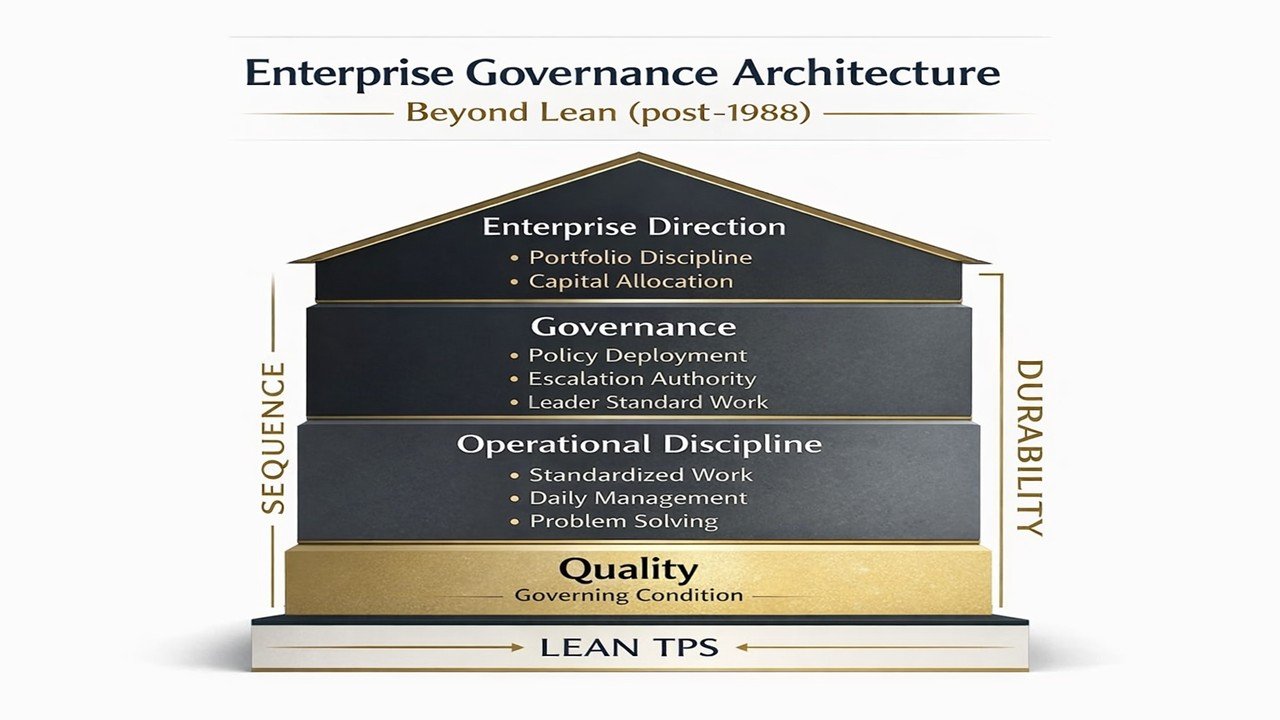
Governance architecture defines structural control before behavior. Management behavior sustains architecture through disciplined repetition. Stability does not arise from intention or effort. Stability arises from enforced structure executed consistently over time.
III. Daily Management as Executed Governance Behavior
Governance cannot be sustained by structure alone. Defined roles, escalation rules, Standardized Work, and visual systems establish control architecture, but architecture remains inert without disciplined execution. Daily Management converts governance design into operational control through structured and repetitive behavior. It is the consistent cycle of review, response, correction, and reinforcement that prevents drift and protects Quality from erosion.
Daily Management is not meeting cadence or reporting routine. Without discipline, it becomes administrative coordination. With discipline, it functions as control that stabilizes the system. Control exists only when defined conditions are reviewed at appropriate intervals, deviations are surfaced immediately, and corrective action is required without hesitation. Without enforcement, governance remains theoretical.
Within Toyota Production System, Daily Management is expressed through specific leadership conduct. Ownership is defined before action. Method clarity precedes execution. Review occurs before assumptions form. Correction occurs before deviation becomes tolerated. Learning is integrated before repetition continues. Verification precedes closure of countermeasures. These are operational requirements necessary to preserve system integrity.
Assignment discipline anchors responsibility within control. Every objective, countermeasure, adjustment, and improvement action requires a defined owner with authority. The Person-In-Charge carries escalation responsibility and outcome accountability. Ambiguous ownership allows problems to circulate without resolution. Circulating problems consume attention while structural exposure remains. In such conditions, Quality depends on individual effort rather than system design.
Alignment with Standardized Work protects integrity. When outcomes are defined without defining method, individuals substitute personal interpretation for approved sequence and timing. Variation increases, especially when buffers are reduced and tolerance for delay is limited. Clear instruction specifying sequence, timing, and Quality checkpoints maintains alignment with defined normal condition. Leadership must verify adherence to Standardized Work before demanding results.
Cadence discipline establishes tempo and prevents accumulation of deviation. Review intervals must match process sensitivity. Hourly or shift-based evaluation prevents minor deviations from becoming structural instability. When review is delayed, detection weakens. Delayed detection leads to delayed correction, increasing exposure. Quality degradation rarely begins as dramatic failure. It begins as unattended variance that accumulates.
Corrective discipline prevents normalization of abnormality. When deviation appears, leadership requires structured response rather than informal adjustment. Tolerated deviation becomes accepted behavior. Accepted behavior becomes informal standard. Informal standards undermine Standardized Work and weaken integrity. Immediate and consistent correction reinforces structural control.
Sustained performance depends on depth of process understanding. Daily Management remains effective only when individuals understand process logic well enough to execute within defined constraints and respond to abnormality. Rotation, new associates, or workload pressure expose gaps in understanding. Structured teaching, retraining, and reinforcement maintain alignment with Standardized Work and prevent drift. When knowledge is broadly distributed, stability does not depend on heroic intervention. Quality is protected because competence is embedded in routine execution.
Recurring problems signal underlying cause, not isolated events. Containment stabilizes output temporarily but does not remove enabling conditions. Without root cause correction, instability returns and consumes management capacity. As recurrence increases, Daily Management shifts from prevention to reaction. Capacity that should strengthen control is absorbed by repetition of the same issue. Deliberate analysis, verified countermeasure, and careful revision of Standardized Work convert recurrence into learning that strengthens the system.
Governance discipline requires transparency. Status must be visible, accurate, and current. Visual systems must reflect actual condition. Reporting must inform decision-making rather than satisfy documentation. Transparency enables timely correction. Cosmetic reporting conceals instability and delays response.
These behaviors constitute the execution layer of governance. Structure defines control parameters. Behavior enforces them. Without disciplined behavior, structure weakens regardless of design.
Under stable conditions, weak management behavior may remain concealed because buffer absorbs variation. Acceptable output can persist even when execution is inconsistent because excess manpower, inventory, or time cushion masks instability. When buffers are reduced, tolerance narrows and deviation becomes visible quickly. Weakness previously hidden appears as missed takt, delayed escalation, or fluctuating Quality. Reduced buffers expose ambiguity in ownership, hesitation in response, and inconsistency in adherence to Standardized Work.
Jishuken deliberately reduces buffers to test whether Daily Management can sustain stability without excess capacity. Reducing buffer does not create weakness. It makes management behavior visible by removing cushion. When manpower, inventory, or time allowance is reduced, surplus capacity can no longer preserve output. Under these conditions, it becomes clear whether Daily Management is enforced through disciplined governance behavior or whether performance depended on buffer. Quality performance under reduced buffer demonstrates whether leadership conduct can protect defined normal condition when tolerance for delay declines.
IV. Jishuken as Deliberate Reduction of Buffer
Jishuken functions as deliberate reduction of buffer within an already governed system. Buffer exists in many forms: surplus manpower, excess inventory, extended cycle time, redundant skill coverage, and tolerance for delayed decisions. Buffers absorb variation and conceal instability under favorable conditions. When buffers are reduced, deviation can no longer remain hidden within excess capacity.
In systems with substantial buffer, defects and delays may travel across processes before impact becomes visible. Inventory absorbs timing drift. Extra manpower compensates for uneven work. Delayed decisions may not disrupt output immediately. When buffers are removed, the distance between abnormality and consequence shortens. Deviation becomes visible closer to origin because insulation is reduced.
As buffers decline and flow aligns more tightly to takt, processes become more interdependent. Variation at one point affects downstream operations quickly. Under these conditions, hesitation produces visible instability. The issue is not whether deviation exists, but whether leadership addresses it immediately and consistently.
Reducing buffers narrows tolerance for delay. When inventory is lower, manpower tighter, and time allowance limited, response speed directly affects performance. Assignment clarity must be explicit. Execution must align with Standardized Work. Review cadence must match the shortened response window. Corrective action must occur without hesitation. If leadership behavior does not adjust as buffers tighten, deviation spreads and instability follows.
Jishuken does not introduce instability into a stable system. It removes excess capacity that concealed inconsistency. By tightening manpower, lowering inventory, shortening cycle time, or reducing station count, leaders make deviation visible under realistic conditions. What becomes observable is not operator weakness, but the strength or weakness of Daily Management.
Jishuken is not an improvement workshop. It is disciplined internal study conducted under reduced buffer to determine whether governance can protect Quality when tolerance for delay declines. Reducing manpower, inventory, or cycle time does not create capability. It reveals existing capability by removing cushion. The purpose is not to introduce discipline, but to determine whether disciplined management behavior is strong enough to sustain stability under tighter conditions.
When buffers are reduced, governance behavior is tested across dimensions simultaneously. Ownership must remain explicit so response authority is clear at the moment deviation appears. Adherence to Standardized Work must be maintained because informal adjustments introduce variation that buffers can no longer absorb. Review intervals must align with shortened response windows so abnormality is corrected before propagation. Corrective action must prevent normalization of deviation. Recurring issues must be eliminated through verified problem solving rather than managed through repeated containment. Reporting must reflect actual condition so decisions are based on exposure rather than appearance.
Within Toyota practice, buffer reduction is accompanied by intensified review, reinforced visual control, clarified responsibility, and immediate escalation. Quality is not traded for speed. Quality determines whether leadership control is functioning.
When Quality remains stable after buffer reduction, leadership conduct demonstrates that Daily Management functions as intended. If defect frequency increases or instability spreads under the same conditions, governance behavior is not enforced consistently. Jishuken therefore serves as practical evaluation of Daily Management under tighter conditions. Improvement should proceed only after the system demonstrates sustained Quality without reliance on excess buffer.
V. Behavioral Exposure Under Reduced Buffer
The Governance Failure Cascade
Reducing buffer does not damage systems randomly. It reveals the sequence in which governance weaknesses appear. Breakdown follows operational logic. Jishuken exposes inconsistencies that already existed beneath excess capacity.
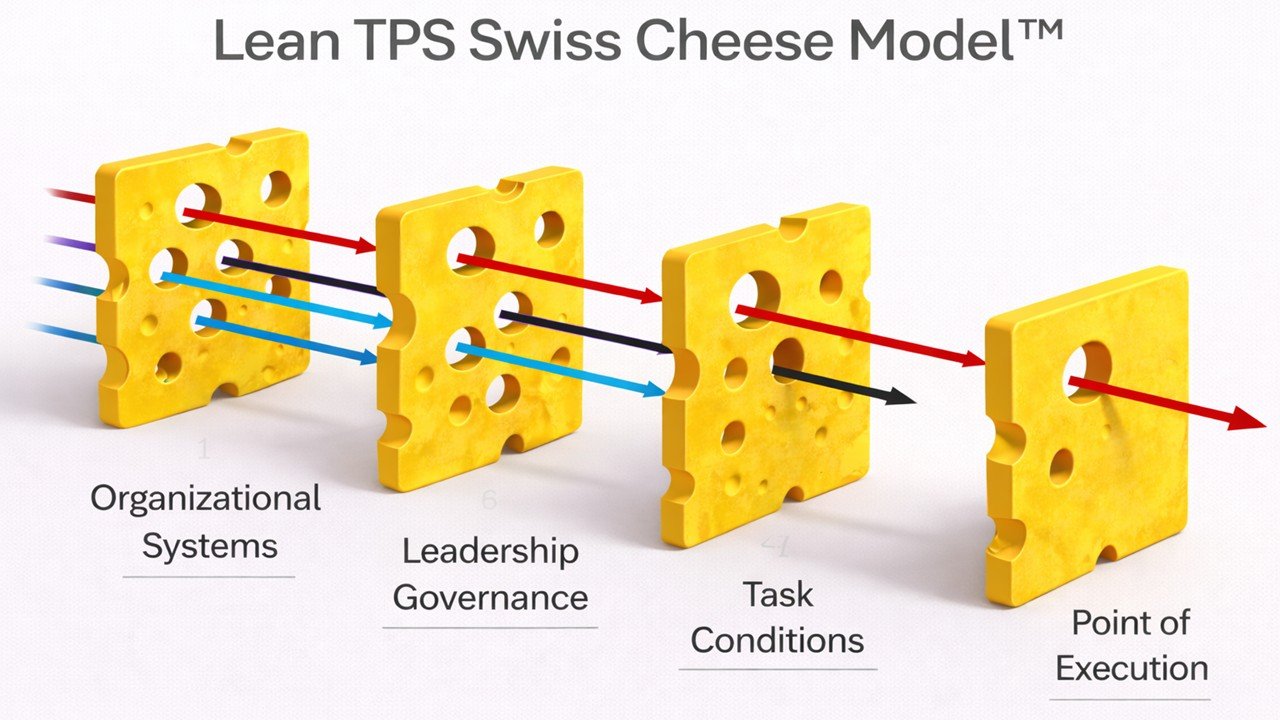
Failure rarely begins as visible crisis. It begins as variation embedded in daily work. Informal workarounds accumulate. Training depth varies across associates and shifts. Escalation habits soften. Minor deviations are tolerated without correction. When buffers are high, these weaknesses remain concealed because buffer absorbs consequence. Output appears stable. Quality appears acceptable. Reducing buffer does not create these conditions. It exposes them.
As buffers decline, tolerance narrows. Reduced manpower, tighter takt alignment, and lower inventory remove cushion. Variation that was previously absorbed becomes consequential. Minor timing drift results in missed takt. Skill gaps produce defects. Ambiguity in authority creates delay. The system reveals whether leadership responds immediately or hesitates.
When assignment discipline weakens, confusion appears quickly. Clear ownership is required under reduced buffer. If responsibility is ambiguous, escalation stalls. Decision delay increases when response speed matters most. Under buffered conditions, informal cooperation may compensate. Under reduced buffer, that compensation disappears. Delay becomes visible and Quality begins to fluctuate.
When leadership fails to reinforce alignment with Standardized Work, adherence to sequence and timing erodes. Individuals substitute personal interpretation for approved method. Differences in execution emerge across operators and shifts. Under reduced buffer, minor variation becomes consequential because deviation can no longer be absorbed. As consistency declines, instability increases and Quality fluctuates.
When review cadence slips, abnormality remains active longer than intended. Hourly or shift review may be postponed in favor of short-term output recovery. Escalation slows. Data reflects prior condition rather than present exposure. Delay allows deviation to spread across connected processes.
When corrective discipline softens, deviation becomes tolerated. Leaders under pressure may accept minor abnormality to preserve flow. Temporary allowances become accepted practice. Informal adjustments replace defined countermeasures. Over time, deviation becomes normalized. Quality declines because abnormality is no longer treated as unacceptable.
As buffers decline, differences in process understanding and skill depth become visible. New associates, rotated operators, or teams under pressure cannot rely on excess capacity to absorb mistakes. Supervisory intervention increases because variation must be corrected more frequently. Experienced individuals may compensate temporarily, preserving output through additional effort. Over time, stability depends on individual experience rather than system control.
Problem solving then degrades. Recurring issues are treated as isolated events. Containment restores output briefly, but root cause elimination is postponed. Recurrence increases. Management attention shifts from prevention to reaction. Capacity that should strengthen governance is consumed by correction.
Reporting may weaken. Visual boards reflect effort rather than condition. Discussion emphasizes activity instead of cause. Escalation becomes uncomfortable. Data is selected to protect appearance. Transparency declines. Quality becomes unpredictable because exposure is no longer matched by disciplined correction.
This sequence defines the governance failure cascade. Variation becomes visible when buffers are removed. Delay allows deviation to spread. Tolerated deviation becomes accepted practice. Accepted practice weakens adherence to standard. Instability becomes chronic rather than episodic.
Operational symptoms follow: rework increases, downstream processes starve, decisions bottleneck, supervisory overload grows. Heroic effort may stabilize output temporarily, but heroics compensate for weak governance rather than correct it.
If leadership does not interrupt this sequence through immediate correction and verified countermeasure, deterioration continues. Standardized Work drifts from defined condition. Visual systems lose credibility. Escalation becomes selective. Root cause analysis is postponed. Quality instability shifts from occasional to persistent.
Reduced buffers expose weaknesses in governance design and execution, not weakness in operators. Jishuken removes insulation that concealed inconsistency. When governance behavior is disciplined, the cascade does not begin. When governance behavior is inconsistent, instability appears quickly.
Quality remains the indicator. Stability under reduced buffer confirms governance maturity. Instability confirms governance deficiency.
VI. Stability Under Reduced Buffer When Governance Is Mature
Reducing buffer does not inevitably produce instability. It produces exposure, and exposure reveals governance condition. When governance is mature, reduced buffer strengthens discipline rather than fracturing it. Tighter conditions require clarity and precision. Mature leadership intensifies control rather than relaxing it.
When manpower is reduced or excess capacity removed, assignment discipline becomes explicit. Ownership sharpens because ambiguity cannot survive under constraint. Decision authority is clarified. Escalation occurs without delay. Response time aligns with process sensitivity. The Person-In-Charge role becomes visible because accountability must be exercised immediately. Clear ownership prevents hesitation. Clear authority prevents paralysis.
When takt is tightened or flow synchronized, direction discipline strengthens. Standardized Work is reviewed and clarified before pace increases. Leaders verify sequence, timing, and Quality checkpoints under new conditions before demanding output. Variation declines because ambiguity is removed deliberately. Method discipline protects Quality as tempo increases.
As tolerance narrows, review cadence strengthens. Hourly review is reinforced rather than postponed. Visual systems reflect actual condition in real time. Abnormality is addressed at detection. Deviation is not allowed to accumulate across shifts or processes. Time discipline aligns with increased sensitivity.
Corrective discipline becomes consistent. Small deviations are not absorbed. Leaders require adherence to defined normal condition without exception. Informal workarounds are eliminated before spreading. Deviation is treated as risk to Quality rather than inconvenience. Reinforcement of normal condition under pressure preserves stability.
Capability depth becomes visible under tighter conditions. Cross-training, process understanding, and familiarity with Standardized Work reduce reliance on heroics. Associates operate within defined method rather than improvising. Supervisory intervention decreases because competence is distributed. Stability depends on system discipline rather than individual effort.
Problem solving proceeds without deferral. Containment stabilizes output, but root cause elimination continues immediately. Recurrence is treated as governance deficiency rather than operator error. Countermeasures are verified under new conditions before standards are revised. Learning strengthens governance.
Reporting remains transparent. Visual systems reflect condition rather than effort. Data informs correction rather than defends performance. Escalation is visible and expected. Transparency supports timely response and protects Quality.
Operational experience confirms this pattern. At Toyota, reductions in manpower and cycle time were implemented within disciplined governance. Disorder did not follow because review cadence intensified, Change Points were identified before execution, responsibilities clarified before shift start, and abnormality response remained immediate. Reduced buffer did not destabilize operation because leadership reinforced Standardized Work and escalation discipline under tighter conditions.
During Toyota Material Handling Manufacturing North America Jishuken activities, tighter conditions revealed differences between facilities. Some maintained stability under reduced buffer. Others exhibited fragility quickly. The difference was not tools or enthusiasm. It was governance maturity. Facilities with disciplined Daily Management sustained Quality. Facilities with inconsistent leadership discipline experienced instability.
Under strong governance, Quality does not deteriorate when buffers are reduced. Reduced buffer demands precision. Precision requires disciplined enforcement of normal condition. Stability under tighter conditions confirms governance maturity. Instability signals weakness that must be corrected before further improvement proceeds.
VII. Change Point Governance Under Daily Operating Risk
Jishuken reduces buffer across an entire system to test whether governance can protect Quality under tighter conditions. Change Points apply the same test at process level. Every operation experiences ongoing change. New associates are introduced, work is rotated, tools replaced, equipment repaired, material conditions vary, engineering specifications adjust, takt is revised, and abnormal responses alter flow. Each change introduces instability that must be governed deliberately.
Without disciplined leadership control, change becomes frequent source of defects. Instability introduced at one point spreads quickly when response is unclear or delayed. Change Point management demonstrates how Daily Management governs instability at its source before it reaches downstream processes.
Effective Change Point governance begins by identifying risk before execution. Exposure associated with change must be recognized before work proceeds, not discovered after defect escape. Visual indication makes change visible so awareness precedes motion. When execution begins without recognition, variation is introduced immediately.
Ownership must be defined before action. A specific individual verifies conditions and executes change according to Standardized Work. Responsibility cannot be generalized because shared accountability delays response. Named ownership ensures verification and establishes clear escalation path. Clear ownership prevents hesitation when deviation appears.
Direction must be clarified before execution. Instructions must align with defined method. Expectations must be confirmed. When change proceeds without alignment to Standardized Work, individuals interpret conditions differently and introduce variation. Alignment with defined sequence and Quality checkpoints prevents variation from spreading when conditions shift.
Review cadence strengthens during change. Monitoring increases when risk rises. Abnormality must be detected immediately. Escalation follows defined rules without negotiation. Delay allows localized deviation to propagate.
Corrective discipline prevents deviation from becoming persistent instability. When deviation appears during change, adherence to defined method is reinforced immediately. Flow cannot be protected at expense of Quality. Tolerance cannot widen to preserve appearance of stability. Deviation during change is treated as risk to Quality.
Repeated change-related defects require structured problem solving. Root cause analysis addresses weaknesses in training, method clarity, review rhythm, or escalation discipline. Countermeasures adjust system rather than assign fault. Governance strengthens through disciplined refinement.
Results are reviewed at defined intervals so learning is captured. Standards are revised only after improvement is verified under operating conditions. Adjustment strengthens governance only when adherence remains disciplined.
Change Point management represents Daily Management under routine instability. Governance behavior intensifies as risk increases. Exposure is visible before execution. Ownership is explicit. Direction is clear. Review is timely. Correction is immediate. Learning strengthens defined normal condition.
Jishuken extends this principle across the system by reducing buffer at scale. If governance cannot manage localized change without instability, broader reduction of margin will reveal weakness immediately.
Quality failures during change are not random. They reveal gaps in clarity, discipline, and leadership alignment. Systems that sustain Quality during daily change demonstrate active governance. Systems that fail during routine change will not withstand tighter conditions.
Daily control of Change Points prepares the organization to operate under reduced margin. Governance that holds under daily risk will hold under tighter system conditions.
VIII. Standardized Work, Jidoka, Just In Time, and Kaizen Within Governance
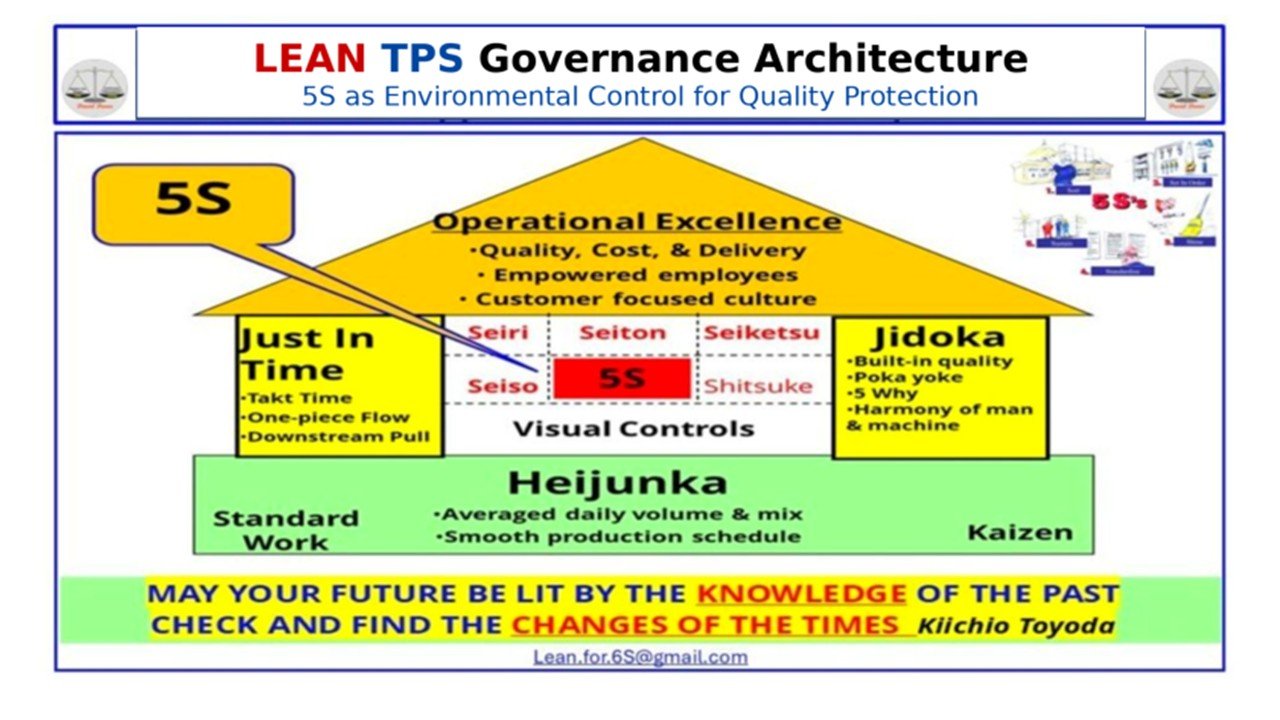
Toyota Production System is often described through visible structural elements. Standardized Work, Jidoka, Just In Time, and Kaizen are presented as performance pillars. These mechanisms do not operate independently. Their effectiveness depends on disciplined governance. Without governance, they become symbolic structures. Within governance, they function as operational controls that protect Quality.
Standardized Work defines normal condition of execution. Sequence, timing, work-in-process limits, safety requirements, and Quality checkpoints establish the approved method against which deviation is measured. Standardized Work functions as control only when enforced. Under weak governance, it is documented but not lived. Under disciplined governance, adherence is verified through Daily Management, deviation triggers structured review, and revision occurs only through validated problem solving rather than informal adjustment. Standardized Work serves as structural reference for system integrity.
Jidoka protects Quality through enforced stop logic. Stop authority has meaning only when leadership reinforces it consistently. Detection without action reduces Jidoka to rhetoric. Governance determines whether stop logic is executed immediately or overridden by output pressure. Under compression, Jidoka reveals leadership maturity. Mature governance responds decisively and treats deviation as unacceptable. Weak governance hesitates, tolerates deviation, and increases defect risk.
Just In Time increases system sensitivity by reducing inventory buffer, synchronizing flow, and aligning work to takt. Reduced buffer removes insulation that absorbed variation. As sensitivity increases, deviation becomes visible at origin rather than traveling across processes. Just In Time does not compensate for governance weakness. It intensifies requirement for disciplined behavior. In systems lacking discipline, sensitivity produces rapid instability. In governed systems, Just In Time sharpens precision, reinforces adherence to defined method, and strengthens Quality protection through immediate exposure.
Kaizen refines structure through deliberate improvement of defined normal condition. Kaizen is not governance. It operates within it. Improvement assumes stability as starting point. Applied to unstable systems, improvement introduces additional variation into uncontrolled condition. Governance must stabilize normal before Kaizen alters it. Under mature governance, Kaizen strengthens structure because change is layered onto disciplined foundation. Under weak governance, Kaizen increases variability because enforcement is insufficient to sustain revised standards.
These mechanisms operate as integrated system within governance rather than isolated techniques. Standardized Work defines normal. Jidoka enforces Quality protection. Just In Time increases sensitivity and reveals deviation. Kaizen refines structure through disciplined learning. Governance sustains all four by enforcing adherence, accelerating escalation, and requiring structural correction.
Jishuken reduces buffer across multiple elements simultaneously. When manpower, inventory, and cycle time are tightened together, the ability of Standardized Work, Jidoka, Just In Time, and Kaizen to function under disciplined control is tested at once. Under consistent governance, Standardized Work continues to define execution, Jidoka triggers immediate response, Just In Time exposes deviation without accumulation, and Kaizen proceeds only after stability is verified. When governance behavior is inconsistent, deviation spreads because adherence, escalation discipline, and corrective action are not sustained under reduced buffer.
Quality remains governing measure. When buffers are reduced, stable Quality demonstrates that Standardized Work, Jidoka, Just In Time, and Kaizen operate within disciplined governance rather than as independent practices. If Quality deteriorates, adherence to defined method, escalation discipline, or corrective enforcement is insufficient. Reduced buffer clarifies whether these mechanisms function together under consistent leadership control or exist as visible practices without sustained enforcement.
IX. Leadership Obligation and System Ownership
Governance cannot be delegated. Supervisors conduct review, engineers analyze data, and associates execute defined work, but leadership owns the control structure that integrates these elements. Governance maturity is not only operational condition. It is leadership condition reflected in how structure is defined, enforced, and sustained.
When Daily Management cadence weakens, leadership permitted erosion through tolerance or inattention. When Visual Management reflects aspiration rather than actual condition, distortion replaced exposure. When responsibilities are unclear, authority was not defined. When deviation becomes normalized, structural drift was accepted. Instability is rarely accidental. It reflects governance decisions made or avoided over time.
Jishuken does not target operators. It targets structure by removing insulation and increasing sensitivity. Reduced margin eliminates tolerance for delay. Increased interdependence exposes hesitation immediately. Under these conditions, leadership conduct becomes visible because response speed, clarity of authority, and enforcement of standard determine whether instability is corrected or amplified.
Under mature governance, leadership response follows consistent pattern. Abnormality is surfaced immediately because exposure is expected. Ownership is clarified before escalation. Direction is reinforced against Standardized Work rather than adjusted informally. Correction is decisive. Root cause analysis follows without delay. Standards are revised only after verified countermeasure demonstrates structural improvement. Quality remains governing condition rather than variable negotiated against output.
Under weak governance, response fluctuates under pressure. Output overrides stop logic. Informal adjustment replaces defined standard. Escalation is delayed to preserve short-term appearance of stability. Review cadence shifts from preventive to reactive. Containment substitutes for structural correction. Quality destabilizes gradually before crisis becomes visible.
Leadership obligation precedes improvement ambition. Enforcement of normal condition requires disciplined repetition independent of short-term metrics. Governance must remain consistent when results appear acceptable and when pressure intensifies. Stability under routine conditions has little meaning if discipline collapses under constraint.
Jishuken does not create leadership maturity. It measures it. Compression exposes whether leadership behavior remains consistent as tolerance narrows and sensitivity increases. Governance exists only when leadership behavior remains stable under pressure. Consistency under constraint demonstrates ownership of control structure.
Quality under compression confirms whether governance is operational rather than rhetorical. Stability signals maturity. Instability signals structural weakness that must be corrected before improvement can be sustained.
X. Final Structural Synthesis
Toyota Production System operates as governed system in which improvement methods function within defined constraint. Constraint establishes acceptable performance boundaries. Disciplined leadership behavior enforces those boundaries through Daily Management. Exposure, escalation, corrective action, and deliberate revision of standard operate as integrated control loop that protects Quality over time.
Standardized Work establishes defined normal condition and provides reference against which deviation is measured. Visual systems make actual condition visible at moment of occurrence so abnormality cannot accumulate. Jidoka requires immediate response when defined abnormal conditions appear, preventing continuation of defective flow. Just In Time reduces inventory buffer and aligns production to takt so variation becomes visible near origin rather than traveling across processes. Kaizen refines defined normal only after stability is demonstrated under disciplined control. These mechanisms function effectively only when leadership consistently reinforces adherence to defined method, enforces timely escalation, and requires structural correction rather than informal adjustment.
When leadership discipline is consistent, reduced buffer strengthens control rather than destabilizing flow. Tighter conditions require clarity of ownership, precision of execution, and immediacy of response. Review cadence aligns with process sensitivity. Deviation is corrected before propagation across operations. Learning is incorporated through deliberate revision of standard following verified countermeasure. Under these conditions, Quality remains stable because governance behavior remains active and aligned with defined constraint.
When leadership discipline is inconsistent, reduced margin exposes delay, ambiguity, and tolerance of deviation. Informal interpretation replaces adherence to defined method. Escalation is postponed to preserve short-term appearance. Containment substitutes for root cause elimination. Managerial capacity is absorbed by reaction. Improvement activity introduces additional variation into system not consistently controlled. Instability emerges not from technical insufficiency, but from inconsistent governance behavior.
The difference between stability and instability under reduced buffer arises from governance maturity rather than tools or intensity of improvement activity. Stability under tighter conditions demonstrates that leadership control is operational and capable of protecting Quality without reliance on excess margin. Instability demonstrates insufficient enforcement discipline that must be corrected before further improvement.
Jishuken reveals this condition by reducing tolerance and observing response. Reduced buffer removes insulation that absorbed inconsistency and makes leadership conduct visible in its effect on Quality. Improvement becomes sustainable only when governance behavior remains consistent under constraint. Quality stability under reduced margin provides direct evidence of that consistency.