A Life in Quality
Twenty-six years inside a profession built on accountability
Quality has been the organizing principle of my professional life. It was never a role, a department, or a résumé label. It was the discipline that governed how work was designed, how decisions were made, and how leaders were held accountable for outcomes.
I entered the Quality profession in the 1990s, when Quality still carried clear meaning. It referred to prevention, not inspection. It referred to management responsibility, not specialist heroics. It referred to systems that made problems visible and forced learning, not projects that produced reports. At that time, Quality was understood as a leadership obligation that cut across engineering, operations, supply, and management. It was not optional and it was not delegated.
My involvement with the American Society for Quality grew naturally out of that understanding. I joined as a practitioner who believed Quality was a profession worth protecting. Over the next twenty-six years, I earned the Certified Quality Technician, Certified Quality Auditor, ASQ-Certified Quality Engineer, and Certified Six Sigma Black Belt designations. I volunteered continuously and served in leadership roles within a local ASQ section. I invested time, effort, and trust because ASQ represented something larger than credentials. It represented stewardship of the discipline.
Those certifications were never an identity. They were tools, acquired to deepen understanding of systems, variation, auditing, and control. The value was not the title, but the expectation that a certified professional understood cause and effect, respected evidence, and recognized that Quality failures were management failures before they were technical ones.
Throughout my career, my work remained grounded in production systems, not abstractions. I developed Quality capability in environments where defects stopped lines, instability surfaced immediately, and leaders were expected to respond in real time. My formative years were spent inside Toyota-governed production systems, where Quality was inseparable from safety, delivery, and cost because it governed the conditions under which work occurred. When systems were poorly designed, no amount of training or analysis compensated for that failure. When systems were designed well, people succeeded without heroics.
That grounding was reinforced through direct exposure to Toyota Production System leadership development, including participation in Jishuken-based learning and cross-plant improvement activity. In those environments, improvement was not assigned to experts. It was owned by leaders accountable for system behavior, day after day.
This grounding shaped how I viewed professional societies and certifications. A Quality society existed to preserve rigor, clarify responsibility, and prevent dilution of meaning. Its role was not to chase trends, expand markets, or mirror consulting frameworks. Its role was to hold the line on what Quality meant, even when that position was inconvenient or unpopular.
For many years, ASQ fulfilled that role well enough to merit continued involvement. The organization was built on a lineage that treated Quality as a system discipline rooted in statistical thinking, leadership accountability, and ethical responsibility. That lineage mattered. It signaled continuity between practice, theory, and governance.
What follows in this article is not a complaint from the outside. It is an account from inside the profession, written by someone who invested decades believing that Quality was worth defending. The critique that comes later only makes sense when this foundation is clear. I did not arrive at disagreement quickly, casually, or emotionally. I arrived there after a long period of observation, participation, and reflection, when it became impossible to reconcile what Quality was meant to be with what it was becoming.
This article begins here because the issue is not personal disappointment. The issue is the loss of a discipline that once governed how organizations thought, learned, and led.
What ASQ Was Created to Protect
Quality as a system of management responsibility
The American Society for Quality was not created to sell credentials. It was created to protect a discipline.
The organization was founded as the American Society for Quality Control, reflecting its original mandate. Quality was treated as a formal management system rooted in control, prevention, and responsibility, not as a collection of tools or techniques. From the beginning, the society positioned Quality as an enterprise obligation that governed how work was designed, how variation was managed, and how leaders were held accountable for outcomes.
As Quality expanded beyond manufacturing into services, healthcare, government, and global supply networks, ASQ expanded with it. That expansion did not dilute the definition. It reinforced it. Quality Control, Quality Assurance, statistical thinking, auditing, and engineering judgment were recognized as distinct professional disciplines that required rigor, ethics, and sustained mastery. The society’s role was to preserve coherence as the field grew, not to chase trends.
This intent was reflected in how ASQ structured certification. Credentials were not symbolic markers or career branding. They were mechanisms to verify competence against defined bodies of knowledge tied directly to practice. Certification validated understanding of systems, variation, and governance. It did not confer authority to override leadership responsibility or substitute for system design.
Certification integrity was enforced structurally. Many ASQ credentials were governed by fixed-length examinations lasting several hours. Bodies of Knowledge were explicitly defined and maintained. Recertification requirements were designed to ensure ongoing professional engagement through practice, education, or re-examination. Some credentials were lifetime by design. Others deliberately required renewal. These were governance decisions, not administrative conveniences.
ASQ’s institutional role extended beyond certification. The society played a formal part in shaping how Quality was understood at the national level, including involvement in the Malcolm Baldrige National Quality Award, which emphasized leadership systems, organizational learning, and performance excellence. This reinforced Quality as a management responsibility, not a specialist function.
These mechanisms mattered. They reinforced the idea that Quality was not something earned once and displayed indefinitely. It was a discipline that demanded continuous learning, ethical practice, and accountability. ASQ functioned as a steward of meaning, maintaining boundaries between Quality as a governing system and improvement methods that were useful but subordinate to it.
The collapse did not begin with malice or incompetence. It began when these boundaries stopped being enforced. Once protection of definition yielded to accommodation of demand, Quality shifted from a governed discipline to a portfolio of offerings. That shift, subtle at first, set the conditions for everything that followed.
The Pioneers ASQ Once Represented
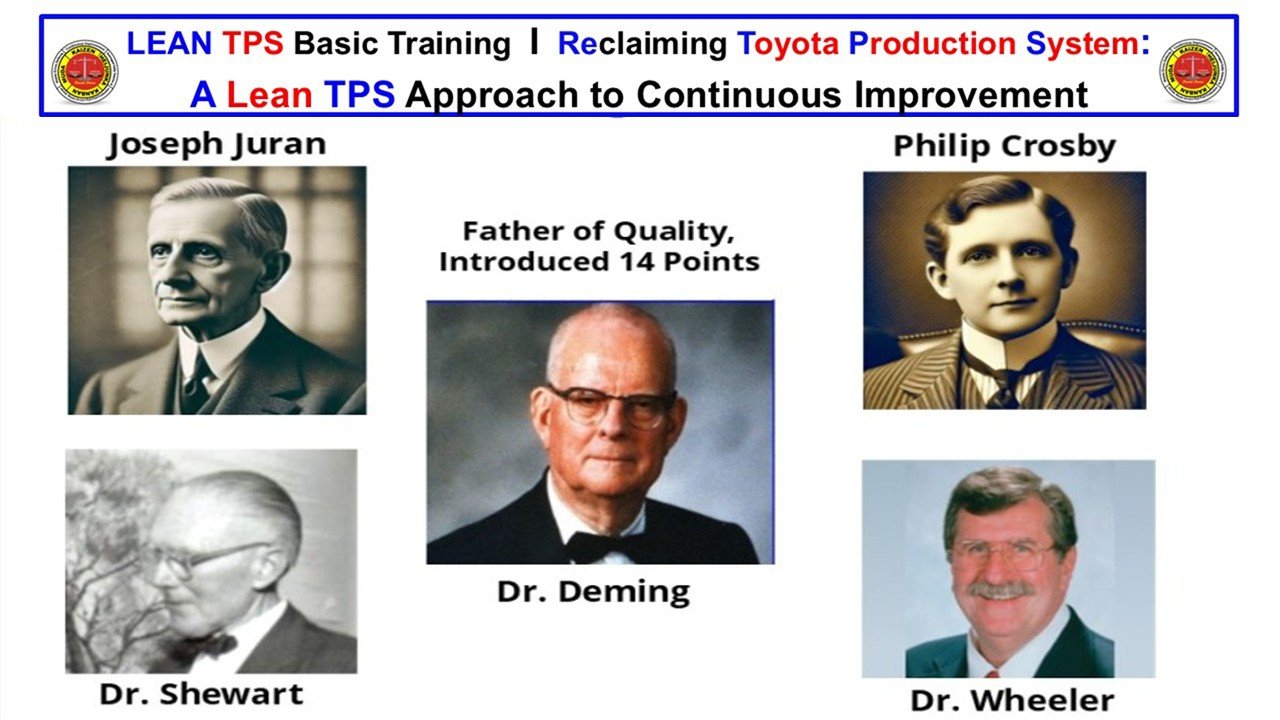
Deming, Juran, Crosby, Shewhart, Wheeler and the meaning of Quality
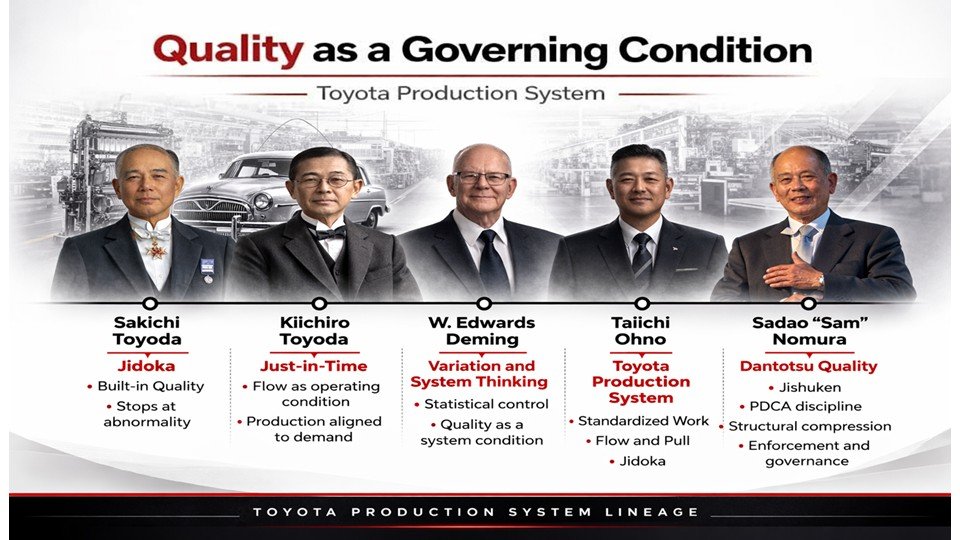
For much of its history, ASQ publicly anchored itself to a specific intellectual lineage. The society’s identity was inseparable from the work of a small group of thinkers who defined Quality as a disciplined, system-level practice rather than a collection of techniques. Their presence was not ceremonial. They represented non-negotiable principles about how organizations learn, govern, and prevent failure.
- Edwards Deming framed Quality as a management responsibility rooted in systems thinking and variation. His work rejected the idea that performance could be improved through targets, exhortations, or inspection alone. Stability, learning, and improvement depended on how leaders designed and managed systems. Quality, in this sense, was inseparable from governance.
Joseph Juran reinforced this view by making Quality a strategic obligation. His trilogy of Quality Planning, Quality Control, and Quality Improvement placed responsibility squarely with leadership. Juran emphasized that most Quality problems were not technical failures but managerial ones. Improvement without management ownership was structurally unsound.
Philip Crosby made prevention central. His assertion that Quality is free was not a slogan. It was a systems argument. Defects cost more to correct than to prevent, and prevention required disciplined process design and leadership commitment. Zero defects was not a motivational goal. It was an expectation created by stable systems.
Walter A. Shewhart provided the scientific foundation. His work on control charts established a clear distinction between common and special causes of variation. This distinction was not academic. It defined when management must change the system and when operators must respond to abnormal conditions. Without this clarity, organizations react blindly and misattribute cause.
Donald J. Wheeler extended Shewhart’s thinking and defended it against misuse. Wheeler repeatedly emphasized that statistical methods exist to support understanding of process behavior, not to impress or intimidate. He challenged approaches that substituted mathematical theater for causal insight. His work reinforced that Quality tools are servants of thinking, not substitutes for it.
ASQ later memorialized some of these figures through named awards and honorary recognition, while others shaped Quality entirely outside professional societies, reinforcing that Quality’s foundations were never dependent on institutional credentialing. Together, these figures shared a common position. Quality was never a credential ladder. It was never a branding exercise. It was never a portable toolkit that could be detached from management responsibility. Quality was a system of thinking that bound leadership behavior to evidence, variation, and prevention.
ASQ once presented these figures as the intellectual spine of the profession. Their inclusion signaled that the society stood for rigor over popularity and clarity over convenience. It also signaled a boundary. Any method, framework, or improvement approach that contradicted these principles did not qualify as Quality, regardless of market demand.
The existence of this boundary exposes the scale of the departure that followed. The principles these pioneers defended are fundamentally incompatible with systems that elevate credentials over systems, experts over leaders, or projects over governance. Understanding their actual positions is necessary before examining how their legacy was diluted.
The work of these figures is treated here as criteria for judgment, not as history for admiration.
Six Sigma (post-1990s)
A corporate project system, not a Quality governance model
Six Sigma did not enter industry as a neutral extension of Quality. It emerged as a corporate quality management system developed inside Motorola during the late 1980s and early 1990s to address chronic yield, defect, and cost problems at scale. Its original purpose was operational recovery within a specific corporate context, not stewardship of the Quality discipline.
The system was designed for executive deployment. Six Sigma framed improvement as a sequence of discrete, time-bounded projects led by specially trained experts. Authority flowed through certification status rather than line management role. Improvement work was selected, scoped, analyzed, and reported within project boundaries. Leadership engagement occurred primarily through sponsorship and tollgate reviews, not through daily governance of work.
This structure was later amplified and globalized through General Electric, where Six Sigma was positioned as a central management initiative tied to financial performance and executive evaluation. Under this model, improvement results were expected to be quantified, reported, and compared across businesses. The belt hierarchy became an internal authority mechanism that allowed Six Sigma to scale rapidly across diverse operations.
These design choices mattered because they reassigned responsibility for Quality. Quality no longer resided primarily with leaders accountable for system conditions. Responsibility shifted toward certified specialists accountable for project outcomes. Leaders approved projects and reviewed results. Experts owned method, analysis, and narrative. The underlying production and service systems often remained unchanged between interventions.
This approach contrasted sharply with the Quality lineage ASQ had historically represented. Deming, Juran, Shewhart, and Wheeler treated Quality as a permanent management obligation governed through system design, variation control, and prevention. Six Sigma reframed that obligation into episodic sponsorship. Improvement activity occurred in cycles. Governance of normal conditions did not.
The appeal of Six Sigma was understandable. The model was packaged, measurable, and transferable. Statistical language conveyed rigor. Certification created clear role definitions. Project results could be summarized in dashboards and financial terms that traveled well in executive forums. These characteristics made Six Sigma attractive to organizations seeking rapid, visible improvement without redesigning how leaders governed daily work.
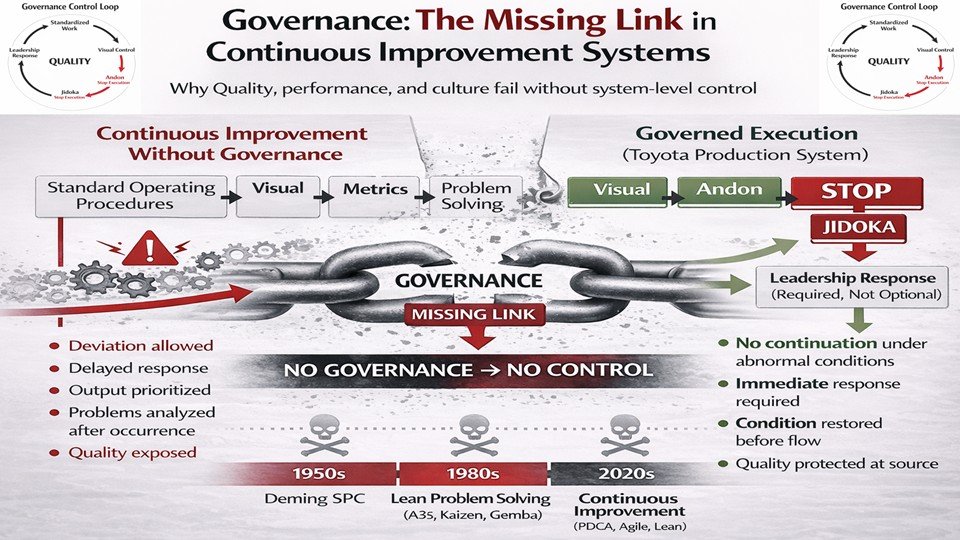
What Six Sigma did not provide was a mechanism for continuous system stability. Quality governance requires explicit definition of normal conditions, immediate visibility of abnormality, and obligated response by leadership when systems deviate. Six Sigma addressed performance gaps after they accumulated. It did not require leaders to design work so that problems surfaced immediately, nor did it bind them to restore stability as a condition of management.
As Six Sigma gained prominence during the 1990s, its structure exerted pressure on professional societies. A project-centric model with a clear credential hierarchy scaled more easily than a governance-centric model that demanded sustained leadership behavior. The market rewarded clarity of titles and certifications. The discipline of Quality required clarity of responsibility.
The outcome was not an explicit rejection of Quality principles, but a structural substitution. Quality became something specialists delivered through projects. Leadership became a sponsor rather than a system owner. Improvement became episodic rather than embedded. Variation was analyzed statistically, often after instability had already propagated through the system.
This reframing created the conditions for what followed. Once Quality was positioned as an intervention rather than a governing state, it became possible to merge it with other frameworks, rebrand it for broader appeal, and package it for education and certification. The next step was structurally enabled.
Lean (post-1988): How ASQ Legitimized a Structural Misunion
When an external label replaced governance and was absorbed into a project hierarchy
Lean entered the mainstream as an external interpretation of the Toyota Production System. The term did not originate at Toyota. It was introduced in the late 1980s by Western researchers studying Japanese manufacturing and popularized through The Machine That Changed the World. Lean was a descriptive label applied after observation, not a designed management system with embedded governance.
What traveled under the name Lean was necessarily partial. Tools, practices, and visible outcomes could be documented and taught. Leadership obligation, daily system governance, and stop-the-line accountability could not. The result was an abstraction. Lean became a collection of methods associated with efficiency, waste reduction, and flow, detached from the management system that made those outcomes sustainable at Toyota.
This distinction mattered when Lean encountered Six Sigma. Lean emphasized flow, waste elimination, and speed. Six Sigma emphasized variation reduction through project-based statistical analysis. On the surface, the two appeared complementary. One addressed efficiency. The other addressed defects. The problem was not overlap. The problem was structural incompatibility.
Toyota never treated flow improvement as a project. Flow was a condition governed daily through Standardized Work, visual control, and leader response. Abnormality triggered immediate action. Problems were not escalated to specialists while leaders observed from a distance. Leaders were obligated to restore stability as part of their role. Improvement was inseparable from operating rhythm.
When Lean was coupled with Six Sigma, that governance requirement disappeared. Lean was reduced to a toolset deployable inside the Six Sigma project architecture. Flow tools were inserted into DMAIC phases. Visual management became a mechanism for project tracking. Kaizen was reframed as a time-boxed intervention event. The operating system was replaced by an improvement overlay.
ASQ played a legitimizing role in this union. By recognizing and promoting Lean Six Sigma as an integrated offering, the society signaled that Lean belonged inside the Six Sigma hierarchy. This was not a neutral accommodation. It formally repositioned Lean as subordinate to a credentialed expert model rather than a leadership-governed system.
Once legitimized, the misunion scaled rapidly. Lean Six Sigma offered everything markets reward. It had clear titles, progressive belt levels, transferable language, and a certification pathway that could be taught, tested, and sold. It removed the need for organizations to redesign leadership behavior, daily accountability, or system stability. Improvement could proceed without changing how managers managed.
The timing matters. Lean Six Sigma emerged in the late 2000s and early 2010s, precisely when organizations and universities were seeking standardized improvement curricula. ASQ’s endorsement gave the model professional credibility. Lean Six Sigma became the default representation of Lean and Quality in education, hiring, and consulting.
This was the point at which Quality governance was effectively replaced. Lean no longer referred to a complete production and management system. It referred to a toolset layered onto a project methodology. Quality no longer referred to prevention embedded in system design. It referred to results delivered by certified specialists.
The union did not fail because Lean or Six Sigma were misunderstood. The union failed because their integration erased the governing conditions that made Quality possible in the first place.
The Belt Economy
When credentials replaced capability
Once Lean was formally absorbed into the Six Sigma project architecture, the conditions were set for a credential economy to take hold. Improvement no longer depended on how work was governed daily. It depended on who held authority through certification. Titles became proxies for competence. Belts became substitutes for system design.
This shift did not occur because organizations suddenly rejected Quality. It occurred because belt systems solved a different problem. They provided a portable, standardized way to signal expertise without requiring organizations to redesign how leaders governed work. A belt could be earned, displayed, and traded across employers. A system of Quality governance could not.
Credential hierarchies scaled where disciplines did not. Belt levels created clear progression paths that aligned with human resources practices, compensation structures, and consulting models. Training could be productized. Exams could be standardized. Improvement could be narrated through project charters and financial summaries. The complexity of operating systems was abstracted away.
The cost of this abstraction was significant. Capability moved out of the system and into individuals. Responsibility shifted from leaders accountable for conditions to experts accountable for results. Problems were framed as analytical challenges rather than design failures. Stability was pursued after the fact through corrective projects instead of being built into daily operations.
This economy rewarded visibility over effectiveness. A completed project with a quantified benefit was easier to recognize than a stable process that prevented problems from occurring. Certification offered tangible evidence of action. System design offered quiet absence of failure. Markets favored the former.
Over time, the belt economy displaced older Quality identities. Roles centered on Quality Control, Quality Assurance, and process ownership lost prominence. Improvement specialists multiplied. Organizations accumulated credentials while underlying systems remained unstable. The language of Quality faded as the language of belts expanded.
This was not simply a change in terminology. It was a change in what organizations believed improvement was. Improvement became something applied to systems rather than something embedded in them. Learning became episodic. Accountability became diffuse. Risk accumulated behind polished reports.
The belt economy persists because it aligns with how modern organizations reward activity. It offers certainty in the form of titles and certifications where system redesign would require sustained leadership effort. It feels concrete. It feels measurable. It feels safe. What it does not do is build Quality into the conditions of work.
By the time this economy was fully established, the foundations that once anchored Quality as a governing discipline had already eroded. The next institution to reinforce that erosion was higher education.
Universities and the Academic Rewriting of Quality
How credential logic became the educational standard
Universities did not initiate the collapse of Quality as a governing discipline. Universities normalized it. Once professional societies and industry frameworks signaled that belts and certifications represented legitimate improvement capability, academic institutions across North America adapted their curricula accordingly. Quality education shifted from system governance to credential preparation.
Programs once centered on Quality Control, Quality Assurance, statistical process control, and management responsibility were reduced, renamed, or absorbed into broader improvement frameworks. In their place emerged Lean, Six Sigma, and Lean Six Sigma certificates structured around progressive belt levels. These offerings were positioned as career credentials rather than disciplinary foundations.
This shift aligned with academic incentives. Belt frameworks provided discrete levels, standardized bodies of knowledge, and exam-based validation. They could be packaged, scheduled, assessed, and marketed efficiently. Governance could not. Leadership accountability, daily system control, and prevention through design require immersion in operating systems and sustained practice, conditions universities are structurally limited in providing.
The United States played a defining role in this transition. Universities such as Villanova became early academic centers for Six Sigma education, offering belt-based programs through executive and continuing education channels. These programs framed Six Sigma, and later Lean Six Sigma, as transferable professional credentials rather than enterprise governance systems. Their visibility and perceived legitimacy accelerated adoption across industries.
Canadian universities and colleges followed the same model. Continuing education divisions introduced Lean Six Sigma certificates and belt-aligned programs presented as Quality education. These programs mirrored U.S. structures in content, progression, and assessment. Students could complete formal university credentials tied to improvement methodologies while receiving limited exposure to Quality as a system of management responsibility.
Together, these developments established a North American academic alignment around credential logic. The same belt hierarchies, bodies of knowledge, and project narratives appeared across institutions in both countries. Quality became teachable as a method set. Governance became peripheral.
Academic adoption reinforced market behavior. Employers began listing Lean Six Sigma belts as proxies for Quality competence. Hiring, promotion, and compensation aligned around credentials rather than system ownership. Graduates entered organizations prepared to manage projects and charters, but not to design, govern, or stabilize production and service systems.
Language changed as a result. Quality ceased to be named as a discipline. It became an adjective attached to initiatives, dashboards, and outcomes. Quality Control and Quality Assurance receded from curricula and job titles. Improvement activity remained visible. Quality governance did not.
Universities did not act with malice. They responded to demand shaped by professional societies, consulting markets, and credential economies. The consequence was structural. By institutionalizing belt frameworks as Quality education across North America, academia helped make the substitution durable.
Once Quality disappeared from education, organizations stopped governing it explicitly. The belt economy no longer required justification. It had become normal.
Capability Built Without Belts, Certifications, or Branding
A system designed to prevent specialist dependency
The contrast with the Toyota Production System is direct and unambiguous. Toyota never created belts. Toyota never issued certifications to establish authority. Toyota never treated improvement as a transferable project discipline detached from daily management. Capability was designed into the operating system itself, not layered onto it through individual credentials.
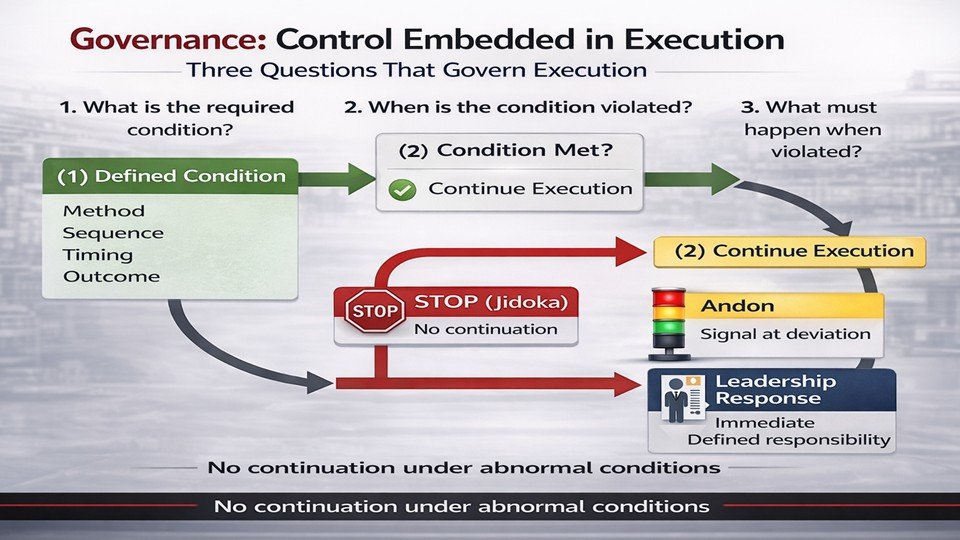
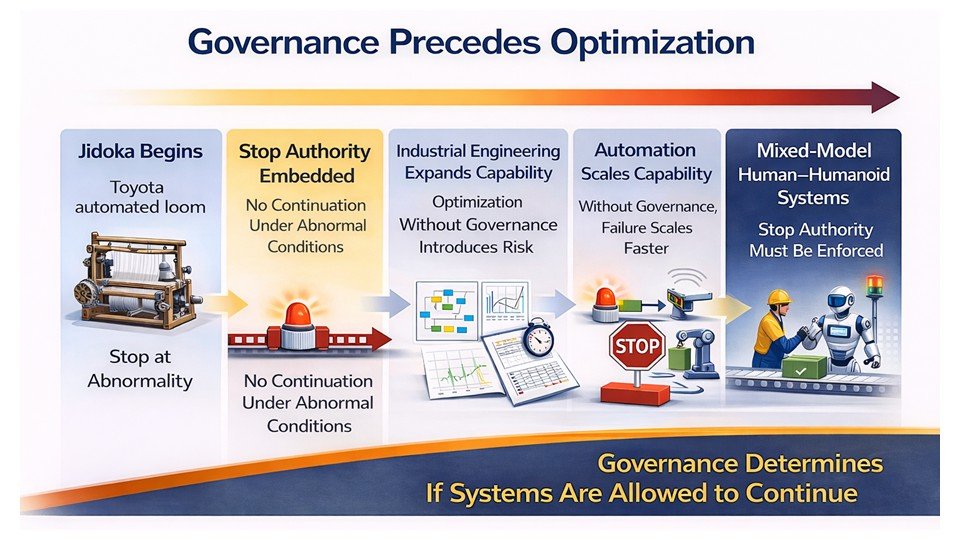
At Toyota, Quality is governed, not delegated. Normal conditions are explicitly defined through Standardized Work. Abnormality is made visible immediately. When conditions deviate, leaders are obligated to respond. Improvement is not initiated through project selection or expert assignment. Improvement is triggered by instability in the system. Responsibility remains with line management at all times.
This design makes specialist ownership of improvement structurally unnecessary and operationally dangerous. If authority were transferred to certified experts, leaders would lose direct responsibility for system conditions. If problems were escalated to specialists for analysis while operations continued unchanged, instability would propagate. Toyota’s system prevents this by binding response authority to leadership roles, not credentials.
Learning at Toyota is experiential and continuous. Capability is developed by solving real problems in real systems under coaching. Methods exist to support thinking, not to replace it. Tools are introduced only when they clarify cause and effect at the point of use. Authority does not come from method knowledge. Authority comes from responsibility for outcomes under defined conditions.
This structure eliminates the need for certification hierarchies. There is no external validation of competence through belts because competence is demonstrated daily through system performance. Leaders cannot sponsor Quality from a distance. Leaders are embedded in the work. When abnormalities occur, the system is stopped, understood, and corrected. No parallel expert organization is required.
Toyota also never separated Quality from production. Quality is not a parallel function or specialist domain. Quality is built into how work flows, how equipment is designed, how materials are supplied, and how people are developed. Safety, delivery, and cost are consequences of this design. Quality governs all of them.
The absence of belts is intentional. Certification systems exist to signal competence where systems cannot enforce it. Toyota invested in system design so that competence is visible without signaling. When systems are stable and transparent, capability does not need declaration. It is evident in performance and behavior.
This approach is incompatible with the belt economy. Belts assume that expertise must be identified, elevated, and mobilized across systems. Toyota assumes that systems must be designed so problems surface and are solved where they occur. One model centralizes improvement authority. The other distributes responsibility through structure.
Understanding what Toyota never did matters because it exposes the false equivalence created by Lean Six Sigma branding. Lean, as practiced at Toyota, is not a lighter version of Six Sigma. It is a different governing logic. When Lean is reduced to tools and inserted into a project hierarchy, it ceases to function as a production and management system.
This distinction explains why credential layers create systemic blind spots rather than control. The mechanism is structural, not cultural. It can be explained. It can be predicted. It can be prevented.
The Lean TPS Swiss Cheese Failure Mode
How credential layering creates systemic risk
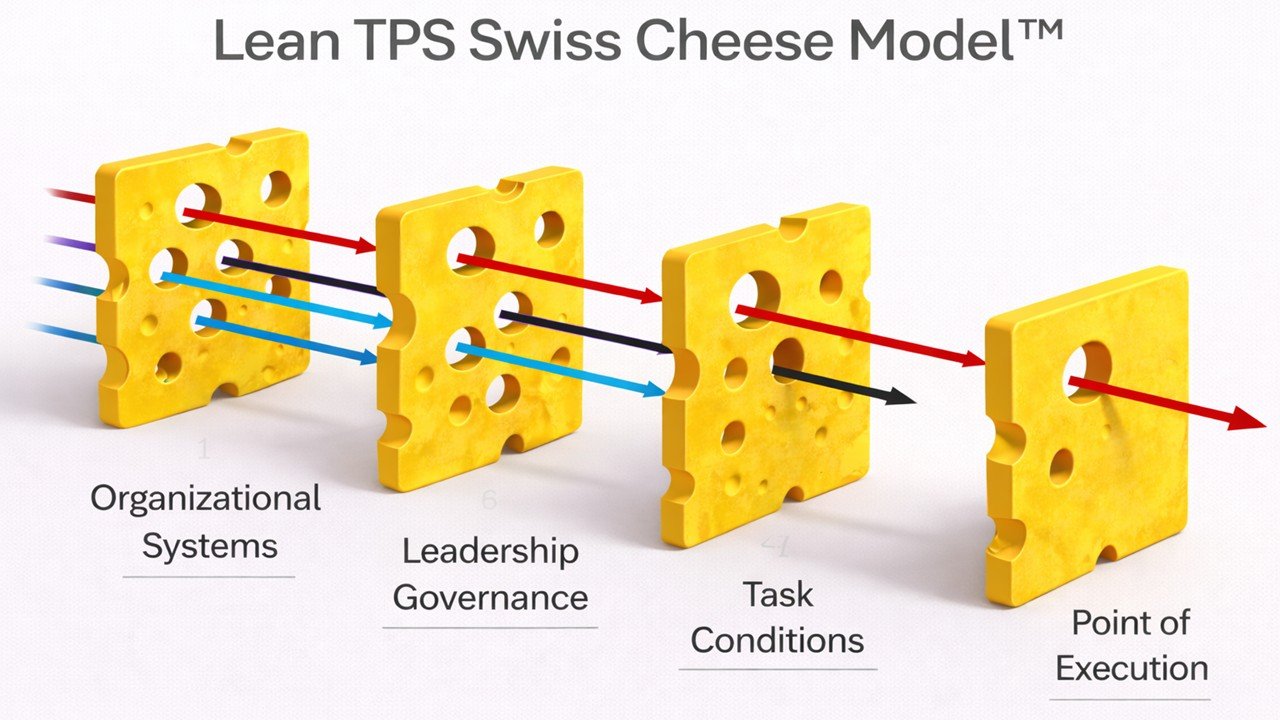
Credential-based improvement systems fail in predictable ways. The failure is not random and it is not cultural. The failure is structural. The Lean TPS Swiss Cheese Model exists to explain why recombining Quality into layered specialist systems inevitably hides risk and fractures accountability.
Each layer of certification introduced into an organization creates separation. Roles become defined by titles rather than responsibility for conditions. Improvement authority moves away from the point of work and into expert domains. As layers accumulate, direct visibility of system behavior diminishes.
In a governed system, abnormality is surfaced immediately and ownership is unambiguous. In a credentialed system, abnormality is routed. Problems are reframed as projects. Time is inserted between detection and response. During that delay, risk propagates. By the time analysis begins, consequences have already spread across the system.
Credential layers also reshape behavior. Leaders defer to experts. Experts optimize within project boundaries. No one owns the whole system. Quality fragments across initiatives, dashboards, and reports. Each layer appears to add control. Collectively, the layers reduce it. Controls exist, but alignment does not. This is the Swiss Cheese failure mode.
This structure explains why belts persist despite repeated disappointment. Credential layers provide psychological safety. They create the appearance of rigor without requiring leaders to redesign how work is governed daily. Commitment to improvement can be demonstrated through projects and certifications while underlying system instability remains untouched. Risk is concealed behind process maps, tollgates, and financial summaries.
As layering continues, feedback weakens. Operators learn to wait for projects rather than escalate abnormalities. Managers learn to sponsor improvement rather than intervene directly. Specialists learn to define success in terms of completion rather than stability. Systems become brittle. Failures appear sudden, but they are the predictable outcome of accumulated misalignment.
Lean TPS prevents this failure by design. It removes layers rather than adding them. Responsibility remains with leaders accountable for system conditions. Improvement is inseparable from daily management. Visual control exposes deviation immediately. Standards make abnormality unmistakable. Response is immediate, not scheduled.
The Swiss Cheese Model does not argue against learning, analysis, or expertise. It argues against substituting credentials for governance. When improvement authority is layered instead of embedded, Quality ceases to be a property of work and becomes an artifact of reporting.
This is not a theoretical critique. It explains why organizations with extensive certification portfolios continue to experience the same failures year after year. Without governing structure, additional layers do not add protection. They add opacity.
A Values-Based Break
Why I walked away from ASQ
Leaving the American Society for Quality was not an impulsive decision. It followed a long period of observation in which the distance between what Quality is and what ASQ legitimized became impossible to reconcile.
For more than two decades, I remained engaged because the society still appeared to serve a necessary role. ASQ had once acted as a steward of the discipline, preserving clarity around Quality as a system of management responsibility. That stewardship depended on boundaries. Quality was not everything that improved results. It was not interchangeable with productivity frameworks or project methodologies. It had a defined meaning rooted in prevention, causality, and leadership obligation.
That meaning eroded as ASQ increasingly aligned itself with credential economies built around Six Sigma and Lean Six Sigma. The issue was not the existence of Six Sigma certifications. The issue was the signal sent when Lean was formally positioned inside that hierarchy and presented as part of the same credential ladder. At that point, ASQ was no longer protecting the definition of Quality. It was expanding a marketplace.
This created a values conflict that could not be resolved through incremental adjustment. Continued participation implied endorsement of a definition of Quality in which governance was optional and credentials were sufficient. It implied acceptance of a model where improvement authority resided with certified experts rather than with leaders accountable for system conditions. That position was incompatible with everything I had learned through practice.
The decision to leave was not a rejection of volunteers, staff, or colleagues. Many remain capable, committed, and sincere. The break was institutional, not personal. It reflected a refusal to legitimize a structure that reframed Quality as a commercial product rather than a governing discipline.
Walking away meant relinquishing certifications, roles, and identity markers accumulated over decades. That decision was not symbolic. It was deliberate. Quality without integrity is not neutral. When definitions collapse, systems fail quietly until consequences surface publicly.
This break clarified purpose. It made explicit what had been implicit for years. Quality cannot be defended from within institutions that no longer enforce its boundaries. When stewardship gives way to accommodation, participation becomes complicity.
The choice to leave was therefore not an exit from Quality. It was an act of alignment with it.
What a Quality Society Must Decide
Governance or marketplace
The story described in this article is not unique to ASQ, but ASQ is the clearest example because of the role it once played. A professional society does more than offer services. It defines boundaries. It decides what belongs inside a discipline and what does not. Those decisions shape how generations of practitioners think, speak, and act.
A Quality society faces a fundamental choice. It can treat Quality as a governed system of leadership accountability, or it can treat Quality as a portfolio of marketable credentials. It cannot do both without contradiction. Governance requires clarity, restraint, and the willingness to exclude. Markets reward expansion, accessibility, and branding. When market logic dominates, definition collapses.
Quality as a discipline does not survive on popularity. It survives on rigor. It requires leaders to accept responsibility for system design, stability, and prevention. It requires practitioners to distinguish cause from noise and structure from activity. It requires institutions to protect meaning even when doing so limits growth.
Credential economies offer a different promise. They offer scale without governance, mobility without responsibility, and recognition without system ownership. They are attractive precisely because they reduce friction. What they cannot deliver is durable Quality. Systems built on credentials rather than structure eventually fail, not because people lack effort, but because accountability is fragmented.
The disappearance of Quality from everyday language is not accidental. It is the predictable result of institutions choosing accommodation over stewardship. When Quality is no longer named, it is no longer governed. When it is no longer governed, it becomes invisible until failure forces attention.
Reclaiming Quality does not require new frameworks or rebranding. It requires restored boundaries. It requires professional societies willing to defend definitions rather than expand catalogs. It requires education that teaches system thinking before methods. It requires leaders who govern conditions, not outcomes.
This article does not propose reform programs or alternative certifications. It records a divergence. One path treats Quality as a discipline that governs how organizations operate. The other treats Quality as an attribute that can be conferred, traded, and displayed.
A Quality society must decide which path it serves.
Continuity With the Earlier Articles in This Series
This article extends a line of inquiry developed across earlier work on LeanTPS.ca, each examining a different pathway through which governance was separated from system behavior.
Kaizen (post-1980s): How Governance Was Removed from the Toyota Production System
This article traced how Kaizen became portable by shedding Jishuken, escalation, and leadership obligation, turning improvement activity into a substitute for system governance.
https://leantps.ca/kaizen-post-1980s-how-governance-was-removed-from-the-toyota-production-system/
Why the Toyota Production System Is Being Rewritten to Fit Lean (post-1988)
This article examined how TPS was abstracted into frameworks and interpretations once its operating conditions were removed, making outcomes dependent on intent rather than structure.
https://leantps.ca/toyota-production-system-vs-lean-post-1988/
Six Sigma (post-1990s) and Lean Six Sigma (post-2010s): How Quality Governance Was Replaced
This article examined how certification systems, project logic, and belt hierarchies displaced management ownership of Quality, producing technically capable organizations without durable control.
https://leantps.ca/six-sigma-lean-six-sigma-quality-governance/
Why Compare Industrial Engineering and the Toyota Production System: Governance Preceded Optimization
This article explained why technical disciplines with strong analytical foundations repeatedly fail to sustain Quality without governance. It showed how Industrial Engineering and TPS share common roots in system analysis, yet diverge structurally once authority, stop logic, and leadership obligation are considered.
https://leantps.ca/why-compare-industrial-engineering-and-the-toyota-production-system-governance-preceded-optimization/