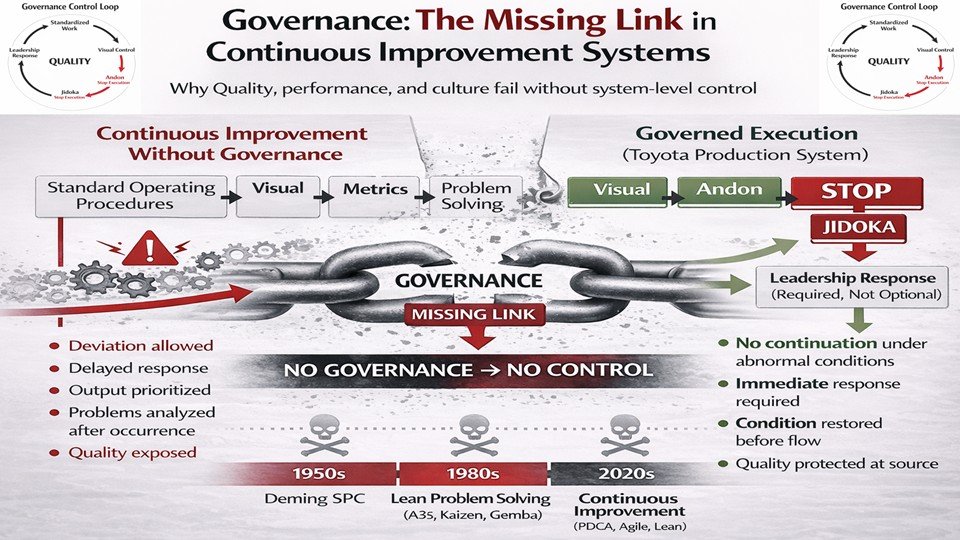
Why Quality, performance, and culture fail without system-level control
1.0 The Observable Failure of Modern Continuous Improvement
Governance in continuous improvement defines how work is controlled, how abnormality is exposed, and how Quality is protected at the source. Organizations across industries deploy structured improvement systems that claim to stabilize performance and protect Quality, yet execution remains uncontrolled at the point of work. Lean (post-1988), Six Sigma, Lean Six Sigma, Kata, and Theory of Constraints represent the dominant structured improvement systems in modern organizations. Additional methods, including Agile, TQM, Kaizen-based programs, and training frameworks, extend this landscape through variations in tools and application, which increases activity without establishing how work must be controlled during execution.
Over multiple decades, organizations have adopted successive waves of improvement systems that introduce new tools, training models, and implementation frameworks. Adoption expands, methods evolve, and participation increases, yet system behavior remains variable because no mechanism defines and enforces conditions at the point of work. Improvement capability grows, yet the operating state is not maintained, which allows variation to re-enter as soon as attention shifts.
Financial pressure reinforces this instability by shifting decision criteria toward output and cost rather than controlled execution. Management systems prioritize short-term targets that influence how work is performed under constraint. Cost reduction initiatives adjust headcount, inventory, or cycle time without establishing the conditions required to sustain performance, which introduces variability into the system. Output targets drive behavior that allows work to proceed under abnormal conditions to meet volume or schedule expectations, which sacrifices Quality for throughput. Financial reporting rewards short-term gains that do not reflect system stability, which reinforces decisions that undermine controlled execution.
Universities teach these methods through abstraction that separates analysis from operating conditions, which produces knowledge of improvement without establishing how work must behave. Certification systems validate proficiency in tools and techniques, yet certification does not provide authority to interrupt execution or prevent deviation. Training expands participation and creates common language across the organization, yet shared language does not define required action under real operating pressure. Knowledge increases, participation expands, and language aligns, yet behavior is not governed by system requirement.
Control of execution requires defined conditions that specify how work must be performed, which are established through Standardized Work. Standardized Work defines method, sequence, timing, and expected outcome so that normal and abnormal conditions can be distinguished without interpretation. When these conditions are not defined or maintained, no baseline exists to detect deviation or require response. Improvement systems operate without this foundation when tools and methods are applied without establishing Standardized Work as the condition for execution.
Organizations institutionalize improvement through departments, roles, and initiatives that operate alongside production rather than governing it. Continuous improvement teams facilitate events, lead workshops, and support projects that target specific problems, yet execution outside those events returns to prior conditions. Engineering functions, including industrial and process engineering, define methods and introduce process changes, yet these designs do not govern how work is performed during execution. Supervisors manage output and schedule, yet they rely on judgment because no mechanism requires interruption when conditions deviate. Dashboards, scorecards, and visual reports display performance after execution, which creates awareness without enforcing response. Performance discussions occur away from the point of work, which delays action and allows instability to remain.
System performance remains unstable because execution is not constrained by enforced adherence to defined conditions. Improvement activity produces localized gains that do not persist because conditions are not held during operation. Variation re-enters immediately when attention shifts because no mechanism prevents recurrence. Quality failures persist because detection occurs after defects are produced rather than through conditions that prevent occurrence. Measurement systems report results after execution, which allows loss to accumulate before corrective action begins. Teams identify problems, analyze causes, and implement solutions, yet behavior remains unmanaged during execution. Performance becomes dependent on effort because the system does not control how work must proceed.
Continuous improvement activity remains high while system performance remains unstable because no mechanism governs how work behaves during execution. Methods increase awareness, expand participation, and generate solutions, yet awareness does not enforce adherence to defined conditions. Deviation is visible, analyzed, and discussed, yet immediate correction is not required at the point of occurrence. Quality is not protected because abnormal conditions are allowed to propagate before intervention occurs. Organizations interpret high activity as progress, yet activity does not equate to control when execution is not governed. The observable condition reflects a system where effort, knowledge, and participation are present, yet behavior is not controlled, which produces instability regardless of the level of improvement activity.
2.0 The Expansion and Fragmentation of Improvement Systems
Improvement systems have expanded through structured methods that isolate specific dimensions of performance rather than defining control of the full system. Lean (post-1988) is applied as a collection of tools that target waste reduction, flow improvement, and workplace organization, which improves visibility and efficiency within defined areas but does not establish governing conditions for execution. Six Sigma defines variation through statistical measurement and provides analytical methods to reduce defects, which strengthens understanding of process behavior but does not determine how work proceeds during operation. Lean Six Sigma combines tool-based intervention with statistical analysis, which increases the range of problems that can be addressed but does not unify how execution must behave across the system. Kata introduces structured routines that develop problem-solving behavior through coaching cycles, which improves thinking capability but does not establish required adherence during execution. Theory of Constraints focuses on identifying constraints and optimizing flow, which improves throughput at limiting points but does not govern behavior across all operating conditions.
Each method improves a portion of system performance by introducing mechanisms that operate within a defined scope. Tool application changes specific processes, statistical methods reduce variation where measurement is applied, and coaching routines develop capability where practiced. These mechanisms create localized effectiveness because intervention occurs at specific points rather than across the entire system. Execution outside those points is influenced by local decisions rather than defined conditions that apply consistently across all work. Improvement occurs where attention is directed, yet performance varies where no common control structure exists.
Expansion across methods introduces fragmentation because each system maintains its own structure, language, and view of performance. Lean (post-1988) emphasizes waste and flow, Six Sigma emphasizes variation and capability, Kata emphasizes behavior and learning, and Theory of Constraints emphasizes throughput and constraint management. These perspectives drive different priorities in how work is analyzed and improved, which prevents alignment at the level of execution. Integration does not occur because no unifying mechanism connects these perspectives into a single system that defines how work must behave. Organizations adopt multiple systems simultaneously, which increases activity and capability while fragmenting how improvement is understood and applied.
Fragmentation becomes visible in daily operation when different parts of the organization apply different methods to the same system. One area focuses on flow, another on defect reduction, and another on coaching routines, which creates inconsistency in how problems are approached and resolved. Measurement systems produce conflicting signals because each method defines performance differently, which obscures the actual condition of execution. Visual management reflects these differences, which prevents a single, clear distinction between normal and abnormal conditions. Teams interpret performance through the method they use, which disconnects improvement activity from system-wide behavior.
Operational cadence further separates these methods because improvement cycles operate independently from execution cycles. Kaizen events introduce short-term intervention, Six Sigma projects follow extended analytical timelines, and Kata routines operate through structured coaching cycles. Execution continues between these cycles without defined constraints, which allows instability to remain while improvement activity is underway. Response timing is determined by the method rather than by system conditions at the point of work. Learning develops within each method, yet execution remains inconsistent because behavior is not governed continuously.
Financial and operational decisions interact with this fragmented landscape without a governing structure that aligns behavior. Cost reduction initiatives, production targets, and resource constraints influence how work is performed, yet these decisions are not bounded by defined execution conditions. Methods are applied within these constraints without establishing how work must proceed, which amplifies inconsistency across the system. Financial objectives and improvement activity operate in parallel rather than within a unified system of control, which increases variability and exposes Quality to risk.
Expansion without governance creates a system where methods coexist without alignment, which prevents the establishment of stable execution. Each method contributes insight, capability, and localized improvement, yet none define and enforce conditions that apply across all work. Execution varies based on local interpretation, timing, and effort because control has not been established as a system requirement.
Methods have expanded in scope, adoption, and institutional support, yet expansion has not produced system governance. Improvement systems increase awareness, capability, and activity, yet they do not establish how work must behave under all conditions. The absence of a unifying control mechanism allows variation to remain, which prevents consistent protection of Quality. Fragmentation is not a failure of method adoption. Fragmentation is the result of systems that improve without governing execution.
3.0 What Continuous Improvement Teaches Today
Continuous improvement systems teach a structured model designed to develop learning, analysis, and problem-solving capability rather than control of execution. Target versus actual establishes a comparison condition that defines deviation through numerical difference. Red and green status converts this comparison into a visual classification that signals acceptable or unacceptable outcomes. Gemba observation directs attention to the point of work so that conditions can be seen directly. Root cause analysis methods, including structured approaches such as 5 Whys, A3 problem solving, PDCA cycles, and other analytical frameworks, trace cause relationships through investigation and experimentation. Kaizen activity introduces structured intervention where teams modify processes. Leadership behaviors emphasize engagement, presence, and support for problem solving. The model defines how organizations observe, analyze, and improve performance.
These elements form a learning system. Comparison highlights gaps between expected and actual outcomes. Visual status systems align understanding across teams. Direct observation reveals how work is performed in practice. Analytical and experimental methods deepen understanding of cause and effect. Improvement activity introduces changes to address identified issues. Leadership involvement reinforces participation and sustains engagement. Capability develops through repeated cycles of observation, analysis, and intervention, which strengthens the organization’s ability to identify and solve problems.
The structure of this system separates learning from execution. Detection, analysis, and improvement occur as distinct activities rather than as part of the execution cycle itself. Response follows review rather than being triggered at the moment conditions change. Problem-solving is organized around cycles, events, and reviews, which creates a temporal gap between performance and action. Learning accumulates through reflection and intervention, yet behavior during operation is not governed by defined requirements that must be maintained in real time.
Operational behavior reflects this separation. Performance is assessed, discussed, and improved through structured routines, while the underlying operating conditions remain unchanged. Supervisors manage targets, engineers analyze causes, and teams participate in improvement activity, yet these actions operate alongside execution rather than within it. The system becomes effective at understanding performance and generating solutions, yet it does not define how work must behave during operation.
Quality is treated within this model as an outcome to be evaluated and improved rather than as a condition to be maintained. Defects are identified through inspection, reporting, and analysis, which supports learning and improvement over time. Correction follows detection, and improvement reduces recurrence, yet Quality is not preserved as a controlled state because the system does not establish the conditions required to maintain it continuously during execution.
A control system operates differently by integrating detection, response, and execution into a single mechanism. Conditions define how work must proceed, deviation is exposed as it occurs, and response is triggered as part of execution. Work does not rely on review cycles or discretionary action to restore conditions. Control is achieved when behavior is governed by defined requirements that operate continuously.
Continuous improvement systems do not establish this structure because they are designed to develop capability rather than to enforce behavior. They strengthen the ability to observe, analyze, and improve, yet they do not define how work must be controlled during execution. The result is a system that becomes more capable over time while remaining reliant on local decision-making in how work is performed.
4.0 The Break Point: Understanding Does Not Create Control
Performance is determined by the conditions under which work is executed, not by the level of understanding within the organization. Statistical methods define variation and improve awareness of instability. Measurement systems quantify performance after it is produced. Analytical frameworks explain cause relationships and strengthen diagnosis. These elements increase knowledge of system behavior, yet they do not influence how work proceeds during execution. Visibility and understanding describe performance, but they do not define or enforce how work must be performed.
Understanding variation does not create stability because detection alone does not establish required action. Responsibility may be assigned, expectations communicated, and objectives defined, yet execution remains dependent on judgment when no condition requires compliance. Organizations rely on individuals to interpret signals and decide when to respond, which introduces variability in timing, consistency, and effectiveness. Knowledge informs decision-making, yet it does not constrain behavior.
This distinction becomes visible in how systems respond to abnormal conditions. Deviation is identified, escalated, and analyzed, yet response is organized around discussion, investigation, and decision rather than immediate correction. Action is separated from occurrence. The system becomes effective at recognizing and explaining problems, yet it does not govern how execution must behave when those problems arise.
Control requires a different structure. Execution must be governed by defined conditions that specify how work is performed and what constitutes normal operation. Standardized Work establishes these conditions by defining method, sequence, timing, and expected outcome. Deviation must be exposed at the moment it occurs, and response must be triggered by the condition itself rather than by interpretation. Execution is constrained by these requirements so that work cannot proceed outside defined conditions. Quality is protected when behavior is governed during execution, not evaluated after the fact.
The break point separates understanding from control. Knowledge, analysis, and intention describe system behavior but do not govern it. Control exists only when conditions define execution and response is required as part of that execution. Without this structure, behavior remains dependent on interpretation, and stability cannot be achieved regardless of how well the system is understood.
5.0 The Core System Failure
System failure occurs when work is allowed to proceed under known abnormal conditions. Measurement, observation, and reporting expose deviation, yet exposure does not alter execution. The system reveals problems but does not stop them. Defects are produced, delays accumulate, and variability expands because no condition requires interruption at the point of occurrence. Visibility exists, yet control does not.
Standards define how work should be performed, yet they do not govern behavior when adherence is optional. Documentation, training, and visual references establish intended execution, while Standardized Work defines method, sequence, timing, and expected outcome. These conditions provide the baseline required to distinguish normal from abnormal. When enforcement is absent, this distinction carries no consequence. Execution shifts under pressure, variation is introduced, and the defined condition is not restored. Standards function as reference rather than control.
Leadership operates within this condition through observation and decision rather than required response. Supervisors manage output and schedule, yet they allow work to proceed under deviation because no mechanism requires stoppage. Engineers analyze causes and design solutions, yet execution remains unchanged during investigation. Leaders review performance, initiate actions, and prioritize issues, yet response timing varies based on judgment. Action occurs, but it is not required. Problems are addressed, but not contained at the point of occurrence.
Daily operation reinforces this pattern. Abnormal conditions are identified through reporting systems, yet work proceeds while decisions are made. Visual indicators signal performance status, yet they trigger discussion rather than immediate correction. Meetings become the mechanism for response, which shifts action away from the point of work. Teams manage deviation through explanation and adjustment, which embeds instability into the system. Abnormal conditions become accepted as part of normal operation.
The system permits deviation without consequence because no mechanism connects abnormality to required action. Execution occurs under conditions that violate defined standards because no constraint prevents progression. Stop authority is absent or not exercised, which allows defects and instability to move forward. Quality is exposed because abnormal conditions are not contained at the source. The system manages outcomes rather than controlling execution.
This condition defines a governance failure. Continuous improvement provides methods to observe, analyze, and improve processes, yet it does not establish the enforcement required to control execution. Governance defines the conditions, response requirements, and mechanisms that prevent continuation under abnormal states. Without governance, execution relies on effort and judgment, and improvement cannot be sustained.
A system without governance operates in a failed state regardless of the level of improvement activity. Performance depends on intervention because stability is not built into execution. Quality is not protected because abnormal conditions are allowed to propagate before correction occurs. Stability cannot be achieved when deviation is permitted. The core failure is not a lack of improvement. The core failure is a system that does not control how work behaves.
6.0 Governance Defined as System Control
Governance defines how a system controls execution by establishing and enforcing the conditions under which work must be performed. Control exists when execution is constrained by defined requirements that operate continuously at the point of work. Standardized Work establishes these conditions by defining method, sequence, timing, and expected outcome so that normal and abnormal states can be distinguished without interpretation. When these conditions are enforced, execution becomes predictable because variation is immediately detectable and cannot be absorbed into normal operation.
Control in the Toyota Production System operates as a sequence of interdependent mechanisms that form a single governing chain. Standardized Work defines the required condition for execution. Visual control makes that condition observable in real time so that deviation becomes immediately visible. Andon converts that visibility into a signal that identifies abnormality at the moment it occurs. Jidoka enforces that signal by requiring interruption when conditions are not met. Leadership response is then triggered as an obligation defined by the system, not as a decision. This sequence operates continuously during execution, and each element depends on the previous to ensure that deviation is not only seen but acted upon without delay.
Deviation must be exposed at the moment it occurs. Visual control represents expected conditions and displays actual performance in real time so that abnormality becomes immediately visible. Signals, indicators, and direct observation remove reliance on interpretation by making condition explicit. Exposure alone does not create control. Control exists only when exposure is inseparable from required response.
Response must occur at the point of occurrence. Abnormal conditions require immediate action to restore the defined state before work proceeds. Delay allows deviation to propagate, which increases loss and reduces system stability. Response becomes a system requirement when it is triggered by condition rather than initiated by choice. Execution cannot continue while abnormality exists.
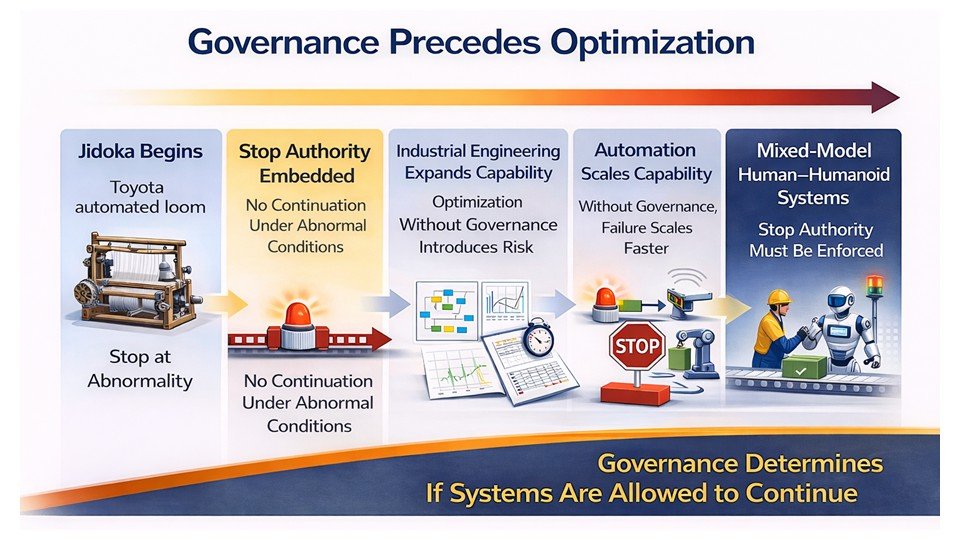
Jidoka establishes the shift from observation to control. Abnormality does not trigger discussion. It triggers interruption. Stop authority ensures that execution cannot proceed when defined conditions are not met. Work stops, the condition is corrected, and only then does execution resume. This prevents defects, delay, and instability from moving forward and protects Quality at the source.
Enforcement defines whether governance exists. The system does not allow leadership to delay response, reinterpret conditions, or prioritize output over adherence. When abnormality occurs, interruption is required and correction is mandatory. Response is not discretionary. It is defined by the system. Any continuation under abnormal conditions represents a failure of governance, not a situational decision.
Accountability defines who responds and how response is executed. Responsibility is triggered by system condition rather than assigned through hierarchy. The system specifies who must act, how action occurs, and when escalation is required. This removes variability in response behavior and ensures that abnormality is addressed consistently.
These elements form a closed control loop. Standardized Work defines the condition, visual control exposes deviation, Andon signals abnormality, Jidoka enforces interruption, and accountability ensures response. When these mechanisms operate together, deviation cannot persist. When any element is missing, execution becomes variable and control is lost.
Quality is not an outcome of the system. Quality is the condition that determines whether execution is allowed to continue. When defined conditions are not met, execution stops. Quality is maintained by enforcing adherence during operation, not by inspection after the fact. Work performed under enforced conditions produces consistent outcomes because variation is corrected in real time. Output achieved under abnormal conditions introduces instability regardless of volume or cost.
Financial pressure distorts behavior when control is absent. Targets encourage continuation under abnormal conditions to meet output expectations. Governance prevents this distortion by establishing conditions that cannot be bypassed. Financial objectives operate within system constraints rather than overriding them. Stability is achieved when execution is controlled, not when output is maximized.
Governance in continuous improvement systems prevents the system from operating in a failed state by controlling how work behaves under all conditions. Execution becomes stable when deviation is immediately visible, response is required, and continuation is prevented. Control is not applied to the system. Control is the system.
7.0 The Absence of Foundational Conditions
Execution loses stability when the conditions that define how work must be performed are not established and enforced as requirements. Standards exist as documentation, training material, and reference points, yet they do not govern behavior when adherence is optional. Work proceeds based on interpretation because no condition requires compliance under operating pressure. Standardized Work, when present, defines method, sequence, timing, and expected outcome, yet without enforcement it cannot distinguish normal from abnormal in a way that carries consequence. Stability requires that these conditions are held constant during execution. When they are not, variation is introduced at the point of work and becomes part of normal operation.
The system begins to drift when deviation is allowed to continue without interruption. Abnormal conditions are observed, yet work proceeds, which removes the boundary between acceptable and unacceptable states. Over time, repeated exposure to uncorrected deviation changes perception. What was defined as abnormal becomes accepted because it is consistently observed. Teams adjust expectations to match actual behavior rather than restoring defined conditions. The system no longer recognizes deviation as a trigger for action because deviation has been absorbed into normal operation.
Problem-solving reinforces this drift when closure is defined by completion of activity rather than restoration of condition. Issues are documented, analyzed, and assigned actions, yet execution is not required to return to a defined state. Problems are marked as closed when tasks are completed, not when conditions are stabilized. Corrective actions address symptoms or isolated causes, yet the underlying execution conditions remain unchanged. The same problem reappears because the condition that allowed it to occur was never corrected. Learning does not accumulate because it is not embedded into how work is performed.
Changes are introduced into the system without verification of their effect on execution. Solutions are implemented based on analysis and expected outcome, yet no mechanism confirms whether the new condition holds under real operating conditions. Improvement is measured through results rather than through adherence to defined conditions. Variation re-enters because the system does not require confirmation that execution now conforms to Standardized Work. Changes accumulate as layers on top of unstable conditions, which increases complexity without improving control.
Leadership behavior adapts to this environment by managing outcomes rather than enforcing conditions. Supervisors adjust schedules, reallocate resources, and intervene to address immediate issues, yet they do not restore defined execution conditions because no mechanism requires it. Engineers introduce process changes, yet they do not govern how those processes are executed daily. Continuous improvement teams facilitate problem-solving, yet they do not control execution between interventions. Each function operates within its role, yet no function enforces the conditions required for stable execution.
The absence of foundational conditions creates a system where behavior is shaped by tolerance rather than control. Execution proceeds based on accepted variation, which removes the basis for stability. Deviation is not corrected at the source, problems are resolved without condition change, and solutions are implemented without verification. Control is absent because no mechanism defines, enforces, and sustains how work must behave. Without these foundational elements, the system cannot maintain stability or protect Quality, regardless of the level of improvement activity applied.
8.0 Reframing Major Improvement Systems Under Governance Absence
Improvement systems must be evaluated based on their ability to control execution rather than their ability to analyze, improve, or optimize performance. Control requires that conditions are defined, adherence is enforced, response is immediate, and continuation under abnormal states is prevented. Systems that do not establish these elements cannot govern behavior regardless of their analytical strength or improvement capability. Evaluation through this lens exposes a consistent structural limitation across widely adopted methods: they develop insight and capability, yet they do not determine how work must proceed under all conditions.
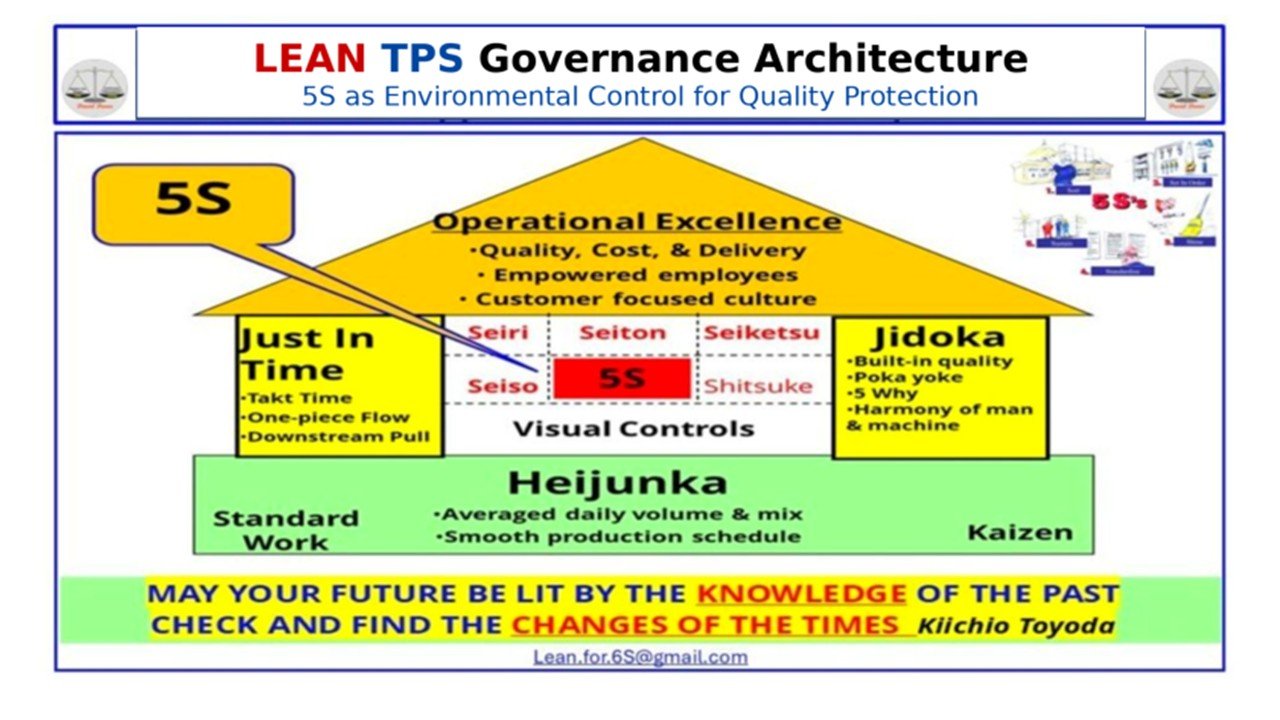
Lean (post-1988) improves visibility and flow through structured tools and workplace organization. Value stream mapping, 5S, and visual controls reveal inefficiencies and support process redesign, which improves how work is arranged. In practice, these improvements are often introduced through events that reorganize the workplace, rebalance work, and remove visible waste. Performance improves during and immediately after intervention because attention is focused and conditions are temporarily aligned. Over time, variation re-enters as execution is influenced by demand changes, staffing variation, and local decisions. Without enforced conditions, the improved state is not maintained. The system gradually returns to prior patterns, and additional events are required to restore performance. Improvement becomes cyclical rather than sustained because execution is not governed.
Six Sigma strengthens analytical capability by defining variation and applying statistical methods to reduce defects. Data is collected, analyzed, and interpreted to identify root causes and improve process capability. In operation, this results in projects that investigate performance issues over extended periods. While analysis is underway, the process continues to operate under the same conditions that produced the problem. Defects are identified, measured, and reduced through corrective action, yet they are not prevented at the moment they occur. Improvement is achieved through reduction of variation over time rather than through control of execution. Quality improves statistically, yet remains exposed operationally because no mechanism constrains behavior during production.
Lean Six Sigma combines these approaches to expand the range of intervention across processes. Tools and analysis are applied together to address both flow and variation, which increases the scope of improvement activity. In practice, this creates a more capable problem-solving system that can address complex issues across multiple functions. However, integration occurs at the level of method rather than at the level of execution. Projects deliver improvements, and tools support implementation, yet daily operation remains dependent on local interpretation. The system becomes more effective at solving problems, yet it does not establish how work must behave continuously. Improvement becomes broader, yet stability remains dependent on attention.
Kata develops structured problem-solving behavior through routine and coaching. Individuals learn to observe conditions, define target states, experiment, and reflect, which builds disciplined thinking. In application, this produces regular coaching cycles where individuals practice improvement through structured routines. Capability increases as individuals learn how to approach problems systematically. However, execution between these cycles remains unchanged. Work is performed under the same conditions regardless of the learning that occurs. The organization becomes more capable of improving, yet behavior during execution is not constrained. Learning and execution operate in parallel rather than as a single controlled system.
Theory of Constraints improves system performance by focusing attention on the limiting factor that constrains throughput. Resources and activities are aligned to protect the constraint, which increases flow and output at the system level. In practice, this results in prioritization, buffering, and scheduling decisions that maximize throughput at the constraint. Performance improves as bottlenecks are managed more effectively. However, control is concentrated at a single point, and execution outside the constraint remains variable. Local inefficiencies and variation continue to exist and must be managed continuously to prevent impact on the constraint. The system improves throughput, yet does not eliminate instability across all operations.
Across these systems, improvement is achieved through intervention rather than through enforced behavior. Events, projects, routines, and analyses introduce change, improve understanding, and increase capability. However, execution is not governed continuously by defined conditions. Problems are addressed after they are identified, and improvements are implemented after analysis, yet the system does not require that behavior conforms to defined conditions during every cycle of work. Instability is managed rather than prevented.
The absence of governance allows these methods to coexist without alignment. Organizations apply multiple systems simultaneously, which increases capability but fragments behavior. Different areas adopt different approaches, which leads to variation in how work is performed, how problems are addressed, and how performance is interpreted. No unifying mechanism defines how execution must behave across all areas. The system becomes more capable, yet less consistent.
All systems stop short of control because they do not establish the condition–response–interruption loop required to govern execution. Methods improve understanding, capability, and localized performance, yet they do not define how work must behave at every point of execution. Quality remains exposed because abnormal conditions are not constrained at the source. Improvement continues, yet system behavior remains variable because execution is not controlled.
9.0 The Toyota Contrast: Governance as Designed, Enforced, and Transferred
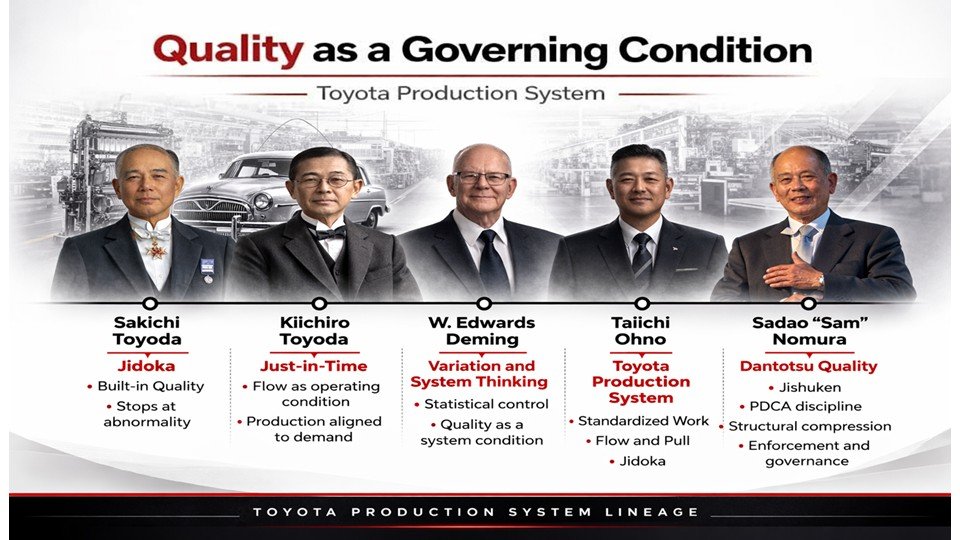
The limitation observed across modern improvement systems does not originate from the absence of tools, analysis, or capability. It originates from the absence of a system that governs how work must be performed. The Toyota Production System demonstrates a different approach by designing governance directly into execution and developing that capability through structured transfer, enforced practice, and leadership accountability.
At Toyota, system development begins with the establishment of foundational conditions that define how work must be performed under all operating circumstances. Training does not begin with tools or projects. It begins with the definition of conditions. Basic TPS training establishes how Standardized Work, visual control, and response operate together to define normal and abnormal states. This foundation ensures that execution is governed before improvement is introduced. Capability is developed within a controlled system, not applied to an uncontrolled process.
Standardized Work is established as the required condition for execution. Method, sequence, timing, and expected outcome are defined and must be maintained during operation. This is not documentation or reference. It is the governing condition that defines how work must proceed. Visual control makes these conditions observable in real time so that deviation is immediately visible at the point of work. These elements establish the initial control structure that governs behavior before additional methods are introduced.
Jidoka establishes enforcement. Abnormality does not trigger analysis, discussion, or delayed response. Abnormality triggers interruption. Execution stops when conditions are not met. This is not discretionary. It is required. Stop authority is embedded in the system so that deviation cannot continue once detected. Correction must occur before work resumes. This mechanism prevents defects, delay, and instability from propagating. Quality is protected at the source because the system does not permit continuation under abnormal conditions.
Governance is developed and reinforced through Jishuken. Jishuken is not training in the conventional sense. It is a structured system for developing leadership capability in governance through direct application under controlled conditions. Leaders are required to establish Standardized Work, expose deviation, enforce response, and sustain conditions in real operations. Performance is not evaluated based on improvement activity. It is evaluated based on the ability to establish and maintain control. Learning occurs through execution under enforcement, not through classroom instruction or isolated events.
The role of senior advisors within this system is not to guide or suggest. It is to enforce. Sadao Nomura represents this function through direct intervention that requires adherence to defined conditions. Nomura’s approach does not focus on explaining methods or encouraging participation. It focuses on exposing deviation, requiring immediate response, and ensuring that conditions are enforced without exception. Leadership is held accountable for system behavior, not for improvement activity. This establishes governance as a requirement, not as an objective.
What Toyota does not allow defines the boundary of the system. Governance is not described through intention. It is defined through constraint. The system establishes conditions that cannot be violated without immediate consequence.
Governance at Toyota is enforced through required response, not leadership judgment. Abnormality does not trigger evaluation or prioritization. It triggers immediate interruption. Leadership cannot delay action, reinterpret conditions, or allow continuation under deviation. Response is not chosen. It is required by the system. When abnormality occurs, execution stops, correction is made, and only then does work resume. Any continuation under abnormal conditions represents a failure of system governance, not a decision made under pressure.
Toyota does not allow work to continue under abnormal conditions because continuation under deviation immediately exposes Quality, destabilizes execution, and normalizes failure within the operating system. When defined conditions are not met, execution stops. That stoppage is not a symbolic act or a training exercise. It is the governing response required to prevent defects, delay, and instability from moving forward. The system does not accept output produced outside defined conditions as valid progress because output without control carries hidden loss into the next operation.
Toyota does not allow delayed response because delay changes abnormality from a contained condition into a propagated condition. Response is required at the point of occurrence, not later through discussion, scheduling, or review. Once deviation is visible, correction must begin immediately so that the system can be restored before further work proceeds. Delay is itself a governance failure because it allows the system to operate knowingly outside its defined state.
Toyota does not allow decision-based adherence because adherence is not left to personal judgment, management preference, or situational interpretation. Individuals do not determine whether abnormality is serious enough to require action. The system defines the condition, the trigger, and the required response. Leadership therefore does not function as a discretionary evaluator standing outside the process. Leadership functions as the required responder inside the process once abnormality has been exposed.
Toyota does not allow abnormality to be ignored because visibility exists to force response, not to create awareness alone. A visible abnormality that produces no action is not evidence of control. It is evidence that the control loop has failed. Signals, visuals, and exposure mechanisms have meaning only when they are inseparable from response. When abnormality is seen and allowed to continue, the system teaches tolerance instead of discipline and replaces governance with observation.
Toyota does not allow trade-offs between output and condition because production targets do not override the operating requirements that protect Quality. Work performed under abnormal conditions is not accepted as necessary throughput or temporary accommodation. It is treated as system failure because it introduces defects, delay, rework, and instability into downstream operations. The system therefore protects condition first. Output is valid only when it is achieved within governed execution.
These constraints define governance. The system controls behavior by preventing continuation under conditions that violate defined standards. Improvement operates within these constraints, not in place of them. The significance of the Toyota model is not that it values discipline more strongly than other systems. The significance is that it converts discipline into operating requirement through mechanisms that define, expose, interrupt, and restore conditions continuously during execution.
The transfer of TPS into North American operations followed this exact structure. At Toyota BT Raymond, system development did not begin with tool implementation or project-based improvement. It began with foundational training that defined how conditions govern execution. Leaders were required to establish Standardized Work, apply visual control, and enforce response at the point of work. Jishuken activities aligned operations across facilities by applying the same governance mechanisms under varying conditions. The objective was not localized improvement. The objective was consistent system behavior.
This approach contrasts directly with modern implementations that begin with tools, certification, or initiative-based programs. Toyota establishes control first, then develops capability within that controlled environment. Improvement is not applied to unstable conditions. Improvement operates within a system that prevents instability from persisting. Governance is not introduced as a concept. It is embedded in how work is performed and reinforced through daily execution and leadership accountability.
The result is a system where behavior is determined by defined conditions, response is required when deviation occurs, and execution cannot proceed outside established limits. Capability develops because individuals operate within a system that enforces correct behavior continuously. Learning accumulates because it is embedded in execution under control. Quality is protected because abnormal conditions are corrected immediately and cannot propagate.
The Toyota system demonstrates that governance is not an extension of continuous improvement. Governance is the foundation that makes continuous improvement effective. Systems that adopt tools without establishing control remain dependent on interpretation and effort. Systems that establish governance first create the conditions under which improvement produces stable, repeatable, and sustained results.
10.0 Top-Down Governance vs Bottom-Up Improvement
Continuous improvement is commonly structured as a bottom-up activity where problems are identified and addressed at the point of work through participation and engagement. Teams observe conditions, identify gaps, and initiate improvement actions based on local knowledge and experience. Leaders support this activity by facilitating problem-solving, removing barriers, and reinforcing participation through presence at the gemba. This structure increases involvement and generates improvement activity, yet it places responsibility for response on individuals rather than on the system. Action is initiated based on observation and judgment, which creates variability in when and how problems are addressed. Improvement occurs, yet execution remains dependent on discretion because no condition requires a consistent response.
This model assumes that engagement and capability will stabilize performance. Teams are expected to recognize abnormality, investigate causes, and implement solutions, which builds learning over time. However, recognition does not require action, and capability does not enforce behavior. Two teams observing the same condition may respond differently, delay action, or allow continuation based on competing priorities. The system relies on people to decide when to act, which introduces inconsistency into execution. Participation increases, yet control is not established because response is not governed.
System behavior is not determined by participation. System behavior is determined by the conditions that define how work must proceed under all circumstances. These conditions specify what is allowed, what is required, and what is prevented during execution. When conditions are enforced, behavior becomes consistent because execution is constrained by system requirements rather than individual choice. Standardized Work defines how work must be performed, visual control exposes deviation, and response is triggered by the condition itself. Behavior follows the system because the system defines and enforces it.
This responsibility resides with leadership, not at the point of work. Executives and senior leaders design the system that governs execution by establishing standards, defining response requirements, and ensuring enforcement mechanisms operate continuously. Leadership determines whether execution is controlled or discretionary by deciding whether conditions are required or optional. When system design does not include enforced response, variability is introduced regardless of the level of engagement at the front line. Leadership presence does not create control. Leadership design does.
The critical distinction is not between top-down and bottom-up as competing approaches. The distinction is between system design and system participation. Bottom-up activity contributes learning, identifies problems, and supports improvement, yet it does not determine how work must behave. Top-down governance establishes the conditions that make response unavoidable. When abnormality occurs, the system requires action. When conditions are not met, execution stops. This is not dependent on initiative or judgment. It is required by design.
Organizations that emphasize observation without control create a gap between seeing and acting. Leaders go to the gemba, review conditions, and discuss performance, yet they do not establish mechanisms that require immediate response. Abnormality is visible, yet continuation is permitted. Discussion replaces interruption, and alignment replaces action. The system becomes effective at recognizing problems, yet ineffective at preventing them from continuing.
Governance is designed top-down because system conditions originate from decisions that define how work is structured and controlled. Execution at the point of work reflects these decisions through enforced behavior that operates consistently across the system. Behavior does not align through agreement. Behavior aligns through constraint. When the system requires adherence, individuals operate within those requirements regardless of preference or pressure.
Bottom-up improvement remains necessary because it develops capability and supports continuous learning. However, it cannot replace governance because it does not establish control. Without top-down system design, bottom-up activity becomes an overlay on uncontrolled execution. Problems are identified, analyzed, and improved, yet variation persists because no mechanism governs how work must proceed.
Stable performance and protection of Quality require that governance defines the system and improvement operates within it. When this relationship is reversed, behavior varies, response is inconsistent, and execution remains unstable. Top-down governance does not limit improvement. It enables it by establishing the controlled conditions under which improvement can be sustained.
11.0 The Toyota System: Governance as Embedded Control
System behavior in the Toyota Production System is governed through mechanisms that define, expose, and enforce conditions at the point of work. Governance is not applied as a management layer after execution. It is built into how work is performed. Visual control makes those conditions visible during execution so that deviation is immediately detectable. Response is not optional. It is required by the system. Execution operates within defined conditions that cannot be bypassed without consequence, which establishes control as a continuous function of the system rather than an activity applied after performance is measured.
Control exists only when detection is inseparable from action. Jidoka establishes this connection by linking abnormality to interruption. When conditions deviate from Standardized Work, execution does not continue while the issue is observed, analyzed, or discussed. Execution stops. This is the critical shift from awareness to control. Stop authority is not a managerial decision. It is a system requirement. Interruption prevents defects, delay, and instability from moving forward, which protects Quality at the source. Work resumes only after the defined condition is restored, which reinforces adherence and prevents normalization of deviation.
Andon operationalizes this control by making abnormality visible and assigning immediate responsibility for response. Signals are generated at the moment deviation occurs and are visible to both operators and leaders. The signal does not communicate information for later action. It triggers response in real time. The system defines who must respond, how response occurs, and when escalation is required. Leader involvement is not discretionary. It is required when the signal is activated. Visibility without response would return the system to observation. In this system, visibility is inseparable from action.
Execution cannot proceed under abnormal conditions because continuation is structurally prevented. Detection leads to exposure, exposure leads to interruption, and interruption requires correction. This sequence operates within each cycle of work. There is no separation between execution and control. The process does not produce and then evaluate. The process controls while it operates. Abnormality is contained at the point of occurrence rather than managed after the fact. This prevents instability from propagating and preserves system integrity.
Governance operates as a closed control loop embedded in execution. Standardized Work defines the required condition, visual control exposes deviation, Andon signals abnormality, Jidoka enforces interruption, and response restores the condition. These elements function together continuously. When any element is weakened, control degrades and variation re-enters. When they operate together, execution remains stable because deviation cannot persist. Quality is maintained because abnormal conditions are corrected before they produce loss.
Improvement occurs within this controlled environment rather than being applied to unstable processes. Problems are surfaced during execution, corrected immediately, and then analyzed to prevent recurrence. Learning is grounded in actual conditions rather than reconstructed after failure. Changes are made to defined conditions and verified through execution, which ensures that improvement is sustained. Stability is not assumed. It is enforced. This allows learning to accumulate and capability to develop without introducing additional variation.
The Toyota system does not treat continuous improvement as a separate program because improvement is inseparable from controlled execution. The system defines how work must behave and ensures that deviation cannot continue without response. Governance is embedded in this design, which allows performance to remain stable while improvement occurs. Control is not achieved through effort or attention. Control is achieved through system design that enforces conditions during every cycle of execution.
The Toyota Production System demonstrates that stable performance and protection of Quality require governance to be built into the process itself. Execution is controlled because conditions are defined, deviation is exposed, response is required, and continuation under abnormal states is prevented. This is not an overlay. This is the system.
12.0 The Time Dimension of Governance
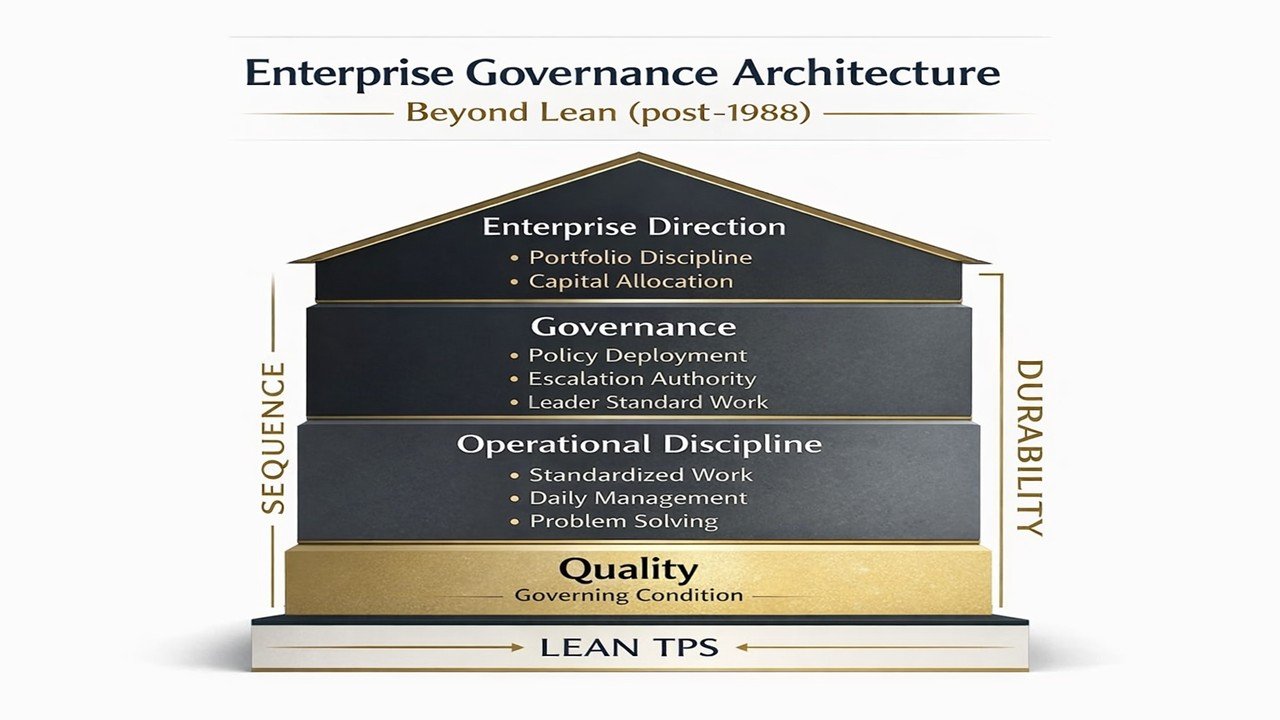
System development follows a sequence in which control is established through layered construction rather than introduced through isolated effort. Governance is built by defining conditions, enforcing adherence, and stabilizing execution before additional elements are introduced. Each layer establishes a controlled state that must hold under real operating conditions. When stability is achieved, it becomes the foundation for the next layer. This sequence ensures that system behavior remains consistent as complexity increases. Without this progression, new elements are introduced into unstable conditions, which amplifies variation rather than improving performance.
The sequence begins with condition definition. Standardized Work establishes how work must be performed so that normal and abnormal states are clearly defined. Exposure mechanisms then make deviation visible at the point of work during execution. Response requirements enforce correction when conditions are not met. These elements form the initial control structure. They must operate together during every cycle of execution before additional mechanisms are introduced. Stability is not assumed based on design. Stability is confirmed through repeated execution under real operating pressure.
Each layer must demonstrate that deviation cannot persist before expansion occurs. If abnormal conditions continue without interruption, the system is not stable regardless of how well it is understood. Introducing additional tools, methods, or complexity into this condition increases variability because the underlying execution remains uncontrolled. Sequential development prevents this outcome by requiring that control is established and sustained before expansion. Progress is measured by the ability to maintain defined conditions, not by the number of improvements implemented.
Initiative-based approaches bypass this sequence by introducing change without establishing control. Programs, projects, and campaigns increase activity and create temporary focus, yet they do not embed mechanisms that govern execution continuously. Improvement occurs during the initiative, then degrades when attention is removed because no condition requires adherence. Execution returns to prior patterns because behavior was never constrained by the system. Initiatives produce change. They do not produce control.
Time is required because governance must be validated through execution, not declared through implementation. Conditions must hold under variation in demand, resource constraints, and operating pressure. Response must occur consistently regardless of who is present or what priorities exist. Stop authority must be exercised without hesitation when conditions are violated. These behaviors cannot be assumed. They must be proven through repeated cycles of operation. Control exists only when these mechanisms function reliably over time.
Toyota developed governance through this sequence by establishing control mechanisms, validating them in operation, and sustaining them before expanding the system. Each layer was required to function under real conditions before additional elements were introduced. Stability preceded expansion because controlled execution provided the basis for reliable improvement. Learning accumulated because it was embedded within stable conditions rather than applied to unstable processes.
The time dimension of governance reflects a structural requirement, not a limitation. Control cannot be accelerated through effort or compressed through initiative. It must be constructed, tested, and sustained through execution. Systems that attempt to scale without establishing this foundation introduce complexity into instability, which degrades performance and exposes Quality. Systems that follow the sequence build stability first, then expand capability on a controlled base.
Governance develops over time because control must become the normal condition of execution. When conditions are defined, enforced, and sustained across all operating scenarios, the system becomes stable. Only then can additional complexity be introduced without reintroducing variation. Stability is not a phase. It is a requirement that must be maintained continuously as the system evolves.
13.0 Visual Management as a Governance Mechanism
Visual management functions as a control mechanism when it makes execution conditions explicit and links them directly to required action at the point of work. It is not the display of information. It is the representation of condition. Visual standards define what must occur, and visual indicators show whether those conditions are being met during execution. When designed correctly, the state of the process can be recognized immediately without interpretation. Normal and abnormal are visible in real time, which allows deviation to be identified at the moment it emerges.
Communication and reporting operate outside of execution. They transmit information, summarize results, and support review after the fact. Visual management operates within execution. It does not describe performance. It determines how work proceeds. A visual condition that indicates abnormality is not a signal for discussion. It is a trigger for action. The distinction is structural. Information can be acknowledged and deferred. A control signal cannot. When visual management is functioning as governance, it connects condition directly to obligation.
Visibility must be designed against defined conditions. Standardized Work provides the baseline, and visual representation makes that baseline observable. Method, sequence, timing, and expected outcome are expressed in a way that allows deviation to be recognized instantly. Indicators, markings, signals, and boards are not decorative elements. They are representations of expected state. When actual execution differs from the defined condition, the deviation is immediately apparent without analysis. This removes ambiguity from detection and eliminates delay between occurrence and recognition.
The effectiveness of visual management is determined by what happens when abnormality is seen. A signal that exposes deviation without requiring action is informational. A signal that requires response becomes part of control. The system must define who responds, how response occurs, and when escalation is required. Action is not dependent on awareness or agreement. It is required by the condition itself. When visual signals are tied to response, detection and correction occur within the same moment of execution.
Interruption is a necessary extension of this mechanism. When conditions are not met, visual signals must lead to the ability to stop or contain execution. Without interruption, visibility does not prevent continuation under abnormal states. Visual management becomes enforcement when exposure leads directly to response and, when necessary, to stoppage. This connection ensures that deviation cannot persist once it is visible. Quality is protected because abnormal conditions are contained at the source rather than allowed to propagate.
Visual management fails when it is separated from enforcement. Dashboards that display results, boards that track metrics, and indicators that classify performance without requiring action create awareness without control. In these conditions, abnormality is visible yet tolerated. Signals accumulate without consequence, and response is delayed or inconsistent. The system becomes effective at showing problems while allowing them to continue.
Visual management functions as governance when it operates as part of the control loop. Defined conditions establish what must occur, visual signals expose deviation, response is triggered immediately, and execution is interrupted if conditions are not restored. These elements must operate together during every cycle of work. When they do, visual management becomes a mechanism that governs behavior rather than a tool that describes it.
The role of visual management is to ensure that abnormality cannot remain hidden, ignored, or deferred. It makes deviation visible and connects that visibility to required action. This linkage transforms visibility into control. Execution remains stable when visual conditions enforce adherence to defined standards, which protects Quality and sustains consistent system behavior.
14.0 Governance Builds Culture
Organizational culture is not formed by intention, communication, or training. It is formed by how work is required to be performed under real operating conditions. Behavior follows the system that governs execution. When conditions define what must occur, what is permitted, and what is prevented, individuals act within those constraints regardless of preference. Culture is not what is said or taught. Culture is what the system requires and reinforces during execution.
Governance establishes this behavior by defining conditions and enforcing adherence at the point of work. Standardized Work specifies how tasks must be performed. Visual control exposes deviation as it occurs. Response is required when conditions are not met. Interruption prevents continuation under abnormal states. These mechanisms do not influence behavior indirectly. They determine behavior directly. Individuals do not choose whether to comply. The system defines compliance as the only allowable path for execution.
Consistency of enforcement creates consistency of behavior. When abnormality always leads to response, individuals respond without delay. When deviation always leads to interruption, continuation under abnormal conditions does not occur. When standards are always required, execution aligns with defined conditions. Over time, this consistency removes variation in how individuals act. Behavior stabilizes because the system does not allow alternatives. Culture begins to form as a reflection of this stability.
Repetition transforms enforced behavior into organizational reflex. Individuals no longer rely on instruction or supervision to determine how to act. The response to abnormality becomes immediate because the system has conditioned that response through enforcement. Adherence to standards becomes automatic because deviation cannot continue. This reflex is not learned through explanation. It is developed through repeated exposure to a system that requires consistent action. The system shapes behavior until it becomes the default mode of operation.
Alignment across roles reinforces this effect. Operators execute within defined conditions, leaders respond according to system requirements, and support functions operate within the same constraints. No role is exempt from enforcement. Leaders do not override conditions for output, and operators do not bypass standards for convenience. The system applies equally across all levels, which eliminates inconsistency in behavior. Culture becomes unified because the system governs everyone in the same way.
Attempts to build culture through training, communication, or engagement fail when they are not supported by enforcement. Values, expectations, and principles may be communicated, yet behavior diverges when execution is not constrained. Individuals adapt to the actual conditions of work, not the stated expectations. When deviation is tolerated, tolerance becomes the culture. When response is delayed, delay becomes the norm. Culture reflects what the system allows, not what the organization promotes.
Governance builds culture by making behavior a requirement rather than a choice. The system defines how work must proceed, enforces adherence to those conditions, and prevents deviation from continuing. Over time, this produces consistent behavior that no longer depends on awareness, motivation, or supervision. Culture emerges as a byproduct of controlled execution.
Quality is sustained because behavior is consistent with defined conditions. Abnormality is corrected immediately, deviation does not propagate, and execution remains stable across all operating scenarios. Culture is not an input to the system. Culture is the result of a system that governs how work is performed.
15.0 The Path Forward: Building Governance Sequentially
Building governance requires a defined sequence that establishes control through the construction of conditions, mechanisms, and enforcement in a specific order. Control does not emerge from activity or initiative. It is created when each layer defines how work must behave and ensures that deviation cannot continue. The sequence begins with condition definition because execution cannot be governed without a clear standard that distinguishes normal from abnormal.
Condition definition establishes how work must be performed by specifying method, sequence, timing, and expected outcome. Standardized Work provides this foundation by removing ambiguity and defining the boundaries within which execution is permitted. Without this baseline, deviation cannot be identified because no reference exists. Condition definition is not documentation. It is the specification of required behavior that must hold during execution under all operating conditions.
Visibility follows condition definition and establishes the ability to detect deviation as it occurs. Visual control represents expected conditions and makes actual performance observable in real time at the point of work. Detection must be immediate and unambiguous so that abnormality cannot remain hidden or be subject to interpretation. Visibility creates the moment of recognition, yet recognition alone does not change behavior. Detection must be directly connected to action for control to exist.
Response mechanisms define how the system reacts when abnormal conditions are detected. The system must specify what action is required, where it occurs, and how the defined condition is restored. Response is triggered by the condition itself, not by individual choice. Immediate action prevents deviation from propagating, which protects Quality at the source. Execution cannot continue while abnormality exists, which ensures that response is not delayed or deferred.
Interruption establishes the point at which control becomes absolute. When conditions are not met, execution stops. This is not a managerial decision. It is a system requirement. Stop authority ensures that deviation cannot continue and that correction must occur before work proceeds. Without interruption, response becomes optional and deviation persists. Interruption transforms detection and response into enforcement by preventing continuation under abnormal states.
Accountability defines who must respond and how response is executed. Responsibility is tied to system conditions rather than assigned through hierarchy or discretion. The system specifies who acts, how escalation occurs, and how resolution is achieved. This removes variability in response behavior and ensures that abnormal conditions are addressed consistently regardless of role or situation. Accountability ensures that response is not dependent on availability or preference.
Enforcement ensures that defined conditions are maintained during execution by linking all prior elements into a closed control loop. Standards are not suggestions. They are requirements that must be adhered to continuously. Deviation is not tolerated because continuation is prevented until conditions are restored. Enforcement sustains control by ensuring that detection leads to response, response leads to correction, and correction restores the defined condition. When enforcement is present, behavior is governed rather than influenced.
Stabilization occurs when these elements operate together reliably under real operating conditions. Stability is demonstrated when execution remains controlled across variation in demand, resources, and operating pressure. The system no longer depends on intervention to correct deviation because deviation cannot persist. Performance becomes predictable because execution is constrained by enforced conditions. Stability is not achieved through improvement activity. It is achieved through sustained control.
Expansion extends governance to additional processes, areas, and levels only after stability has been established. New elements are introduced into a controlled environment where conditions are defined and enforced. Expansion builds on stability, which allows complexity to increase without introducing variability. When expansion occurs without prior stabilization, variation is amplified and system performance degrades. Growth without control increases instability rather than capability.
The sequence cannot be altered or compressed. Each layer depends on the previous layer to function. Condition definition enables visibility, visibility enables response, response requires interruption, interruption requires accountability, accountability supports enforcement, enforcement produces stabilization, and stabilization allows expansion. Removing or bypassing any layer breaks the control structure and returns execution to variability.
Governance is constructed through this sequence, not implemented through isolated effort. Control is achieved when each layer is established, validated through execution, and sustained over time. This sequence defines the path forward because it ensures that system behavior is governed, execution is stable, and Quality is protected under all conditions.
16.0 Closing Position
Continuous improvement develops the ability to observe, analyze, and improve performance, yet it does not determine how work must be performed during execution. Methods create visibility, build capability, and generate change, yet they operate as a system of learning rather than a system of control. Performance is understood, problems are addressed, and improvements are introduced, yet behavior remains dependent on interpretation when execution is not governed by enforced conditions.
Governance establishes control by defining how work must proceed and by enforcing that requirement during execution. Conditions are specified, deviation is exposed, response is required, and execution is constrained within defined limits. Behavior is not guided by intention or awareness. Behavior is determined by the system that governs it. Stability emerges when execution is defined and enforced, not when it is observed and improved.
The distinction is not between improvement and governance as competing approaches. Improvement develops capability. Governance defines behavior. Capability without control produces variation. Control creates the conditions under which capability can be applied consistently. Improvement becomes effective only when it operates within a system that governs how work must be performed.
Quality is maintained when conditions are preserved during execution. It is not created through inspection or confirmed through reporting. It is sustained when defined conditions are enforced and restored as part of the work itself. Consistent outcomes result from controlled execution, not from retrospective evaluation. Quality becomes stable when it is treated as a condition that must be maintained rather than as an outcome that is measured.
Governance is not a philosophy. Governance is the system that defines and enforces how work must behave. It establishes the conditions that control execution, removes discretion from response, and ensures that defined states are maintained. When governance is embedded in system design, control is continuous, stability is sustained, and Quality is protected under all operating conditions.
Continuous improvement without governance remains limited to observation, analysis, and episodic change. Governance establishes the conditions under which improvement can be sustained. Control is the prerequisite that allows improvement to produce lasting results.