Introduction: Control Before Improvement
Defining Conditions as the Basis for Quality Stability
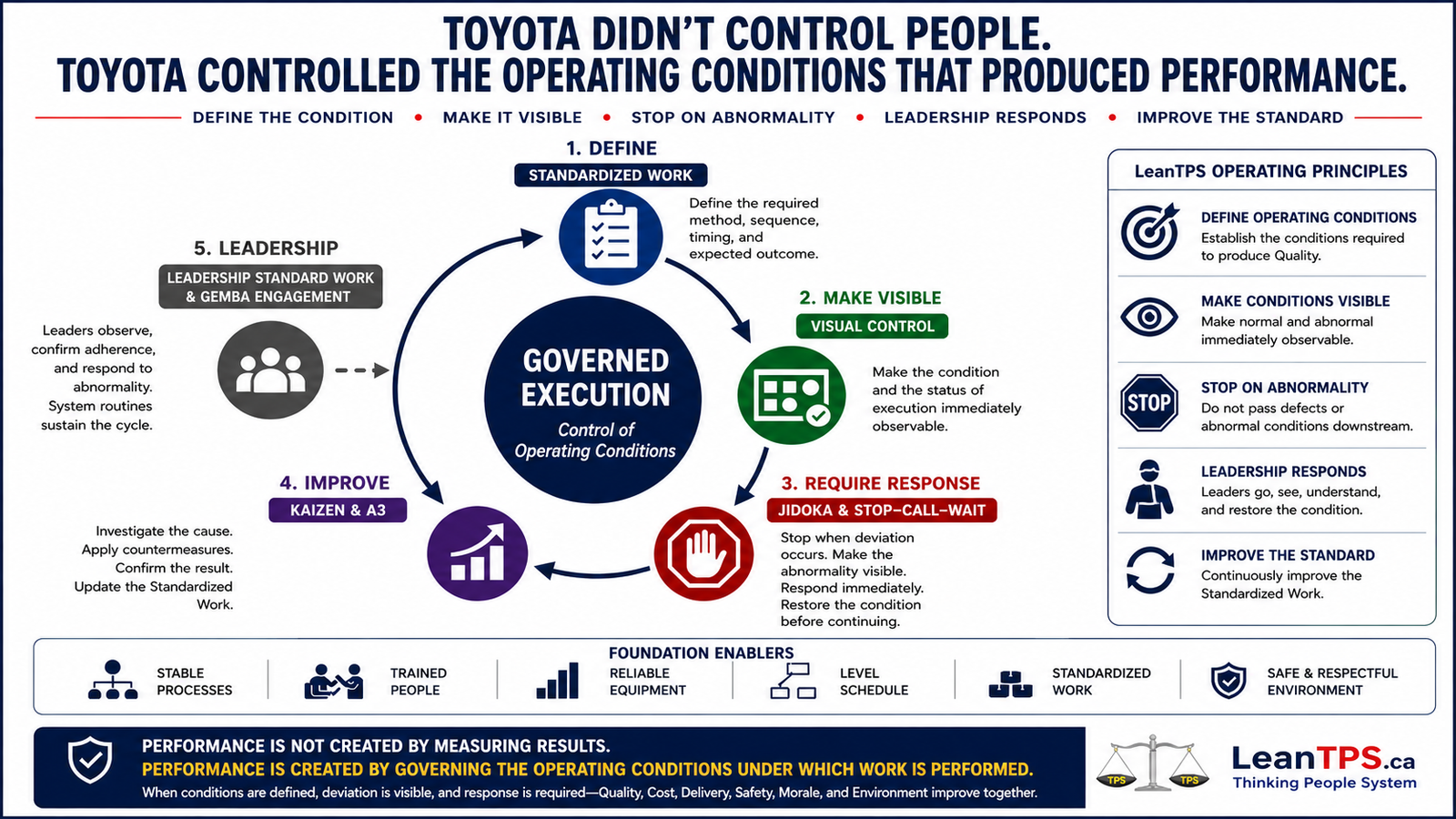
Lean TPS governance establishes control by defining conditions, detecting deviation, and enforcing response during execution. A Lean TPS system requires that the condition for execution is explicitly defined before any improvement activity begins. Execution is governed by conditions that specify method, sequence, timing, and outcome, and these conditions must be met for work to proceed. When conditions are not defined, execution defaults to individual judgment, variation increases, and Quality becomes unstable because work continues without a controlled state.
Organizations introduce tools, launch projects, and expand training without establishing the conditions that govern execution. System behavior follows these choices. Work continues under abnormal conditions because no boundary exists that removes permission to proceed. Deviation is observed but not enforced, and response remains optional. When execution is not governed by defined and enforced conditions, improvement activity does not produce stability and Quality does not hold.
Control is established by defining the condition, exposing when the condition is not met, and requiring response before continuation. Standardized Work defines the condition that governs execution and establishes the required state that must be maintained. Visual control exposes the condition in real time so that normal and abnormal states are immediately distinguishable at the point of work. When deviation occurs, exposure alone is not sufficient. Response is required, and work does not continue under abnormal conditions.
Failure occurs when any part of the condition is not met and execution continues. Method may vary, sequence may be bypassed, timing may drift, and outcomes may fall outside specification. When continuation is permitted under these conditions, instability propagates across the system and Quality is degraded at the source. The system becomes dependent on detection after the fact instead of control during execution.
A Lean TPS system requires that interruption occurs when conditions are not met and that response restores the defined condition before execution resumes. Jidoka enforces this requirement by removing the ability to continue under abnormal conditions. Andon signals deviation at the moment it occurs and identifies the need for immediate response. Leadership is structured as the required responder, with responsibility triggered by condition violation and defined by the system rather than by preference or hierarchy.
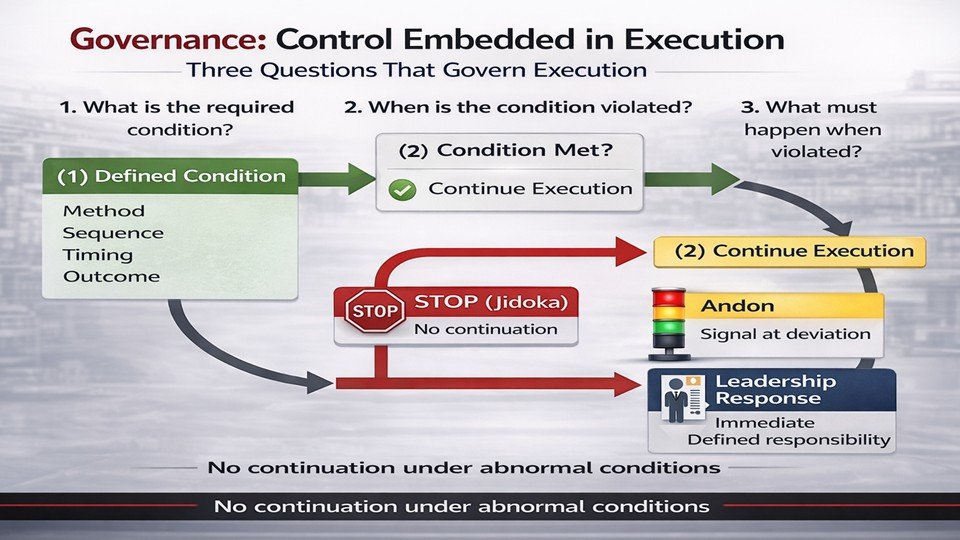
The system operates through three governing questions that define control. The required condition for execution must be explicitly defined. The point at which the condition is violated must be clearly identifiable. The response that is required when the condition is not met must be enforced without delay. When these questions are answered and enforced, execution is controlled, Quality is protected as a condition, and improvement operates within a stable system.
Section 1: Defining the Condition
Establishing the Required State That Governs Execution
A Lean TPS system requires that the condition for execution is explicitly defined as the required state that must be true for work to proceed. A condition defines method, sequence, timing, and outcome, and these elements must be satisfied during each cycle of work. When the condition is not defined, execution defaults to individual judgment, and variation enters the system because no single state governs how work is performed.
The condition is composed of four elements that together define normal execution. Method specifies how the work must be performed using defined tools and techniques. Sequence defines the exact order in which each step must occur. Timing defines the required pace of execution aligned to demand. Outcome defines the required result within specification. When all four elements are met, the condition exists and execution is normal.
The condition is binary and does not allow partial compliance. The condition is either met or not met. When any element of method, sequence, timing, or outcome is not satisfied, the condition does not exist and execution is abnormal. Work does not continue under abnormal conditions, and response is required to restore the condition before execution resumes.
Standardized Work defines the condition and establishes the required state that must be maintained. Standardized Work is not documentation and does not describe preferred practice. Standardized Work defines the condition that governs execution and removes variation in how work is performed. When Standardized Work is treated as reference material, the condition is not enforced and execution becomes inconsistent.
The condition must be visible and verifiable at the point of work. When the condition is not visible, it cannot be confirmed, and deviation is not detected at the moment it occurs. Work continues under abnormal conditions because the system cannot distinguish between normal and abnormal states during execution. Visibility enables exposure, and exposure enables response.
Failure occurs when the condition is not defined or not enforced and execution continues. Method may vary, sequence may be bypassed, timing may drift, and outcome may fall outside specification. When continuation is permitted under these conditions, the system operates across multiple states, and Quality becomes unstable because no defined condition governs execution.
A Lean TPS system requires that the condition is defined, visible, and enforced during execution. When these elements are present, execution is governed, deviation is contained at the point of occurrence, and Quality is maintained as a condition of the system.
Section 2: Lean TPS Governance and the Required Condition for Execution
Reframing Quality as a Required State of Execution
A Lean TPS system requires that Quality is defined as a condition of execution rather than an outcome of performance. Quality exists only when the required state is maintained during each cycle of work. When Quality is treated as a result, it is evaluated after execution, and control is not established at the point where work occurs.
Outcome-based management measures results after deviation has already occurred. Metrics, targets, and inspection identify defects, but they do not prevent the conditions that produce them. Work continues under abnormal conditions because no mechanism exists to interrupt execution when the required state is not met. Control is applied after production, and the system permits deviation during execution.
Variation is the direct result of conditions that are not defined or not enforced. Execution drifts when the required state is not maintained, and each instance of drift introduces inconsistency. Inconsistency accumulates into variation because the system allows multiple states of execution. When variation is addressed through analysis instead of condition control, the source of instability remains active.
Control is established only when the condition governs execution during each cycle of work. Standardized Work defines the required state, and visual control exposes whether that state is maintained. When the condition is violated, work does not continue, and response is required before execution resumes. Without enforced interruption, the system absorbs deviation and continues operating in an uncontrolled state.
Inspection does not provide control because it occurs after execution. Detection without interruption allows defects to pass through the system and shifts correction downstream. Control requires that deviation is addressed at the moment it occurs. Jidoka enforces interruption when the condition is not met and prevents continuation until the required state is restored.
Leadership responsibility is defined by the system that governs execution. Leaders design the conditions that define normal work, confirm that those conditions are maintained, and enforce response when they are violated. Responsibility is triggered by condition failure and is not assigned through hierarchy or preference. When leadership operates as a required responder, execution remains governed and Quality is maintained as a condition.
Quality is protected only when the condition for execution is defined, deviation is exposed, and response is enforced before continuation. When these elements are not present, work proceeds under abnormal conditions and variation persists. A Lean TPS system maintains Quality by controlling execution, not by measuring results.
Section 3: The First Question: What Is the Required Condition for Execution
Defining the Condition That Governs Work
A Lean TPS system requires that the condition for execution is explicitly defined before work begins. The condition establishes the required state that must be maintained during each cycle of execution. When the condition is not defined, execution defaults to interpretation, and control does not exist.
The condition for execution is structured through four elements that define normal work. Method specifies how the work is performed using the required tools and techniques. Sequence defines the order in which each step must occur without deviation. Timing establishes the required pace of execution aligned to demand. Outcome defines the expected result within specification. When these elements are defined and maintained, the condition exists and execution remains controlled.
Standardized Work defines this condition and establishes the baseline for execution. Standardized Work does not describe preferred practice and is not used for reference. Standardized Work defines the required state that must be met during execution. When Standardized Work is treated as documentation, the condition is not enforced and execution becomes inconsistent.
SOPs, documentation, and best practices describe how work is performed but do not govern execution. These forms of documentation allow interpretation and adaptation at the point of work. When interpretation is allowed, variation is introduced and conditions are not maintained. A defined condition removes interpretation by specifying how work must be performed and what result must be achieved.
Ambiguity at the level of condition creates instability in the system. When the required state is not clearly defined or not enforced, execution varies across operators and cycles. This variation is not random. It is produced by the absence of a single governing condition. Work continues under multiple states, and Quality becomes unstable because no defined condition controls execution.
A Lean TPS system requires that the condition is visible at the point of execution. Visibility represents the condition in real time and allows immediate recognition of normal and abnormal states. Visual control exposes whether the condition is met during execution and eliminates delay in detecting deviation.
Control exists only when the condition is defined, visible, and enforced during execution. When the condition is not visible, deviation is not detected at the moment it occurs and work continues under abnormal conditions. When the condition is visible and deviation is recognized, response is required and execution is governed. Quality is maintained only when the condition controls execution.
Section 4: Making the Condition Visible
Exposing the Condition at the Point of Execution
A Lean TPS system requires that the condition for execution is visible in real time at the point of work. Visual control represents the defined condition so that normal and abnormal states are immediately distinguishable during execution. Visibility is a required element of control because a condition that cannot be seen cannot be enforced.
Visual control embeds the condition within the workplace so that execution is continuously compared against the required state. Tools, steps, timing, and outcomes are structured to reflect the defined condition. When this structure is present, deviation is exposed at the moment it occurs and does not require analysis or interpretation.
Reporting does not provide control because reporting occurs after execution. Reports summarize results after deviation has already occurred and do not prevent continuation under abnormal conditions. Control requires that deviation is exposed during execution so that response occurs immediately. When visibility is delayed, detection is delayed, and execution continues without control.
Immediate detection occurs when the condition is directly comparable to execution at the point of work. Deviation is observable when the required method is not followed, when sequence is not maintained, when timing exceeds the defined pace, or when the outcome falls outside specification. Visibility removes interpretation by making deviation evident through comparison to the defined state.
The workplace determines whether conditions are observable or concealed. When tools are not fixed, locations are not defined, sequences are not displayed, and timing is not tracked, the condition is not visible. Deviation blends into normal work and remains undetected, and execution continues under abnormal conditions. When the workplace is structured to represent the condition, abnormality is exposed immediately and cannot be ignored.
5S Thinking establishes the environment required for visibility by defining location, quantity, and condition for all elements within the workspace. The environment is structured so that absence, excess, or displacement is immediately observable. This structure exposes deviation in execution and reinforces the visibility of the condition during each cycle of work.
Visibility exposes the condition but does not establish control on its own. When deviation is visible and execution continues, the system remains permissive and Quality is not protected. Control is established when visible deviation triggers required response and removes the ability to continue under abnormal conditions.
Section 5: The Second Question: When Is the Condition Violated
Defining Deviation Without Interpretation
A Lean TPS system requires that the point of condition violation is explicitly defined and immediately recognizable during execution. A condition exists only when the required state is maintained without deviation. The condition is binary. The condition is either met or not met. When any element of the required state is not satisfied, the condition does not exist and execution is abnormal.
The binary nature of the condition removes interpretation and judgment from the system. Deviation is not evaluated through opinion, experience, or tolerance. Deviation is defined by the absence of the required state. When interpretation is allowed, execution varies across individuals and situations, and the system becomes dependent on decision making rather than governed behavior.
Condition violation occurs across each element of execution. Method is violated when the defined process or tool is not used. Sequence is violated when steps occur out of order or are bypassed. Timing is violated when execution does not align with the defined pace. Outcome is violated when the result falls outside specification. Any single violation defines execution as abnormal.
Tolerance of deviation destroys control because it allows work to continue under conditions that are not defined. When deviation is accepted within a range or adjusted through judgment, the boundary between normal and abnormal is removed. Execution continues across multiple states, and the system no longer operates within a controlled condition. Quality degrades because variation is permitted instead of prevented.
Immediate detection is required to maintain control. When violation is recognized at the moment it occurs, response is initiated before the condition propagates. When detection is delayed, abnormal conditions persist and execution continues without control. Correction shifts downstream and the system absorbs instability instead of preventing it.
A Lean TPS system requires that condition violation is signaled at the moment it occurs. Andon provides this signal by identifying deviation during execution and triggering required response. The signal establishes that the condition is not met and that execution does not continue. When Andon is connected to defined conditions and immediate detection, deviation cannot remain hidden and cannot be deferred.
Condition violation defines the point at which control is enforced. When the condition is not met, execution is abnormal and continuation is not permitted. Detection and signaling establish the boundary between normal and abnormal states and require response that restores the condition and protects Quality.
Section 6: The Third Question: What Must Happen When the Condition Is Violated
Enforcing Interruption and Required Response
A Lean TPS system requires that execution is interrupted immediately when the condition is not met. Interruption is not a decision made by an individual. Interruption is a required system behavior that occurs when method, sequence, timing, or outcome deviates from the defined condition. When interruption does not occur, execution continues under abnormal conditions and control is not established.
Jidoka enforces interruption by removing the ability to continue when the condition is violated. The system does not rely on awareness or judgment to determine whether work should proceed. The system enforces the stop. When the condition is not met, execution does not continue. This enforcement protects the system from propagating deviation and establishes a boundary that cannot be bypassed.
Permission to continue under abnormal conditions is removed through system design. When continuation is allowed, even temporarily, the condition no longer governs execution. Operators and leaders adjust behavior to maintain output rather than restore the required state. This behavior introduces instability and degrades Quality because abnormal conditions are absorbed into normal work.
The response to condition violation follows a defined structure that restores the required state before execution resumes. Execution stops when the condition is not met. The abnormality is signaled so that the need for response is visible. Correction is performed to restore the condition. Confirmation verifies that the required state has been reestablished. Execution restarts only after the condition is confirmed. Each step in this sequence is required and cannot be bypassed.
Escalation is not equivalent to enforced response. Escalation communicates that a problem exists and requests attention. Enforced response requires that action occurs before continuation. When escalation is used without enforcement, response becomes dependent on availability, priority, and judgment. When response is enforced, responsibility is triggered by the system and action occurs during execution.
Quality is protected at the source when interruption and response are enforced. Deviation is contained at the point where it occurs and does not propagate to downstream processes. Correction restores the defined condition and prevents recurrence within the current cycle of work. When interruption is not enforced, defects move through the system and require correction after the fact.
A Lean TPS system requires that interruption, signaling, correction, confirmation, and restart occur as a single integrated response to condition violation. When any part of this sequence is missing, execution continues under abnormal conditions and control is lost. When the sequence is enforced, the system maintains defined conditions, prevents propagation of deviation, and protects Quality as a condition of execution.
Section 7: Leadership as a Required Responder
Defining Leadership Through System Responsibility
A Lean TPS system requires that leadership is defined by response to condition violation rather than by position within hierarchy. Leadership responsibility is established through the system that governs execution and is triggered when the defined condition is not met. Leaders do not observe deviation as an external activity. Leaders respond as a required part of execution when abnormal conditions occur.
Leader Standard Work defines the cadence and structure for confirmation and response. Leaders verify that method, sequence, timing, and outcome are maintained at the point of work. When the condition is met, confirmation reinforces control. When the condition is not met, response is required and must occur immediately. Leader Standard Work does not schedule observation for reporting. Leader Standard Work enforces presence at the point of execution where conditions are confirmed and restored.
Responsibility is triggered by condition violation and is not assigned through preference, availability, or hierarchy. The system defines who must respond, how response occurs, and when escalation is required. When the condition is violated, leadership is engaged by the system and must act to restore the required state. This removes ambiguity in responsibility and ensures that response occurs during execution.
Optional response behavior is eliminated when leadership is structured as a required responder. When response is optional, deviation persists and execution continues under abnormal conditions. Leaders may choose to act or delay based on competing priorities. This behavior introduces variability and prevents the system from maintaining control. When response is required, action occurs without delay and deviation is contained at the source.
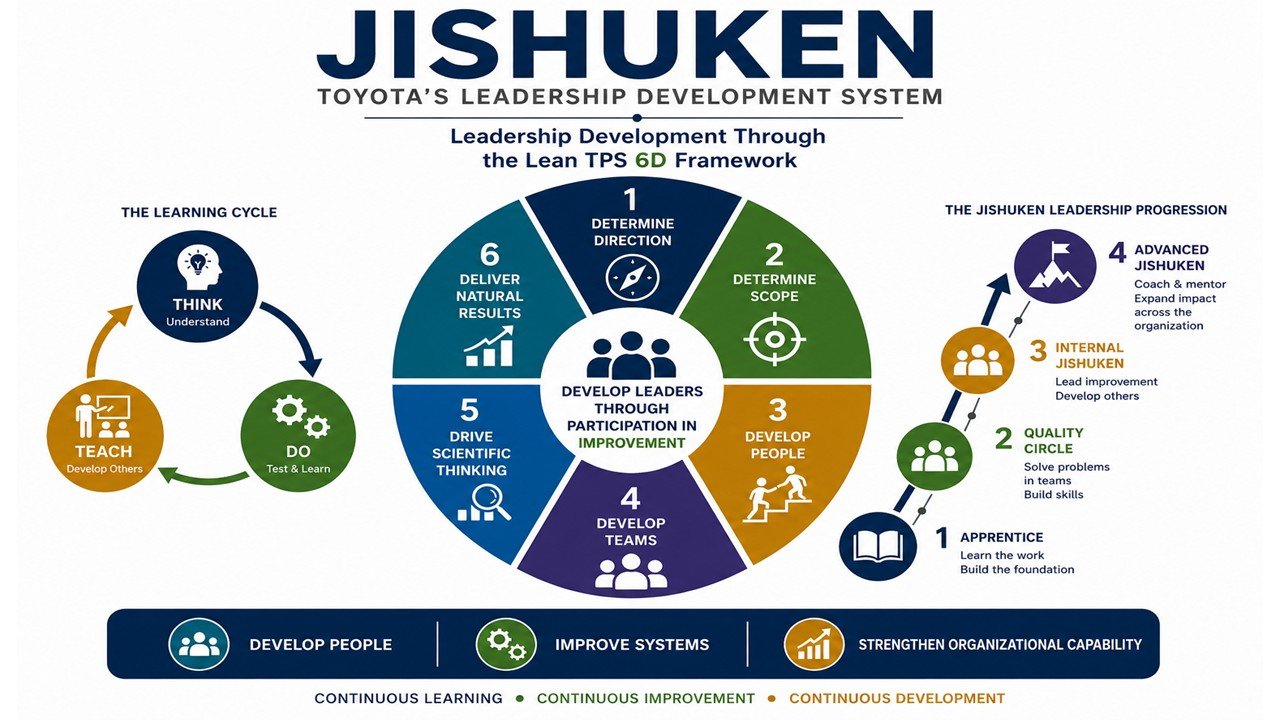
Capability develops through repeated exposure to condition violation and required response. Leaders learn the system by engaging directly with abnormal conditions, restoring defined states, and confirming that execution remains controlled. Learning is not transferred through instruction alone. Learning is embedded in execution through repeated cycles of detection, response, and confirmation.
A Lean TPS system requires that leadership designs the conditions that define execution, confirms that those conditions are maintained, and enforces response when they are violated. When leadership operates within this structure, execution remains governed, deviation is contained, and Quality is protected as a condition of the system.
Section 8: Why Most Lean Implementations Fail
Failure to Establish Conditions and Enforce Control
A Lean TPS system requires that execution is governed by defined and enforced conditions. Most implementations fail because tools are introduced without establishing the conditions that define normal work. When conditions are not defined, tools operate without a governing state, and execution varies across operators and cycles. Work continues under abnormal conditions because no boundary exists that removes permission to proceed.
Visibility without enforcement does not establish control. Visual systems expose deviation, but exposure alone does not change behavior. When deviation is visible and execution continues, the system becomes permissive. Abnormal conditions are observed without response, and deviation becomes accepted within daily work.
Training without control does not produce stable execution. Training transfers knowledge of how work should be performed, but knowledge does not define or enforce conditions. When execution is not governed, individuals adapt training to fit circumstances, and variation increases. The system becomes dependent on individual capability rather than defined conditions.
Improvement activity without system stability does not sustain results. Projects and events introduce changes, but those changes are not maintained when conditions are not enforced during execution. Work returns to prior patterns because adherence to the defined condition is not required. Improvement becomes temporary because control is not established.
Dependence on individuals replaces system behavior when conditions are not defined and enforced. Operators compensate for gaps, leaders intervene based on judgment, and outcomes depend on experience rather than structure. Performance varies because behavior is not governed by the system.
Lean (post-1988) drift reflects this pattern of failure. Tools, certifications, and frameworks are applied without establishing the control logic that defines and enforces conditions. Improvement is treated as activity rather than as a function of governed execution. Systems remain unstable because execution is not controlled.
A Lean TPS system requires that tools operate within defined conditions, visibility triggers enforced response, training supports governed execution, and improvement occurs within a stable system. When these elements are not present, execution remains uncontrolled, deviation persists, and Quality is not maintained as a condition of the system.
Section 9: From Description to Control
Shifting from Documentation to Governed Execution
A Lean TPS system requires that execution is governed by defined conditions rather than described through documentation. Descriptive systems explain how work is intended to be performed but do not enforce how work must be performed. When execution is guided by description, interpretation is introduced at the point of work, and variation becomes inherent in system behavior. Work continues under abnormal conditions because no mechanism exists to prevent deviation from the described state.
Controlling systems define the required condition for execution and enforce adherence during each cycle of work. The system establishes method, sequence, timing, and outcome as the required state and removes the ability to deviate without consequence. When the condition is not met, execution does not continue. Response is required to restore the defined state before work resumes. Control is established through enforcement of conditions, not through explanation of intent.
Documentation supports understanding but does not control execution. SOPs, procedures, and work instructions describe processes and provide reference for training and communication. These documents do not enforce behavior at the point of work and do not prevent continuation under abnormal conditions. When documentation is treated as the primary mechanism of control, execution becomes dependent on individual interpretation and adherence.
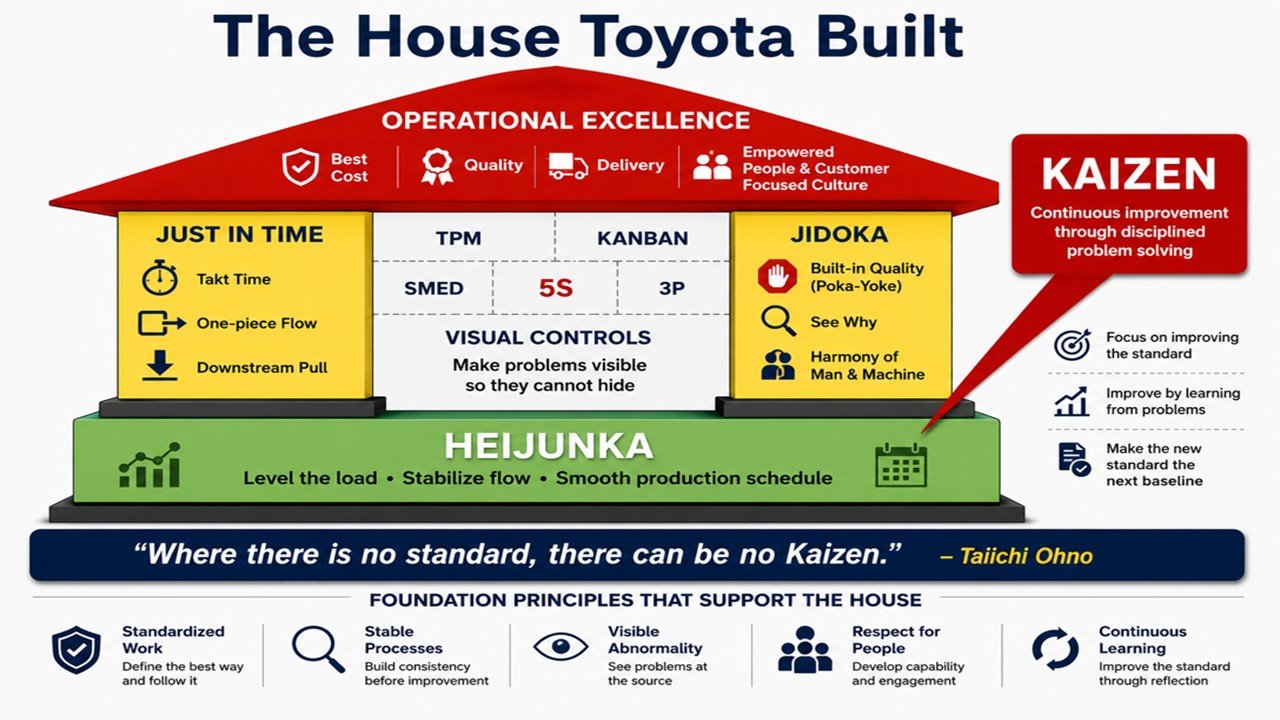
Execution is governed when the condition is defined, visible, and enforced during operation. Standardized Work establishes the condition that must be maintained. Visual control exposes whether the condition is met in real time. Jidoka enforces interruption when the condition is violated and requires response before continuation. These elements operate together to create a system that controls execution rather than describing it.
The transition from analysis to governed operation requires a shift in how problems are addressed. Analysis identifies variation and explains causes after deviation has occurred. Governed operation prevents variation by enforcing the condition during execution. When the system is designed to control execution, analysis supports refinement of conditions rather than compensating for their absence.
System behavior changes when conditions are enforced. Work no longer proceeds based on judgment or adaptation. Execution follows the defined condition, and deviation is contained at the point where it occurs. Leaders respond as part of execution, and correction restores the required state before continuation. Variation is reduced because the system does not permit multiple states of execution.
A Lean TPS system requires that description supports control but does not replace it. When conditions are defined, exposed, and enforced, execution becomes predictable, deviation is contained, and Quality is maintained as a condition of the system.
Section 10: Application in Leadership Conversations
Framing Governance as the Operating Model
A Lean TPS system requires that leadership conversations define how execution is governed rather than which initiatives will be pursued. Discussion must begin with the condition that defines normal work and the requirement that execution does not proceed when that condition is not met. When conversations focus on initiatives, tools, or programs, the system remains descriptive and does not establish control.
CEO and senior leadership discussions must establish that the operating model is defined by conditions and enforced response. The required state of execution must be specified through method, sequence, timing, and outcome, and this state must be maintained during every cycle of work. When the condition is not met, execution does not continue, and response is required to restore the defined state. This framing defines how the business operates rather than what the business intends to improve.
Initiative language describes activity without defining system behavior. Terms such as projects, programs, and transformations introduce work but do not establish the conditions that govern execution. Operating model language defines boundaries, specifies required states, and enforces response when those states are not maintained. When leadership adopts operating model language, execution becomes controlled and repeatable.
Discussion must be anchored in conditions and interruption to establish control. Leaders must define the condition for execution, ensure that deviation is visible at the point of work, and require interruption when the condition is violated. When interruption is not enforced, work continues under abnormal conditions and the system remains unstable. Anchoring conversation in these elements establishes the mechanisms that govern execution.
Tool-based entry points do not establish governance. Tools operate within a system but do not define or enforce the conditions that control execution. When leadership begins with tools, the system is built around activity rather than control, and outcomes remain dependent on interpretation. Avoiding tool-based entry points ensures that the system is designed around conditions and response.
Governance is established when leadership defines the condition for execution, confirms that the condition is maintained, and enforces response when it is not. Responsibility is triggered by condition violation and is embedded in daily operation. When governance is defined as the foundation, execution is controlled, deviation is contained, and Quality is protected as a condition of the system.
Section 11: System Integration: Standardized Work, Andon, Jidoka
Operating as a Single Control System
A Lean TPS system requires that Standardized Work, Andon, and Jidoka operate as an integrated control system during execution. Standardized Work defines the condition that must be maintained through method, sequence, timing, and outcome. Andon exposes when the condition is not met at the moment deviation occurs. Jidoka enforces interruption and prevents continuation until the condition is restored. When these elements operate together, execution is governed and Quality is protected as a condition of the system.
The sequence of operation is defined by dependency between these elements. Standardized Work establishes the required state that defines normal execution. Andon signals deviation when the required state is not maintained and identifies the need for response. Jidoka enforces the stop and removes the ability to continue under abnormal conditions. This sequence ensures that deviation is defined, exposed, and acted upon during execution without delay.
Dependency between these elements is required for control to exist. Standardized Work without Andon does not expose deviation at the moment it occurs. Andon without Jidoka signals abnormality but allows continuation under abnormal conditions. Jidoka without Standardized Work cannot define what constitutes normal or abnormal execution. When any element is missing or operates independently, the system becomes permissive and control is not established.
Separation of these elements breaks the system because each element relies on the others to complete the control loop. When Standardized Work is treated as documentation, Andon becomes informational, and Jidoka is not enforced, execution continues under abnormal conditions. Deviation is observed but not contained, and Quality is not protected at the source. Integration ensures that each element reinforces the others and maintains control of execution.
Reinforcement occurs through daily execution where conditions are defined, deviation is exposed, and response is enforced in every cycle of work. Leaders confirm that Standardized Work defines the required condition, that Andon signals deviation immediately, and that Jidoka enforces interruption without exception. This repetition embeds the control system into daily operation and ensures that behavior is governed by the system rather than by individual judgment.
A Lean TPS system requires that Standardized Work, Andon, and Jidoka function as a single integrated mechanism that defines, exposes, and enforces the condition for execution. When these elements operate together, deviation is contained at the point of occurrence, execution remains controlled, and Quality is maintained as a condition of the system.
Closing: Preventing Continuation Under Abnormal Conditions
Establishing Control as the Foundation for Quality
A Lean TPS system requires that execution is governed by three questions that define control. The required condition for execution must be explicitly defined through method, sequence, timing, and outcome. The point at which the condition is violated must be immediately recognizable during execution. The response required when the condition is not met must be enforced without delay. When these three elements operate together, execution is controlled and Quality is maintained as a condition of the system.
Control precedes improvement because improvement depends on a stable and defined state of execution. When conditions are not defined, exposed, and enforced, improvement activity operates on an unstable system and results do not hold. Work continues under abnormal conditions, variation accumulates, and outcomes remain inconsistent. When control is established, improvement operates within defined boundaries and reinforces the condition that governs execution.
Quality exists only when the required condition is maintained during each cycle of work. Quality is not achieved through measurement or inspection after execution. Quality is protected through enforcement of conditions during execution. When the condition is not met, work does not continue, and response restores the defined state before execution resumes. This enforcement prevents deviation from propagating and maintains stability at the source.
A Lean TPS system requires that continuation under abnormal conditions is not permitted. When work continues despite violation of method, sequence, timing, or outcome, control does not exist and the system becomes dependent on judgment. Deviation is absorbed into normal work, and Quality is degraded. When continuation is prevented, the system enforces the boundary between normal and abnormal states and maintains control of execution.
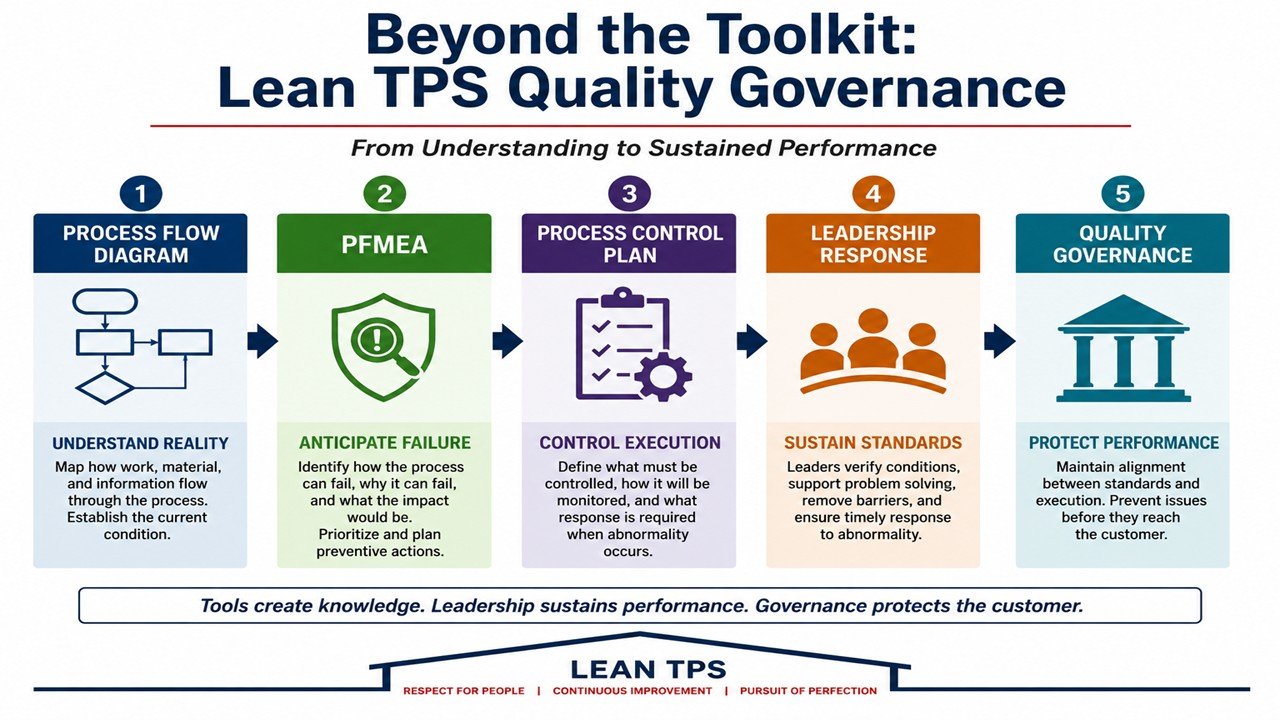
The system extends beyond individual elements and requires integration across condition definition, exposure, response, and learning. When these elements are aligned, execution is governed, leadership responds as required, and learning is embedded through repeated cycles of confirmation and correction. This integration establishes a system that maintains control and protects Quality as a condition of execution.
Further development of this system requires expansion into condition design, response structure, and leadership integration at scale. The next stage addresses how conditions are constructed, how response is embedded across functions, and how governance is sustained across the organization.