Introduction
At Toyota, every improvement activity follows a common logic. It begins with observation, develops through structure, and concludes with learning. That logic is captured in the A3 PDCA Report. The report is not a document. It is a method for making thinking visible.
Inside Lean TPS, the A3 is the bridge between Standardized Work, problem solving, and leadership reflection. It compresses complex activity into one visual format that connects cause, countermeasure, and confirmation. The A3 teaches that improvement is not about filling forms or launching projects. It is about building capability through logic that can be seen, discussed, and taught.
1. The Purpose of the A3 PDCA Report
The A3 format exists to slow down thinking and align people around a shared problem. It is structured to force the user to separate facts from opinions, define gaps from standards, and develop countermeasures based on confirmed data. Every step follows the Plan-Do-Check-Act cycle, not as four stages but as one continuous loop of learning.
The report reveals whether a team understands the situation they are addressing. If the content is vague, the thinking is unclear. If the logic flows, the system is working. That is why Toyota treats the A3 as both a problem-solving tool and a leadership development process.
2. The Plan Phase: Defining Reality
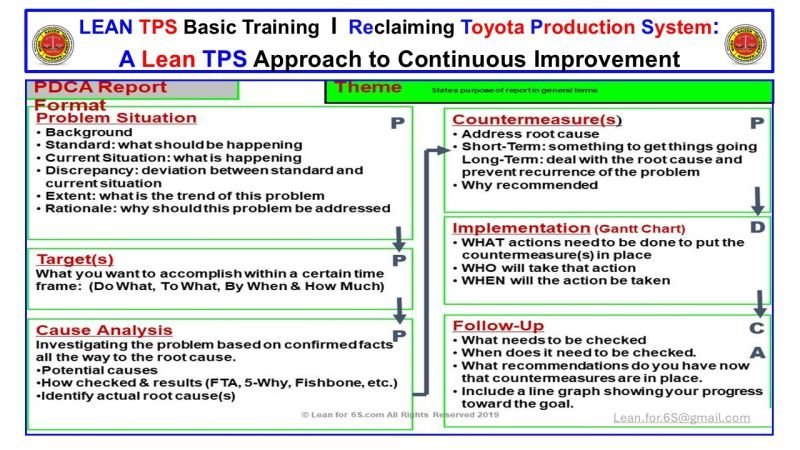
The first section of the A3 builds the Plan. It begins with a clear theme and a detailed problem situation.
- Background: What standard should exist?
- Current Situation: What is actually happening?
- Discrepancy: What is the measurable gap?
- Extent and Trend: How severe is it and how is it changing?
- Rationale: Why should it be addressed now?
This phase demands fact-based observation at the Gemba. The writer must see the work directly, verify the condition, and understand how it deviates from expectation. If the background is weak, every step that follows will rest on assumption.
The Plan phase also defines a target. Each A3 must specify what will be accomplished, by when, to what standard, and with what measure. This is not an estimate. It is a commitment based on current capacity and observed data.
3. Cause Analysis: Where Learning Happens
The next section investigates cause. In Lean TPS, this is the most critical and most neglected step. Teams often jump straight to countermeasures. The A3 prevents that by requiring evidence.
Root cause analysis begins with structured questioning. Tools such as 5-Why, Fishbone, and FTA (Fault Tree Analysis) are used to trace the problem to its source. The team confirms each cause through observation, not assumption. This analysis transforms discussion into shared learning. The act of verifying each possible cause teaches leaders how to think scientifically and base actions on fact.
4. Countermeasures: From Reaction to Design
Once causes are confirmed, the A3 defines countermeasures. These are not fixes. They are designed changes to the process or system that eliminate the identified cause. Countermeasures are divided into short-term actions to stabilize conditions and long-term actions to prevent recurrence.
Each countermeasure must include why it was chosen, how it will be applied, and what result it should produce. The reasoning is visible, not hidden in discussion. This makes the A3 a tool of transparency. It allows anyone reviewing the report to understand the thinking, not just the outcome.
5. Implementation: Making Action Visible
In the Do phase, the A3 connects planning to execution. Implementation is visualized through a simple Gantt layout or step sequence that identifies who will act, what will be done, and when each step will occur. Timing, ownership, and dependencies are clear.
The purpose is not bureaucracy. It is confirmation that action follows logic. Implementation converts countermeasures into real activity with defined accountability. When used properly, this section replaces status meetings with visual confirmation. Everyone can see the progress.
6. Follow-Up: Learning Through Reflection
The Check and Act phases are where most organizations drift. Once a task is complete, they move on. Toyota does not. Follow-up is built into the A3 as a learning cycle.
The team records what was checked, when, and by whom. They verify results against the target and update the graph showing progress toward the goal. Any remaining gap triggers reflection: What was missed? What new learning was gained?
Follow-up is also where leadership involvement is visible. Leaders confirm that reflection occurred, that countermeasures were sustained, and that new standards were created. The process does not end with completion. It ends when learning is documented and transferred.
7. Leadership Development Through the A3
Every A3 is both a management and learning tool. At Toyota, it is used to develop leadership capability at every level. When leaders coach others through the A3, they are not giving answers. They are teaching how to think.
This interaction builds discipline in observation, cause analysis, and reflection. Over time, it creates a culture where people base actions on fact, not opinion. The A3 Report therefore becomes the foundation for leader standard work, teaching how to ask questions, confirm facts, and connect daily activity to system goals.
8. The A3 as a System of Alignment
When multiple A3 Reports are linked across departments, they form an organizational network of improvement. Each A3 aligns with a higher-level target condition, creating vertical and horizontal connection.
This structure turns the A3 from a problem-solving sheet into a management system. It aligns strategy, operations, and learning into one framework. In this way, PDCA is not an isolated tool. It is the logic of the organization made visible.
9. Why Format Is Not Enough
Many organizations copy the A3 format but lose the purpose. They fill in boxes without understanding the reasoning behind them. The result looks like an A3 but does not think like one.
The strength of the A3 lies in the interaction between people, not the template. It works only when used to facilitate observation, dialogue, and coaching. Without that discipline, it becomes another report.
Conclusion
The A3 PDCA Report is the structural backbone of Lean TPS problem solving. It transforms improvement from a collection of activities into a system of thinking. It links problem definition, cause analysis, and reflection into one visible cycle.
When used correctly, it builds the capability to see, learn, and improve at every level. That is what Toyota means by developing people before developing systems. The A3 Report is how that development becomes visible.